PUBLISHER: Mordor Intelligence | PRODUCT CODE: 2119258

PUBLISHER: Mordor Intelligence | PRODUCT CODE: 2119258
Plant Based Seafood - Market Share Analysis, Industry Trends & Statistics, Growth Forecasts (2026 - 2031)
According to Mordor Intelligence, the plant-based seafood market size is expected to grow from USD 568.34 million in 2025 to USD 611.36 million in 2026 and is forecast to reach USD 983.65 million by 2031 at 9.98% CAGR over 2026-2031.
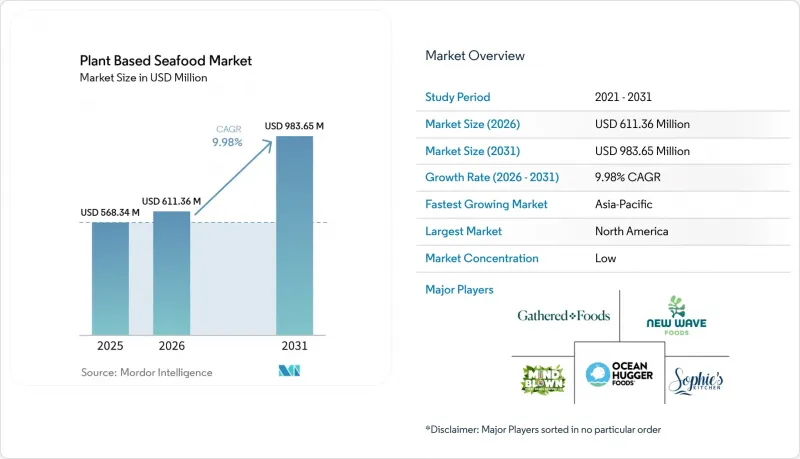
This report is Segmented by Product Type (Plant-Based Fish, Shrimp, Crab, Tuna, Salmon, Other Product Types), Source (Soy Protein, Pea Protein, Wheat Protein, Algae & Seaweed, Others), Distribution Channel (Off-Trade, On-Trade), and Geography (North America, Europe, Asia-Pacific, South America, Middle East and Africa). The Market Forecasts are Provided in Terms of Value (USD).
Global Plant Based Seafood Market Trends and Insights
Rising vegan and flexitarian consumer population
The plant-based seafood market is benefiting from the growing number of vegan and flexitarian consumers who are increasingly choosing plant-based alternatives for health, sustainability, and ethical reasons. Flexitarian eating habits are expanding demand for products such as plant-based fish, shrimp, tuna, and shellfish alternatives across retail and foodservice channels. In 2025, approximately 25.8 million people worldwide chose to try a vegan diet during Veganuary, highlighting continued growth in vegan and flexitarian adoption of plant-based foods. This expanding consumer base is encouraging manufacturers to increase product innovation and distribution of plant-based seafood products. Health-focused communication can also be more relevant than animal welfare messaging for consumers managing diet-related concerns. In the plant-based seafood market, repeat demand is likely to depend on clear nutrition, reliable preparation, and a flavor profile that does not require consumers to change their normal meal routines.
Growing concerns over overfishing and marine biodiversity loss
Increasing awareness of overfishing and marine biodiversity loss is encouraging consumers to choose plant-based seafood as a more sustainable alternative to conventional seafood products. Declining wild fish stocks, habitat degradation, and pressure on marine ecosystems are strengthening demand for alternative protein sources that reduce dependence on wild-caught species. Governments, environmental organizations, and food companies are also promoting responsible seafood consumption and sustainable sourcing practices. Plant-based seafood supports ocean conservation goals while providing products that closely replicate the taste and texture of traditional seafood. This shift is driving greater investment, product innovation, and retail expansion across the plant-based seafood industry.
High product prices compared with conventional seafood
Price remains a major barrier because commodity shrimp, whitefish, and canned tuna can be affordable protein options in many markets. A 2026 article in Nature Food identified price parity as a central threshold for alternative protein commercialization. Food-grade protein isolates, high-moisture extrusion, specialty flavor inputs, and smaller production volumes can keep unit costs high. A product may gain trial purchases if its claims are appealing, but repeat demand can weaken when the price gap remains clear and sensory performance is uncertain. This challenge is especially important in the plant-based seafood market because shoppers can easily return to conventional seafood when promotions end. Producers need manufacturing methods that reduce cost without weakening texture, nutrition, or shelf stability, since a lower-price product may still fail if it separates during cooking, lacks expected flavor, or cannot move through normal retail and foodservice distribution systems.
Other drivers and restraints analyzed in the detailed report include:
- Health-driven preference for cholesterol-free and low-mercury products
- Government and Institutional Support for Sustainable Food Systems
- Taste and texture gap versus real seafood
For complete list of drivers and restraints, kindly check the Table Of Contents.
Segment Analysis
Plant-based fish held 53.67% of the plant-based seafood market share in 2025, supported by familiar items such as breaded fillets, fish sticks, and burgers. These formats fit established frozen-food distribution systems and require little change in how shoppers or kitchen staff prepare meals. Plant-based shrimp is the fastest-growing product type at a 12.11% CAGR through 2031, supported by its use in bowls, pasta, appetizers, stir-fries, and catering. Plant-based tuna can appeal to consumers who want to limit high-mercury fish choices, while crab and salmon alternatives can target premium retail and restaurant occasions. The plant-based seafood market benefits when each format solves a defined recipe need rather than simply copying a broad seafood category, because shoppers and kitchen operators often decide between products based on the dish they intend to prepare, not on the protein source alone.
Plant-based salmon needs a flaky structure, visible layers, cooking tolerance, and a balanced fat profile for credible use in everyday recipes. Microalgae-based oils can help developers add DHA and EPA, nutrients commonly associated with seafood, while reducing reliance on fish-derived inputs. Plant-based crab and scallop products suit specialty retail and chef-led menus where texture, appearance, and serving format all matter. Calamari and other seafood alternatives remain smaller categories, but published research is widening the technical options for structured products. FDA draft guidance issued in January 2025 helps clarify labeling expectations for plant-based alternatives to animal-derived foods, reducing uncertainty for brands entering new product categories
Complete Report Scope:
- By Product Type
- Plant-Based Fish
- Plant-Based Shrimp
- Plant-Based Crab
- Plant-Based Tuna
- Plant-Based Salmon
- Other Product Types
- By Source
- Soy Protein
- Pea Protein
- Wheat Protein
- Algae & Seaweed
- Others
- By Distribution Channel
- Off-Trade
- Supermarkets/Hypermarkets
- Convenience Stores
- Online Retail Stores
- Other Distribution Channels
- On-Trade
- Off-Trade
- By Geography
- North America
- United States
- Canada
- Mexico
- Rest of North America
- Europe
- Germany
- United Kingdom
- Italy
- France
- Spain
- Netherlands
- Rest of Europe
- Asia-Pacific
- China
- India
- Japan
- Australia
- Indonesia
- Rest of Asia-Pacific
- South America
- Brazil
- Argentina
- Rest of South America
- Middle East and Africa
- South Africa
- Saudi Arabia
- United Arab Emirates
- Rest of Middle East and Africa
- North America
Geography Analysis
North America accounted for 37.51% of revenue in 2025, making it the largest regional contributor to the plant-based seafood market. The region has established alternative-protein retail distribution, cold-chain capacity, and a broad base of grocery and foodservice buyers familiar with plant-based foods. These factors give companies more established pathways to test new products, assess repeat purchase behavior, refine packaging, and identify the seafood formats best suited for each channel. The United States provides a large market for product trials through supermarkets, specialty stores, restaurants, and institutional menus.
Europe is an important production and ingredient base, as several countries support protein processing, extrusion equipment, fermentation capacity, and algae development. The European Commission's work on alternative proteins and algae gives the region a policy basis for new ingredient and product development. This work may help companies assess ingredient availability, food-use pathways, environmental requirements, and the practical conditions needed to move from small-scale formulation to broader commercial production. EU food rules require reviews of novel foods, naming, and ingredient status, but clearer pathways can favor companies that prepare early. Established grocery systems, foodservice activity, and demand for familiar fish alternatives give the plant-based seafood market a practical route to regional expansion.
Asia-Pacific is expected to be the fastest-growing region, registering a 12.45% CAGR through 2031. The region's high seafood consumption means even limited adoption of alternatives can generate meaningful product volumes. Japan supports ready-to-eat applications, including convenience-store meals, while China offers a large foodservice market for branded menu partnerships. Algae and seaweed are familiar food ingredients in several regional cuisines, which can make some formulations easier to explain to consumers. India's labeling requirements emphasize standardized formulations and transparent claims. Meanwhile, the Middle East and Africa remain early-stage markets, where modern retail, urban dining, localized recipes, suitable price points, and consumer education will be critical before the category can establish stable distribution and scale widely.
- Gathered Foods Corporation (Good Catch)
- Ocean Hugger Foods, Inc.
- New Wave Foods, Inc.
- Sophie's Kitchen, Inc.
- The Plant Based Seafood Co.
- Current Foods, Inc.
- Hooked Foods AB
- Kuleana, Inc.
- Atlantic Natural Foods, LLC
- Beyond Meat, Inc.
- Impossible Foods Inc.
- Turtle Island Foods SPC
- Conagra Brands, Inc. (Gardein)
- Kellanova (MorningStar Farms)
- OmniFoods (Green Monday Holdings)
- Prime Roots
- Tofuna Fysh, Inc.
- SoFine Foods B.V.
- Bonsan GmbH
- Daiya Foods Inc.
Additional Benefits:
- The market estimate (ME) sheet in Excel format
- 3 months of analyst support
TABLE OF CONTENTS
1 INTRODUCTION
- 1.1 Study Assumptions and Market Definition
- 1.2 Scope of the Study
2 RESEARCH METHODOLOGY
3 EXECUTIVE SUMMARY
4 MARKET LANDSCAPE
- 4.1 Market Overview
- 4.2 Market Drivers
- 4.2.1 Rising vegan and flexitarian consumer population
- 4.2.2 Growing concerns over overfishing and marine biodiversity loss
- 4.2.3 Increasing demand for sustainable seafood alternatives
- 4.2.4 Health-driven preference for cholesterol-free and low-mercury products
- 4.2.5 Government and institutional support for sustainable food systems
- 4.2.6 Rising awareness of seafood contamination and food safety risks
- 4.3 Market Restraints
- 4.3.1 High product prices compared with conventional seafood
- 4.3.2 Taste and texture gap versus real seafood
- 4.3.3 Restricted product variety across seafood categories
- 4.3.4 Limited consumer awareness in emerging markets
- 4.4 Consumer Behavior Analysis
- 4.5 Regulatory Landscape
- 4.6 Technological Outlook
- 4.7 Porter's Five Forces Analysis
- 4.7.1 Bargaining Power of Suppliers
- 4.7.2 Bargaining Power of Buyers
- 4.7.3 Threat of New Entrants
- 4.7.4 Threat of Substitutes
- 4.7.5 Intensity of Competitive Rivalry
5 MARKET SIZE & GROWTH FORECASTS (VALUE)
- 5.1 By Product Type
- 5.1.1 Plant-Based Fish
- 5.1.2 Plant-Based Shrimp
- 5.1.3 Plant-Based Crab
- 5.1.4 Plant-Based Tuna
- 5.1.5 Plant-Based Salmon
- 5.1.6 Other Product Types
- 5.2 By Source
- 5.2.1 Soy Protein
- 5.2.2 Pea Protein
- 5.2.3 Wheat Protein
- 5.2.4 Algae & Seaweed
- 5.2.5 Others
- 5.3 By Distribution Channel
- 5.3.1 Off-Trade
- 5.3.1.1 Supermarkets/Hypermarkets
- 5.3.1.2 Convenience Stores
- 5.3.1.3 Online Retail Stores
- 5.3.1.4 Other Distribution Channels
- 5.3.2 On-Trade
- 5.3.1 Off-Trade
- 5.4 By Geography
- 5.4.1 North America
- 5.4.1.1 United States
- 5.4.1.2 Canada
- 5.4.1.3 Mexico
- 5.4.1.4 Rest of North America
- 5.4.2 Europe
- 5.4.2.1 Germany
- 5.4.2.2 United Kingdom
- 5.4.2.3 Italy
- 5.4.2.4 France
- 5.4.2.5 Spain
- 5.4.2.6 Netherlands
- 5.4.2.7 Rest of Europe
- 5.4.3 Asia-Pacific
- 5.4.3.1 China
- 5.4.3.2 India
- 5.4.3.3 Japan
- 5.4.3.4 Australia
- 5.4.3.5 Indonesia
- 5.4.3.6 Rest of Asia-Pacific
- 5.4.4 South America
- 5.4.4.1 Brazil
- 5.4.4.2 Argentina
- 5.4.4.3 Rest of South America
- 5.4.5 Middle East and Africa
- 5.4.5.1 South Africa
- 5.4.5.2 Saudi Arabia
- 5.4.5.3 United Arab Emirates
- 5.4.5.4 Rest of Middle East and Africa
- 5.4.1 North America
6 COMPETITIVE LANDSCAPE
- 6.1 Market Concentration
- 6.2 Strategic Moves
- 6.3 Market Share Analysis
- 6.4 Company Profiles (Includes Company Highlights, Strategic Information, Core Segments, Financials, Products & Services, Recent Developments)
- 6.4.1 Gathered Foods Corporation (Good Catch)
- 6.4.2 Ocean Hugger Foods, Inc.
- 6.4.3 New Wave Foods, Inc.
- 6.4.4 Sophie's Kitchen, Inc.
- 6.4.5 The Plant Based Seafood Co.
- 6.4.6 Current Foods, Inc.
- 6.4.7 Hooked Foods AB
- 6.4.8 Kuleana, Inc.
- 6.4.9 Atlantic Natural Foods, LLC
- 6.4.10 Beyond Meat, Inc.
- 6.4.11 Impossible Foods Inc.
- 6.4.12 Turtle Island Foods SPC
- 6.4.13 Conagra Brands, Inc. (Gardein)
- 6.4.14 Kellanova (MorningStar Farms)
- 6.4.15 OmniFoods (Green Monday Holdings)
- 6.4.16 Prime Roots
- 6.4.17 Tofuna Fysh, Inc.
- 6.4.18 SoFine Foods B.V.
- 6.4.19 Bonsan GmbH
- 6.4.20 Daiya Foods Inc.
7 MARKET OPPORTUNITIES AND FUTURE OUTLOOK

