PUBLISHER: Mordor Intelligence | PRODUCT CODE: 2119285

PUBLISHER: Mordor Intelligence | PRODUCT CODE: 2119285
Robotics Foundation Models - Market Share Analysis, Industry Trends & Statistics, Growth Forecasts (2026 - 2031)
According to Mordor Intelligence, the robotics foundation models market size is projected to expand from USD 97.46 million in 2025 and USD 144.01 million in 2026 to USD 787.86 million by 2031, registering a CAGR of 40.48% between 2026 to 2031.
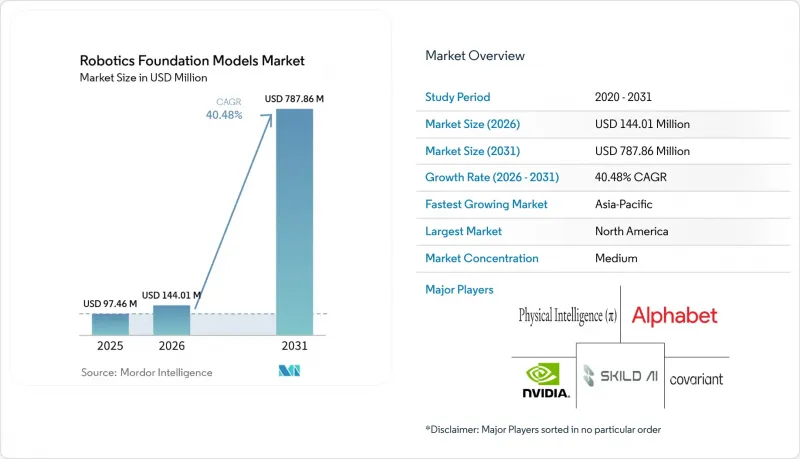
This report is Segmented by Model Architecture (Vision-Language-Action Models, Embodied Reasoning Models, and More), Deployment Mode (Cloud-Based, and On-Premises), Application (Warehouse Picking and Sorting, Industrial Assembly Operations, and More), End-User Industry (Manufacturers, System Integrators, and More), and Geography. The Market Forecasts are Provided in Terms of Value (USD).
Global Robotics Foundation Models Market Trends and Insights
Industrial Automation and Labor Shortages
Manufacturing and logistics employers are increasing automation investment because shortages now affect tasks that fixed equipment cannot easily perform. U.S. industrial robot installations rose 11% to 38,000 units in 2025, while robot density reached 307 operational units per 10,000 manufacturing employees. These conditions favor robots that can interpret changing product layouts, package shapes, and work instructions. Foundation models can support restocking, mixed-item handling, and other tasks where conventional robots require extensive reprogramming. Global industrial robot installations reached 621,000 units in 2025, and Asia accounted for 79% of installations, showing that the automation push extends beyond North America. The robotics foundation models market therefore benefits when employers seek flexible capacity rather than another narrowly programmed machine that must be reconfigured when local tasks, stock profiles, or product conditions change.
Demand for General-Purpose Robot Intelligence
Enterprises with task-specific robots often incur new integration costs when product lines or facility layouts change. This issue has increased interest in systems that can transfer learned skills across tasks and robot types. Physical Intelligence reported that its π0.7 model combined skills learned from separate datasets to complete novel manipulation sequences without task-specific training. The result points to a practical value proposition for general-purpose robot intelligence, particularly in automotive, electronics, and logistics operations with frequent variation. A broader robot policy may reduce the need to maintain separate systems for each handling or assembly task. This opportunity supports the robotics foundation models market because enterprises increasingly view model access and ongoing updates as core automation infrastructure for facilities where changing tasks otherwise increase integration effort and delay operational returns.
High Cost and Scarcity of Real-World Robot Data
Real-world robot demonstrations require synchronized visual, force, motion, and language data, which is costly to collect at a commercial scale. The constraint is most evident in garment handling, surgical work, and complex assembly, where physical variation limits the value of synthetic data alone. NVIDIA-Medtech released Open-H-Embodiment in 2026 with 770 hours of surgical robot data from 50 or more institutions across 20 robot platforms. The scale of this coordinated dataset also shows the operational work needed to standardize actions and data streams across institutions. Universal Robots and Scale AI introduced UR AI Trainer to capture synchronized motion, force, and vision data from production robots for industrial VLA training. The robotics foundation models market remains advantaged toward companies with deployed fleets, even as simulation, cross-embodiment training, and shared datasets improve access for firms without large operating fleets or specialist data teams.
Other drivers and restraints analyzed in the detailed report include:
- Expansion of Multimodal Vision-Language-Action Models
- Open Robotics Models Lowering Development Barriers
- Safety Certification and Liability Uncertainty
For complete list of drivers and restraints, kindly check the Table Of Contents.
Segment Analysis
Vision-Language-Action models held 54.67% of the robotics foundation models market share in 2025. Their lead reflects the ability to process images, language task descriptions, and robot-state data in one backbone. This design supports instruction-following behavior without complex links between separate perception, planning, and action components. NVIDIA described GR00T N1.7 as an open, commercially licensed VLA for general humanoid robot skills and identified training partners, including Unitree Robotics and Agile Robots. The industrial installed base gives VLA models a clear commercial route across established industrial settings with repeatable handling and assembly work in the robotics foundation models market.
World models hold a smaller revenue position but remain important because they represent physical environments for planning and testing. NVIDIA-Medtech stated that Cosmos-H-Surgical-Simulator generated realistic surgical video from robot kinematics across nine surgical platforms, which can support validation before physical deployment. Embodied reasoning models are projected to expand at a 46.53% CAGR through 2031, the fastest rate within the architecture segment. Physical Intelligence reported that π0.7 matched task-specific systems on coffee preparation, laundry folding, and box assembly without task-specific training data. Behavior policy, cross-embodiment control, and tool-orchestration models serve narrower needs as development frameworks improve access for smaller integrators that need affordable starting points and adaptable control policies in the robotics foundation models market.
Cloud-based deployment accounted for 57.26% of revenue in 2025. Enterprises use cloud systems for centralized model updates, shared compute, and the aggregation of robot data across sites. Universal Robots and Scale AI stated that UR AI Trainer captures production motion, force, and vision data to support imitation learning from the lab to the factory. This model connects deployment data with policy refinement and lowers infrastructure barriers for mid-sized enterprises. The cloud channel is projected to expand at a 43.61% CAGR through 2031, making it the fastest deployment mode in the robotics foundation models market.
On-premises deployment remains important where operations need data control, low latency, or reliable local operation. Defense sites, pharmaceutical cleanrooms, and remote mining operations may not accept dependence on external cloud connections. NVIDIA positioned Jetson Thor for real-time robot inference and control at the edge, helping facilities retain sensitive operational data. European data-residency rules and sector security requirements also support local deployment where cloud use is restricted. The coexistence of cloud learning and edge control will remain relevant as customers balance model improvement with operational control, local resilience, and data-protection obligations in the robotics foundation models market.
Complete Report Scope:
- By Model Architecture
- Vision-Language-Action Models
- Embodied Reasoning Models
- World Models
- Other Model Architectures (Behavior Policy Models, Cross-Embodiment Control Models, Tool-Orchestration Models)
- By Deployment Mode
- Cloud-Based
- On-Premises
- By Application
- Warehouse Picking and Sorting
- Industrial Assembly Operations
- Material Handling and Packaging
- Mobile Inspection and Navigation
- Home Service Execution
- Other Applications (Commercial Service Interaction, Medical Care Assistance, Agriculture and Field Operations, Defense and Security Operations, Hazardous-Environment Operations, Research and Education Development)
- By End-User Industry
- Manufacturers
- Logistics and Warehousing Providers
- System Integrators
- Healthcare Providers
- Defense and Security Organizations
- Other End-User Industries
- By Geography
- North America
- United States
- Canada
- Mexico
- South America
- Brazil
- Argentina
- Chile
- Rest of South America
- Europe
- Germany
- United Kingdom
- France
- Italy
- Russia
- Rest of Europe
- Asia-Pacific
- China
- Japan
- South Korea
- India
- Southeast Asia
- Rest of Asia-Pacific
- Middle East
- Turkey
- Israel
- GCC Countries
- Rest of Middle East
- Africa
- South Africa
- Egypt
- Rest of Africa
- North America
Geography Analysis
North America held 45.74% of the robotics foundation models market share in 2025. The region combines frontier model developers, cloud infrastructure, and enterprise spending on automation. U.S. industrial robot installations increased by 11% to 38,000 units in 2025, while robot density reached 307 units per 10,000 manufacturing employees, supporting deployments in manufacturing, logistics, and related services. ANSI/A3 R15.06-2025 sets updated industrial safety requirements that align with ISO 10218 and create a clearer validation reference for deployers.
Asia-Pacific is projected to expand at a 46.84% CAGR through 2031, representing the fastest-growing regional opportunity. The Japan Robot Industry Association reported that 2025 robot orders rose 25.7% to JPY 1,045.6 billion (USD 6.97 billion), and forecast 2026 orders of JPY 1,220 billion (USD 8.13 billion). Japan is coordinating data collection and shared development of foundation models through the AI Robot Foundation Technology Consortium. South Korea had a robot density of 1,220 units per 10,000 manufacturing employees, creating a large installed base for retrofits in electronics and semiconductor production. Asia-Pacific can expand the robotics foundation models market through new deployments and upgrades to established automated facilities.
Europe had a robot density of 267 units per 10,000 manufacturing employees in 2024, the highest regional level reported by the International Federation of Robotics. This installed automation base supports adoption, although detailed compliance requirements and slower investment in frontier models may limit the pace relative to North America and Asia-Pacific. South America, the Middle East, and Africa held a modest but emerging position in the robotics foundation models market. Brazil offers demand from automotive assembly and food processing, while South Africa offers a relevant use case in mining inspection and hazardous navigation. Broader adoption will depend on cloud infrastructure, smart manufacturing, and logistics initiatives in Gulf countries, as well as localized data that reflects regional languages, work environments, and operating conditions in the robotics foundation models market.
- NVIDIA Corporation
- Alphabet Inc.
- Physical Intelligence
- Skild AI
- Covariant
- Figure AI, Inc.
- Field AI, Inc.
- 1X Technologies AS
- Boston Dynamics, Inc.
- Microsoft Corporation
- Amazon.com, Inc.
- Agility Robotics, Inc.
- Sanctuary Cognitive Systems Corporation
- Apptronik, Inc.
- Genesis AI
- Dyna Robotics, Inc.
- NEURA Robotics GmbH
- Agile Robots SE
- UBTECH Robotics Corp Ltd
- Toyota Motor Corporation
- Tesla, Inc.
- Huawei Technologies Co., Ltd.
- Tencent Holdings Limited
- Agibot Inc.
- Unitree Robotics
Additional Benefits:
- The market estimate (ME) sheet in Excel format
- 3 months of analyst support
TABLE OF CONTENTS
1 INTRODUCTION
- 1.1 Study Assumptions and Market Definition
- 1.2 Scope of the Study
2 RESEARCH METHODOLOGY
3 EXECUTIVE SUMMARY
4 MARKET LANDSCAPE
- 4.1 Market Overview
- 4.2 Market Drivers
- 4.2.1 Industrial Automation and Labor Shortages
- 4.2.2 Growing Demand for General-Purpose Robot Intelligence
- 4.2.3 Expansion of Multimodal Vision-Language-Action Models
- 4.2.4 Open Robotics Models Lowering Development Barriers
- 4.2.5 Robot Data Flywheels From Commercial Deployments
- 4.2.6 Simulation-First Training Reducing Physical Data Requirements
- 4.3 Market Restraints
- 4.3.1 High Cost and Scarcity of Real-World Robot Data
- 4.3.2 Safety Certification and Liability Uncertainty
- 4.3.3 Embodiment Transfer Failures in Long-Tail Tasks
- 4.3.4 Inference Economics and Edge-Compute Constraints
- 4.4 Industry Value-Chain Analysis
- 4.5 Regulatory Landscape
- 4.6 Technological Outlook
- 4.7 Porter's Five Forces Analysis
- 4.7.1 Intensity of Competitive Rivalry
- 4.7.2 Bargaining Power of Suppliers
- 4.7.3 Bargaining Power of Buyers
- 4.7.4 Threat of New Entrants
- 4.7.5 Threat of Substitutes
5 MARKET SIZE AND GROWTH FORECASTS (VALUE)
- 5.1 By Model Architecture
- 5.1.1 Vision-Language-Action Models
- 5.1.2 Embodied Reasoning Models
- 5.1.3 World Models
- 5.1.4 Other Model Architectures (Behavior Policy Models, Cross-Embodiment Control Models, Tool-Orchestration Models)
- 5.2 By Deployment Mode
- 5.2.1 Cloud-Based
- 5.2.2 On-Premises
- 5.3 By Application
- 5.3.1 Warehouse Picking and Sorting
- 5.3.2 Industrial Assembly Operations
- 5.3.3 Material Handling and Packaging
- 5.3.4 Mobile Inspection and Navigation
- 5.3.5 Home Service Execution
- 5.3.6 Other Applications (Commercial Service Interaction, Medical Care Assistance, Agriculture and Field Operations, Defense and Security Operations, Hazardous-Environment Operations, Research and Education Development)
- 5.4 By End-User Industry
- 5.4.1 Manufacturers
- 5.4.2 Logistics and Warehousing Providers
- 5.4.3 System Integrators
- 5.4.4 Healthcare Providers
- 5.4.5 Defense and Security Organizations
- 5.4.6 Other End-User Industries
- 5.5 By Geography
- 5.5.1 North America
- 5.5.1.1 United States
- 5.5.1.2 Canada
- 5.5.1.3 Mexico
- 5.5.2 South America
- 5.5.2.1 Brazil
- 5.5.2.2 Argentina
- 5.5.2.3 Chile
- 5.5.2.4 Rest of South America
- 5.5.3 Europe
- 5.5.3.1 Germany
- 5.5.3.2 United Kingdom
- 5.5.3.3 France
- 5.5.3.4 Italy
- 5.5.3.5 Russia
- 5.5.3.6 Rest of Europe
- 5.5.4 Asia-Pacific
- 5.5.4.1 China
- 5.5.4.2 Japan
- 5.5.4.3 South Korea
- 5.5.4.4 India
- 5.5.4.5 Southeast Asia
- 5.5.4.6 Rest of Asia-Pacific
- 5.5.5 Middle East
- 5.5.5.1 Turkey
- 5.5.5.2 Israel
- 5.5.5.3 GCC Countries
- 5.5.5.4 Rest of Middle East
- 5.5.6 Africa
- 5.5.6.1 South Africa
- 5.5.6.2 Egypt
- 5.5.6.3 Rest of Africa
- 5.5.1 North America
6 COMPETITIVE LANDSCAPE
- 6.1 Market Concentration
- 6.2 Strategic Moves
- 6.3 Market Share Analysis
- 6.4 Company Profiles (includes Global Level Overview, Market Level Overview, Core Segments, Financials as available, Strategic Information, Market Rank/Share, Products and Services, Recent Developments)
- 6.4.1 NVIDIA Corporation
- 6.4.2 Alphabet Inc.
- 6.4.3 Physical Intelligence
- 6.4.4 Skild AI
- 6.4.5 Covariant
- 6.4.6 Figure AI, Inc.
- 6.4.7 Field AI, Inc.
- 6.4.8 1X Technologies AS
- 6.4.9 Boston Dynamics, Inc.
- 6.4.10 Microsoft Corporation
- 6.4.11 Amazon.com, Inc.
- 6.4.12 Agility Robotics, Inc.
- 6.4.13 Sanctuary Cognitive Systems Corporation
- 6.4.14 Apptronik, Inc.
- 6.4.15 Genesis AI
- 6.4.16 Dyna Robotics, Inc.
- 6.4.17 NEURA Robotics GmbH
- 6.4.18 Agile Robots SE
- 6.4.19 UBTECH Robotics Corp Ltd
- 6.4.20 Toyota Motor Corporation
- 6.4.21 Tesla, Inc.
- 6.4.22 Huawei Technologies Co., Ltd.
- 6.4.23 Tencent Holdings Limited
- 6.4.24 Agibot Inc.
- 6.4.25 Unitree Robotics
7 MARKET OPPORTUNITIES AND FUTURE OUTLOOK
- 7.1 White-Space and Unmet-Need Assessment

