PUBLISHER: Mordor Intelligence | PRODUCT CODE: 2119290

PUBLISHER: Mordor Intelligence | PRODUCT CODE: 2119290
Inverter Battery Water - Market Share Analysis, Industry Trends & Statistics, Growth Forecasts (2026 - 2031)
According to Mordor Intelligence, the inverter battery water market size is estimated at USD 233.67 million in 2025 and is estimated to grow from USD 245.70 million in 2026 to USD 318.64 million by 2031, at a CAGR of 5.34% during the forecast period (2026-2031).
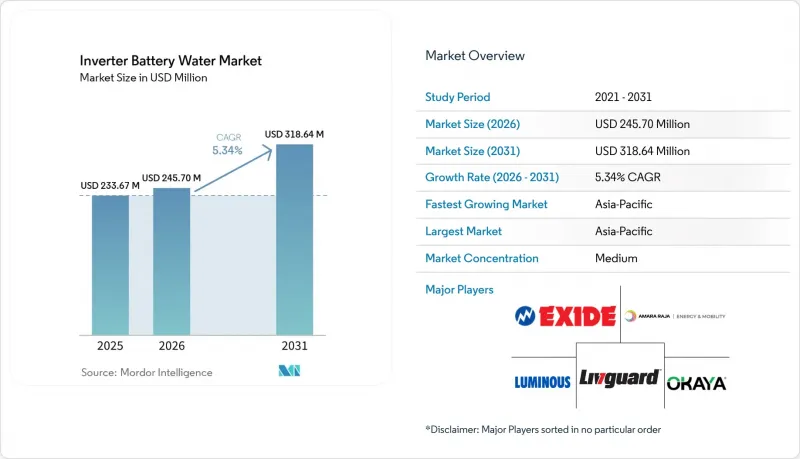
This report is Segmented by Product Type (Distilled Water, Demineralized Water, and More), Battery Type (Tubular Inverter Batteries, Flat Plate Inverter Batteries, and More), End-User Industry (Residential, Commercial, and More), and Geography (Asia-Pacific, North America, Europe, South America, and Middle-East and Africa). The Market Forecasts are Provided in Terms of Value (USD).
Global Inverter Battery Water Market Trends and Insights
Rising Backup-Power Penetration and Power Outage Frequency
India's grid reliability gap supports continued demand for flooded inverter batteries. Ministry of Power data for 2024-25 showed annual outage duration below 2 hours in urban Maharashtra and above 1,200 hours in rural Bihar and Uttar Pradesh. These conditions make installing a tubular battery a practical necessity for many households rather than a discretionary purchase. According to World Bank data, the East Asia and Pacific region recorded the highest annual urbanization rate globally at 3%. New urban households in grid-stressed locations can increase inverter use and battery cycling. More frequent cycling can shorten the interval between electrolyte additions. This relationship allows the inverter battery water market to grow through both fleet additions and higher consumption per installed battery.
Growth of Tubular Flooded Lead-Acid Inverter Batteries
Tubular batteries' deep-discharge capability supports regular use in homes where outages require frequent battery cycling. Exide Industries offers a 60-month warranty for tubular batteries, while Luminous Power Technologies offers 60-66-month terms for tall tubular ranges. Manufacturers specify regular electrolyte-level inspections, especially in high-temperature conditions. EnerSys and Trojan Battery manuals require distilled or demineralized water for flooded battery maintenance. The flooded portion of the stationary lead-acid battery market is forecast to reach USD 3.48 billion by 2031.
Shift to Sealed VRLA and Lithium Batteries Reducing Water Demand
Sealed VRLA batteries dominate the stationary lead-acid battery market in 2025 and do not require electrolyte replenishment. Each new sealed unit reduces the addressable maintenance requirement for water. Luminous commissioned a 500 MWh lithium-ion battery assembly line in Baddi in January 2026. Livguard also launched the Lithium XOne Universal Battery in May 2026, compatible with inverter systems. The installed Indian residential base remains largely tubular lead-acid and follows 5-7 year replacement cycles. This replacement profile means flooded batteries continue to support the inverter battery water market through 2030, even as maintenance-free alternatives gain adoption.
Other drivers and restraints analyzed in the detailed report include:
- Battery Life Preservation and Maintenance Awareness
- Heat and Climate Stress Increasing Watering Frequency in Installed Fleets
- Informal Low-Cost and Unbranded Substitutes
For complete list of drivers and restraints, kindly check the Table Of Contents.
Segment Analysis
Distilled water accounted for 43.84% of revenue in 2025. It remains the most widely specified product for consumer and commercial flooded-battery maintenance. EnerSys and Trojan Battery manuals identify distilled or demineralized water as suitable for electrolyte top-ups. Its strong position reflects established use by household buyers and organized service networks. The product also aligns with the conductivity and total dissolved solids limits in IEC 62877-2:2016.
Demineralized water is projected to record the highest product-type CAGR, at 5.86%, from 2026 to 2031. Ion-exchange production can support commercial-scale supply for telecom operators and institutional buyers that procure water in bulk. This production route plays a practical role in the inverter battery water market, where recurring maintenance is required across large battery banks. Deionized water occupies a middle position between distilled and ultra-pure products. It is used in multi-country telecom programs that apply IEC conductivity thresholds as a common procurement requirement. Ultra-pure battery water remains a smaller category for original equipment manufacturers and precision industrial buyers with strict electrode-compatibility requirements.
Complete Report Scope:
- By Product Type
- Distilled Water
- Demineralized Water
- Deionized Water
- Ultra-Pure Battery Water
- By Battery Type
- Tubular Inverter Batteries
- Flat Plate Inverter Batteries
- Others (Industrial Lead-Acid Batteries, Other Flooded Lead-Acid Batteries)
- By End-User Industry
- Residential
- Commercial
- Industrial
- Telecom
- By Geography
- Asia-Pacific
- China
- India
- Japan
- South Korea
- Rest of Asia-Pacific
- North America
- United States
- Canada
- Mexico
- Europe
- Germany
- United Kingdom
- France
- Italy
- Rest of Europe
- South America
- Brazil
- Argentina
- Rest of South America
- Middle-East and Africa
- Saudi Arabia
- South Africa
- Rest of Middle-East and Africa
- Asia-Pacific
Geography Analysis
Asia-Pacific accounted for 46.38% of global revenue in 2025 and is forecast to expand at a 6.05% CAGR through 2031. India remains the region's largest driver of demand, as prolonged outages make inverter maintenance necessary for many households. Rural Bihar and Uttar Pradesh experienced annual outage durations above 1,200 hours per household in 2024-25. China contributes to industrial and commercial demand, which is increasingly governed by GB/T 42323-2023. This standard strengthens the position of suppliers that can provide documented quality. Southeast Asia also supports regional demand through climate-sensitive grid systems and hydropower dependence. The World Bank reported that the 2023 drought shut down 11 hydropower stations in northern Vietnam, causing prolonged blackouts. Indonesia, the Philippines, and Myanmar have grid conditions conducive to the adoption of residential and commercial inverters. Japan and South Korea represent more specialized demand for deionized and ultra-pure grades in industrial applications. North America and Europe represent a moderate combined share, as residential flooded-battery inverters are less common in these regions. Flooded lead-acid batteries continue to support marine, industrial, and off-grid renewable applications in North America.
Europe is constrained by greater use of VRLA and lithium chemistry and higher grid reliability. Industrial and data-center applications continue to drive demand for demineralized and deionized water. South America, the Middle-East, and Africa have conditions that favor the use of flooded batteries where grid service is irregular or temperatures are high. Brazil and Argentina lead South American output through residential and commercial inverter deployments. Temperatures above 40°C in the Middle-East increase water loss in flooded battery banks during charging. Sub-Saharan African telecom sites continue to rely on older flooded battery banks, particularly in rural and remote locations.
- Amara Raja Energy & Mobility Limited
- Anchiale Technologies Pvt Ltd
- BePURE
- C&D Technologies, Inc.
- Cleansol
- Cosmic Electronics
- EXIDE INDUSTRIES LTD.
- HBL Engineering Limited
- Livguard
- Luminous India
- Myg Engineering Private Limited
- Neckkonix
- Okaya Power Private Limited
- RIGHTPURE INDUSTRIES
- Su-Kam
- Water Care Technologies
Additional Benefits:
- The market estimate (ME) sheet in Excel format
- 3 months of analyst support
TABLE OF CONTENTS
1 Introduction
- 1.1 Study Assumptions and Market Definition
- 1.2 Scope of the Study
2 Research Methodology
3 Executive Summary
4 Market Landscape
- 4.1 Market Overview
- 4.2 Market Drivers
- 4.2.1 Rising Backup-Power Penetration and Power Outage Frequency
- 4.2.2 Growth of Tubular Flooded Lead-Acid Inverter Batteries
- 4.2.3 Battery Life Preservation and Maintenance Awareness
- 4.2.4 Expansion of E-Commerce and Branded Battery Service Networks
- 4.2.5 Water-Quality Traceability and Low-TDS Assurance for Warranty Compliance
- 4.2.6 Heat and Climate Stress Increasing Watering Frequency in Installed Fleets
- 4.3 Market Restraints
- 4.3.1 Shift to Sealed VRLA and Lithium Batteries Reducing Water Demand
- 4.3.2 Informal Low-Cost and Unbranded Substitutes
- 4.3.3 Low Unit Value and High Logistics-to-Product-Cost Ratio
- 4.3.4 User Misuse and Cross-Application Confusion With RO, Boiled, or Rainwater
- 4.4 Value Chain Analysis
- 4.5 Porter's Five Forces Analysis
- 4.5.1 Threat of New Entrants
- 4.5.2 Bargaining Power of Suppliers
- 4.5.3 Bargaining Power of Buyers
- 4.5.4 Threat of Substitutes
- 4.5.5 Competitive Rivalry
5 Market Size and Growth Forecasts (Value)
- 5.1 By Product Type
- 5.1.1 Distilled Water
- 5.1.2 Demineralized Water
- 5.1.3 Deionized Water
- 5.1.4 Ultra-Pure Battery Water
- 5.2 By Battery Type
- 5.2.1 Tubular Inverter Batteries
- 5.2.2 Flat Plate Inverter Batteries
- 5.2.3 Others (Industrial Lead-Acid Batteries, Other Flooded Lead-Acid Batteries)
- 5.3 By End-User Industry
- 5.3.1 Residential
- 5.3.2 Commercial
- 5.3.3 Industrial
- 5.3.4 Telecom
- 5.4 By Geography
- 5.4.1 Asia-Pacific
- 5.4.1.1 China
- 5.4.1.2 India
- 5.4.1.3 Japan
- 5.4.1.4 South Korea
- 5.4.1.5 Rest of Asia-Pacific
- 5.4.2 North America
- 5.4.2.1 United States
- 5.4.2.2 Canada
- 5.4.2.3 Mexico
- 5.4.3 Europe
- 5.4.3.1 Germany
- 5.4.3.2 United Kingdom
- 5.4.3.3 France
- 5.4.3.4 Italy
- 5.4.3.5 Rest of Europe
- 5.4.4 South America
- 5.4.4.1 Brazil
- 5.4.4.2 Argentina
- 5.4.4.3 Rest of South America
- 5.4.5 Middle-East and Africa
- 5.4.5.1 Saudi Arabia
- 5.4.5.2 South Africa
- 5.4.5.3 Rest of Middle-East and Africa
- 5.4.1 Asia-Pacific
6 Competitive Landscape
- 6.1 Market Concentration
- 6.2 Strategic Moves
- 6.3 Market Share (%)/Ranking Analysis
- 6.4 Company Profiles (includes Global Overview, Market Overview, Core Segments, Financials as available, Strategic Information, Products and Services, and Recent Developments)
- 6.4.1 Amara Raja Energy & Mobility Limited
- 6.4.2 Anchiale Technologies Pvt Ltd
- 6.4.3 BePURE
- 6.4.4 C&D Technologies, Inc.
- 6.4.5 Cleansol
- 6.4.6 Cosmic Electronics
- 6.4.7 EXIDE INDUSTRIES LTD.
- 6.4.8 HBL Engineering Limited
- 6.4.9 Livguard
- 6.4.10 Luminous India
- 6.4.11 Myg Engineering Private Limited
- 6.4.12 Neckkonix
- 6.4.13 Okaya Power Private Limited
- 6.4.14 RIGHTPURE INDUSTRIES
- 6.4.15 Su-Kam
- 6.4.16 Water Care Technologies
7 Market Opportunities and Future Outlook
- 7.1 White-Space and Unmet-Need Assessment

