PUBLISHER: Mordor Intelligence | PRODUCT CODE: 2119328

PUBLISHER: Mordor Intelligence | PRODUCT CODE: 2119328
Sodium Gluconate - Market Share Analysis, Industry Trends & Statistics, Growth Forecasts (2026 - 2031)
According to Mordor Intelligence, the sodium gluconate market size was valued at USD 617.34 million in 2025 and is estimated to grow from USD 642.84 million in 2026 to reach USD 795.36 million by 2031, at a CAGR of 4.35% during the forecast period (2026-2031).
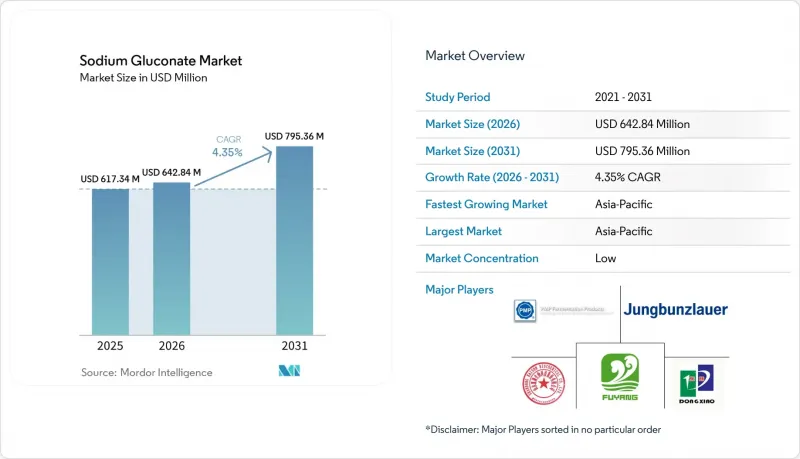
This report is Segmented by Grade (Industrial Grade, Food Grade, Pharmaceutical Grade and Technical Grade), Form (Powder, Liquid, and Granules), Application (Concrete Admixtures, Cleaning Agents and Detergents, Water Treatment, and More), and Geography (Asia-Pacific, North America, Europe, South America, and Middle-East and Africa). The Market Forecasts are Provided in Terms of Value (USD).
Global Sodium Gluconate Market Trends and Insights
Construction Activity and Concrete Admixture Demand
Construction activity remains the strongest driver for the sodium gluconate market because ready-mix and precast concrete use the compound as a set retarder and water reducer. These functions extend workable time in hot-weather pours and help producers lower water-to-cement ratios while meeting required compressive strength. Civil engineering work in utilities, transport corridors, and other public infrastructure supports recurring demand for concrete admixtures. Ultra-high-performance concrete requires more controlled dosing than many lignosulfonate-based retarders can provide. This requirement supports demand for specification grade sodium gluconate in projects where concrete performance and timing are tightly managed.
Biodegradable Chelant Substitution in Cleaning and Water Treatment
The sodium gluconate market benefits when industrial and institutional formulators replace persistent chelants in cleaning and water treatment applications. Sodium gluconate achieved 98% biodegradation within 2 days. It also showed copper-sequestration capacity 4.5 times higher than that of ethylenediaminetetraacetic acid in strongly alkaline cleaning conditions at pH 12-13. Its phosphorus-free profile supports applications in cooling water and reverse-osmosis systems where discharge requirements influence formulation choices. Sodium gluconate can also support European Union Ecolabel and COSMOS certification pathways for products that require biodegradable ingredients. These attributes strengthen its role in caustic cleaning and bottle-washing uses where alkaline performance is important.
Corn-Derived Glucose and Energy Cost Volatility
Corn-derived glucose and energy cost volatility can constrain the sodium gluconate market by putting pressure on fermentation margins. The corn starch represents 55-70% of production cost, and energy represented a further 15-25%. Producers without an integrated glucose supply are more exposed when feedstock prices move beyond contract pricing windows. Wet milling and enzymatic hydrolysis require substantial energy, so higher electricity prices can narrow the cost advantage of fermentation-derived products. This exposure is particularly relevant to non-integrated producers in China that buy glucose from outside suppliers. Changes in corn availability and biofuel policy can also make forward cost planning more difficult for smaller operators.
Other drivers and restraints analyzed in the detailed report include:
- Growth in Pharmaceutical and Nutraceutical Formulations
- Rising Clean-Label and Fermentation-Derived Ingredient Demand
- Substitution by Citric Acid, Phosphates, Lignosulfonates, GLDA and MGDA
For complete list of drivers and restraints, kindly check the Table Of Contents.
Segment Analysis
Industrial grade held 45.40% of the sodium gluconate market share in 2025, supported by its use in concrete admixtures, textile processing, metal surface treatment, and industrial cleaning. This grade serves customers whose specifications focus on concentration and functional performance rather than pharmacopeial verification. Food grade is used for chelation in packaged foods and beverages, flavor adjustment in stevia-sweetened products, and pH control in dairy and fermented food processing. Technical grade supports metal cleaning, rust removal, and electroplating bath maintenance. Pharmaceutical grade is projected to expand at a 5.09% CAGR through 2031, making it the fastest-growing grade in the sodium gluconate industry. Calcium gluconate injectables, intravenous electrolyte ingredients, and cell-therapy buffer chemistry support this growth. Pharmaceutical grade pricing is typically 12-15% higher per metric ton than industrial grade. The sodium gluconate market is therefore shifting toward grades with stronger quality controls and documentation requirements.
Grade requirements differ across national food, pharmaceutical, and industrial standards. China's National Medical Products Administration and changing food purity standards have raised pressure on domestic producers to improve heavy-metal and microbial controls. Smaller operators in Shandong can face greater difficulty funding purification upgrades than vertically integrated suppliers. Jungbunzlauer Suisse AG positions its food grade sodium gluconate against Food Chemicals Codex and European Union Commission Regulation No. 231/2012 requirements. The company also offers U.S. Pharmacopeia and personal care grades for pharmaceutical and cosmetic uses. These requirements widen the quality gap between compliant pharmaceutical material and commodity industrial material. The sodium gluconate industry benefits from this distinction because audited grade quality supports customer qualification and premium pricing.
Complete Report Scope:
- By Grade
- Industrial Grade
- Food Grade
- Pharmaceutical Grade
- Technical Grade
- By Form
- Powder
- Liquid
- Granules
- By Application
- Concrete Admixtures
- Cleaning Agents and Detergents
- Water Treatment
- Food and Pharmaceutical
- Other Applications (Textile Processing, Metal Treatment, Personal Care, Agriculture, Bioprocessing)
- By Geography
- Asia-Pacific
- China
- India
- Japan
- South Korea
- ASEAN Countries
- Rest of Asia-Pacific
- North America
- United States
- Canada
- Mexico
- Europe
- Germany
- United Kingdom
- France
- Italy
- NORDIC Countries
- Rest of Europe
- South America
- Brazil
- Argentina
- Rest of South America
- Middle-East and Africa
- Saudi Arabia
- South Africa
- Rest of Middle-East and Africa
- Asia-Pacific
Geography Analysis
Asia-Pacific held 46.80% of the sodium gluconate market size in 2025 and is forecast to grow at a 4.70% CAGR through 2031. The region is both the main supply base and the largest consumption area for the sodium gluconate market. Chinese capacity concentration has supported exports to Southeast Asia, the Middle-East, and Europe. India, Vietnam, Indonesia, and Thailand support regional demand through infrastructure, water treatment, and industrial cleaning.
In December 2025, Gujarat Ambuja Exports Limited began commercial production at its Hubli, Karnataka facility with 30,000 tons per annum (TPA) of installed capacity and targeted 120,000 TPA by 2028. This addition provides an Indian supply option besides Chinese production. North America and Europe are mature markets where compliance and grade quality shape demand. The U.S. International Trade Commission upheld antidumping duties of 213.15% and countervailing duties of 194.67% on relevant imports from China in its 2024 sunset review. Jungbunzlauer completed its acquisition of a Thomson, Illinois, production site in November 2025, improving proximity to North American customers.
South America and Middle-East, and Africa remain smaller demand areas for the sodium gluconate market. Brazil supports concrete admixture demand, while other South American markets offer water treatment and industrial cleaning opportunities. Gulf Cooperation Council utility and transport programs support industrial grade demand in Saudi Arabia and the United Arab Emirates. Desalination expansion, municipal water upgrades, and South Africa's pharmaceutical manufacturing base support demand for biodegradable scale inhibitors and pharmaceutical grade material.
- Anil Bioplus Limited
- Dong Xiao Biotechnology Co., Ltd.
- FUSO CHEMICAL CO., LTD.
- Henan Kingsun Chemical Co., Ltd.
- Jungbunzlauer Suisse AG
- PMP FERMENTATION PRODUCTS, INC.
- Qingdao Kehai Biochemistry Co., Ltd.
- Roquette Freres
- SHANDONG FUYANG BIO-TECH. CO. LTD.
- Shandong Kaison Biochemical Co., Ltd.
- Shandong Parkson Biotechnology Co. Ltd.
- Shandong Qilu Biotechnology Group Co., Ltd.
- Shandong Xinhong Pharmaceutical Co., Ltd
- Weifang Honghai chemical .,Co Ltd
- Weifang Jianbao Biotechnology Co., Ltd.
- XIWANG GROUP CO. LTD.
Additional Benefits:
- The market estimate (ME) sheet in Excel format
- 3 months of analyst support
TABLE OF CONTENTS
1 Introduction
- 1.1 Study Assumptions and Market Definition
- 1.2 Scope of the Study
2 Research Methodology
3 Executive Summary
4 Market Landscape
- 4.1 Market Overview
- 4.2 Market Drivers
- 4.2.1 Construction Activity and Concrete Admixture Demand
- 4.2.2 Biodegradable Chelant Substitution in Cleaning and Water Treatment
- 4.2.3 Growth in Pharmaceutical and Nutraceutical Formulations
- 4.2.4 Rising Clean-Label and Fermentation-Derived Ingredient Demand
- 4.2.5 High-Purity Sodium Gluconate Demand in Bioprocessing and Cell-Therapy Workflows
- 4.2.6 Liquid Sodium Gluconate Customization for Concrete Admixture Producers
- 4.3 Market Restraints
- 4.3.1 Corn-Derived Glucose and Energy Cost Volatility
- 4.3.2 Substitution by Citric Acid, Phosphates, Lignosulfonates, GLDA and MGDA
- 4.3.3 Fermentation Wastewater and Environmental Compliance Costs
- 4.3.4 Concentration Risk in Chinese Production Clusters and Export Logistics
- 4.4 Value and Supply-Chain Analysis
- 4.5 Porter's Five Forces Analysis
- 4.5.1 Bargaining Power of Suppliers
- 4.5.2 Bargaining Power of Buyers
- 4.5.3 Threat of New Entrants
- 4.5.4 Threat of Substitutes
- 4.5.5 Competitive Rivalry
5 Market Size and Growth Forecasts (Value)
- 5.1 By Grade
- 5.1.1 Industrial Grade
- 5.1.2 Food Grade
- 5.1.3 Pharmaceutical Grade
- 5.1.4 Technical Grade
- 5.2 By Form
- 5.2.1 Powder
- 5.2.2 Liquid
- 5.2.3 Granules
- 5.3 By Application
- 5.3.1 Concrete Admixtures
- 5.3.2 Cleaning Agents and Detergents
- 5.3.3 Water Treatment
- 5.3.4 Food and Pharmaceutical
- 5.3.5 Other Applications (Textile Processing, Metal Treatment, Personal Care, Agriculture, Bioprocessing)
- 5.4 By Geography
- 5.4.1 Asia-Pacific
- 5.4.1.1 China
- 5.4.1.2 India
- 5.4.1.3 Japan
- 5.4.1.4 South Korea
- 5.4.1.5 ASEAN Countries
- 5.4.1.6 Rest of Asia-Pacific
- 5.4.2 North America
- 5.4.2.1 United States
- 5.4.2.2 Canada
- 5.4.2.3 Mexico
- 5.4.3 Europe
- 5.4.3.1 Germany
- 5.4.3.2 United Kingdom
- 5.4.3.3 France
- 5.4.3.4 Italy
- 5.4.3.5 NORDIC Countries
- 5.4.3.6 Rest of Europe
- 5.4.4 South America
- 5.4.4.1 Brazil
- 5.4.4.2 Argentina
- 5.4.4.3 Rest of South America
- 5.4.5 Middle-East and Africa
- 5.4.5.1 Saudi Arabia
- 5.4.5.2 South Africa
- 5.4.5.3 Rest of Middle-East and Africa
- 5.4.1 Asia-Pacific
6 Competitive Landscape
- 6.1 Market Concentration
- 6.2 Strategic Moves
- 6.3 Market Share (%)/Ranking Analysis
- 6.4 Company Profiles (includes Global Overview, Market Overview, Core Segments, Financials as available, Strategic Information, Products and Services, and Recent Developments)
- 6.4.1 Anil Bioplus Limited
- 6.4.2 Dong Xiao Biotechnology Co., Ltd.
- 6.4.3 FUSO CHEMICAL CO., LTD.
- 6.4.4 Henan Kingsun Chemical Co., Ltd.
- 6.4.5 Jungbunzlauer Suisse AG
- 6.4.6 PMP FERMENTATION PRODUCTS, INC.
- 6.4.7 Qingdao Kehai Biochemistry Co., Ltd.
- 6.4.8 Roquette Freres
- 6.4.9 SHANDONG FUYANG BIO-TECH. CO. LTD.
- 6.4.10 Shandong Kaison Biochemical Co., Ltd.
- 6.4.11 Shandong Parkson Biotechnology Co. Ltd.
- 6.4.12 Shandong Qilu Biotechnology Group Co., Ltd.
- 6.4.13 Shandong Xinhong Pharmaceutical Co., Ltd
- 6.4.14 Weifang Honghai chemical .,Co Ltd
- 6.4.15 Weifang Jianbao Biotechnology Co., Ltd.
- 6.4.16 XIWANG GROUP CO. LTD.
7 Market Opportunities and Future Outlook
- 7.1 White-Space and Unmet-Need Assessment

