PUBLISHER: Mordor Intelligence | PRODUCT CODE: 2119552

PUBLISHER: Mordor Intelligence | PRODUCT CODE: 2119552
Podcast Marketing Services - Market Share Analysis, Industry Trends & Statistics, Growth Forecasts (2026 - 2031)
According to Mordor Intelligence, the podcast marketing services market size was valued at USD 2.71 billion in 2025 and is estimated to grow from USD 2.94 billion in 2026 to reach USD 5.12 billion by 2031, at a CAGR of 11.66% during the forecast period 2026-2031.
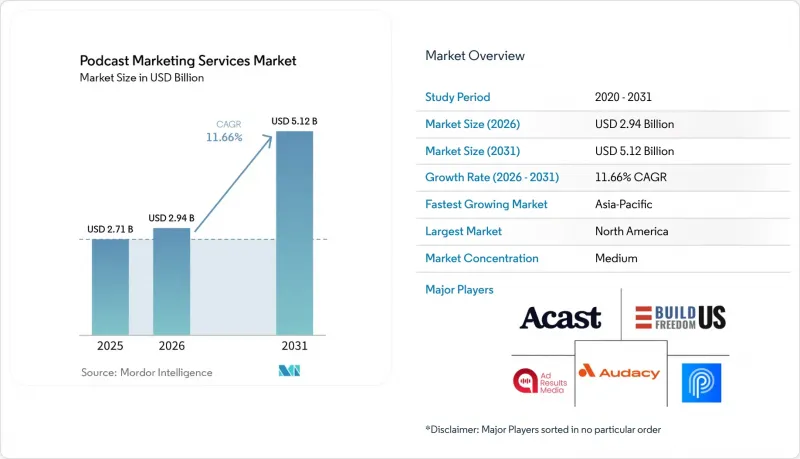
This report is Segmented by Service Type (Strategy and Show Development, Production and Post-Production, Distribution and Audience Development, Sponsorship and Host-Read Ad Sales, Analytics and Attribution, and More), Revenue Model (Sponsorship Management, and More), End-User Industry (Retail and E-Commerce, BFSI, and More), and Geography. The Market Forecasts are Provided in Terms of Value (USD).
Global Podcast Marketing Services Market Trends and Insights
Rising Demand for Authentic Host-Read and Creator-Led Advertising
Host-read advertising supports the podcast marketing services market because listeners often view a host's recommendation differently from a standard commercial message. This makes the relationship between the brand, the host, and the intended audience central to campaign design, rather than treating each placement as interchangeable inventory or a standard media placement. The agency must understand the client's objectives, the host's voice, the audience's interests, and any claim that needs careful review. A well-developed integration needs a clear commercial purpose, language that suits the show, and enough time for the host to understand the product before recording. Service providers must therefore assess host fit, develop clear briefs, negotiate usage, and protect the natural character of an endorsement. The model also requires transparent disclosure where a commercial relationship exists, especially for clients in regulated categories. As brands seek host partnerships at greater scale, agencies that can preserve audience trust while managing campaign operations have a practical advantage, particularly when a campaign needs consistent delivery across multiple shows, hosts, and release dates.
Expansion of Branded Podcasts in Business and Enterprise Marketing
Branded programs are extending the podcast marketing services market beyond seasonal advertising purchases and into longer-term content planning. New podcast advertisers spent USD 39,231 in their first month in 2025 and USD 64,616 per month during the following 6 months, compared with USD 18,200 at launch and USD 30,445 per month during the following 6 months in 2024. The spending pattern reflects a larger commitment from new entrants once they begin using podcasts as part of an ongoing communication program. It also suggests that the first months of a program are often used to establish production routines, test formats, and identify the audience topics that merit continued investment. A branded show can support executive visibility, customer education, and subject-focused conversations without relying only on a short campaign window. This approach also raises the importance of editorial planning, consistent publishing, guest coordination, and distribution support across the full life of a program. It makes the choice of themes and guests both a commercial and a content decision. Financial services and healthcare clients require additional attention to disclosures and advertising standards, which can favor providers with relevant compliance experience and documented review processes that clients can apply before publishing an episode.
Measurement and Attribution Gaps Beyond Downloads
Measurement limitations can constrain the podcast marketing services market because a download or a view does not capture the full commercial impact of a campaign. The challenge is more pronounced when a campaign appears across RSS feeds, video platforms, social clips, and paid media channels, each using different reporting methods. Spotify introduced a new plays standard in June 2026 that counts an episode after at least 30 seconds of consumption, and it also expanded creator analytics. The update provides a more consistent activity signal, but it does not resolve every question about conversion, revenue, or cross-platform exposure. Service providers often need to combine audience data, post-purchase surveys, promo codes, and client sales data to form a fuller view. This creates additional operating work and can slow decisions when clients require clear evidence before committing larger budgets. It also means that campaign reports must explain what each measure can show, where its limits remain, and how several measures fit together in a practical account of campaign performance for the client.
Other drivers and restraints analyzed in the detailed report include:
- Growth of Video Podcast Consumption Across Platform Ecosystems
- Better Programmatic Buying and Audience Targeting for Audio Inventory
- High Ongoing Investment Needed to Build and Sustain Branded Podcast Audiences
For complete list of drivers and restraints, kindly check the Table Of Contents.
Segment Analysis
Production and Post-Production accounted for 29.06% of the market in 2025, supported by demand for coordinated audio and video output. Brands increasingly need studios, agencies, and specialists that can take a show from planning through editing and final distribution, with clear responsibilities for creative approval, technical quality, and publishing timing. Production work remains necessary whether the objective is brand awareness, customer education, internal communication, or sponsorship revenue. High-quality recording, visual presentation, editing, and publishing are important because audiences encounter the same show across multiple platforms and form opinions about the client from every version of the content. Strategy and Show Development, Distribution and Audience Development, Sponsorship and Host-Read Ad Sales, and Content Repurposing make up the other service categories, showing that a podcast program needs a connected operating model rather than isolated production support.
Analytics and Attribution is projected to grow at a 12.31% CAGR through 2031, making it the fastest-growing service category in the podcast marketing services market. This activity is gaining importance because clients need to explain results to senior marketing, finance, and operating teams. Spotify's June 2026 plays standard gives creators a common activity measure for episodes consumed for at least 30 seconds. Video distribution adds further reporting surfaces, and this makes download-centered measurement less complete than it was for audio-only campaigns. Providers that can join platform reporting with client data, surveys, and promotion codes can offer more useful campaign reviews. Content repurposing supports this work because 1 recording can inform social posts, email material, and search-focused assets, although each output still needs suitable reporting and governance that links activity to the wider program.
Complete Report Scope:
- By Service Type
- Strategy and Show Development
- Production and Post-Production
- Distribution and Audience Development
- Sponsorship and Host-Read Ad Sales
- Analytics and Attribution
- Content Repurposing
- By Revenue Model
- Sponsorship Management
- Subscription and Membership Strategy
- Affiliate Marketing
- By End-User Industry
- Retail and E-commerce
- BFSI
- Healthcare and Life Sciences
- IT and Telecommunications
- Media and Entertainment
- Other End-User Industries
- By Geography
- North America
- United States
- Canada
- Mexico
- South America
- Brazil
- Argentina
- Chile
- Rest of South America
- Europe
- Germany
- United Kingdom
- France
- Italy
- Spain
- Rest of Europe
- Asia-Pacific
- China
- Japan
- India
- South Korea
- Australia
- Rest of Asia-Pacific
- Middle East
- United Arab Emirates
- Saudi Arabia
- Qatar
- Rest of Middle East
- Africa
- South Africa
- Egypt
- Nigeria
- Rest of Africa
- North America
Geography Analysis
North America held 48.23% of the podcast marketing services market share in 2025, supported by a mature advertising infrastructure, high listener participation, and established programmatic buying tools. The region has a broad mix of networks, platforms, production companies, agencies, and measurement specialists, serving established audio buyers and newer brands testing video podcast formats. This range of participants offers clients several routes to market, but it also makes specialist advice useful when comparing platform terms, production models, and campaign reporting. North American service providers are also responding to the need for combined audio-and-video campaign planning.
Asia-Pacific is projected to grow at a 12.44% CAGR through 2031, making it the fastest-growing region in the podcast marketing services market. The region's expansion is linked to mobile-first listening in India and Southeast Asia, corporate adoption in Japan, and paid content activity in China. These conditions increase the need for local-language production, audience development, and distribution support, while providers must also account for differing platform preferences, commercial practices, and regulatory requirements across the region. Demand can favor agencies that combine local market understanding with the ability to coordinate regional programs for multinational clients.
Europe, South America, the Middle East, and Africa represent smaller regional segments of the podcast marketing services market. Europe has regulated advertising environments that can create demand for providers with experience in disclosure, rights, and data-protection requirements, while South America's larger podcast audiences are concentrated in Brazil and Argentina, where younger mobile-centered audiences can support advertiser interest. Cross-border rights issues and currency volatility can make regional direct-response campaigns harder to scale. The Middle East and Africa remain earlier-stage markets where branded content from multinational companies is building the supply of English- and Arabic-language programming, and operating conditions differ widely between countries.
- Acast AB
- Ad Results Media LLC
- Audacy, Inc.
- Build Freedom LLC
- Podcasting Ltd
- Fresh Air Production Ltd
- JAR Podcast Solutions Inc.
- Lower Street Media Ltd
- Pacific Content Inc.
- Pod People LLC
- Podbean Tech Inc.
- Podfly Productions, LLC
- Podigy LLC
- Quill Inc.
- Resonate Recordings, LLC
- iHeartMedia, Inc.
- Sirius XM Holdings Inc.
- Studiopod Media LLC
- Sweet Fish Media, LLC
- True Native Media, LLC
Additional Benefits:
- The market estimate (ME) sheet in Excel format
- 3 months of analyst support
TABLE OF CONTENTS
1 INTRODUCTION
- 1.1 Study Assumptions and Market Definition
- 1.2 Scope of the Study
2 RESEARCH METHODOLOGY
3 EXECUTIVE SUMMARY
4 MARKET LANDSCAPE
- 4.1 Market Overview
- 4.2 Market Drivers
- 4.2.1 Rising Demand for Authentic Host-Read and Creator-Led Advertising
- 4.2.2 Expansion of Branded Podcasts in Business and Enterprise Marketing
- 4.2.3 Growth of Video Podcast Consumption Across Youtube and Platform Ecosystems
- 4.2.4 Better Programmatic Buying and Audience Targeting for Audio Inventory
- 4.2.5 Repurposing Economics Turn One Recording Into Full-Funnel Content Packages
- 4.2.6 Corporate Internal and Private Podcasting Expands Agency Wallet Share
- 4.3 Market Restraints
- 4.3.1 Measurement and Attribution Gaps Beyond Downloads
- 4.3.2 High Ongoing Investment Needed to Build and Sustain Branded Podcast Audiences
- 4.3.3 Platform Dependency Shifts Discovery Power Toward Youtube and Walled Gardens
- 4.3.4 Rights, Music, and Cross-Border Compliance Complexity Slows Multi-Market Rollouts
- 4.4 Industry Value Chain Analysis
- 4.5 Regulatory Landscape
- 4.6 Technological Outlook
- 4.7 Impact of Macroeconomic Factors on the Market
- 4.8 Porter's Five Forces Analysis
- 4.8.1 Threat of New Entrants
- 4.8.2 Bargaining Power of Buyers
- 4.8.3 Bargaining Power of Suppliers
- 4.8.4 Threat of Substitutes
- 4.8.5 Industry Rivalry
5 MARKET SIZE AND GROWTH FORECASTS (VALUE)
- 5.1 By Service Type
- 5.1.1 Strategy and Show Development
- 5.1.2 Production and Post-Production
- 5.1.3 Distribution and Audience Development
- 5.1.4 Sponsorship and Host-Read Ad Sales
- 5.1.5 Analytics and Attribution
- 5.1.6 Content Repurposing
- 5.2 By Revenue Model
- 5.2.1 Sponsorship Management
- 5.2.2 Subscription and Membership Strategy
- 5.2.3 Affiliate Marketing
- 5.3 By End-User Industry
- 5.3.1 Retail and E-commerce
- 5.3.2 BFSI
- 5.3.3 Healthcare and Life Sciences
- 5.3.4 IT and Telecommunications
- 5.3.5 Media and Entertainment
- 5.3.6 Other End-User Industries
- 5.4 By Geography
- 5.4.1 North America
- 5.4.1.1 United States
- 5.4.1.2 Canada
- 5.4.1.3 Mexico
- 5.4.2 South America
- 5.4.2.1 Brazil
- 5.4.2.2 Argentina
- 5.4.2.3 Chile
- 5.4.2.4 Rest of South America
- 5.4.3 Europe
- 5.4.3.1 Germany
- 5.4.3.2 United Kingdom
- 5.4.3.3 France
- 5.4.3.4 Italy
- 5.4.3.5 Spain
- 5.4.3.6 Rest of Europe
- 5.4.4 Asia-Pacific
- 5.4.4.1 China
- 5.4.4.2 Japan
- 5.4.4.3 India
- 5.4.4.4 South Korea
- 5.4.4.5 Australia
- 5.4.4.6 Rest of Asia-Pacific
- 5.4.5 Middle East
- 5.4.5.1 United Arab Emirates
- 5.4.5.2 Saudi Arabia
- 5.4.5.3 Qatar
- 5.4.5.4 Rest of Middle East
- 5.4.6 Africa
- 5.4.6.1 South Africa
- 5.4.6.2 Egypt
- 5.4.6.3 Nigeria
- 5.4.6.4 Rest of Africa
- 5.4.1 North America
6 COMPETITIVE LANDSCAPE
- 6.1 Market Concentration
- 6.2 Strategic Moves
- 6.3 Market Share Analysis
- 6.4 Company Profiles (includes Global Level Overview, Market Level Overview, Core Segments, Financials as available, Strategic Information, Market Rank/Share, Products and Services, Recent Developments)
- 6.4.1 Acast AB
- 6.4.2 Ad Results Media LLC
- 6.4.3 Audacy, Inc.
- 6.4.4 Build Freedom LLC
- 6.4.5 Podcasting Ltd
- 6.4.6 Fresh Air Production Ltd
- 6.4.7 JAR Podcast Solutions Inc.
- 6.4.8 Lower Street Media Ltd
- 6.4.9 Pacific Content Inc.
- 6.4.10 Pod People LLC
- 6.4.11 Podbean Tech Inc.
- 6.4.12 Podfly Productions, LLC
- 6.4.13 Podigy LLC
- 6.4.14 Quill Inc.
- 6.4.15 Resonate Recordings, LLC
- 6.4.16 iHeartMedia, Inc.
- 6.4.17 Sirius XM Holdings Inc.
- 6.4.18 Studiopod Media LLC
- 6.4.19 Sweet Fish Media, LLC
- 6.4.20 True Native Media, LLC
7 MARKET OPPORTUNITIES AND FUTURE OUTLOOK
- 7.1 White-Space and Unmet-Need Assessment

