PUBLISHER: Mordor Intelligence | PRODUCT CODE: 2119570

PUBLISHER: Mordor Intelligence | PRODUCT CODE: 2119570
North America Building Automation Systems - Market Share Analysis, Industry Trends & Statistics, Growth Forecasts (2026 - 2031)
According to Mordor Intelligence, the North America building automation systems market size reached USD 76.57 billion in 2026 and is forecast to climb to USD 128.93 billion by 2031, reflecting a 10.98% CAGR.
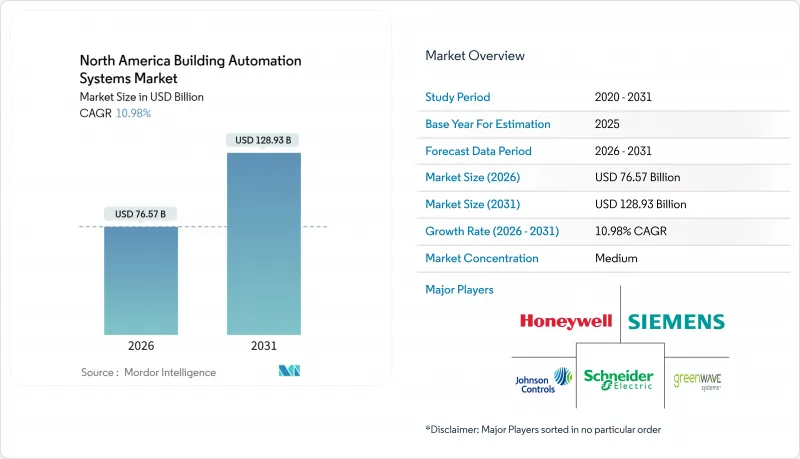
This report is Segmented by Component (Hardware, Software, and Services), System Type (HVAC Control Systems, Lighting Control Systems, Security and Access Control Systems, and More), Communication Technology (Wired, and Wireless), End-User (Residential, Commercial, and More), and Country. The Market Sizes and Forecasts are Provided in Terms of Value in USD for all the Above Segments.
North America Building Automation Systems Market Trends and Insights
Adoption Of AI Enabled Predictive Maintenance And Analytics
Machine-learning models convert raw sensor feeds into early-warning diagnostics that predict equipment degradation three days ahead with 85% accuracy, cutting emergency repairs by 40% and lengthening asset life by 15%. Subscription-based analytics platforms allow vendors to guarantee uptime, shifting revenue from one-time parts sales to performance contracts. A 2025 deployment across 1,200 buildings demonstrated that aggregated cloud data helps operators benchmark anomalies portfolio-wide, a task single-site analysis cannot match. Edge controllers embedding inference engines now execute algorithms locally, trimming latency to 50 milliseconds and reducing cloud bandwidth needs.
Federal And State Incentives Accelerating Building Decarbonization
The Inflation Reduction Act increased the Section 179D deduction to USD 5.00 per square foot for projects hitting 50% energy savings, halving simple payback from eight to four years. New York City's Local Law 97 fines USD 268 per tonne of CO2-equivalent emissions above caps, converting automation into a compliance tool rather than a discretionary upgrade. California's 2025 Title 24 update mandates fault detection on large HVAC systems, effectively making automation standard in 90% of new commercial installs. Combined carrots and sticks have compressed procurement cycles from 18 months to nine as owners race to secure incentives before the 2032 phase-down.
High Upfront Retrofit Costs For Legacy Buildings
Comprehensive retrofits cost USD 2.50-USD 6.00 per square foot, pushing a 100,000 square-foot project to USD 250,000-USD 600,000. Smaller landlords face 7-10 year paybacks without rebates, exceeding the five-year hurdle typical of discretionary spending. Wireless kits trim labor by up to 40% but hardware still strains cash flow. On-bill, zero-interest utility financing reached 92% participation in a Seattle pilot, yet scaling needs regulatory approval that can take two years.
Other drivers and restraints analyzed in the detailed report include:
- Rapid Growth Of Connected HVAC Retrofit Projects
- Corporate ESG Commitments Driving Smart Building Investments
- Skilled Labor Shortage For BAS Integration And Cybersecurity
For complete list of drivers and restraints, kindly check the Table Of Contents.
Segment Analysis
Software grew 11.55% annually through 2031, outpacing hardware's 46.84% of North America building automation systems market share in 2025 as cloud platforms convert device data into recurring fees. The building automation systems market size for software reached USD 1.2 billion at Johnson Controls alone in 2025, up 34% year over year. Owners favor opex contracts that avoid capital depreciation while scaling across portfolios. Hardware margins are tightening as commoditization pushes controller prices down by 8%-12% annually, prompting manufacturers to bundle devices with analytics subscriptions.
Edge computing blurs category lines. New controllers perform machine-learning inference locally, cutting latency from 500 milliseconds to 50 milliseconds and reducing outbound traffic. Service revenue pivots from break-fix calls to performance guarantees, commanding a 25% premium when vendors share savings. These shifts indicate that competitive advantage is migrating away from proprietary devices toward data ecosystems that improve algorithm accuracy with every additional building.
Energy management and analytics platforms are expanding at 11.74% a year, the fastest pace among system types. They forecast load a day ahead with 92% accuracy, enabling pre-cooling that avoids peak tariffs and trims utility bills by up to 25%. HVAC control retained 39.42% of the 2025 revenue share in the North America building automation systems market, yet its growth moderates as saturation rises in Class A offices. Lighting systems benefit from wireless commissioning tools that reduce installation time by 40% and lift retrofit viability.
Unified dashboards now link access control with HVAC zoning, eliminating energy waste from unoccupied areas. Fire and life-safety upgrades follow code mandates; the 2025 edition of NFPA 72 broadened networked detector requirements, growing the addressable retrofit pool by 18%. As utilities reward flexibility, PJM paid USD 85 per kilowatt-hour for demand response in 2025. Energy platforms unlock a new revenue stream, boosting returns by 300 basis points.
Complete Report Scope:
- By Component
- Hardware
- Software
- Services
- By System Type
- HVAC Control Systems
- Lighting Control Systems
- Security and Access Control Systems
- Energy Management and Analytics Platforms
- Fire and Life Safety Systems
- By Communication Technology
- Wired
- Wireless
- By End-User
- Residential
- Commercial
- Industrial
- Institutional / Government
- By Country
- United States
- Canada
- Mexico
List of Companies Covered in this Report:
- Johnson Controls International PLC
- Honeywell International Inc.
- Siemens AG
- Schneider Electric SE
- Greenwave Systems Inc.
- Uplight Inc.
- Panasonic Holdings Corporation
- ABB Ltd.
- Carrier Global Corporation
- Trane Technologies plc
- Rockwell Automation Inc.
- Legrand SA
- Lutron Electronics Co. Inc.
- Cisco Systems Inc.
- Delta Controls Inc.
- Distech Controls Inc.
- Emerson Electric Co.
- Crestron Electronics Inc.
- Hubbell Incorporated
Additional Benefits:
- The market estimate (ME) sheet in Excel format
- 3 months of analyst support
TABLE OF CONTENTS
1 INTRODUCTION
- 1.1 Study Assumptions and Market Definition
- 1.2 Scope of the Study
2 RESEARCH METHODOLOGY
3 EXECUTIVE SUMMARY
4 MARKET LANDSCAPE
- 4.1 Market Overview
- 4.2 Market Drivers
- 4.2.1 Adoption of AI-Enabled Predictive Maintenance and Analytics
- 4.2.2 Federal and State Incentives Accelerating Building Decarbonization
- 4.2.3 Rapid Growth of Connected HVAC Retrofit Projects
- 4.2.4 Corporate ESG Commitments Driving Smart Building Investments
- 4.2.5 Move Toward Open Interoperable BACnet/IP and MQTT Protocols
- 4.2.6 Emerging Demand for Indoor Air Quality Monitoring Post-Pandemic
- 4.3 Market Restraints
- 4.3.1 High Upfront Retrofit Costs for Legacy Buildings
- 4.3.2 Skilled Labor Shortage for BAS Integration and Cybersecurity
- 4.3.3 Rising Cyber-Security Compliance Costs
- 4.3.4 Semiconductor Supply Chain Volatility Impacting Controller Availability
- 4.4 Industry Value-Chain Analysis
- 4.5 Regulatory Landscape
- 4.6 Technological Outlook
- 4.7 Porter's Five Forces Analysis
- 4.7.1 Bargaining Power of Suppliers
- 4.7.2 Bargaining Power of Consumers
- 4.7.3 Threat of New Entrants
- 4.7.4 Threat of Substitutes
- 4.7.5 Intensity of Competitive Rivalry
- 4.8 Impact of Macroeconomic Factors on the Market
- 4.9 Investment Analysis
5 MARKET SIZE AND GROWTH FORECASTS (VALUE)
- 5.1 By Component
- 5.1.1 Hardware
- 5.1.2 Software
- 5.1.3 Services
- 5.2 By System Type
- 5.2.1 HVAC Control Systems
- 5.2.2 Lighting Control Systems
- 5.2.3 Security and Access Control Systems
- 5.2.4 Energy Management and Analytics Platforms
- 5.2.5 Fire and Life Safety Systems
- 5.3 By Communication Technology
- 5.3.1 Wired
- 5.3.2 Wireless
- 5.4 By End-User
- 5.4.1 Residential
- 5.4.2 Commercial
- 5.4.3 Industrial
- 5.4.4 Institutional / Government
- 5.5 By Country
- 5.5.1 United States
- 5.5.2 Canada
- 5.5.3 Mexico
6 COMPETITIVE LANDSCAPE
- 6.1 Market Concentration
- 6.2 Strategic Moves
- 6.3 Market Share Analysis
- 6.4 Company Profiles (includes Global Level Overview, Market Level Overview, Core Segments, Financials as available, Strategic Information, Market Rank/Share, Products and Services, Recent Developments)
- 6.4.1 Johnson Controls International PLC
- 6.4.2 Honeywell International Inc.
- 6.4.3 Siemens AG
- 6.4.4 Schneider Electric SE
- 6.4.5 Greenwave Systems Inc.
- 6.4.6 Uplight Inc.
- 6.4.7 Panasonic Holdings Corporation
- 6.4.8 ABB Ltd.
- 6.4.9 Carrier Global Corporation
- 6.4.10 Trane Technologies plc
- 6.4.11 Rockwell Automation Inc.
- 6.4.12 Legrand SA
- 6.4.13 Lutron Electronics Co. Inc.
- 6.4.14 Cisco Systems Inc.
- 6.4.15 Delta Controls Inc.
- 6.4.16 Distech Controls Inc.
- 6.4.17 Emerson Electric Co.
- 6.4.18 Crestron Electronics Inc.
- 6.4.19 Hubbell Incorporated
7 MARKET OPPORTUNITIES AND FUTURE OUTLOOK
- 7.1 White-Space and Unmet-Need Assessment

