PUBLISHER: Mordor Intelligence | PRODUCT CODE: 2119594

PUBLISHER: Mordor Intelligence | PRODUCT CODE: 2119594
Atlanta Data Center - Market Share Analysis, Industry Trends & Statistics, Growth Forecasts (2026 - 2031)
According to Mordor Intelligence, the atlanta data center market size in 2026 is estimated at 1.82 GW of installed IT power, up from 0.92 GW in 2025, with 2031 projections showing 7.68 GW of installed IT power, growing at a 26.95% CAGR over 2026-2031.
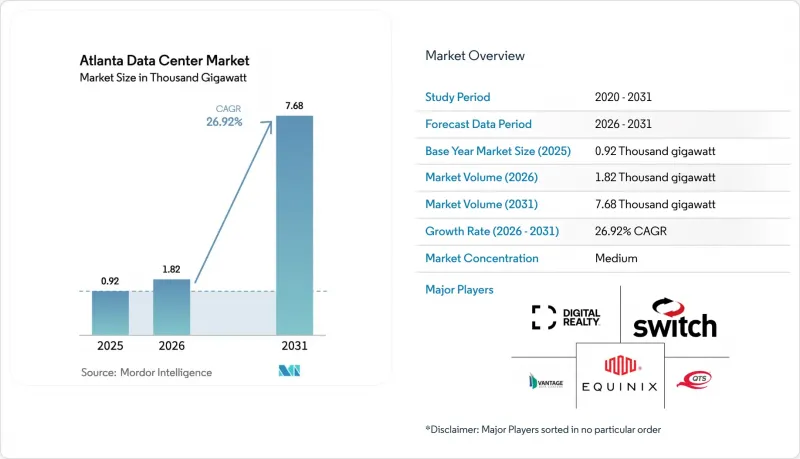
This report is Segmented by Data Center Size (Small, Medium, Large, Massive, Mega), Tier Type (Tier 1&2, Tier 3, Tier 4), and Data Center Type (Cloud Service Providers (CSPs), Colocation Type, and More). The Market Forecasts are Provided in Terms of Value (USD).
Atlanta Data Center Market Trends and Insights
AI / Cloud-Led Hyperscale Builds: Reshaping Power Requirements
Atlanta's newest hyperscale campuses are being engineered for rack densities exceeding 40 kW to satisfy AI training clusters. Microsoft alone is investing USD 1.8 billion in three local facilities totaling 324 MW. Electric Power Research Institute notes AI already accounts for 10-20% of data-center electricity draw nationwide, a share that could push sector demand to 9.1% of U.S. generation by 2030. Premium pricing follows the newest builds owing to their liquid cooling, extra switchgear and on-site substations, while legacy halls face retrofit pressures. The clustering of these sites in the southern metro is forming purpose-built utility zones where redundant transmission, looped fiber and 100-acre parcels converge.
Edge-Computing and Latency-Sensitive Workloads: Driving Urban Deployments
Mobile gaming, tele-health and financial-trading platforms are spurring a lattice of micro-facilities across downtown Atlanta. American Tower has added edge nodes near Peachtree Center to keep hop counts under five milliseconds. Vapor IO and Comcast are piloting last-mile edge services to dovetail with existing cable plant. EdgeConneX operates two sites totaling 16 MW within a three-mile radius of city hall. These deployments trim network latency for AI inference, interactive media and autonomous-vehicle telemetry, positioning metro Atlanta as both a core and edge nexus.
Utility Power-Delivery Lead-Times: Critical Infrastructure Bottleneck
Georgia Power expects industrial electricity demand to multiply 17-fold by 2035, with data centers absorbing 80% of that growth. Average lead times for high-voltage extensions approach four years, forcing phased build-outs and on-site gas turbine deployments. Metro mayors warn that 8.2 GW of extra capacity is required by 2030 to keep pace with bookings. New state rules now compel large projects to co-fund sub-station upgrades to shield residential customers from rate hikes.
Other drivers and restraints analyzed in the detailed report include:
- Georgia Tax and Renewable-Energy Incentives: Fiscal Catalysts
- Surging AI Power Constraints in NoVA Divert Demand: Geographic Redistribution
- Escalating Land and Construction Costs: Economic Pressure Points
For complete list of drivers and restraints, kindly check the Table Of Contents.
Segment Analysis
Mega sites held 53.12% of Atlanta data center market share in 2025, translating into 467.5 MW of active IT capacity in 2025. This dominance pushes the Atlanta data center market size for mega builds toward 1.57 GW by mid-decade as announced expansions come online. Economies of scale allow operators to undercut power costs and deploy SCADA-enabled distribution at room scale rather than row scale. Amazon Web Services' USD 11 billion Georgia program involves multiple 100 MW+ blocks and sets a blueprint for campus-style resiliency. The Massive tier (20-100 MW) is forecast to climb 28.73% annually as second-tier clouds and SaaS vendors secure future-proven footprints. Meanwhile, Medium and Large categories remain relevant for private-cloud transition workloads, edge caching and compliance-driven isolation zones. Smaller (sub-5 MW) halls have pivoted toward telco edge clusters and research labs that prize proximity over watt scale.
Economically, mega campuses secure PUE values near 1.2 by integrating rooftop heat-exchanger loops and on-site chilled-water plants. Land aggregation tactics bundle parcels into 200-acre super sites, reducing municipal approvals per megawatt delivered. The strategy also supports multi-building phasing that aligns capital draws with pre-leased commitments, preserving developer IRRs. Over the next five years, the Atlanta data center market is expected to shift another 12 percentage points toward mega and massive stock as AI rack densities exceed 80 kW and require specialized power trenways.
Tier 3 inventory occupied 65.72% of active floor space in 2025, underlining its status as the standard for mission-critical yet cost-sensitive deployments. The Atlanta data center market size allocated to Tier 3 halls is projected to surpass 2.42 GW by 2031 as enterprises retire on-premises server rooms. However, Tier 4 is registering a 28.54% CAGR, buoyed by machine-learning clusters, fintech clearing systems and defense workloads that cannot tolerate a single point of failure. Operators justify the capex premium by commanding service-level agreements featuring five-nines uptime and shorter mean-time-to-repair. Flexential's Alpharetta site illustrates Tier 4 economics with liquid cooling, up-flow containment and 1,500 W per square foot densities.
Tier 1 and Tier 2 footprints cater mainly to archival storage, staging areas and disaster-recovery seats, but their share is sliding as price differentials narrow. Design trends show Tier 3 sites integrating selective Tier 4 attributes-dual utility feeds, segmented busways and battery-energy-storage systems-to future-proof assets without a full Tier 4 price tag.
Complete Report Scope:
- By Data Center Size
- Small
- Medium
- Large
- Hyperscale
- By Tier Type
- Tier 1 and 2
- Tier 3
- Tier 4
- By Data Center Type
- Cloud Service Providers (CSPs)
- Enterprise, Modular and Edge
- Colocation
- Non-Utilized
- Utilized
- Colocation Type
- Retail
- Wholesale
- Colocation Type
- By End User Industry
- Cloud and IT
- Telecom
- Media and Entertainment
- Government
- BFSI
- Manufacturing
- E-Commerce
- Other End User
List of Companies Covered in this Report:
- QTS Realty Trust
- Vantage Data Centers Management Company, LLC
- EDC VENTURE LLC (Edged)
- Digital Realty Trust Inc.
- Quadranet Systems Limited
- H5 Data Centers
- DataBank Holdings Ltd.
- EVODC, LLC (Evocative)
- Krypt
- Lumen Technologies
- Cogent Communications Holdings, Inc.
- Assurant, Inc.
- Csquare (Phoenix Infrastructure LLC)
- Summit Hosting
- EdgeConneX, Inc.
- Equinix Inc.
- Apotech Group
- Vault Networks, Inc.
- Coloblox Data Centers
- CoreSite
- Enzu Inc.
Additional Benefits:
- The market estimate (ME) sheet in Excel format
- 3 months of analyst support
TABLE OF CONTENTS
1 INTRODUCTION
- 1.1 Study Assumptions and Market Definition
- 1.2 Scope of the Study
2 RESEARCH METHODOLOGY
3 EXECUTIVE SUMMARY
4 MARKET LANDSCAPE
- 4.1 Market Overview
- 4.2 Market Drivers
- 4.2.1 AI / cloud-led hyperscale builds
- 4.2.2 Edge-computing and latency-sensitive workloads
- 4.2.3 Georgia tax and renewable-energy incentives
- 4.2.4 Surging AI power constraints in NoVA divert demand
- 4.2.5 Surplus dark-fiber along I-285 and I-20 corridors
- 4.2.6 Sub-sea cable upgrade via Myrtle Beach landing
- 4.3 Market Restraints
- 4.3.1 Utility power-delivery lead-times
- 4.3.2 Escalating land and construction costs
- 4.3.3 Prospective water-usage restrictions for cooling
- 4.3.4 Skilled labor gap for high-density builds
- 4.4 Digital Infrastructure Indicators
- 4.4.1 Smartphone Users
- 4.4.2 Data Traffic per Smartphone
- 4.4.3 Mobile Data Speed
- 4.4.4 Broadband Data Speed
- 4.5 Value / Supply-Chain Analysis
- 4.6 Regulatory Landscape
- 4.7 Technological Outlook
- 4.8 Assessment of the impact of Macro Economic Trends on the Market
- 4.9 Porter's Five Forces
- 4.9.1 Bargaining Power of Suppliers
- 4.9.2 Bargaining Power of Buyers
- 4.9.3 Threat of New Entrants
- 4.9.4 Threat of Substitutes
- 4.9.5 Competitive Rivalry
5 MARKET SIZE AND GROWTH FORECASTS (MW)
- 5.1 By Data Center Size
- 5.1.1 Small
- 5.1.2 Medium
- 5.1.3 Large
- 5.1.4 Hyperscale
- 5.2 By Tier Type
- 5.2.1 Tier 1 and 2
- 5.2.2 Tier 3
- 5.2.3 Tier 4
- 5.3 By Data Center Type
- 5.3.1 Cloud Service Providers (CSPs)
- 5.3.2 Enterprise, Modular and Edge
- 5.3.3 Colocation
- 5.3.3.1 Non-Utilized
- 5.3.3.2 Utilized
- 5.3.3.2.1 Colocation Type
- 5.3.3.2.1.1 Retail
- 5.3.3.2.1.2 Wholesale
- 5.3.3.2.1 Colocation Type
- 5.4 By End User Industry
- 5.4.1 Cloud and IT
- 5.4.2 Telecom
- 5.4.3 Media and Entertainment
- 5.4.4 Government
- 5.4.5 BFSI
- 5.4.6 Manufacturing
- 5.4.7 E-Commerce
- 5.4.8 Other End User
6 COMPETITIVE LANDSCAPE
- 6.1 Market Concentration
- 6.2 Strategic Moves
- 6.3 Market Share Analysis (MW)
- 6.4 Company Profiles (includes Global level Overview, Market level overview, Core Segments, Financials as available, Strategic Information, Market Rank/Share for key companies, Products and Services, and Recent Developments)
- 6.4.1 QTS Realty Trust
- 6.4.2 Vantage Data Centers Management Company, LLC
- 6.4.3 EDC VENTURE LLC (Edged)
- 6.4.4 Digital Realty Trust Inc.
- 6.4.5 Quadranet Systems Limited
- 6.4.6 H5 Data Centers
- 6.4.7 DataBank Holdings Ltd.
- 6.4.8 EVODC, LLC (Evocative)
- 6.4.9 Krypt
- 6.4.10 Lumen Technologies
- 6.4.11 Cogent Communications Holdings, Inc.
- 6.4.12 Assurant, Inc.
- 6.4.13 Csquare (Phoenix Infrastructure LLC)
- 6.4.14 Summit Hosting
- 6.4.15 EdgeConneX, Inc.
- 6.4.16 Equinix Inc.
- 6.4.17 Apotech Group
- 6.4.18 Vault Networks, Inc.
- 6.4.19 Coloblox Data Centers
- 6.4.20 CoreSite
- 6.4.21 Enzu Inc.
7 MARKET OPPORTUNITIES AND FUTURE OUTLOOK
- 7.1 White-space and Unmet-need Assessment

