PUBLISHER: Mordor Intelligence | PRODUCT CODE: 2119598

PUBLISHER: Mordor Intelligence | PRODUCT CODE: 2119598
Europe Clearing Houses And Settlements - Market Share Analysis, Industry Trends & Statistics, Growth Forecasts (2026 - 2031)
According to Mordor Intelligence, the European clearing houses and settlements market size was valued at USD 2.05 quadrillion in 2025 and estimated to grow from USD 2.08 quadrillion in 2026 to reach USD 2.24 quadrillion by 2031, at a CAGR of 1.52% during the forecast period (2026-2031).
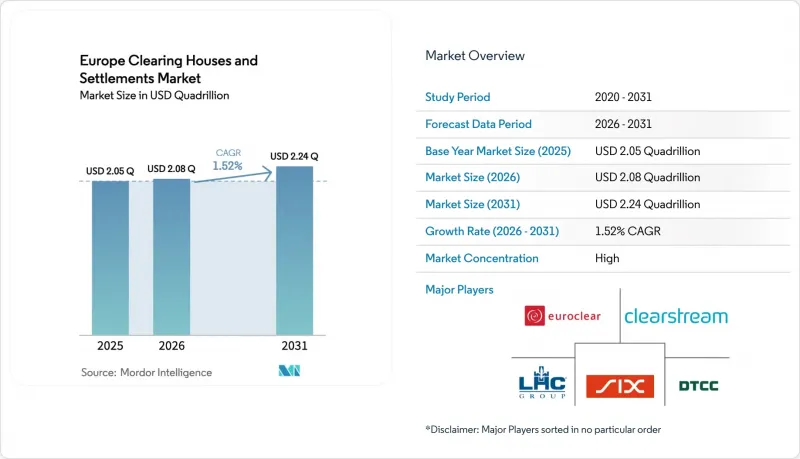
This report is Segmented by Type (Outward Clearing House and Inward Clearing House), by Service (TARGET2, Sepa, Ebics, and Other Services), by Participant Type (Banks, Investment & Clearing Brokers, Payment Service Providers (PSPs), and Others), and by Country (United Kingdom, Germany, France, Spain, Italy, Nordics, and Rest of Europe). The Market Forecasts are Provided in Terms of Value (USD).
Europe Clearing Houses And Settlements Market Trends and Insights
Mandatory Migration to T+1 Settlement Drives Infrastructure Modernization
ESMA confirmed in January 2025 that all EU trading venues must adopt T+1 settlement by October 11, 2027, creating the single largest operational overhaul since TARGET2-Securities went live. Euroclear and Clearstream, two prominent central securities depositories, have allocated substantial financial resources to enhance straight-through-processing capabilities. These upgrades are designed to address the challenges posed by compressed settlement timelines. Industry stakeholders project that these advancements will lead to a measurable reduction in settlement failures, particularly as shorter settlement cycles contribute to improved liquidity management and operational efficiency. Faster post-trade windows also intensify collateral turnover, presenting fresh revenue opportunities for clearing houses that can integrate margin and settlement in near real time. The transition compels buy-side firms to automate trade affirmation within hours, accelerating demand for standardized ISO 20022 messaging across the entire value chain.
ECB TARGET Services Consolidation Enhances Cross-Border Efficiency
The Eurosystem Collateral Management System (ECMS) launched in June 2025, merging national collateral pools into a single platform and extending TARGET services to Danmarks Nationalbank for DKK processing. Real-time collateral mobility replaces a patchwork of bilateral agreements, cutting cross-border processing costs by 15-20% for major banks. Instant-payment rails built on TIPS now settle both EUR and DKK within seconds, spawning new service lines for clearing houses able to orchestrate intraday liquidity. The ECB roadmap foresees onboarding additional non-eurozone currencies by 2027, potentially diverting volumes away from legacy correspondent networks. A unified infrastructure also lays technical foundations for digital euro settlement, intensifying the strategic relevance of pan-European clearing platforms.
Legacy System Dependencies Constrain Modernization Pace
Many European banks still rely on mainframe COBOL cores dating back decades, complicating ISO 20022 conversion efforts and throttling straight-through processing gains. Deutsche Bank disclosed in Q3 2024 that full migration will extend into 2026 because of deep integration touchpoints with payment engines. According to industry estimates, the cumulative costs associated with migration are exerting a disproportionate financial burden on tier-2 and tier-3 lenders. The declining availability of skilled COBOL programmers is driving up labor expenses and extending project completion timelines, creating additional operational challenges. Furthermore, clearing houses are required to maintain dual-protocol gateways to accommodate the transition, which diminishes the anticipated network efficiency benefits of universal ISO 20022 adoption. This dual-protocol requirement highlights inefficiencies and adds complexity to the migration process, further straining resources within the financial ecosystem.
Other drivers and restraints analyzed in the detailed report include:
- Pan-European ETF Growth Accelerates Central Clearing Demand
- Basel III Implementation Reshapes Collateral Management
- Post-Brexit Rule Divergence Complicates Cross-Border Clearing
For complete list of drivers and restraints, kindly check the Table Of Contents.
Segment Analysis
Outward clearing houses captured 55.74% of the European clearing houses and settlements market share in 2025, reflecting their scale advantages in processing high-volume cross-border trades. The European clearing houses and settlements market size contribution from inward clearing is projected to climb at a 7.32% CAGR as domestic settlement complexities mount under T+1 rules. Outward providers benefit from standardized workflows and multi-currency risk engines that lower marginal processing costs, enabling competitive pricing for pan-European trading firms. Inward operators, by contrast, capitalize on local regulatory familiarity and niche asset-class expertise, justifying premium fees on lower volumes. ECB's ECMS rollout harmonizes collateral workflows, neutralizing some scale disadvantages for inward houses and enabling hybrid models combining local presence with cross-border reach.
Clients increasingly demand consolidated risk dashboards that aggregate outward and inward exposures seamlessly, prompting leading platforms to offer "clearing-as-a-service" modules. Technology budgets now allocate to artificial-intelligence-driven predictive analytics that spot intraday liquidity pinch points. Brexit has further amplified outward volume as UK firms route euro-denominated derivatives via EU hubs, boosting Frankfurt and Paris traffic. Meanwhile, Nordic inward houses leverage strong domestic digitization to attract regional equities and green bond clearing. The competitive frontier is shifting toward value-added collateral optimization and integrated reporting, areas where outward and inward houses that converge capabilities stand to gain a disproportionate share.
Complete Report Scope:
- By Type
- Outward Clearing House
- Inward Clearing House
- By Service
- TARGET2
- SEPA
- EBICS
- Other Services
- By Participant Type
- Banks
- Investment & Clearing Brokers
- Payment Service Providers (PSPs)
- Others
- By Geography
- United Kingdom
- Germany
- France
- Spain
- Italy
- BENELUX (Belgium, Netherlands, Luxembourg)
- NORDICS (Denmark, Finland, Iceland, Norway, Sweden)
- Rest of Europe
List of Companies Covered in this Report:
- Euroclear
- Clearstream (Deutsche Borse Group)
- LCH Group (London Stock Exchange Group)
- SIX x-clear
- Euronext Securities
- DTCC EuroCCP
- BME Clearing
- Keler CCP
- CC&G (Cassa di Compensazione e Garanzia)
- Eurex Clearing
- ICE Clear Europe
- Nasdaq Clearing
- LME Clear
- Monte Titoli
- Athens Exchange CSD
- EuroCCP N.V.
- OMX Clearing
- Skandinaviska Enskilda Banken CSD
- CME CE Clearing Europe
Additional Benefits:
- The market estimate (ME) sheet in Excel format
- 3 months of analyst support
TABLE OF CONTENTS
1 Introduction
- 1.1 Study Assumptions & Market Definition
- 1.2 Scope of the Study
2 Research Methodology
3 Executive Summary
4 Market Landscape
- 4.1 Market Overview
- 4.2 Market Drivers
- 4.2.1 Mandatory migration to T+1 settlement cycles across EU markets
- 4.2.2 ECB-led consolidation of TARGET-Services raising straight-through processing
- 4.2.3 Rapid growth of pan-European ETF & derivatives volumes requiring central clearing
- 4.2.4 Basel III end-game collateral rules boosting initial-margin flows
- 4.2.5 Pilots of DLT-based smart-contract clearing under the EU DLT-Pilot Regime
- 4.2.6 Rising demand for ESG-linked repo & collateral optimisation services
- 4.3 Market Restraints
- 4.3.1 Legacy COBOL core-systems delaying ISO 20022 adoption
- 4.3.2 Heightened concentration-risk flagged by ESMA systemic-importance tests
- 4.3.3 Post-Brexit divergence between UK EMIR 3.0 and EU EMIR 3.0
- 4.3.4 Smaller CSD participants' high integration costs for TARGET-Instant Payment Settlement (TIPS)
- 4.4 Value / Supply-Chain Analysis
- 4.5 Regulatory Landscape
- 4.6 Technological Outlook
- 4.7 Porter's Five Forces
- 4.7.1 Threat of New Entrants
- 4.7.2 Bargaining Power of Suppliers
- 4.7.3 Bargaining Power of Buyers
- 4.7.4 Threat of Substitutes
- 4.7.5 Competitive Rivalry
5 Market Size & Growth Forecasts
- 5.1 By Type
- 5.1.1 Outward Clearing House
- 5.1.2 Inward Clearing House
- 5.2 By Service
- 5.2.1 TARGET2
- 5.2.2 SEPA
- 5.2.3 EBICS
- 5.2.4 Other Services
- 5.3 By Participant Type
- 5.3.1 Banks
- 5.3.2 Investment & Clearing Brokers
- 5.3.3 Payment Service Providers (PSPs)
- 5.3.4 Others
- 5.4 By Geography
- 5.4.1 United Kingdom
- 5.4.2 Germany
- 5.4.3 France
- 5.4.4 Spain
- 5.4.5 Italy
- 5.4.6 BENELUX (Belgium, Netherlands, Luxembourg)
- 5.4.7 NORDICS (Denmark, Finland, Iceland, Norway, Sweden)
- 5.4.8 Rest of Europe
6 Competitive Landscape
- 6.1 Market Concentration
- 6.2 Strategic Moves
- 6.3 Market Share Analysis
- 6.4 Company Profiles (includes Global level Overview, Market level overview, Core Segments, Financials as available, Strategic Information, Market Rank/Share for key companies, Products & Services, and Recent Developments)
- 6.4.1 Euroclear
- 6.4.2 Clearstream (Deutsche Borse Group)
- 6.4.3 LCH Group (London Stock Exchange Group)
- 6.4.4 SIX x-clear
- 6.4.5 Euronext Securities
- 6.4.6 DTCC EuroCCP
- 6.4.7 BME Clearing
- 6.4.8 Keler CCP
- 6.4.9 CC&G (Cassa di Compensazione e Garanzia)
- 6.4.10 Eurex Clearing
- 6.4.11 ICE Clear Europe
- 6.4.12 Nasdaq Clearing
- 6.4.13 LME Clear
- 6.4.14 Monte Titoli
- 6.4.15 Athens Exchange CSD
- 6.4.16 EuroCCP N.V.
- 6.4.17 OMX Clearing
- 6.4.18 Skandinaviska Enskilda Banken CSD
- 6.4.19 CME CE Clearing Europe
7 Market Opportunities & Future Outlook
- 7.1 Tokenised-securities clearing frameworks under ESMA sandbox
- 7.2 Cross-border real-time mobility of digital-asset collateral between UK & EU CCPs

