PUBLISHER: Mordor Intelligence | PRODUCT CODE: 2119605

PUBLISHER: Mordor Intelligence | PRODUCT CODE: 2119605
Concierge Medicine - Market Share Analysis, Industry Trends & Statistics, Growth Forecasts (2026 - 2031)
According to Mordor Intelligence, the concierge medicine market size is estimated at USD 24.63 billion in 2026, and is expected to reach USD 37.98 billion by 2031, at a CAGR of 9.05% during the forecast period (2026-2031).
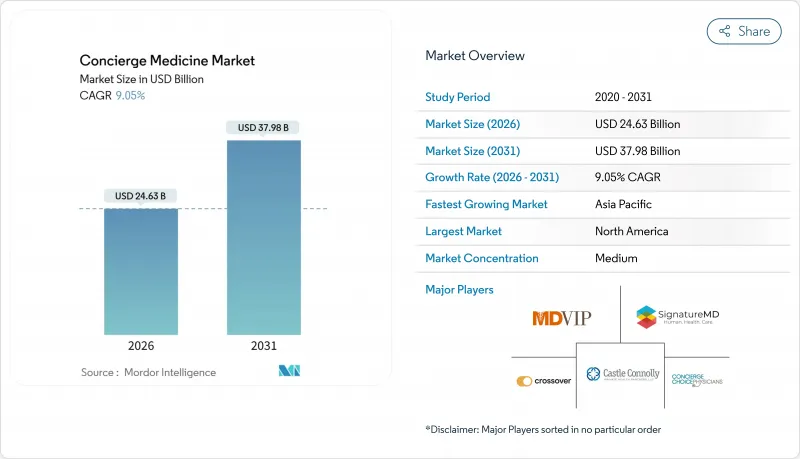
This report is Segmented by Application (Primary Care, Pediatrics, Cardiology, and More), Ownership Model (Physician-Owned Solo Practices, Physician-Led Group Practices, and More), Service Tier (Entry, Mid, Premium), Delivery Mode (In-Person, Hybrid, Virtual-Only), and Geography (North America, Europe, Asia-Pacific, MEA, South America). The Market Forecasts are Provided in Terms of Value (USD).
Global Concierge Medicine Market Trends and Insights
Growing Demand for Personalized, Time-Rich Primary Care
Patients increasingly pay direct annual fees ranging from USD 1,000 to USD 50,000 to secure same-day appointments, extended visits, and seamless coordination, which are often absent in fee-for-service settings. In a 2024 analysis of 18,432 on-demand house-call visits, 52% were self-funded, and 94.2% of users indicated they would rebook, underscoring a durable willingness to spend for convenience. High-net-worth households grew by 562,000 in North America during 2024, broadening the premium customer base. Chronic-disease patients also opt for memberships to hedge against hospital readmissions, translating lifestyle demand into steady subscription revenue. The shift signals a structural shift toward patient-financed, value-driven primary care, supporting the expansion of the concierge medicine market.
Physician Burnout Pushing Practice Conversions
Burnout affected 43% of U.S. physicians in 2024, and 35% considered leaving their current roles within two years. Concierge models typically cap panels at 300-600 patients, compared to 2,000-2,500 in traditional practices, which eases the administrative load. MDVIP, with over 1,300 affiliated doctors, reported 96% physician satisfaction and 90% patient retention in December 2024. A JAMA Health Forum study showed that hospital-employed physicians charge 10.7% more than independent physicians, intensifying pressure for independent conversion. With just 42.2% of doctors remaining in physician-owned settings in 2024, scarcity enables concierge providers to command higher fees, reinforcing momentum toward membership practice models.
Limited Insurance Reimbursement / High Out-of-Pocket Fees
Membership fees are generally ineligible for reimbursement under Medicare or commercial plans, as they are viewed as non-medical amenities. CMS guidance permits billing only for incremental covered services, leaving annual fees entirely patient-funded. Affordability barriers narrow the eligible population in lower-income markets. Hospital-affiliated physicians already charge 10.7% more than independents, heightening cost concerns that make concierge access appear exclusive. Entry-level direct-primary care tiers priced below USD 3,000 aim to broaden their reach, yet these stripped-down offerings often lack diagnostic breadth, which limits their competitiveness.
Other drivers and restraints analyzed in the detailed report include:
- Telehealth & Remote Monitoring Integration
- Aging, High-Net-Worth Population Expansion
- Shrinking Pool of Independent Primary-Care Physicians
For complete list of drivers and restraints, kindly check the Table Of Contents.
Segment Analysis
Cardiology controlled 27.31% of the concierge medicine market share in 2025 on the back of executive demand for ongoing risk surveillance and immediate cath-lab access. The concierge medicine market size for cardiovascular offerings is expected to expand steadily alongside aging demographics that elevate disease burden. Pediatrics, though smaller today, is forecast to grow at 11.62% CAGR through 2031, fueled by rising childhood obesity, diabetes, and behavioral disorders documented by the White House in May 2025.
Specialty diversification continues. Psychiatry concierge demand is escalating as employers link mental health access to productivity, while primary care remains foundational for broad patient panels. Dermatology, orthopedics, and women's health emerge in pockets where patients value aesthetic outcomes or fertility monitoring, but still account for modest proportions of the overall concierge medicine market size. Providers are increasingly bundling primary care with specialty access to differentiate themselves, creating composite programs that deepen loyalty and lengthen membership tenure.
Physician-led group practices held 59.83% of the concierge medicine market size in 2025, leveraging shared infrastructure and cross-referral dynamics to keep per-member costs in check. Group economics also support investments in electronic records and remote monitoring, which solo offices often struggle to fund. Virtual-only concierge platforms, however, are projected to record a 12.38% CAGR to 2031, drawing strength from minimal real-estate overhead and AI-enhanced triage that enables clinicians to manage larger panels without compromising visit quality.
Corporate-owned networks such as One Medical, now part of Amazon, operate more than 200 clinics serving roughly 815,000 members, demonstrating how scale amplifies bargaining power with payers and suppliers. Franchise formats provide turnkey platforms for doctors lacking capital to develop proprietary technology, while hospital-affiliated programs integrate inpatient pathways but often fall short in terms of concierge-level responsiveness. Overall, competitive positioning pivots on a provider's capacity to balance the intimacy of care with operational efficiency, a tension central to the future trajectory of the concierge medicine market.
Complete Report Scope:
- By Application
- Primary Care
- Pediatrics
- Cardiology
- Psychiatry & Mental Health
- Other Applications
- By Ownership Model
- Physician-Owned Solo Practices
- Physician-Led Group Practices
- Corporate-Owned Clinics
- Hospital/Health-System Affiliated Programs
- Franchise Models
- Virtual-Only Concierge Platforms
- By Service Tier
- Entry-Level (USD <3 k p.a.)
- Mid-Level (USD 3-10 k p.a.)
- Premium / Ultra-Luxury (USD > 10 k p.a.)
- By Delivery Mode
- In-Person
- Hybrid
- Virtual-Only
- By Geography
- North America
- United States
- Canada
- Mexico
- Europe
- Germany
- United Kingdom
- France
- Italy
- Spain
- Rest of Europe
- Asia-Pacific
- China
- Japan
- India
- Australia
- South Korea
- Rest of Asia-Pacific
- Middle East & Africa
- GCC
- South Africa
- Rest of Middle East & Africa
- South America
- Brazil
- Argentina
- Rest of South America
- North America
Geography Analysis
North America commanded 38.36% revenue share in 2025, upheld by the largest pool of independent physicians and the densest high-net-worth population. The concierge medicine market size in the United States expanded, with practice counts increasing from 1,658 in 2018 to 3,036 in 2023, and the number of clinicians rising from 3,935 to 7,021 over the same period. U.S. employers further accelerate penetration, bundling memberships to curb absenteeism and emergency department spending. Canada and Mexico exhibit fledgling adoption, centered in major metropolitan areas, where cross-border medical tourists seek continuity of care.
The Asia-Pacific region is projected to grow at a 12.38% CAGR through 2031, driven by rapidly expanding disposable incomes, particularly in China and India. Eighty percent of Asia-Pacific consumers voice interest in health maintenance services, with half ready to pay premiums and ninety percent preferring single-point coordination. Telemedicine use doubled from 2020 to 2024, laying infrastructure that concierge platforms can leverage. AXA Hong Kong's 2025 upgrade of its Greater Bay Area Medical Concierge Service Network exemplifies the growth of cross-border care. Japan's aging cohort and Australia's private insurance norms add further runway for regional expansion.
Europe experiences a moderate uptake, with Germany, the United Kingdom, and France at the forefront, each benefiting from private spending upticks and permissive direct contracting regulations. GCC economies in the Middle East welcome ultra-luxury providers catering to expatriate executives who seek continuity across their global postings. South America remains emergent; affluent segments in Brazil and Argentina adopt concierge services, but broader diffusion is slowed by affordability and fragmented insurance frameworks. Diverse regulatory regimes necessitate localized models, encouraging large operators to form regional partnerships to mitigate the risk of entry.
- AtlasMD
- Baylor Scott & White Premier
- Carbon Health (Concierge Tier)
- Castle Connolly Private Health Partners
- Cedars-Sinai Concierge Medicine
- Concierge Choice Physicians
- Crossover Health
- EliteHealth
- Forward
- MDVIP
- One Medical (Amazon)
- Paragon Private Health
- PartnerMD
- Peninsula Doctor
- Privia Health
- Priority Physicians
- Qliance (Legacy Case)
- SignatureMD
- Sollis Health
Additional Benefits:
- The market estimate (ME) sheet in Excel format
- 3 months of analyst support
TABLE OF CONTENTS
1 Introduction
- 1.1 Study Assumptions & Market Definition
- 1.2 Scope of the Study
2 Research Methodology
3 Executive Summary
4 Market Landscape
- 4.1 Market Overview
- 4.2 Market Drivers
- 4.2.1 Growing Demand for Personalised, Time-Rich Primary Care
- 4.2.2 Physician Burnout Pushing Practice Conversions
- 4.2.3 Telehealth & Remote Monitoring Integration
- 4.2.4 Ageing, High-Net-Worth Population Expansion (HNW & UHNW)
- 4.2.5 Corporate Employers Adding Concierge Benefits
- 4.2.6 AI-Enabled "Continuous Care" Concierge Platforms
- 4.3 Market Restraints
- 4.3.1 Limited Insurance Reimbursement / High Out-of-Pocket Fees
- 4.3.2 Shrinking Pool of Independent Primary-Care Physicians
- 4.3.3 Regulatory Ambiguity (Insurance Law & Medicare Rules)
- 4.3.4 Equity & Access Concerns Triggering Policy Push-Back
- 4.4 Value / Supply-Chain Analysis
- 4.5 Regulatory Landscape
- 4.6 Technological Outlook
- 4.7 Porter's Five Forces Analysis
- 4.7.1 Threat of New Entrants
- 4.7.2 Bargaining Power of Buyers
- 4.7.3 Bargaining Power of Suppliers
- 4.7.4 Threat of Substitutes
- 4.7.5 Competitive Rivalry
5 Market Size & Growth Forecasts
- 5.1 By Application
- 5.1.1 Primary Care
- 5.1.2 Pediatrics
- 5.1.3 Cardiology
- 5.1.4 Psychiatry & Mental Health
- 5.1.5 Other Applications
- 5.2 By Ownership Model
- 5.2.1 Physician-Owned Solo Practices
- 5.2.2 Physician-Led Group Practices
- 5.2.3 Corporate-Owned Clinics
- 5.2.4 Hospital/Health-System Affiliated Programs
- 5.2.5 Franchise Models
- 5.2.6 Virtual-Only Concierge Platforms
- 5.3 By Service Tier
- 5.3.1 Entry-Level (USD < 3 k p.a.)
- 5.3.2 Mid-Level (USD 3-10 k p.a.)
- 5.3.3 Premium / Ultra-Luxury (USD > 10 k p.a.)
- 5.4 By Delivery Mode
- 5.4.1 In-Person
- 5.4.2 Hybrid
- 5.4.3 Virtual-Only
- 5.5 By Geography
- 5.5.1 North America
- 5.5.1.1 United States
- 5.5.1.2 Canada
- 5.5.1.3 Mexico
- 5.5.2 Europe
- 5.5.2.1 Germany
- 5.5.2.2 United Kingdom
- 5.5.2.3 France
- 5.5.2.4 Italy
- 5.5.2.5 Spain
- 5.5.2.6 Rest of Europe
- 5.5.3 Asia-Pacific
- 5.5.3.1 China
- 5.5.3.2 Japan
- 5.5.3.3 India
- 5.5.3.4 Australia
- 5.5.3.5 South Korea
- 5.5.3.6 Rest of Asia-Pacific
- 5.5.4 Middle East & Africa
- 5.5.4.1 GCC
- 5.5.4.2 South Africa
- 5.5.4.3 Rest of Middle East & Africa
- 5.5.5 South America
- 5.5.5.1 Brazil
- 5.5.5.2 Argentina
- 5.5.5.3 Rest of South America
- 5.5.1 North America
6 Competitive Landscape
- 6.1 Market Concentration
- 6.2 Market Share Analysis
- 6.3 Company Profiles (includes Global level Overview, Market-level Overview, Core Segments, Financials, Strategic Information, Market Rank/Share, Products & Services, Recent Developments)
- 6.3.1 AtlasMD
- 6.3.2 Baylor Scott & White Premier
- 6.3.3 Carbon Health (Concierge Tier)
- 6.3.4 Castle Connolly Private Health Partners
- 6.3.5 Cedars-Sinai Concierge Medicine
- 6.3.6 Concierge Choice Physicians
- 6.3.7 Crossover Health
- 6.3.8 EliteHealth
- 6.3.9 Forward
- 6.3.10 MDVIP
- 6.3.11 One Medical (Amazon)
- 6.3.12 Paragon Private Health
- 6.3.13 PartnerMD
- 6.3.14 Peninsula Doctor
- 6.3.15 Privia Health
- 6.3.16 Priority Physicians
- 6.3.17 Qliance (Legacy Case)
- 6.3.18 SignatureMD
- 6.3.19 Sollis Health
7 Market Opportunities & Future Outlook
- 7.1 White-space & Unmet-need Assessment

