PUBLISHER: Mordor Intelligence | PRODUCT CODE: 2119608

PUBLISHER: Mordor Intelligence | PRODUCT CODE: 2119608
Dermatology CRO - Market Share Analysis, Industry Trends & Statistics, Growth Forecasts (2026 - 2031)
According to Mordor Intelligence, the dermatology CRO market size is projected to expand from USD 5.73 billion in 2025 and USD 6.02 billion in 2026 to USD 8.10 billion by 2031, registering a CAGR of 6.11% between 2026 to 2031.
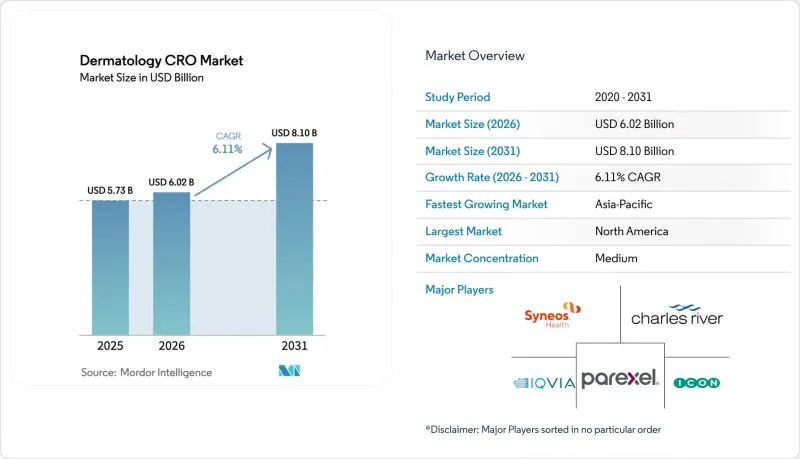
This report is Segmented by Service Type (Pre-Clinical Services, Clinical Trial Services, Post-Market Monitoring & Pharmacovigilance, and More), Phase (Phase I, and More), Study Design (Interventional Trials, and More), Sponsor Type (Pharmaceutical Companies, and More), Indication (Acne, and More), and Geography (North America, and More). The Market Forecasts are Provided in Terms of Value (USD).
Global Dermatology CRO Market Trends and Insights
Accelerating Sponsor Outsourcing to Specialized Dermatology CROs
Sponsors are pivoting from generalist providers to niche CROs that train investigators on PASI, EASI, and Investigator Global Assessment scoring. Functional-service agreements embed CRO staff within sponsor teams, allowing tighter oversight while offloading monitoring and reconciliation tasks. Endpoint variability can inflate sample sizes by up to 30% if assessors lack certification, so sponsors pay premiums-often exceeding USD 15 million for global pivotal studies-to partners that guarantee centralized image adjudication. The pattern is strongest in psoriasis and atopic dermatitis Phase II programs and is spreading across Asia-Pacific as Western firms navigate China's Center for Drug Evaluation and Japan's ethnic-sensitivity requirements. Niche CROs that own proprietary training modules continue to win contracts even when price competition intensifies.
Growing R&D Investment by Dermatology-Focused Pharma & Biotech Firms
Dermatology R&D outlays by the ten largest pharmaceutical companies increased from USD 8 billion in 2021 to USD 11 billion in 2025 as pipelines diversified toward IL-13, IL-17, and IL-23 pathways. Venture financing topped USD 2.3 billion in 2024, channeling capital to gene-therapy and RNA-interference start-ups. With limited internal resources, these younger firms outsource 80-90% of clinical work, boosting the Global dermatology CRO market. Recent FDA approvals for deucravacitinib and lebrikizumab validated novel mechanisms, reinforcing sponsor appetite for additional dermatology assets.
High Cost & Complexity of Dermatology Trials Due to Subjective Endpoints
Per-patient costs run 25-35% higher than oncology or cardiology studies of comparable size because PASI and EASI scoring require certified raters, photographic documentation, and centralized review. A 600-patient Phase III psoriasis trial can exceed USD 40 million, with USD 8 million allocated to endpoint-specific activities. To compensate for inter-rater variability of up to 30%, sponsors routinely over-enroll by 10-20%. The FDA now insists on reliability studies before pivotal start, adding nine months to development. Smaller biotech companies sometimes shrink geographic scope or delay launches, tempering near-term growth in the Global dermatology CRO market.
Other drivers and restraints analyzed in the detailed report include:
- Decentralized / Virtual Dermatology Trials Enabled by AI-Powered Imaging
- Regulatory Support for Adaptive & Accelerated Trial Pathways
- Investigator Shortages & Patient-Recruitment Bottlenecks
For complete list of drivers and restraints, kindly check the Table Of Contents.
Segment Analysis
Clinical Trial Services accounted for 44.63% of Global dermatology CRO market share in 2025 and stay central because sponsors need turnkey protocol development, monitoring, and safety reporting. Demand is especially heavy in Phase II psoriasis studies where rapid dose-ranging is critical. Data Management & Biostatistics, however, is the fastest riser, projected to post a 10.35% CAGR through 2031 as sponsors chase real-time dashboards and AI-assisted scoring. The Global dermatology CRO market size for analytics has grown as CROs integrate electronic data capture with lesion classifiers, slashing adjudication cycles to days. Secondary services such as Regulatory & Medical Writing command premium fees for orphan-drug dossiers, while Post-Market Monitoring gains relevance as accelerated biologic approvals come with long-term safety commitments.
Smaller but essential revenue streams emerge from Pre-clinical testing of topical formulations and Quality & Compliance audits. Three FDA warning letters in 2024 cited inadequate source-document verification, nudging sponsors to engage CROs offering independent audit teams. Competition intensifies around decentralized-trial readiness; vendors bolting telemedicine into standard monitoring attract higher margins than those providing commoditized site oversight alone.
Phase II commanded 36.13% of revenue in 2025, reflecting its role in establishing biopsy, imaging, or biomarker endpoints before sponsors commit to USD 100 million Phase III programs. Adaptive designs are trimming cohort sizes, yet Phase II remains the workhorse for psoriasis, atopic dermatitis, and emerging IL-17 assets. The Global dermatology CRO market size linked to Phase I is accelerating at 9.74% CAGR as gene-editing and topical RNA-interference agents enter the clinic. These novel modalities demand unique safety labs and pharmacodynamic sampling, opening niches for CROs operating leukapheresis units or GMP skin biopsy facilities.
Phase III growth is steadier because sponsors exploit interim analyses to lock in commercial positioning with fewer patients. Phase IV registries, though smaller by contract value, secure steady revenue as regulators expect real-world safety follow-up for systemic immunomodulators. CROs holding claims databases and EHR linkages draw disproportionate share of these post-approval studies.
Complete Report Scope:
- By Service Type
- Pre-clinical Services
- Clinical Trial Services
- Post-Market Monitoring & Pharmacovigilance
- Regulatory & Medical Writing Services
- Data Management & Biostatistics
- Quality & Compliance Auditing
- By Phase
- Phase I
- Phase II
- Phase III
- Phase IV
- By Study Design
- Interventional Trials
- Observational Studies
- Real-World Evidence Studies
- In-silico / Digital Dermatology Trials
- By Sponsor Type
- Pharmaceutical Companies
- Biotechnology Firms
- Medical & Aesthetic Device Companies
- Academic & Research Institutes
- By Indication
- Acne
- Psoriasis
- Atopic Dermatitis
- Skin Cancer
- Rare Dermatologic Disorders
- By Geography
- North America
- United States
- Canada
- Mexico
- Europe
- Germany
- France
- United Kingdom
- Italy
- Spain
- Rest of Europe
- Asia-Pacific
- China
- Japan
- India
- South Korea
- Australia
- Rest of Asia-Pacific
- Middle East & Africa
- GCC
- South Africa
- Rest of Middle East & Africa
- South America
- Brazil
- Argentina
- Rest of South America
- North America
Geography Analysis
North America captured 39.42% of Global dermatology CRO market share in 2025 because the United States concentrates sponsor headquarters, investigator networks, and FDA incentives that speed approvals. Per-patient costs remain highest, yet sponsors accept the premium since U.S. data underpins payer negotiations. Canada and Mexico expand steadily as multi-ethnic enrollment hubs that reduce overall study budgets by up to 30%.
Europe with Germany, France, and the United Kingdom leading volumes due to harmonized EMA processes and widespread electronic health records that facilitate recruitment. The EMA's 2025 endpoint harmonization trimmed cross-border protocol amendments by two months, lowering direct costs. Southern markets such as Italy and Spain now attract dermatology trials with 25% lower per-patient spending while preserving investigator quality.
Asia-Pacific is projected to post the fastest 8.46% CAGR to 2031. China compressed trial approvals to nine months by 2025, and Japan's revised pricing rewards first-in-class dermatology drugs, fueling sponsor appetite. India offers 50-60% cost savings but grapples with investigator shortages and state-level regulatory fragmentation. Australia and South Korea, though smaller in volume, provide rapid ethics review cycles that appeal to early-phase gene-therapy studies.
The Middle East & Africa and South America currently contribute modest revenue but attract rare-disease protocols where patient clusters exist. Saudi Arabia and the United Arab Emirates invest in research centers as part of economic diversification, while Brazil and Argentina entice sponsors with 20% lower monitoring fees despite longer approval timelines.
- Accel Clinical Research
- Alira Health
- Atlantia Clinical Trials
- BioPharma Services Inc.
- Charles River
- Clinipace (dMed)
- CMIC Group
- Covance (Labcorp Drug Development)
- Dermatology Contract Research Inc. (DCRI)
- ICON
- IQVIA
- KCR S.A.
- Linical Co., Ltd.
- Lotus Clinical Research
- MedPace
- Novotech Health Holdings
- Parexel International
- Pharm-Olam
- Premier Research
- PSI CRO
- QPS Holdings LLC
- SGS
- Syneos Health
- TFS HealthScience
- Thermo Fisher Scientific
- WuXi Clinical (WuXi AppTec)
Additional Benefits:
- The market estimate (ME) sheet in Excel format
- 3 months of analyst support
TABLE OF CONTENTS
1 Introduction
- 1.1 Study Assumptions & Market Definition
- 1.2 Scope of the Study
2 Research Methodology
3 Executive Summary
4 Market Landscape
- 4.1 Market Overview
- 4.2 Market Drivers
- 4.2.1 Rising Prevalence of Chronic Skin Diseases
- 4.2.2 Growing R&D Investment by Dermatology-Focused Pharma & Biotech Firms
- 4.2.3 Accelerating Sponsor Outsourcing to Specialized Dermatology Cros
- 4.2.4 Regulatory Support for Adaptive & Accelerated Trial Pathways
- 4.2.5 Decentralized/Virtual Dermatology Trials Enabled By AI-Powered Imaging
- 4.2.6 Emerging Demand for UV-Induced DNA-Damage Biomarkers
- 4.3 Market Restraints
- 4.3.1 High Cost & Complexity of Dermatology Trials Due to Subjective Endpoints
- 4.3.2 Investigator Shortages & Patient-Recruitment Bottlenecks
- 4.3.3 Data-Integrity Concerns With AI-Based Lesion Assessment Tools
- 4.3.4 Margin Pressure from Sponsor-Built In-House Digital Trial Platforms
- 4.4 Value / Supply-Chain Analysis
- 4.5 Regulatory Landscape
- 4.6 Technological Outlook
- 4.7 Porter's Five Forces Analysis
- 4.7.1 Bargaining Power of Suppliers
- 4.7.2 Bargaining Power of Buyers
- 4.7.3 Threat of New Entrants
- 4.7.4 Threat of Substitutes
- 4.7.5 Intensity of Competitive Rivalry
5 Market Size & Growth Forecasts (Value in USD)
- 5.1 By Service Type
- 5.1.1 Pre-clinical Services
- 5.1.2 Clinical Trial Services
- 5.1.3 Post-Market Monitoring & Pharmacovigilance
- 5.1.4 Regulatory & Medical Writing Services
- 5.1.5 Data Management & Biostatistics
- 5.1.6 Quality & Compliance Auditing
- 5.2 By Phase
- 5.2.1 Phase I
- 5.2.2 Phase II
- 5.2.3 Phase III
- 5.2.4 Phase IV
- 5.3 By Study Design
- 5.3.1 Interventional Trials
- 5.3.2 Observational Studies
- 5.3.3 Real-World Evidence Studies
- 5.3.4 In-silico / Digital Dermatology Trials
- 5.4 By Sponsor Type
- 5.4.1 Pharmaceutical Companies
- 5.4.2 Biotechnology Firms
- 5.4.3 Medical & Aesthetic Device Companies
- 5.4.4 Academic & Research Institutes
- 5.5 By Indication
- 5.5.1 Acne
- 5.5.2 Psoriasis
- 5.5.3 Atopic Dermatitis
- 5.5.4 Skin Cancer
- 5.5.5 Rare Dermatologic Disorders
- 5.6 By Geography
- 5.6.1 North America
- 5.6.1.1 United States
- 5.6.1.2 Canada
- 5.6.1.3 Mexico
- 5.6.2 Europe
- 5.6.2.1 Germany
- 5.6.2.2 France
- 5.6.2.3 United Kingdom
- 5.6.2.4 Italy
- 5.6.2.5 Spain
- 5.6.2.6 Rest of Europe
- 5.6.3 Asia-Pacific
- 5.6.3.1 China
- 5.6.3.2 Japan
- 5.6.3.3 India
- 5.6.3.4 South Korea
- 5.6.3.5 Australia
- 5.6.3.6 Rest of Asia-Pacific
- 5.6.4 Middle East & Africa
- 5.6.4.1 GCC
- 5.6.4.2 South Africa
- 5.6.4.3 Rest of Middle East & Africa
- 5.6.5 South America
- 5.6.5.1 Brazil
- 5.6.5.2 Argentina
- 5.6.5.3 Rest of South America
- 5.6.1 North America
6 Competitive Landscape
- 6.1 Market Concentration
- 6.2 Market Share Analysis
- 6.3 Company Profiles (includes Global level Overview, Market level overview, Core Segments, Financials as available, Strategic Information, Market Rank/Share for key companies, Products and Services, and Recent Developments)
- 6.3.1 Accel Clinical Research
- 6.3.2 Alira Health
- 6.3.3 Atlantia Clinical Trials
- 6.3.4 BioPharma Services Inc.
- 6.3.5 Charles River Laboratories International Inc.
- 6.3.6 Clinipace (dMed)
- 6.3.7 CMIC Group
- 6.3.8 Covance (Labcorp Drug Development)
- 6.3.9 Dermatology Contract Research Inc. (DCRI)
- 6.3.10 ICON plc
- 6.3.11 IQVIA Holdings Inc.
- 6.3.12 KCR S.A.
- 6.3.13 Linical Co., Ltd.
- 6.3.14 Lotus Clinical Research
- 6.3.15 Medpace Holdings Inc.
- 6.3.16 Novotech Health Holdings
- 6.3.17 Parexel International Corporation
- 6.3.18 Pharm-Olam
- 6.3.19 Premier Research
- 6.3.20 PSI CRO AG
- 6.3.21 QPS Holdings LLC
- 6.3.22 SGS SA
- 6.3.23 Syneos Health Inc.
- 6.3.24 TFS HealthScience
- 6.3.25 Thermo Fisher Scientific
- 6.3.26 WuXi Clinical (WuXi AppTec)
7 Market Opportunities & Future Outlook
- 7.1 White-space & Unmet-Need Assessment

