PUBLISHER: Mordor Intelligence | PRODUCT CODE: 2125723

PUBLISHER: Mordor Intelligence | PRODUCT CODE: 2125723
Agriculture CRO Services - Market Share Analysis, Industry Trends & Statistics, Growth Forecasts (2026 - 2031)
According to Mordor Intelligence, the agriculture CRO services market size was valued at USD 11.20 billion in 2025 and estimated to grow from USD 12.47 billion in 2026 to reach USD 21.34 billion by 2031, at a CAGR of 11.33% during the forecast period (2026-2031).
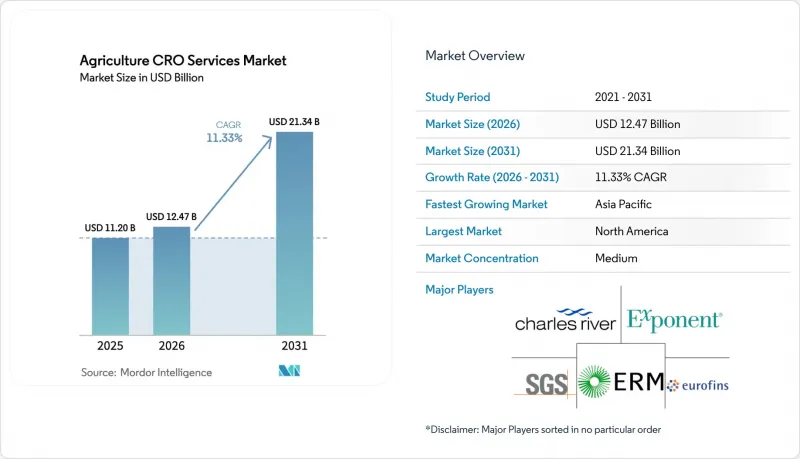
This report is Segmented by Service Type (Field Services, Laboratory Services, Regulatory Services, and Other Services), by Sector (Crop Protection Chemicals, Fertilizers, and Seeds), and by Geography (North America, Europe, Asia-Pacific, South America, Middle East, and Africa). The Market Forecasts are Provided in Terms of Value (USD).
Global Agriculture CRO Services Market Trends and Insights
Rising Research and Development Outsourcing to Contain Soaring Discovery Costs
Rising discovery costs are driving agrochemical companies to outsource non-core scientific activities. Bayer's 2024 filings demonstrate this trend, as the Crop Science division faces challenges despite the group's total research expenditure of EUR 5,860 million (USD 6,446 million). Contract Research Organization (CRO) partnerships reduce time-to-market by up to two years, enhancing returns on research investment. Companies depend on external partners for specialized services such as advanced toxicology, multi-site field trials, and predictive modeling, avoiding substantial internal infrastructure costs. Global competition emphasizes the importance of efficient capital allocation, supporting continued outsourcing growth. These dynamics increase the demand for agricultural CRO services, ranging from initial discovery screening to regulatory submission.
Regulatory Tightening Drives Demand for Third-Party Compliance Expertise
The Environmental Protection Agency's 2024 framework requires applicants to incorporate data requirements from the Environmental Protection Agency, the Food and Drug Administration, and the United States Department of Agriculture, thereby increasing dossier complexity and compliance costs. International regulatory changes include Argentina's National Service of Agri-Food Health and Quality (SENASA) Resolution 1081/2024, which updated testing protocols while maintaining strict technical requirements. Companies work with specialized CRO regulatory teams to comply with regulations on formulations, microbials, and gene-edited seeds. The selection of CRO partners now depends heavily on their expertise in Good Laboratory Practice, dossier harmonization, and multi-jurisdiction submissions. As a result, regulatory consulting has become the fastest-growing service segment in the agriculture CRO services market.
Shortage of Good Laboratory Practice Qualified Field Sites in Key Geographies
The demand for compliant test plots exceeds supply, creating waiting periods for sponsors seeking access to limited testing capacity. Obtaining certifications from organizations such as International Accreditation New Zealand (IANZ) or Australia's National Association of Testing Authorities (NATA) requires a three-year process and substantial investments in data systems, analytical equipment, and personnel training. The restricted availability of certified facilities extends project timelines and increases costs for multi-location trials, constraining the agriculture CRO services market. Biological research faces additional challenges due to requirements for containment facilities and microbial monitoring capabilities, which are absent in most field stations.
Other drivers and restraints analyzed in the detailed report include:
- Growth in Biologicals and Biosolutions Requiring New Efficacy Trials
- Shift to Data-Driven Portfolio Optimization by Agrochemical Majors
- Privacy and Cyber-Security Breaches Undermining Sponsor Confidence
For complete list of drivers and restraints, kindly check the Table Of Contents.
Segment Analysis
Laboratory testing held 46.55% of the agriculture CRO services market share in 2025, driven by its essential functions in residue analytics, environmental fate modeling, and efficacy confirmation. Sponsors utilize chromatography, mass spectrometry, and molecular diagnostics to meet registration requirements. Eurofins Scientific increased its laboratory capacity by 98,000 square meters in 2024 to address higher throughput demands, despite experiencing a 10% decline in agrosciences revenue due to temporary client budget constraints. The integration of digital informatics and automated sample processing has become standard practice, reducing data processing time and enhancing the operational efficiency of global providers. The concentration of analytical infrastructure reinforces this segment's dominant position in the agriculture CRO services market.
Regulatory consulting services are projected to grow at a 12.64% CAGR through 2031, driven by increasing dossier complexity. The development of biologicals and gene-edited crops requires comprehensive submissions addressing mode of action, microbiome effects, and socio-economic risks. CROs with diverse teams encompassing toxicology, environmental sciences, and legal policy expertise are securing more contracts. SGS's Farm Sustainability Assessment program demonstrates this service integration by combining laboratory analysis with compliance verification and certification audits. Regional specialists maintain strong relationships with local regulators, indicating that expertise remains competitive with scale advantages in this expanding segment of the agriculture CRO services market.
Complete Report Scope:
- By Service Type
- Field Services
- Laboratory Services
- Regulatory Services
- Other Services (Product Development Services, Precision Agriculture Services, Seed Services, etc.)
- By Sector
- Crop Protection Chemicals
- Fertilizers
- Seeds
- By Geography
- North America
- United States
- Canada
- Mexico
- Rest of North America
- Europe
- Germany
- United Kingdom
- France
- Spain
- Rest of Europe
- Asia-Pacific
- China
- India
- Japan
- Australia
- Rest of Asia-Pacific
- South America
- Brazil
- Argentina
- Chile
- Rest of South America
- Middle East
- Saudi Arabia
- United Arab Emirates
- Rest of Middle East
- Africa
- South Africa
- Kenya
- Rest of Africa
- North America
Geography Analysis
North America holds 54.10% of the agriculture CRO services market share in 2025. The region's strength stems from the Environmental Protection Agency's multi-agency biotech framework, United States Department of Agriculture innovation grants, and precision farming implementation across millions of hectares. Canada's regulatory alignment and Mexico's planned glyphosate transition expand the diversity of research projects. The collaboration between Corteva and John Deere for digital agriculture validation strengthens CRO bookings, while carbon sequestration measurement under farm bill incentives creates additional revenue opportunities in sustainability verification.
Asia-Pacific demonstrates the highest growth rate at 12.11% CAGR. The region's expansion is supported by China's biotechnology regulation updates and India's export compliance requirements. Government modernization initiatives and increased venture funding facilitate early-stage biological testing. While accreditation challenges remain, the implementation of regional Good Laboratory Practices frameworks and drought resilience initiatives, including Australia's USD 40.3 million program, is reducing capacity limitations. The widespread adoption of sensor-based agronomy solutions in Southeast Asia increases the demand for third-party validation services.
Europe and South America exhibit different but complementary growth trajectories. European growth is driven by the Green Deal and Farm to Fork initiatives, generating demand for biological efficacy testing, carbon footprint verification, and circular nutrient research. South America excels in biological crop protection, with Brazil's biologicals market requiring specialized trials comparing microbial products to chemical alternatives. Argentina's relaxed laboratory selection policies attract international CROs while maintaining rigorous data requirements, demonstrating the market's regulatory evolution.
- Eurofins Scientific SE
- SGS SA
- Charles River Laboratories International, Inc.
- Syntech Research Group, Inc.
- Knoell Germany GmbH
- ERM International Group Limited
- Exponent, Inc.
- Staphyt Group
- Anadiag Group SAS
- RIFCON GmbH
- Ibacon GmbH (Labanalysis Srl)
- Jai Research Foundation
- Smithers Group Inc.
- Laus GmbH
- Ag Metrics Group LLC
Additional Benefits:
- The market estimate (ME) sheet in Excel format
- 3 months of analyst support
TABLE OF CONTENTS
1 Introduction
- 1.1 Study Assumptions and Market Definition
- 1.2 Scope of the Study
2 Research Methodology
3 Executive Summary
4 Market Landscape
- 4.1 Market Overview
- 4.2 Market Drivers
- 4.2.1 Rising Research and Development Outsourcing to Contain Soaring Discovery Costs
- 4.2.2 Regulatory Tightening Drives Demand for Third-party Compliance Expertise
- 4.2.3 Growth in Biologicals and Biosolutions Requiring New Efficacy Trials
- 4.2.4 Precision Agriculture and Digital Farming Tools Need Validation Studies
- 4.2.5 Shift to Data-Driven Portfolio Optimization by Agrochemical Majors
- 4.2.6 Venture Funding Surge for Ag-Tech Start-Ups Lacking In-house Trial Capacity
- 4.3 Market Restraints
- 4.3.1 Shortage of Good Laboratory Practice Qualified Field Sites in Key Geographies
- 4.3.2 Privacy and Cyber-Security Breaches Undermining Sponsor Confidence
- 4.3.3 Rising Cost of Liability Insurance for Field-testing Live Plots
- 4.3.4 Weather-Related Trial Failures Increasing Project Risk and Cost
- 4.4 Regulatory Landscape
- 4.5 Technological Outlook
- 4.6 Porter's Five Forces Analysis
- 4.6.1 Threat of New Entrants
- 4.6.2 Bargaining Power of Buyers
- 4.6.3 Bargaining Power of Suppliers
- 4.6.4 Threat of Substitutes
- 4.6.5 Intensity of Competitive Rivalry
5 Market Size and Growth Forecasts (Value)
- 5.1 By Service Type
- 5.1.1 Field Services
- 5.1.2 Laboratory Services
- 5.1.3 Regulatory Services
- 5.1.4 Other Services (Product Development Services, Precision Agriculture Services, Seed Services, etc.)
- 5.2 By Sector
- 5.2.1 Crop Protection Chemicals
- 5.2.2 Fertilizers
- 5.2.3 Seeds
- 5.3 By Geography
- 5.3.1 North America
- 5.3.1.1 United States
- 5.3.1.2 Canada
- 5.3.1.3 Mexico
- 5.3.1.4 Rest of North America
- 5.3.2 Europe
- 5.3.2.1 Germany
- 5.3.2.2 United Kingdom
- 5.3.2.3 France
- 5.3.2.4 Spain
- 5.3.2.5 Rest of Europe
- 5.3.3 Asia-Pacific
- 5.3.3.1 China
- 5.3.3.2 India
- 5.3.3.3 Japan
- 5.3.3.4 Australia
- 5.3.3.5 Rest of Asia-Pacific
- 5.3.4 South America
- 5.3.4.1 Brazil
- 5.3.4.2 Argentina
- 5.3.4.3 Chile
- 5.3.4.4 Rest of South America
- 5.3.5 Middle East
- 5.3.5.1 Saudi Arabia
- 5.3.5.2 United Arab Emirates
- 5.3.5.3 Rest of Middle East
- 5.3.6 Africa
- 5.3.6.1 South Africa
- 5.3.6.2 Kenya
- 5.3.6.3 Rest of Africa
- 5.3.1 North America
6 Competitive Landscape
- 6.1 Market Concentration
- 6.2 Strategic Moves
- 6.3 Market Share Analysis
- 6.4 Company Profiles (Includes Global level Overview, Market Level Overview, Core Segments, Financials as Available, Strategic Information, Market Rank/Share for Key Companies, Products and Services, and Recent Developments)
- 6.4.1 Eurofins Scientific SE
- 6.4.2 SGS SA
- 6.4.3 Charles River Laboratories International, Inc.
- 6.4.4 Syntech Research Group, Inc.
- 6.4.5 Knoell Germany GmbH
- 6.4.6 ERM International Group Limited
- 6.4.7 Exponent, Inc.
- 6.4.8 Staphyt Group
- 6.4.9 Anadiag Group SAS
- 6.4.10 RIFCON GmbH
- 6.4.11 Ibacon GmbH (Labanalysis Srl)
- 6.4.12 Jai Research Foundation
- 6.4.13 Smithers Group Inc.
- 6.4.14 Laus GmbH
- 6.4.15 Ag Metrics Group LLC
7 Market Opportunities and Future Outlook

