PUBLISHER: Mordor Intelligence | PRODUCT CODE: 2119636

PUBLISHER: Mordor Intelligence | PRODUCT CODE: 2119636
Commercial Security Robot - Market Share Analysis, Industry Trends & Statistics, Growth Forecasts (2026 - 2031)
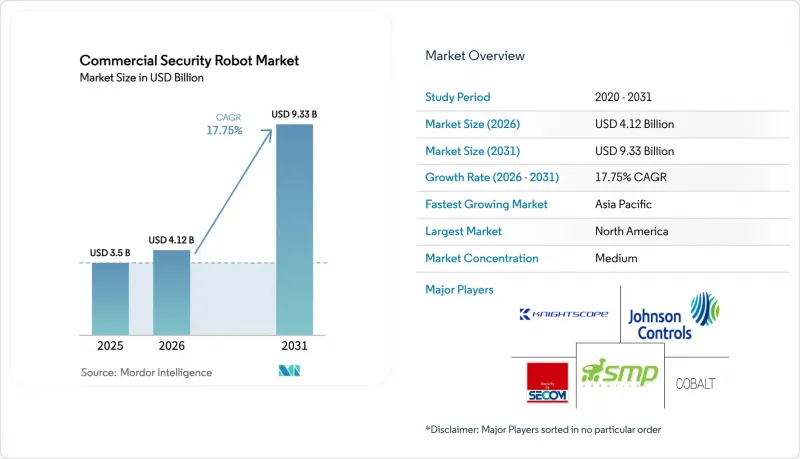
According to Mordor Intelligence, the commercial security robot market size was valued at USD 3.5 billion in 2025 and estimated to grow from USD 4.12 billion in 2026 to reach USD 9.33 billion by 2031, at a CAGR of 17.75% during the forecast period (2026-2031).
This report is Segmented by Robot Type (Wheeled Ground Robots, Specialized/Premium Platforms, and More), End User (Commercial Buildings, Industrial and Logistics Facilities, and More), Autonomy Level (Autonomous and Tele-Operated), Component (Hardware, and Software and Services), and Geography (North America, South America, Europe, and More). The Market Forecasts are Provided in Terms of Value (USD).
Global Commercial Security Robot Market Trends and Insights
Rising Adoption of Autonomous Patrol Robots for Perimeter Security
Security teams increasingly deploy autonomous patrol robots to fill blind spots that fixed cameras and roving guards struggle to cover. Asylon's DroneDog-2 combines quadruped mobility with dock-launched drones, extending surveillance to multilevel terrains and rooftops. SMP Robotics proved outdoor resilience when its S5.2 platform maintained 99.2% uptime during harsh-weather pilots in 2024.Integrated thermal imaging, paired with AI object detection, now identifies intruders beyond 500 meters, effectively raising the perimeter without requiring additional towers or cables. RAD's ROAMEO Gen 4 layers predictive analytics onto patrol data, alerting operators before a potential breach occurs rather than after an alarm trips. These autonomous capabilities can reduce guard headcount while maintaining 24/7 coverage, a proposition that resonates in large industrial parks and energy assets, where staffing is costly.
Declining Cost of LiDAR and Battery Technologies
Solid-state LiDAR modules have seen a significant drop in price since 2024, as photonics integration and MEMS manufacturing have reached scale. Lower sensor costs make millimeter-level mapping affordable for mid-tier users who once relied on basic ultrasonic collision pairs. Parallel improvements in lithium-ion chemistry now yield 12-hour duty cycles for wheeled robots, removing frequent charging as an operational bottleneck. Vendors are already field-testing solid-state batteries that promise longer runtimes and lower fire risk in indoor deployments. Predictive battery-management software can flag degradation 30 days in advance, allowing planned swaps during lulls instead of emergency shut-offs. Together, cheaper perception and longer endurance widen the commercial security robot market's pool of viable buyers beyond blue-chip campuses.
High Upfront CAPEX and Lifecycle OPEX
Full-site security robot deployments can cost USD 150,000-500,000, a hurdle for mid-sized enterprises lacking large capital budgets. Annual upkeep, including sensor calibration, software licensing, and drivetrain maintenance, typically accounts for 25-30% of the purchase price, complicating ROI models. When iRobot secured a USD 200 million term loan in 2024, lenders priced it at an interest rate above 9%, underscoring the perceived operational risk in robotics ventures. Leasing and robotics-as-a-service contracts offer alternatives; however, some buyers hesitate due to long-term commitments and performance guarantees. Until hardware prices fall further or financial products mature, CAPEX remains the most immediate drag on the commercial security robot market.
Other drivers and restraints analyzed in the detailed report include:
- Surge in Security Breaches at Critical Infrastructure and Public Venues
- Insurance-Premium Incentives for Certified Robotic Guards
- Data-Privacy and AI-Liability Concerns
For complete list of drivers and restraints, kindly check the Table Of Contents.
Segment Analysis
Ground robots held a 40.45% share of the commercial security robot market in 2025, cementing their role as baseline perimeter guardians that navigate paved paths and corridors without structural retrofits. Aerial security drones, however, are flying ahead with a projected 20.89% CAGR as private 5G enables split-second path updates and multi-drone swarming.
Legged and hybrid robots such as Boston Dynamics' Spot prove valuable in sites with stairs, catwalks, or uneven terrain, areas where wheels struggle. Autonomous marine surveillance units, though niche, protect ports and offshore infrastructure where human patrols are cost-prohibitive. Cross-platform orchestration dashboards now allow command centers to task ground, air, and marine units from a single console, making mixed-fleet deployments feasible. Edge AI reduces bandwidth requirements, allowing even remote sites with limited backhaul to deploy intelligent patrols.
Commercial buildings accounted for 22.05% of 2025 revenue, primarily driven by corporate campuses and shopping centers that prioritize visible deterrence and continuous patrol logs. Yet, public infrastructure projects, such as airports, transit hubs, and city centers, are on track for a 19.12% CAGR as municipalities embed robots into smart-city sensor grids. The commercial security robot market size allocated to government contracts is growing as stimulus funds target resilience upgrades following high-profile attacks.
Industrial and logistics facilities utilize robots to inspect perimeter fencing and loading docks in conjunction with warehouse automation workflows. Healthcare campuses adopt privacy-sensitive patrol bots that also serve as telepresence emergency aids, an attractive dual function amid nurse shortages. Integration with building-management systems triggers automatic door lockdowns or HVAC isolation when robots confirm a threat, demonstrating value beyond pure observation.
Complete Report Scope:
- By Robot Type
- Wheeled Ground Robots
- Specialized / Premium Platforms (Legged + Hybrid)
- Aerial Security Drones
- Autonomous Marine Surveillance Robots
- By End User
- Commercial Buildings
- Industrial and Logistics Facilities
- Retail and Shopping Malls
- Airports and Transportation Hubs
- Public Infrastructure and Smart City
- By Autonomy Level
- Autonomous
- Tele-operated
- By Component
- Hardware
- Software and Services
- By Geography
- North America
- United States
- Canada
- Mexico
- South America
- Brazil
- Argentina
- Rest of South America
- Europe
- Germany
- United Kingdom
- France
- Italy
- Spain
- Russia
- Rest of Europe
- Asia-Pacific
- China
- Japan
- India
- South Korea
- South-East Asia
- Rest of Asia-Pacific
- Middle East and Africa
- Middle East
- Saudi Arabia
- United Arab Emirates
- Rest of Middle East
- Africa
- South Africa
- Egypt
- Rest of Africa
- Middle East
- North America
Geography Analysis
North America dominates the commercial security robot market, accounting for 35.85% of the revenue in 2025, thanks to early enterprise pilots and a robust robotics investment pipeline. Major airports and third-party logistics centers validate robots for perimeter patrols and baggage-hall analytics, creating reference success stories that shorten procurement cycles. Venture capitalists cluster around Boston and Silicon Valley, providing startups with rapid prototyping resources and channel partnerships.
Asia-Pacific registers the steepest 19.65% CAGR to 2031, led by government smart-city mandates in China and 5G-enabled test corridors in South Korea. Singapore's regulatory sandboxes fast-track commercial trials, while Japan subsidizes automation grants to mitigate labor shortages. Regional supply-chain advantages in sensors and printed circuits lower bill-of-material costs, making mid-tier robots price-competitive for smaller property managers.
Europe balances opportunity with regulation: GDPR and the AI Act prolong sales cycles, yet vendors that pass conformity assessments gain a barrier to entry over less-compliant rivals. The Netherlands' EUR 100 million SecFund channels capital to dual-use security robotics, and Germany's Industry 4.0 initiatives extend their reach into manufacturing showrooms. Meanwhile, Middle East energy exporters are procuring robots for pipeline surveillance in remote deserts, where human patrols are impractical, illustrating adoption beyond urban centers.
- Knightscope, Inc.
- SMP Robotics Systems Corp.
- Cobalt Robotics, Inc.
- Ava Robotics, Inc.
- Nordic Unmanned ASA
- Turing Video, Inc.
- Secom Co., Ltd.
- Guardforce AI Co., Ltd.
- Guangzhou Gosuncn Robot Co., Ltd.
- Zhejiang Uniview Technologies Co., Ltd.
- Ademco Security Group Pte. Ltd.
- Boston Dynamics, Inc.
- Johnson Controls International plc
- Milrem Robotics OU
- OMRON Corporation
- Enryu Co., Ltd.
- Skytron Energy Robotics GmbH
- RoboTiCan Ltd.
- Ascent Robotics, Inc.
- DroneSec Pty Ltd.
- SMP Robotics Solutions, LLC
Additional Benefits:
- The market estimate (ME) sheet in Excel format
- 3 months of analyst support
TABLE OF CONTENTS
1 INTRODUCTION
- 1.1 Study Assumptions and Market Definition
- 1.2 Scope of the Study
2 RESEARCH METHODOLOGY
3 EXECUTIVE SUMMARY
4 MARKET LANDSCAPE
- 4.1 Market Overview
- 4.2 Market Drivers
- 4.2.1 Rising adoption of autonomous patrol robots for perimeter security
- 4.2.2 Declining cost of Li-DAR and battery technologies
- 4.2.3 Surge in security breaches at critical-infrastructure and public venues
- 4.2.4 Insurance-premium incentives for certified robotic guards
- 4.2.5 ESG-linked financing favouring low-carbon robotic security
- 4.2.6 Private 5G networks enabling ultra-low latency robot fleets
- 4.3 Market Restraints
- 4.3.1 High upfront CAPEX and lifecycle OPEX
- 4.3.2 Data-privacy and AI-liability concerns
- 4.3.3 Vandalism and tampering risk raising TCO
- 4.3.4 Edge-AI robustness limits in extreme weather
- 4.4 Industry Value Chain Analysis
- 4.5 Regulatory Landscape
- 4.6 Impact of Macroeconomic Factors on the Market
- 4.7 Technological Outlook
- 4.8 Porter's Five Forces Analysis
- 4.8.1 Bargaining Power of Suppliers
- 4.8.2 Bargaining Power of Buyers
- 4.8.3 Threat of New Entrants
- 4.8.4 Threat of Substitutes
- 4.8.5 Intensity of Competitive Rivalry
5 MARKET SIZE AND GROWTH FORECASTS (VALUE)
- 5.1 By Robot Type
- 5.1.1 Wheeled Ground Robots
- 5.1.2 Specialized / Premium Platforms (Legged + Hybrid)
- 5.1.3 Aerial Security Drones
- 5.1.4 Autonomous Marine Surveillance Robots
- 5.2 By End User
- 5.2.1 Commercial Buildings
- 5.2.2 Industrial and Logistics Facilities
- 5.2.3 Retail and Shopping Malls
- 5.2.4 Airports and Transportation Hubs
- 5.2.5 Public Infrastructure and Smart City
- 5.3 By Autonomy Level
- 5.3.1 Autonomous
- 5.3.2 Tele-operated
- 5.4 By Component
- 5.4.1 Hardware
- 5.4.2 Software and Services
- 5.5 By Geography
- 5.5.1 North America
- 5.5.1.1 United States
- 5.5.1.2 Canada
- 5.5.1.3 Mexico
- 5.5.2 South America
- 5.5.2.1 Brazil
- 5.5.2.2 Argentina
- 5.5.2.3 Rest of South America
- 5.5.3 Europe
- 5.5.3.1 Germany
- 5.5.3.2 United Kingdom
- 5.5.3.3 France
- 5.5.3.4 Italy
- 5.5.3.5 Spain
- 5.5.3.6 Russia
- 5.5.3.7 Rest of Europe
- 5.5.4 Asia-Pacific
- 5.5.4.1 China
- 5.5.4.2 Japan
- 5.5.4.3 India
- 5.5.4.4 South Korea
- 5.5.4.5 South-East Asia
- 5.5.4.6 Rest of Asia-Pacific
- 5.5.5 Middle East and Africa
- 5.5.5.1 Middle East
- 5.5.5.1.1 Saudi Arabia
- 5.5.5.1.2 United Arab Emirates
- 5.5.5.1.3 Rest of Middle East
- 5.5.5.2 Africa
- 5.5.5.2.1 South Africa
- 5.5.5.2.2 Egypt
- 5.5.5.2.3 Rest of Africa
- 5.5.5.1 Middle East
- 5.5.1 North America
6 COMPETITIVE LANDSCAPE
- 6.1 Market Concentration
- 6.2 Strategic Moves
- 6.3 Market Share Analysis
- 6.4 Company Profiles (includes Global-level Overview, Market-level Overview, Core Segments, Financials as available, Strategic Information, Market Rank/Share, Products and Services, Recent Developments)
- 6.4.1 Knightscope, Inc.
- 6.4.2 SMP Robotics Systems Corp.
- 6.4.3 Cobalt Robotics, Inc.
- 6.4.4 Ava Robotics, Inc.
- 6.4.5 Nordic Unmanned ASA
- 6.4.6 Turing Video, Inc.
- 6.4.7 Secom Co., Ltd.
- 6.4.8 Guardforce AI Co., Ltd.
- 6.4.9 Guangzhou Gosuncn Robot Co., Ltd.
- 6.4.10 Zhejiang Uniview Technologies Co., Ltd.
- 6.4.11 Ademco Security Group Pte. Ltd.
- 6.4.12 Boston Dynamics, Inc.
- 6.4.13 Johnson Controls International plc
- 6.4.14 Milrem Robotics OU
- 6.4.15 OMRON Corporation
- 6.4.16 Enryu Co., Ltd.
- 6.4.17 Skytron Energy Robotics GmbH
- 6.4.18 RoboTiCan Ltd.
- 6.4.19 Ascent Robotics, Inc.
- 6.4.20 DroneSec Pty Ltd.
- 6.4.21 SMP Robotics Solutions, LLC
7 MARKET OPPORTUNITIES AND FUTURE OUTLOOK
- 7.1 White-space and Unmet-need Assessment

