PUBLISHER: Mordor Intelligence | PRODUCT CODE: 2120608

PUBLISHER: Mordor Intelligence | PRODUCT CODE: 2120608
Security Robots - Market Share Analysis, Industry Trends & Statistics, Growth Forecasts (2026 - 2031)
According to Mordor Intelligence, the security robots market size is expected to increase from USD 17.84 billion in 2025 to USD 20.22 billion in 2026 and reach USD 37.82 billion by 2031, growing at a CAGR of 13.34% over 2026-2031.
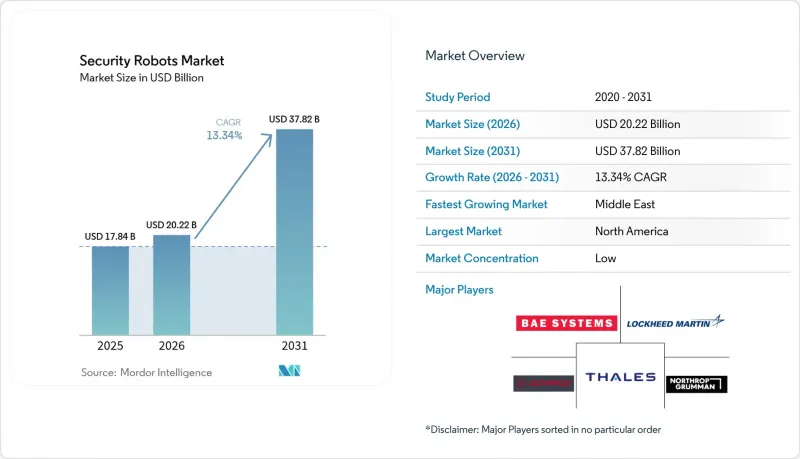
This report is Segmented by Type (Unmanned Ground Vehicles, Autonomous Underwater Vehicles, Hybrid Amphibious Robots), Component (Hardware, Software and AI Stack, Services), End User (Defense and Military, Residential and Private Estates, and More), Application (Patrolling and Surveillance, Spying and Reconnaissance, and More), and Geography. The Market Forecasts are Provided in Terms of Value (USD).
Global Security Robots Market Trends and Insights
Deployment of AI-Enabled Perception Stacks Lowering False-Alarm Rates in Critical Infrastructure
Critical-infrastructure owners are replacing rule-based motion detection with multimodal perception systems that fuse thermal, visible-light, and radar inputs. MOBOTIX field tests at European utility substations cut false positives by 70% in 2024, freeing control-room staff to investigate validated alerts. Edge inference on NVIDIA Jetson modules eliminates cloud latency and supports air-gapped defense sites. Updated 2025 guidelines from the United States Department of Energy mandate AI-verified intrusion detection at Category I nuclear facilities, accelerating purchase cycles. Insurance carriers now offer premium discounts to facilities that deploy certified AI perception, creating an economic catalyst beyond operational efficiency.
Expansion of Civilian BVLOS Drone Corridors for Security Patrols
The United States Federal Aviation Administration approved routine BVLOS operations in 2024, letting utilities, border agencies, and pipeline operators monitor linear assets without manned chase aircraft. Australia's Civil Aviation Safety Authority enacted a similar BVLOS framework in 2025, widening drone-patrol coverage for remote mining sites and offshore oil platforms. ASTM International's F3411 remote-identification standard calms public-safety concerns by requiring real-time broadcast of drone ID and telemetry. Shield AI's V-BAT platform, which won a multi-year United States Army perimeter-surveillance contract in 2025, exemplifies military validation spilling into civilian procurement. The alignment of regulation, standards, and field-proven technology is shrinking adoption timelines across energy, transportation, and defense sectors.
Fragmented Radio-Frequency Spectrum Regulations Limiting Multi-Robot Fleets
Swarm intelligence demands low-latency links, yet radio-frequency allocations vary widely. The International Telecommunication Union's 2023 conference earmarked 5.9 GHz for vehicle networking in some regions, while others dedicate it to Wi-Fi, forcing security-robot vendors to design multiple radio configurations. European Union members apply divergent rules to sub-1 GHz industrial bands, inflating certification costs and delaying cross-border rollouts. Until bodies such as ETSI finalize harmonized bands, operators will face greater integration complexity and reduced economies of scale.
Other drivers and restraints analyzed in the detailed report include:
- Mandates for Perimeter Intrusion Detection at Energy Assets
- Adoption of Robot-as-a-Service by Commercial Real-Estate Operators
- Public Backlash Against Face-Recognition Patrol Bots in Municipal Deployments
For complete list of drivers and restraints, kindly check the Table Of Contents.
Segment Analysis
Autonomous underwater vehicles, while only a minority slice today, are expanding at a 13.96% CAGR as navies seek persistent subsurface ISR capabilities. The FY 2026 United States Navy budget earmarked USD 257.5 million for extra-large AUVs, and Australia's Ghost Shark aims for 60-day endurance by 2027. Unmanned ground vehicles nonetheless accounted for 47.23% of revenue in 2025, reflecting their versatility across indoor patrol, EOD missions, and perimeter sweeps. Boston Dynamics' Spot won contracts with the New York Police Department and Singapore's Home Team Science and Technology Agency, underscoring its adaptability to urban and industrial environments. Hybrid amphibious robots, capable of moving between beachheads and shallow waters, serve coastal LNG terminals and offshore wind farms yet face high acquisition costs exceeding USD 600,000.
The security robots market for underwater platforms is projected to grow sharply as allied Indo-Pacific navies expand undersea sensor grids. By contrast, ground-vehicle growth is moderating as installed bases mature, though refresh cycles focused on modular sensor payloads sustain a healthy replacement curve. Over the forecast period, platform interoperability with joint-domain command networks will become a decisive factor in contract awards, nudging vendors to adopt open-architecture standards.
Hardware accounted for 64.89% of 2025 revenue, but perception, mapping, and fleet-orchestration software are expanding faster at a 13.91% CAGR. NVIDIA Jetson Orin modules now ship with Shield AI, Knightscope, and Anduril robots, providing 200 TOPS of edge AI compute for real-time detection. The security robots market share held by software subscriptions is climbing as customers pay recurring fees for over-the-air upgrades that sharpen accuracy and add functionality. Teledyne FLIR's infrared modules remain ubiquitous, providing kilometer-scale detection in zero-lux environments.
Services installation, training, and remote monitoring remain a smaller but rising slice. The shift to robot-as-a-service shifts asset risk to vendors, increasing revenue from monthly fees rather than one-time sales. Compliance standards such as ISO 13482 influence service quality expectations, and early adopters reward vendors able to blend autonomous patrols with 24/7 human tele-ops for incident confirmation.
Complete Report Scope:
- By Type
- Unmanned Ground Vehicles
- Autonomous Underwater Vehicles
- Hybrid Amphibious Robots
- By Component
- Hardware
- Software and AI Stack
- Services
- By End User
- Defense and Military
- Government and Law-Enforcement
- Commercial and Industrial Facilities
- Residential and Private Estates
- By Application
- Patrolling and Surveillance
- Explosive Detection and Disposal
- Spying and Reconnaissance
- Search and Rescue Disaster Response
- Fire and Hazardous-Environment Response
- By Geography
- North America
- United States
- Canada
- Mexico
- South America
- Brazil
- Argentina
- Rest of South America
- Europe
- United Kingdom
- Germany
- France
- Italy
- Rest of Europe
- Asia Pacific
- China
- Japan
- India
- South Korea
- Rest of Asia Pacific
- Middle East and Africa
- Middle East
- United Arab Emirates
- Saudi Arabia
- Rest of Middle East
- Africa
- South Africa
- Egypt
- Rest of Africa
- Middle East
- North America
Geography Analysis
North America commanded 37.83% of the security robots market share in 2025, supported by mature defense procurement, expanding retail robot-as-a-service rollouts, and the Federal Aviation Administration's beyond-visual-line-of-sight framework. Regional spending is reinforced by the United States Navy's multi-year budget for extra-large autonomous underwater vehicles and by Canadian mining operators that use unmanned ground vehicles at remote sites. Mexico is expanding drone surveillance along both borders through bilateral security assistance, broadening the addressable security robotics market across the continent. Competitive pilots at United States utility companies show that aerial robots can cut inspection costs by more than 40%, creating a strong economic case for continued investment. As cyber-hardening standards tighten, North American buyers increasingly favor platforms with encrypted command links and anti-jamming safeguards.
The Middle East is projected to grow at a 14.39% CAGR through 2031, the fastest pace among all regions. Saudi Arabia's Vision 2030 mandates tie refinery and desalination plant licenses to compliance with autonomous patrol requirements, triggering immediate tenders for rugged hybrid platforms. The United Arab Emirates has field-tested unmanned ground vehicles for crowd management and maritime drones for port security, signaling government endorsement that de-risks private-sector adoption. Israel continues to export reconnaissance drones to neighboring states despite export-control checks, adding specialized payload demand such as loitering munitions for border surveillance.
Europe maintains a mid-tier share, driven by the United Kingdom, Germany, and France, yet growth lags due to stringent biometric-privacy rules under the European Union Artificial Intelligence Act. Germany's security-technology guidelines require certified encryption for command-and-control links, extending vendor qualification cycles and favoring established defense primes. Asia Pacific shows rapid uptake in China, Japan, South Korea, and India as governments modernize border security and mitigate labor shortages; China alone has deployed thousands of patrol robots across major metro systems. South America and Africa remain nascent but rising, with Brazil's rainforest monitoring program and South Africa's private-security pilots illustrating early momentum. Currency constraints and import duties temper immediate volume in these emerging regions, but multilateral financing and falling hardware prices are expected to unlock additional orders over the forecast horizon.
- Lockheed Martin Corp.
- Northrop Grumman Corp.
- Thales SA
- BAE Systems plc
- Leonardo S.p.A.
- Elbit Systems Ltd.
- AeroVironment Inc.
- Knightscope Inc.
- SZ DJI Technology Co. Ltd.
- SMP Robotics Corp.
- Boston Dynamics Inc.
- Teledyne FLIR LLC
- Kongsberg Gruppen ASA
- QinetiQ Group plc
- RoboTex Inc.
- Recon Robotics Inc.
- Cobalt Robotics Inc.
- Shield AI, Inc.
- G4S plc
- Magos Systems
- DroneSense Inc.
Additional Benefits:
- The market estimate (ME) sheet in Excel format
- 3 months of analyst support
TABLE OF CONTENTS
1 INTRODUCTION
- 1.1 Study Assumptions and Market Definition
- 1.2 Scope of the Study
2 RESEARCH METHODOLOGY
3 EXECUTIVE SUMMARY
4 MARKET LANDSCAPE
- 4.1 Market Overview
- 4.2 Market Drivers
- 4.2.1 Deployment of AI-enabled perception stacks lowering false-alarm rates in critical infrastructure
- 4.2.2 Expansion of civilian BVLOS drone corridors for security patrols
- 4.2.3 Mandates for perimeter intrusion detection at energy assets
- 4.2.4 Adoption of robot-as-a-service (RaaS) by commercial real-estate operators
- 4.2.5 Accelerated demand for indoor UGVs triggered by retail shrink crisis
- 4.2.6 Growing naval budgets for autonomous underwater ISR
- 4.3 Market Restraints
- 4.3.1 Fragmented radio-frequency spectrum regulations limiting multi-robot fleets
- 4.3.2 Public backlash against face-recognition patrol bots in municipal deployments
- 4.3.3 High total cost of ruggedised all-terrain platforms for petro-chemical sites
- 4.3.4 Cyber-hardening gaps exposing C2 links to spoofing and jamming
- 4.4 Industry Value Chain Analysis
- 4.5 Impact of Macroeconomic Factors on the Market
- 4.6 Regulatory and Standardisations Outlook
- 4.7 Technological Outlook
- 4.8 Porter's Five Forces Analysis
- 4.8.1 Threat of New Entrants
- 4.8.2 Bargaining Power of Buyers
- 4.8.3 Bargaining Power of Suppliers
- 4.8.4 Threat of Substitutes
- 4.8.5 Intensity of Competitive Rivalry
5 MARKET SIZE AND GROWTH FORECASTS (VALUE)
- 5.1 By Type
- 5.1.1 Unmanned Ground Vehicles
- 5.1.2 Autonomous Underwater Vehicles
- 5.1.3 Hybrid Amphibious Robots
- 5.2 By Component
- 5.2.1 Hardware
- 5.2.2 Software and AI Stack
- 5.2.3 Services
- 5.3 By End User
- 5.3.1 Defense and Military
- 5.3.2 Government and Law-Enforcement
- 5.3.3 Commercial and Industrial Facilities
- 5.3.4 Residential and Private Estates
- 5.4 By Application
- 5.4.1 Patrolling and Surveillance
- 5.4.2 Explosive Detection and Disposal
- 5.4.3 Spying and Reconnaissance
- 5.4.4 Search and Rescue Disaster Response
- 5.4.5 Fire and Hazardous-Environment Response
- 5.5 By Geography
- 5.5.1 North America
- 5.5.1.1 United States
- 5.5.1.2 Canada
- 5.5.1.3 Mexico
- 5.5.2 South America
- 5.5.2.1 Brazil
- 5.5.2.2 Argentina
- 5.5.2.3 Rest of South America
- 5.5.3 Europe
- 5.5.3.1 United Kingdom
- 5.5.3.2 Germany
- 5.5.3.3 France
- 5.5.3.4 Italy
- 5.5.3.5 Rest of Europe
- 5.5.4 Asia Pacific
- 5.5.4.1 China
- 5.5.4.2 Japan
- 5.5.4.3 India
- 5.5.4.4 South Korea
- 5.5.4.5 Rest of Asia Pacific
- 5.5.5 Middle East and Africa
- 5.5.5.1 Middle East
- 5.5.5.1.1 United Arab Emirates
- 5.5.5.1.2 Saudi Arabia
- 5.5.5.1.3 Rest of Middle East
- 5.5.5.2 Africa
- 5.5.5.2.1 South Africa
- 5.5.5.2.2 Egypt
- 5.5.5.2.3 Rest of Africa
- 5.5.5.1 Middle East
- 5.5.1 North America
6 COMPETITIVE LANDSCAPE
- 6.1 Market Concentration
- 6.2 Strategic Moves and Partnerships
- 6.3 Market Share Analysis
- 6.4 Company Profiles (includes Global Level Overview, Market Level Overview, Core Segments, Financials as available, Strategic Information, Market Rank/Share, Products and Services, Recent Developments)
- 6.4.1 Lockheed Martin Corp.
- 6.4.2 Northrop Grumman Corp.
- 6.4.3 Thales SA
- 6.4.4 BAE Systems plc
- 6.4.5 Leonardo S.p.A.
- 6.4.6 Elbit Systems Ltd.
- 6.4.7 AeroVironment Inc.
- 6.4.8 Knightscope Inc.
- 6.4.9 SZ DJI Technology Co. Ltd.
- 6.4.10 SMP Robotics Corp.
- 6.4.11 Boston Dynamics Inc.
- 6.4.12 Teledyne FLIR LLC
- 6.4.13 Kongsberg Gruppen ASA
- 6.4.14 QinetiQ Group plc
- 6.4.15 RoboTex Inc.
- 6.4.16 Recon Robotics Inc.
- 6.4.17 Cobalt Robotics Inc.
- 6.4.18 Shield AI, Inc.
- 6.4.19 G4S plc
- 6.4.20 Magos Systems
- 6.4.21 DroneSense Inc.
7 MARKET OPPORTUNITIES AND FUTURE OUTLOOK
- 7.1 White-Space and Unmet-Need Assessment

