PUBLISHER: Mordor Intelligence | PRODUCT CODE: 2119639

PUBLISHER: Mordor Intelligence | PRODUCT CODE: 2119639
Green Technology - Market Share Analysis, Industry Trends & Statistics, Growth Forecasts (2026 - 2031)
According to Mordor Intelligence, green technology market size in 2026 is estimated at USD 36.24 billion, growing from 2025 value of USD 29.45 billion with 2031 projections showing USD 102.26 billion, growing at 23.05% CAGR over 2026-2031.
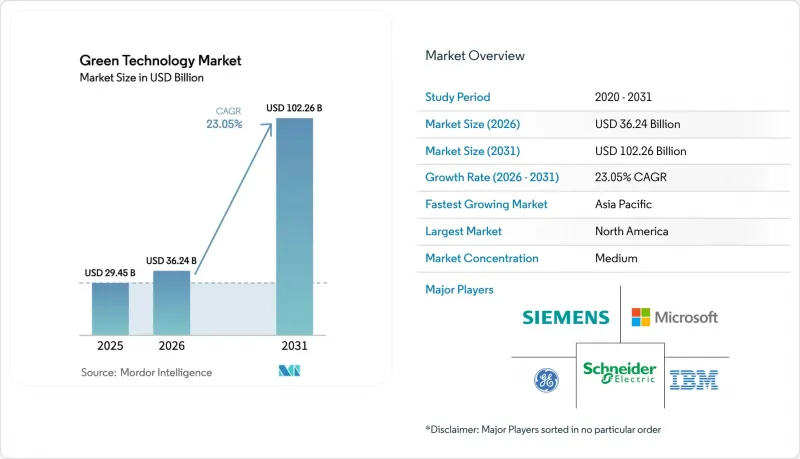
This report is Segmented by Component (Solutions, Services), Technology (Internet of Things (IoT), Artificial Intelligence and Analytics, Digital Twin, and More), Application (Green Building, Carbon Footprint Management, and More), End User Industry (Energy and Utilities, Manufacturing, and More). The Market Forecasts are Provided in Terms of Value (USD).
Global Green Technology Market Trends and Insights
Rising Environmental Awareness and Corporate Net-Zero Mandates
Mandatory sustainability reporting now links executive compensation to emissions targets, prompting companies to embed sensor networks across factories, offices, and logistics nodes. Over 300 listed firms in China must file sustainability disclosures by 2026, reinforcing demand for continuous monitoring tools. Schneider Electric reported record 2024 profits after targeting 800 million tonnes of customer emissions savings by 2025, illustrating how environmental performance is reshaping competitive positioning. Predictable subscription revenues emerge as enterprises move from annual audits to always-on dashboards, and procurement teams increasingly score suppliers on real-time carbon metrics rather than static certificates.
Stringent Decarbonization Policies and Carbon Pricing
The European Commission's Ecodesign for Sustainable Products Regulation extends environmental requirements to nearly all physical goods by 2025, turning optional upgrades into legal obligations.The EU's Carbon Border Adjustment Mechanism forces carbon-intensive exporters to document embedded emissions, encouraging Asia-Pacific manufacturers to accelerate digital monitoring rollouts. Bangladesh, Indonesia, and Vietnam now retrofit textile lines with sensor arrays so finished goods can clear European customs. As a result, multinational supply chains standardize on shared data models, deepening the addressable base for green technology market platforms.
High Upfront Integration and Lifecycle Costs
Total cost of ownership still deters smaller firms even as hardware prices fall. Integration fees can triple list prices once legacy industrial systems and staff retraining enter the equation. Many manufacturers struggle to monetize carbon visibility quickly enough to satisfy short-term budget cycles, so adoption skews toward large enterprises with ring-fenced sustainability capital. Consultants and managed-service providers fill capability gaps, yet their labor premiums widen the affordability gulf, slowing the green technology market in lower-margin sectors.
Other drivers and restraints analyzed in the detailed report include:
- Rapid Cost Decline of IoT Sensors and Cloud Platforms
- AI-Driven Carbon Accounting Platforms Embedded in ERP Stacks
- Critical-Mineral Supply-Chain Bottlenecks
For complete list of drivers and restraints, kindly check the Table Of Contents.
Segment Analysis
Solutions accounted for 77.35% of green technology market share in 2025 because enterprises prefer unified suites that consolidate energy, waste, and emissions dashboards. Vendors package IoT ingestion, analytics, and compliance reporting in single licenses, reducing procurement friction and integration risk. The services segment, growing at a 24.6% CAGR, handles configuration, data cleansing, and staff enablement. Many deployments reveal that realized energy savings often exceed 20%, but only after consultants fine-tune sensor thresholds and predictive algorithms. Services teams also update rule libraries as regulations evolve, safeguarding audit readiness.
Professional-service revenue rises further once firms progress from descriptive to prescriptive analytics. For example, smart-building retrofits that link occupancy sensors to HVAC dampers deliver 20-30% energy savings but require continuous model retraining. Carbon-accounting advisory units translate raw readings into scope-3 disclosures accepted by multiple jurisdictions, sparing clients from duplicated reporting cycles. Together, solutions and services form a flywheel: platform rollouts generate data that exposes new optimization opportunities, which in turn demand additional service engagements, reinforcing the expansion of the green technology market.
IoT maintained 32.55% of the green technology market in 2025, reflecting the sheer volume of connected meters deployed across power grids, farms, and factories. Sensor data underpins performance baselines, enabling AI modules to target anomalies. Blockchain, rising at a 25.4% CAGR, supports trusted carbon-credit provenance and supply-chain insetting schemes where brands offset emissions inside their own ecosystems. Artificial-intelligence workloads refine wind-turbine maintenance schedules, a focus highlighted when Aerones secured USD 62 million to expand robotic inspection services.
Digital-twin engines now mirror entire campuses, letting managers test retrofits virtually before touching assets. Cloud hyperscalers supply elastic compute that crunches high-frequency readings, while edge nodes tackle latency-sensitive tasks such as voltage balancing. Trusted ledgers close the loop by recording verified reductions, allowing automated offset purchases when targets slip. This interplay among sensing, modeling, optimization, and traceability secures IoT's leadership yet leaves room for blockchain's rapid rise, fueling technology diversity inside the green technology market.
Complete Report Scope:
- By Component
- Solutions
- Services
- By Technology
- Internet of Things (IoT)
- Artificial Intelligence and Analytics
- Digital Twin
- Cloud Computing
- Blockchain
- Other Emerging Technologies
- By Application
- Green Building
- Carbon Footprint Management
- Air and Water Pollution Monitoring
- Weather Monitoring and Forecasting
- Crop Monitoring
- Others
- By End-user Industry
- Energy and Utilities
- Manufacturing
- Transportation and Logistics
- Agriculture
- Construction and Real-estate
- IT and Telecom
- Government and Public Sector
- Other Industries
- By Geography
- North America
- United States
- Canada
- Mexico
- South America
- Brazil
- Argentina
- Rest of South America
- Europe
- Germany
- United Kingdom
- France
- Italy
- Spain
- Rest of Europe
- Asia-Pacific
- China
- India
- Japan
- South Korea
- Australia and New Zealand
- Rest of Asia-Pacific
- Middle East and Africa
- Middle East
- Saudi Arabia
- United Arab Emirates
- Turkey
- Rest of Middle East
- Africa
- Nigeria
- South Africa
- Egypt
- Rest of Africa
- Middle East
- North America
Geography Analysis
North America led the green technology market with a 23.45% share in 2025 on the back of federal incentives and deep venture-capital pools. The Inflation Reduction Act funnels billions toward clean-energy infrastructure, while corporate buyers lock in multi-year sustainability budgets. United States firms bundle carbon analytics into enterprise contracts, leveraging mature software ecosystems. Canada scales similar platforms to track cross-border automotive and aerospace supply chains, and Mexico integrates emissions monitoring into maquiladora compliance workflows, reflecting region-wide policy alignment.
Asia-Pacific recorded the fastest projected growth at a 23.8% CAGR, powered by industrial expansion paired with tighter environmental mandates. China's stock-exchange rules, which require sustainability reports from 2026, catalyze factory sensor retrofits. India doubles down on domestic clean-tech IP to offset mineral import risks, and Japan accelerates smart-factory rollouts to maintain export competitiveness. South Korea allotted about USD 101 million to its Strategic Smart City Program, embedding IoT nodes in transport and water grids.
- General Electric
- IBM Corporation
- Microsoft Corporation
- Siemens AG
- Schneider Electric SE
- Wolters Kluwer N.V.
- Oracle Corporation
- CropX Inc.
- Engie Impact
- Sensus (Xylem)
- Trace Genomics
- Accuvio (Diligent)
- Tesla Inc.
- Vestas Wind Systems
- ABB Ltd.
- Cority Software
- Schneider Electric
- Enel S.p.A.
- Siemens Gamesa
- KBR Inc.
Additional Benefits:
- The market estimate (ME) sheet in Excel format
- 3 months of analyst support
TABLE OF CONTENTS
1 INTRODUCTION
- 1.1 Study Assumptions and Market Definition
- 1.2 Scope of the Study
2 RESEARCH METHODOLOGY
3 EXECUTIVE SUMMARY
4 MARKET LANDSCAPE
- 4.1 Market Overview
- 4.2 Market Drivers
- 4.2.1 Rising environmental awareness and corporate net-zero mandates
- 4.2.2 Stringent decarbonization policies and carbon pricing
- 4.2.3 Rapid cost decline of IoT sensors and cloud platforms
- 4.2.4 AI-driven carbon-accounting platforms embedded in ERP stacks
- 4.2.5 Surge in green data-centre investments for Gen-AI workloads
- 4.2.6 Blockchain-based voluntary carbon insetting marketplaces
- 4.3 Market Restraints
- 4.3.1 High upfront integration and lifecycle costs
- 4.3.2 Shortage of green-tech talent in emerging regions
- 4.3.3 Scrutiny of digital-infrastructure Scope-2 emissions
- 4.3.4 Critical-mineral supply-chain bottlenecks
- 4.4 Supply-Chain Analysis
- 4.5 Regulatory Landscape
- 4.6 Technological Outlook
- 4.7 Porter's Five Forces Analysis
- 4.7.1 Bargaining Power of Buyers
- 4.7.2 Bargaining Power of Suppliers
- 4.7.3 Threat of New Entrants
- 4.7.4 Threat of Substitutes
- 4.7.5 Intensity of Competitive Rivalry
- 4.8 Assesment of Macroeconomic Factors on the market
5 MARKET SIZE AND GROWTH FORECASTS (VALUE)
- 5.1 By Component
- 5.1.1 Solutions
- 5.1.2 Services
- 5.2 By Technology
- 5.2.1 Internet of Things (IoT)
- 5.2.2 Artificial Intelligence and Analytics
- 5.2.3 Digital Twin
- 5.2.4 Cloud Computing
- 5.2.5 Blockchain
- 5.2.6 Other Emerging Technologies
- 5.3 By Application
- 5.3.1 Green Building
- 5.3.2 Carbon Footprint Management
- 5.3.3 Air and Water Pollution Monitoring
- 5.3.4 Weather Monitoring and Forecasting
- 5.3.5 Crop Monitoring
- 5.3.6 Others
- 5.4 By End-user Industry
- 5.4.1 Energy and Utilities
- 5.4.2 Manufacturing
- 5.4.3 Transportation and Logistics
- 5.4.4 Agriculture
- 5.4.5 Construction and Real-estate
- 5.4.6 IT and Telecom
- 5.4.7 Government and Public Sector
- 5.4.8 Other Industries
- 5.5 By Geography
- 5.5.1 North America
- 5.5.1.1 United States
- 5.5.1.2 Canada
- 5.5.1.3 Mexico
- 5.5.2 South America
- 5.5.2.1 Brazil
- 5.5.2.2 Argentina
- 5.5.2.3 Rest of South America
- 5.5.3 Europe
- 5.5.3.1 Germany
- 5.5.3.2 United Kingdom
- 5.5.3.3 France
- 5.5.3.4 Italy
- 5.5.3.5 Spain
- 5.5.3.6 Rest of Europe
- 5.5.4 Asia-Pacific
- 5.5.4.1 China
- 5.5.4.2 India
- 5.5.4.3 Japan
- 5.5.4.4 South Korea
- 5.5.4.5 Australia and New Zealand
- 5.5.4.6 Rest of Asia-Pacific
- 5.5.5 Middle East and Africa
- 5.5.5.1 Middle East
- 5.5.5.1.1 Saudi Arabia
- 5.5.5.1.2 United Arab Emirates
- 5.5.5.1.3 Turkey
- 5.5.5.1.4 Rest of Middle East
- 5.5.5.2 Africa
- 5.5.5.2.1 Nigeria
- 5.5.5.2.2 South Africa
- 5.5.5.2.3 Egypt
- 5.5.5.2.4 Rest of Africa
- 5.5.5.1 Middle East
- 5.5.1 North America
6 COMPETITIVE LANDSCAPE
- 6.1 Market Concentration
- 6.2 Strategic Moves
- 6.3 Market Share Analysis
- 6.4 Company Profiles (includes Global-level Overview, Market-level Overview, Core Segments, Financials as available, Strategic Information, Market Rank/Share, Products and Services, Recent Developments)
- 6.4.1 General Electric
- 6.4.2 IBM Corporation
- 6.4.3 Microsoft Corporation
- 6.4.4 Siemens AG
- 6.4.5 Schneider Electric SE
- 6.4.6 Wolters Kluwer N.V.
- 6.4.7 Oracle Corporation
- 6.4.8 CropX Inc.
- 6.4.9 Engie Impact
- 6.4.10 Sensus (Xylem)
- 6.4.11 Trace Genomics
- 6.4.12 Accuvio (Diligent)
- 6.4.13 Tesla Inc.
- 6.4.14 Vestas Wind Systems
- 6.4.15 ABB Ltd.
- 6.4.16 Cority Software
- 6.4.17 Schneider Electric
- 6.4.18 Enel S.p.A.
- 6.4.19 Siemens Gamesa
- 6.4.20 KBR Inc.
7 MARKET OPPORTUNITIES AND FUTURE OUTLOOK
- 7.1 White-Space and Unmet-Need Assessment

