PUBLISHER: Mordor Intelligence | PRODUCT CODE: 2119674

PUBLISHER: Mordor Intelligence | PRODUCT CODE: 2119674
Medical Composites - Market Share Analysis, Industry Trends & Statistics, Growth Forecasts (2026 - 2031)
According to Mordor Intelligence, medical composites market size in 2026 is estimated at USD 1.68 billion, growing from 2025 value of USD 1.51 billion with 2031 projections showing USD 2.83 billion, growing at 11.03% CAGR over 2026-2031.
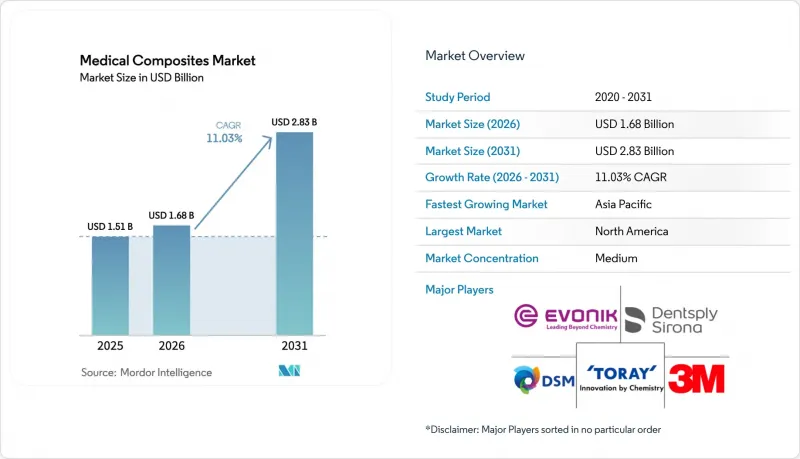
This report is Segmented by Material Type (Carbon Fiber Reinforced Polymer, Glass Fiber Reinforced Polymer, and More), Polymer Matrix (PEEK, Polypropylene, and More), Fibre Type (Carbon Fibre, and More), Application (Surgical Instruments, and More), and Geography (North America, Europe, Asia-Pacific, Middle East & Africa, South America). The Market Forecasts are Provided in Terms of Value (USD).
Global Medical Composites Market Trends and Insights
Surging Chronic Disease Burden & Aging Population
Orthopedic surgeons increasingly prefer composite implants because carbon fiber's fatigue resistance outperforms titanium, lowering revision rates for elderly patients. The demographic surge strengthens long-term demand visibility, encouraging suppliers to scale capacity and pursue wider indications. Tissue engineering scaffolds benefit as clinicians adopt bio-resorbable lattices that obviate secondary removal surgeries. Composite producers respond by tailoring degradation profiles and surface chemistries that promote osteointegration. Insurance payors, under pressure to cut re-operation costs, further validate composite solutions, tightening hospital formularies around proven, durable materials. Consequently, the medical composites market registers steady procurement even during broader economic slowdowns.
Growing Demand for Lightweight, MRI-Compatible Tools
Radiolucent composites remove image artifacts, letting surgeons monitor implant placement in real time across fluoroscopy, CT, and MRI suites. Lower instrument weight reduces intra-operative fatigue, trimming procedure times and enhancing patient outcomes. Hospitals standardize composite imaging tables and positioning systems to guarantee uniform quality across modalities. Robotics vendors adopt carbon-fiber joints to sharpen kinematic accuracy while keeping payloads manageable for precision drive units. As reimbursement models reward efficiency, healthcare providers increasingly specify MRI-compatible composite sets, widening the installed base and locking in recurring replacement sales.
High Production Costs & Limited Supply Chain Depth
Medical-grade carbon fiber commands a premium because only a handful of producers meet ISO 13485 documentation and purity thresholds. Autoclave and laser-machining assets involve high capital outlays, raising entry barriers for new entrants. Disruptions in precursor supply ripple across implant lines, with lead times stretching past 24 weeks during 2024 aerospace demand spikes. OEMs mitigate by dual-sourcing fibers and investing in in-house prepreg lines, yet cost pass-throughs persist, restraining adoption in price-sensitive emerging markets.
Other drivers and restraints analyzed in the detailed report include:
- Advancements in Minimally Invasive & Robotic Surgery Devices
- Rapid Adoption of Robot-Assisted Composite Instruments
- Stringent Multi-Region Regulatory Approvals
For complete list of drivers and restraints, kindly check the Table Of Contents.
Segment Analysis
CFRP commanded 35.05% of the medical composites market in 2025, substantiating its role as the backbone of imaging tables, orthopedic plates, and robotic arm components. The segment benefits from unmatched strength-to-weight ratios that allow thinner profiles without sacrificing load tolerance. Imaging OEMs capitalize on CFRP's radiolucency to achieve artifact-free scans, widening its institutional footprint. Meanwhile, the medical composites market size for ceramic matrix composites is projected to advance at a 11.73% CAGR, propelled by bioactivity that accelerates osteointegration. Development programs pair hydroxyapatite-infused ceramics with resorbable polymers, offering hybrid constructs that knit gradually with host tissue. Production cost curves trend downward as pressureless sintering and microwave sintering reduce cycle times. Hybrid and bio-based composites linger in early-stage trials, yet targeted properties such as antimicrobial efficacy attract clinical attention.
CFRP suppliers deploy automated fiber placement to curtail scrap rates and drive consistent mechanical performance batch-to-batch. Hospitals value the reduced infection risk linked to CFRP's chemical inertness, while insurers flag lower re-operation incidence in postoperative audits. Ceramic matrix innovators leverage additive manufacturing to print lattice structures that match patient-specific defect geometries, shortening operating room time. As surgical robotics shifts toward smaller, outpatient-compatible systems, lightweight ceramic-carbon hybrids offer the stiffness surgeons expect. This evolving material mix ensures the medical composites market retains a robust innovation funnel.
PEEK held 41.22% share in 2025, its elastic modulus mirroring cortical bone and thereby mitigating stress-shielding after implantation. Surgeons prefer PEEK cages for spinal fusion because post-operative imaging clearly distinguishes bone growth around the implant. The medical composites market size expansion for PMMA & acrylics, set for 12.95% CAGR, rests on dental and vertebroplasty demand where low cost and flowable curing matter. Antimicrobial PMMA bone cements containing silver ions are clearing clinical pathways, aiding infection control. Polypropylene retains niche use in catheter components needing chemical resistance at low budgets.
Advances in extrusion-based 3D printing broaden PEEK implant geometries, supporting porous architectures that invite tissue in-growth. Composite matrix developers now blend PEEK with carbon nanotubes to elevate thermal conductivity, facilitating RF ablation probes. PMMA innovators experiment with bioactive glass microspheres to couple radiopacity with controlled elution of therapeutic ions. Regulatory bodies call for robust leachables data, pushing polymer formulators to refine additive packages carefully. The resulting competition ensures that the medical composites market continues to diversify matrix offerings without compromising safety.
Complete Report Scope:
- By Material Type
- Carbon Fiber Reinforced Polymer (CFRP)
- Glass Fiber Reinforced Polymer (GFRP)
- Ceramic Matrix Composites
- Other Materials
- By Polymer Matrix
- PEEK
- Polypropylene (PP)
- PMMA & Acrylics
- Others
- By Fibre Type
- Carbon Fibre
- Glass Fibre
- Aramid & Other High-Performance Fibres
- By Application
- Surgical Instruments
- Diagnostic Imaging Components
- Orthopedic Implants
- Dental Implants
- Tissue Engineering Scaffolds
- Other Applications
- By Geography
- North America
- United States
- Canada
- Mexico
- Europe
- Germany
- United Kingdom
- France
- Italy
- Spain
- Rest of Europe
- Asia-Pacific
- China
- Japan
- India
- Australia
- South Korea
- Rest of Asia-Pacific
- Middle East & Africa
- GCC
- South Africa
- Rest of Middle East & Africa
- South America
- Brazil
- Argentina
- Rest of South America
- North America
Geography Analysis
North America secured 41.10% of the medical composites market in 2025, underpinned by a robust reimbursement ecosystem and continuous R&D investments from players such as 3M and Stryker. The United States accounts for the lion's share, coupling early technology adoption with large-scale hospital networks that standardize composite instrument trays. Canada, leveraging its single-payer system, funds procurement of advanced MRI-compatible tables to cut wait times. Mexico's maquiladora corridor attracts device OEMs seeking cost-optimized composite component production while remaining proximate to US regulatory oversight. Federal funding for orthopedic research sustains pipeline momentum, preserving North American leadership.
Asia-Pacific registers the fastest 11.98% CAGR through 2031, a testament to expanded health insurance coverage, burgeoning middle-class demand, and concerted industrial policies in China and India. Chinese composite producers benefit from state incentives that lower precursor import tariffs, boosting domestic supply capacity. Japan integrates composites into surgical robotic exports, reinforcing the region's high-tech image. India's National Medical Devices Policy 2025 encourages local manufacture of carbon-fiber implants, targeting reduced import dependencies. Southeast Asian nations invest in radiotherapy centers, each specifying carbon-epoxy patient couches, further swelling regional uptake across the medical composites market.
Europe retains a mature yet innovative profile, with stringent MDR rules nudging suppliers toward traceable, high-quality composite lines. Germany spearheads application engineering, embedding smart sensors into spinal rods for postoperative monitoring. The United Kingdom's Catapult network supports SME trials of recyclable thermoplastic composites, aligning with National Health Service carbon-footprint mandates. France pilots hospital take-back programs for single-use composite devices, collecting lifecycle data critical to future regulatory relief. Italy's Lombardy cluster ramps autoclave capacity, exporting orthopedic plates across the EU. Such coordinated initiatives keep Europe integral to technological progress even as growth moderates.
- 3M
- Toray Industries
- Victrex plc (Invibio)
- DSM-Firmenich
- CeramTec GmbH
- SGL Carbon
- Evonik Industries
- Dentsply Sirona
- Solvay
- Kulzer
- Composiflex
- Mitsubishi Chemical Group (MCAM)
- Icotec AG
- Rochling Group
- Zeus Industrial Products
- Trelleborg AB
- Ensinger GmbH
- Hexcel Corporation
- Arkema SA
- Avient Corporation
- LANXESS AG
Additional Benefits:
- The market estimate (ME) sheet in Excel format
- 3 months of analyst support
TABLE OF CONTENTS
1 Introduction
- 1.1 Study Assumptions & Market Definition
- 1.2 Scope of the Study
2 Research Methodology
3 Executive Summary
4 Market Landscape
- 4.1 Market Overview
- 4.2 Market Drivers
- 4.2.1 Surging Chronic Disease Burden & Aging Population
- 4.2.2 Growing Demand for Lightweight, MRI-Compatible Tools
- 4.2.3 Advancements in Minimally-Invasive & Robotic Surgery Devices
- 4.2.4 Rapid Adoption of Robot-Assisted Composite Instruments
- 4.2.5 Regulatory Fast-Track for Carbon-Fiber PEEK Implants
- 4.2.6 Expansion of Diagnostic Imaging Infrastructure
- 4.3 Market Restraints
- 4.3.1 High Production Costs & Limited Supply Chain Depth
- 4.3.2 Stringent Multi-Region Regulatory Approvals
- 4.3.3 End-of-Life Recycling Challenges for Composite Devices
- 4.3.4 Machining & Sterilization Complexity
- 4.4 Porter's Five Forces Analysis
- 4.4.1 Threat of New Entrants
- 4.4.2 Bargaining Power of Buyers
- 4.4.3 Bargaining Power of Suppliers
- 4.4.4 Threat of Substitutes
- 4.4.5 Intensity of Competitive Rivalry
5 Market Size & Growth Forecasts (Value in USD)
- 5.1 By Material Type
- 5.1.1 Carbon Fiber Reinforced Polymer (CFRP)
- 5.1.2 Glass Fiber Reinforced Polymer (GFRP)
- 5.1.3 Ceramic Matrix Composites
- 5.1.4 Other Materials
- 5.2 By Polymer Matrix
- 5.2.1 PEEK
- 5.2.2 Polypropylene (PP)
- 5.2.3 PMMA & Acrylics
- 5.2.4 Others
- 5.3 By Fibre Type
- 5.3.1 Carbon Fibre
- 5.3.2 Glass Fibre
- 5.3.3 Aramid & Other High-Performance Fibres
- 5.4 By Application
- 5.4.1 Surgical Instruments
- 5.4.2 Diagnostic Imaging Components
- 5.4.3 Orthopedic Implants
- 5.4.4 Dental Implants
- 5.4.5 Tissue Engineering Scaffolds
- 5.4.6 Other Applications
- 5.5 By Geography
- 5.5.1 North America
- 5.5.1.1 United States
- 5.5.1.2 Canada
- 5.5.1.3 Mexico
- 5.5.2 Europe
- 5.5.2.1 Germany
- 5.5.2.2 United Kingdom
- 5.5.2.3 France
- 5.5.2.4 Italy
- 5.5.2.5 Spain
- 5.5.2.6 Rest of Europe
- 5.5.3 Asia-Pacific
- 5.5.3.1 China
- 5.5.3.2 Japan
- 5.5.3.3 India
- 5.5.3.4 Australia
- 5.5.3.5 South Korea
- 5.5.3.6 Rest of Asia-Pacific
- 5.5.4 Middle East & Africa
- 5.5.4.1 GCC
- 5.5.4.2 South Africa
- 5.5.4.3 Rest of Middle East & Africa
- 5.5.5 South America
- 5.5.5.1 Brazil
- 5.5.5.2 Argentina
- 5.5.5.3 Rest of South America
- 5.5.1 North America
6 Competitive Landscape
- 6.1 Market Concentration
- 6.2 Market Share Analysis
- 6.3 Company Profiles (includes Global level Overview, Market level overview, Core Segments, Financials as available, Strategic Information, Market Rank/Share for key companies, Products & Services, and Recent Developments)
- 6.3.1 3M
- 6.3.2 Toray Industries Inc.
- 6.3.3 Victrex plc (Invibio)
- 6.3.4 DSM-Firmenich
- 6.3.5 CeramTec GmbH
- 6.3.6 SGL Carbon
- 6.3.7 Evonik Industries AG
- 6.3.8 Dentsply Sirona
- 6.3.9 Solvay
- 6.3.10 Kulzer GmbH
- 6.3.11 Composiflex
- 6.3.12 Mitsubishi Chemical Group (MCAM)
- 6.3.13 Icotec AG
- 6.3.14 Rochling Group
- 6.3.15 Zeus Industrial Products
- 6.3.16 Trelleborg AB
- 6.3.17 Ensinger GmbH
- 6.3.18 Hexcel Corporation
- 6.3.19 Arkema SA
- 6.3.20 Avient Corporation
- 6.3.21 LANXESS AG
7 Market Opportunities & Future Outlook
- 7.1 White-space & Unmet-Need Assessment

