PUBLISHER: Mordor Intelligence | PRODUCT CODE: 2119675

PUBLISHER: Mordor Intelligence | PRODUCT CODE: 2119675
Automotive Fascia - Market Share Analysis, Industry Trends & Statistics, Growth Forecasts (2026 - 2031)
According to Mordor Intelligence, the automotive fascia market size was valued at USD 23.16 billion in 2025 and estimated to grow from USD 24.65 billion in 2026 to reach USD 33.69 billion by 2031, at a CAGR of 6.45% during the forecast period (2026-2031).
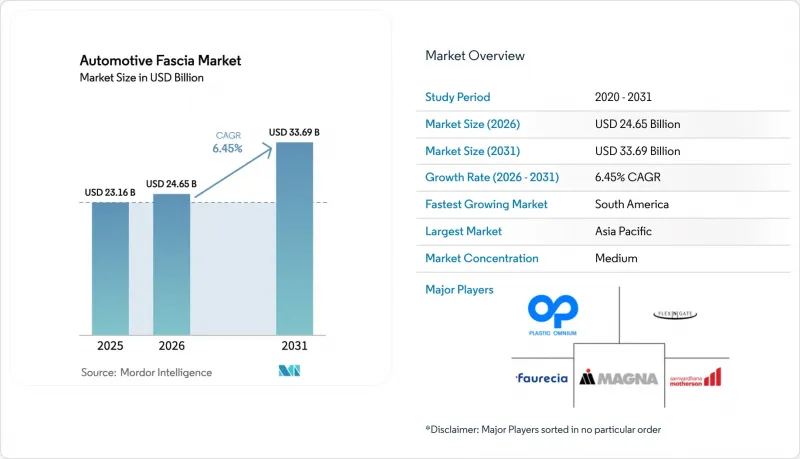
This report is Segmented by Position Type (Front Fascia and Rear Fascia), Material (Plastic Covered Styrofoam, Plastic Covered Aluminum, and More), Vehicle Type (Passenger Cars and More), Sales Channel (OEM and Aftermarket), and Geography. The Market Forecasts are Provided in Terms of Value (USD).
Global Automotive Fascia Market Trends and Insights
Growth of EV and Autonomous Vehicle Platforms
Electric vehicles change cooling loads and open grille-less design options, forcing suppliers to redesign fascia modules that can mount LiDAR, 4D radar, and high-resolution cameras without raising drag. Hyundai Mobis has introduced integrated front-face units for battery cars that package active shutters, millimeter-wave radar, and camera cleaning systems into a single sub-assembly. Additionally, Marelli announced a partnership with Hesai to embed LiDAR into headlamp housings, shifting sensing hardware from bumper skins to lighting clusters. Moreover, premium 800-volt EVs need electromagnetic shielding for high-frequency switching, so fascia panels blend aluminum films with plastic topcoats for EMI control.
Light-weighting and Emission-Regulation Compliance
Stricter CO2 caps in the EU and CAFE targets in North America push OEMs toward lighter structures that still pass FMVSS impact tests. Carbon-fiber reinforced plastics cut as much as 60% mass versus steel yet deliver the same crush-energy absorption. Constellium's M-LightEn consortium commercializes ultra-high-strength aluminum grades with 80% recycled content, reducing component carbon intensity by half. Toyoda Gosei is validating cellulose-nanofiber reinforced polypropylene to trim weight and cradle-to-grave emissions. Sensor additions add weight back in, so engineers juggle mass savings with LiDAR housings and radar radomes.
High Maintenance and Replacement Cost
Calibration of radar and camera modules after a minor parking scrape can lift repair bills by 37%, challenging insurer economics and consumer willingness to pay. OEM-approved bumper paints must remain radar-transparent, narrowing repair-paint options and steering work to certified centers with costly alignment rigs. Independent shops face five-figure investments in ADAS calibration bays, prompting market consolidation. The higher part complexity also boosts idle time, raising rental-car days and pushing insurers to negotiate deeper part discounts with Tier 1 vendors.
Other drivers and restraints analyzed in the detailed report include:
- Integration of Advanced Sensing (LiDAR/Radar) into Fascia
- Modular Front-End Modules Adoption by OEMs
- ADAS-Led Fall in Collision Frequency
For complete list of drivers and restraints, kindly check the Table Of Contents.
Segment Analysis
Front fascia assemblies represented 63.78% automotive fascia market share in 2025, underscoring their central role in aerodynamic drag reduction and pedestrian protection. This segment is forecast to progress at a 6.66% CAGR, fuelled by the need to mount high-definition cameras, long-range radar and cleaning nozzles without enlarging frontal area. Successive design cycles now route washer-fluid channels and heating elements directly into the bumper beam to guarantee sensor uptime in icy climates. Rear fascia systems trail in revenue but are also evolving to accommodate smart-lighting arrays and parking radars that help automated-parking software.
Valeo has begun validating fascia skins printed with embedded micro-LED matrices that deliver dynamic turn signals and cyclist alerts, a preview of communication-centric exteriors. The upcoming NHTSA FMVSS No. 228 rule changes amplify the need for compliant crush cans and deformable foams that maintain head-injury criteria below 1,000 HIC, driving deeper collaboration between polymer chemists and crash-simulation engineers. Bio-polypropylene foams with tuned cell geometry have emerged as candidates to balance energy absorption with recyclability.
Plastic-covered styrofoam retained a 46.10% slice of the automotive fascia market in 2025 due to mature molding economics and global tooling availability. Yet plastic-covered aluminum panels are on track for a 5.96% CAGR to 2031 as EV makers exploit aluminum's thermal conductivity to dissipate inverter heat. Thin 1 mm aluminum substrates laminated with impact-modified PP outer skins weigh 15% less than comparable PP/EPP foams while passing pedestrian impact. Emerging composite skins blend bio-polyurethane back-foams with recycled aluminum films, allowing OEMs to advertise lower cradle-to-gate CO2.
MacDermid Enthone has released anodizing chemistries that accept low-temperature plastics over-molding without blistering, streamlining joins between metal and polymer skins. Recycled aluminum scrap flows from beverage cans into Constellium grades, proving automotive fascia industry progress toward circularity. Steel and rubber blends hold niche beachheads in heavy-duty trucks where stone-chip resistance outweighs weight concerns.
Complete Report Scope:
- By Position Type
- Front Fascia
- Rear Fascia
- By Material
- Plastic-covered Styrofoam
- Plastic-covered Aluminum
- Other Materials (Steel, Rubber, etc.)
- By Vehicle Type
- Passenger Cars
- Light Commercial Vehicles
- Medium and Heavy Commercial Vehicles
- By Sales Channel
- OEM
- Aftermarket
- By Region
- North America
- United States
- Canada
- Rest of North America
- South America
- Brazil
- Argentina
- Rest of South America
- Europe
- United Kingdom
- Germany
- France
- Spain
- Russia
- Rest of Europe
- Asia-Pacific
- China
- India
- Japan
- South Korea
- Rest of Asia-Pacific
- Middle East and Africa
- Saudi Arabia
- United Arab Emirates
- Egypt
- South Africa
- Rest of Middle East and Africa
- North America
Geography Analysis
In 2025, Asia Pacific secured 47.96% of the revenue share, solidifying its position as the manufacturing epicenter of the automotive fascia market. China is one of the largest producers of vehicles in 2024 and keeps scaling gigacasting pilots that could roll fascia, crash beam, and battery tray into one aluminum shot, reducing part counts. India's auto-components roadmap targets a USD 200 billion turnover by FY26, supported by production-linked incentives that reimburse up to 13% of local value addition. Honda's CAD 15 billion (USD 11 billion) commitment to develop a Canadian EV supply chain will open new North American export routes for Asian Tier 1 tooling firms.
South America is the fastest-growing region, with a 6.98% CAGR as Stellantis channels EUR 5.6 billion into Bio-Hybrid drivetrain platforms built in Brazil and Argentina. Bio-ethanol-compatible bumpers require coatings resistant to sugar-based fuel sprays, prompting local formulators to adapt resin chemistries. Colombia has become the region's third-largest assembler, while Peru leverages free-trade agreements to ship plastic inserts and chrome trims into the United States duty-free. Exchange-rate volatility remains a cost-planning hurdle, so suppliers increasingly hedge resin contracts in USD.
North America and Europe retain strategic importance as regulation trend-setters. NHTSA's pending pedestrian rule is already embedded in 2026 model-year North American fascia designs. The EU Circular Economy Action Plan pushes recyclates into trim components and incentivizes digital passports that log resin genealogy. War-risk premiums on Red Sea freight lanes have nudged OEMs toward near-shoring fascia tool builds in Mexico and Eastern Europe. Europe's EV adoption pace demands fast cycles on grille-less styling; conversely, US demand is tied to charging-infrastructure roll-outs, leading to phased tooling plans that mix ICE and EV fascias on the same line for risk mitigation.
- Plastic Omnium
- Magna International
- Faurecia SE
- Flex-N-Gate Corporation
- Samvardhana Motherson Group
- Gestamp Automocion
- Toyoda Gosei
- Dongfeng Electronic Technology
- Aisin Corporation
- Benteler Automotive
- Denso Corporation
- Yanfeng Automotive Trim
- Sanko Gosei
- Chiyoda Manufacturing
- Dakkota Integrated Systems
- Revere Plastics Systems
- Inhance Technologies
- Eakas Corporation
- MRC Manufacturing
Additional Benefits:
- The market estimate (ME) sheet in Excel format
- 3 months of analyst support
TABLE OF CONTENTS
1 Introduction
- 1.1 Study Assumptions & Market Definition
- 1.2 Scope of the Study
2 Research Methodology
3 Executive Summary
4 Market Landscape
- 4.1 Market Overview
- 4.2 Market Drivers
- 4.2.1 Growth of EV and Autonomous Vehicle Platforms
- 4.2.2 Light-weighting and Emission-Regulation Compliance
- 4.2.3 Integration of Advanced Sensing (LiDAR/Radar) into Fascia
- 4.2.4 Increasing Vehicle Production and Sales
- 4.2.5 Modular Front-End Modules Adoption by OEMs
- 4.2.6 Shift to Recycled & Bio-Based Polymers
- 4.3 Market Restraints
- 4.3.1 Raw-Material Price Volatility
- 4.3.2 High Maintenance and Replacement Cost
- 4.3.3 ADAS-Led Fall in Collision Frequency
- 4.3.4 OEM Vertical Integration Curbing Aftermarket
- 4.4 Value / Supply-Chain Analysis
- 4.5 Technological Outlook
- 4.6 Porter's Five Forces
- 4.6.1 Threat of New Entrants
- 4.6.2 Bargaining Power of Buyers
- 4.6.3 Bargaining Power of Suppliers
- 4.6.4 Threat of Substitutes
- 4.6.5 Competitive Rivalry
5 Market Size & Growth Forecasts (Value (USD))
- 5.1 By Position Type
- 5.1.1 Front Fascia
- 5.1.2 Rear Fascia
- 5.2 By Material
- 5.2.1 Plastic-covered Styrofoam
- 5.2.2 Plastic-covered Aluminum
- 5.2.3 Other Materials (Steel, Rubber, etc.)
- 5.3 By Vehicle Type
- 5.3.1 Passenger Cars
- 5.3.2 Light Commercial Vehicles
- 5.3.3 Medium and Heavy Commercial Vehicles
- 5.4 By Sales Channel
- 5.4.1 OEM
- 5.4.2 Aftermarket
- 5.5 By Region
- 5.5.1 North America
- 5.5.1.1 United States
- 5.5.1.2 Canada
- 5.5.1.3 Rest of North America
- 5.5.2 South America
- 5.5.2.1 Brazil
- 5.5.2.2 Argentina
- 5.5.2.3 Rest of South America
- 5.5.3 Europe
- 5.5.3.1 United Kingdom
- 5.5.3.2 Germany
- 5.5.3.3 France
- 5.5.3.4 Spain
- 5.5.3.5 Russia
- 5.5.3.6 Rest of Europe
- 5.5.4 Asia-Pacific
- 5.5.4.1 China
- 5.5.4.2 India
- 5.5.4.3 Japan
- 5.5.4.4 South Korea
- 5.5.4.5 Rest of Asia-Pacific
- 5.5.5 Middle East and Africa
- 5.5.5.1 Saudi Arabia
- 5.5.5.2 United Arab Emirates
- 5.5.5.3 Egypt
- 5.5.5.4 South Africa
- 5.5.5.5 Rest of Middle East and Africa
- 5.5.1 North America
6 Competitive Landscape
- 6.1 Market Concentration
- 6.2 Strategic Moves
- 6.3 Market Share Analysis
- 6.4 Company Profiles (includes Global Level Overview, Market Level Overview, Core Segments, Financials as Available, Strategic Information, Market Rank/Share for Key Companies, Products and Services, SWOT Analysis, and Recent Developments)
- 6.4.1 Plastic Omnium
- 6.4.2 Magna International
- 6.4.3 Faurecia SE
- 6.4.4 Flex-N-Gate Corporation
- 6.4.5 Samvardhana Motherson Group
- 6.4.6 Gestamp Automocion
- 6.4.7 Toyoda Gosei
- 6.4.8 Dongfeng Electronic Technology
- 6.4.9 Aisin Corporation
- 6.4.10 Benteler Automotive
- 6.4.11 Denso Corporation
- 6.4.12 Yanfeng Automotive Trim
- 6.4.13 Sanko Gosei
- 6.4.14 Chiyoda Manufacturing
- 6.4.15 Dakkota Integrated Systems
- 6.4.16 Revere Plastics Systems
- 6.4.17 Inhance Technologies
- 6.4.18 Eakas Corporation
- 6.4.19 MRC Manufacturing
7 Market Opportunities & Future Outlook
- 7.1 White-space & Unmet-Need Assessment

