PUBLISHER: Mordor Intelligence | PRODUCT CODE: 2119687

PUBLISHER: Mordor Intelligence | PRODUCT CODE: 2119687
Italy Construction Equipment - Market Share Analysis, Industry Trends & Statistics, Growth Forecasts (2026 - 2031)
According to Mordor Intelligence, the Italy construction equipment market size in 2026 is estimated at USD 5.88 billion, growing from 2025 value of USD 5.64 billion with 2031 projections showing USD 7.24 billion, growing at 4.26% CAGR over 2026-2031.
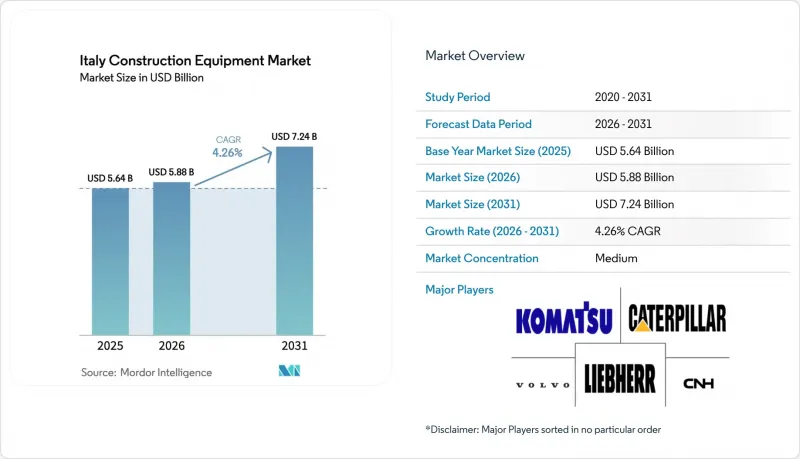
This report is Segmented by Machinery Type (Excavators, Loaders and Backhoes, Cranes, and More), and Propulsion (Internal Combustion Engine, Electric and More), Power Output (Below 75 HP, 75 To 149 HP, 150 To 300 HP, and More), Application (Residential Construction and More), and Region (Northern Italy and More). The Market Forecasts are Provided in Terms of Value (USD) and Volume (Units).
Italy Construction Equipment Market Trends and Insights
National Infrastructure Plan and EU Recovery Fund Outlays
The PNRR commits EUR 194.4 billion to transport, energy and digital corridors, with 39% earmarked for climate action, making it the single largest catalyst for heavy equipment demand nationwide. High-speed rail corridors exceeding 280 km and highway upgrades stimulate extensive orders for excavators, graders and tunneling rigs. Rolling disbursements, EUR 11 billion approved in 2024 alone, create a dependable multiyear project pipeline, smoothing revenue visibility for dealers and rental fleets. As projects observe strict environmental criteria, contractors increasingly favor low-emission models, accelerating electrification across sizeable public tenders. The multiplier effect of logistics improvements also lowers supply-chain costs for OEMs and parts suppliers, reinforcing local assembly footprints.
Residential Renovation Incentives (Superbonus 110%)
Fiscal deductions that once peaked at 110% unleashed a EUR 219 billion renovation boom, driving record utilization rates for mini-excavators, skid-steer loaders and concrete pumps. Nearly 496,000 energy-upgrade projects registered by May 2024 created scheduling backlogs that pushed contractors toward rental fleets to meet delivery dates. While the 2025 budget cuts incentives to 50% for principal dwellings, a transitional surge persists as homeowners rush to lock in higher rebates. This near-term spike boosts aftermarket parts and maintenance revenue but also prompts contractors to rebalance toward infrastructure and commercial jobs once the program tapers.
Rapid Expansion of Rental Equipment Industry
Double-digit fleet growth among national rental firms offers contractors flexible access to new technology without balance-sheet strain. For OEMs, this means larger but more concentrated customers who negotiate harder on price and refresh cycles, compressing equipment margins. Smaller dealers pivot toward service packages and certified used-equipment programs to offset lower wholesale volumes. While rentals uplift utilization of advanced telematics, they delay outright ownership in the SME segment, moderating net new unit sales in the short run.
Other drivers and restraints analyzed in the detailed report include:
- Digitalization Mandates (BIM) Boosting Smart Machinery
- OEM Electrification Roadmaps Lower Total Cost of Ownership (TCO)
- Stricter Stage V Emission Norms Raising Capex
For complete list of drivers and restraints, kindly check the Table Of Contents.
Segment Analysis
Excavators generated 39.78% of the Italy construction equipment market in 2025 as large-scale rail and road corridors demanded robust earthmoving capacities. Crawler variants dominate heavy civil lots, whereas mini-excavators thrive in dense city-center refits backed by heritage preservation codes. Telescopic handlers, the fastest climber at 6.25% CAGR, support warehouse automation, farm logistics and modular construction, reflecting diversification away from purely civil works. Loaders and backhoe units serve municipal maintenance and aggregates handling, holding steady despite slower housing starts. Cranes see selective demand peaks in high-rise schemes in Milan and Rome, yet longer replacement cycles limit their headline growth.
A parallel transition in attachment ecosystems further spurs excavator turnover, as tiltrotators, quick-couplers and 3D machine-control kits become standard inclusions. Contractors increasingly weigh digital job-site integration and operator safety aids over raw horsepower. As a result, premium-priced models with integrated grade-assist achieve quicker payback, reinforcing brand loyalty and raising barriers for low-cost import challengers.
Internal combustion engines still accounted for 82.61% of the Italy construction equipment market in 2025 due to entrenched refueling networks and established service know-how. Yet electric variants compound at 13.86% CAGR, targeting compact loaders, mini-excavators and access platforms where daily cycles align with overnight charging. Battery density improvements and the rollout of fast-charge depots at major worksites narrow productivity gaps versus diesel peers.
Hybrid drivetrains provide an interim step, cutting fuel burn 15-20% in stop-start duty without range anxiety. Stage V compliance costs continue to erode ICE price superiority, accelerating total cost-of-ownership parity as early as 2028 on urban projects with idle-reduction clauses. OEM announcements of dedicated battery Pack-As-a-Service options also lower entry barriers for smaller fleets exploring pilot deployments.
Complete Report Scope:
- By Machinery Type
- Excavators
- Crawler Excavators
- Wheeled Excavators
- Mini/Compact Excavators
- Loaders and Backhoes
- Wheel Loaders
- Skid-Steer Loaders
- Backhoe Loaders
- Cranes
- Tower Cranes
- Mobile Cranes
- Telescopic Handlers
- Motor Graders
- Asphalt Pavers and Compactors
- Drilling and Piling Rigs
- Excavators
- By Propulsion
- Internal Combustion Engine
- Electric
- Hybrid
- By Power Output
- Below 75 HP
- 75 to 149 HP
- 150 to 300 HP
- Above 300 HP
- By Application
- Residential Construction
- Commercial Construction
- Industrial and Manufacturing
- Infrastructure (Road, Rail, Ports, Airports)
- Mining and Quarrying
- Agriculture and Forestry
- By Region
- Northern Italy
- Lombardy
- Veneto
- Piedmont
- Emilia-Romagna
- Central Italy
- Lazio
- Tuscany
- Marche
- Umbria
- Southern Italy and Islands
- Campania
- Apulia
- Sicily
- Sardinia
- Calabria
- Northern Italy
List of Companies Covered in this Report:
- Caterpillar Inc.
- Komatsu Ltd.
- CNH Industrial N.V.
- Liebherr Group
- Hitachi Construction Machinery Co., Ltd.
- Deere and Company
- AB Volvo (Volvo CE)
- Hyundai Doosan Infracore Co., Ltd.
- J.C. Bamford Excavators Ltd (JCB)
- Wirtgen Group
- Manitowoc Company Inc.
- Takeuchi Mfg Co., Ltd.
- Yanmar Holdings Co., Ltd.
- Kubota Corporation
- SANY Group
- XCMG Group
- Fiori Group S.p.A.
- Bomag GmbH (Fayat Group)
- Terex Corporation
- Atlas Copco AB
Additional Benefits:
- The market estimate (ME) sheet in Excel format
- 3 months of analyst support
TABLE OF CONTENTS
1 Introduction
- 1.1 Study Assumptions and Market Definition
- 1.2 Scope of the Study
2 Research Methodology
3 Executive Summary
4 Market Landscape
- 4.1 Market Overview
- 4.2 Market Drivers
- 4.2.1 National Infrastructure Plan and EU Recovery Fund outlays
- 4.2.2 Residential renovation incentives (Superbonus 110%)
- 4.2.3 Digitalization mandates (BIM) boosting smart machinery
- 4.2.4 OEM electrification roadmaps lowering TCO
- 4.2.5 Vineyard and orchard automation driving niche equipment
- 4.2.6 Circular-economy policies expanding recycling facilities
- 4.3 Market Restraints
- 4.3.1 Rapid expansion of rental equipment industry
- 4.3.2 Stricter Stage V emission norms raising capex
- 4.3.3 Fragmented SME contractor base limiting budgets
- 4.3.4 Volatile steel prices inflating equipment costs
- 4.4 Supply-Chain Analysis
- 4.5 Regulatory Landscape
- 4.6 Technological Outlook
- 4.7 Porter's Five Forces Analysis
- 4.7.1 Threat of New Entrants
- 4.7.2 Bargaining Power of Buyers
- 4.7.3 Bargaining Power of Suppliers
- 4.7.4 Threat of Substitutes
- 4.7.5 Intensity of Competitive Rivalry
5 Market Size and Growth Forecasts (Value (USD) and Volume (Units))
- 5.1 By Machinery Type
- 5.1.1 Excavators
- 5.1.1.1 Crawler Excavators
- 5.1.1.2 Wheeled Excavators
- 5.1.1.3 Mini/Compact Excavators
- 5.1.2 Loaders and Backhoes
- 5.1.2.1 Wheel Loaders
- 5.1.2.2 Skid-Steer Loaders
- 5.1.2.3 Backhoe Loaders
- 5.1.3 Cranes
- 5.1.3.1 Tower Cranes
- 5.1.3.2 Mobile Cranes
- 5.1.4 Telescopic Handlers
- 5.1.5 Motor Graders
- 5.1.6 Asphalt Pavers and Compactors
- 5.1.7 Drilling and Piling Rigs
- 5.1.1 Excavators
- 5.2 By Propulsion
- 5.2.1 Internal Combustion Engine
- 5.2.2 Electric
- 5.2.3 Hybrid
- 5.3 By Power Output
- 5.3.1 Below 75 HP
- 5.3.2 75 to 149 HP
- 5.3.3 150 to 300 HP
- 5.3.4 Above 300 HP
- 5.4 By Application
- 5.4.1 Residential Construction
- 5.4.2 Commercial Construction
- 5.4.3 Industrial and Manufacturing
- 5.4.4 Infrastructure (Road, Rail, Ports, Airports)
- 5.4.5 Mining and Quarrying
- 5.4.6 Agriculture and Forestry
- 5.5 By Region
- 5.5.1 Northern Italy
- 5.5.1.1 Lombardy
- 5.5.1.2 Veneto
- 5.5.1.3 Piedmont
- 5.5.1.4 Emilia-Romagna
- 5.5.2 Central Italy
- 5.5.2.1 Lazio
- 5.5.2.2 Tuscany
- 5.5.2.3 Marche
- 5.5.2.4 Umbria
- 5.5.3 Southern Italy and Islands
- 5.5.3.1 Campania
- 5.5.3.2 Apulia
- 5.5.3.3 Sicily
- 5.5.3.4 Sardinia
- 5.5.3.5 Calabria
- 5.5.1 Northern Italy
6 Competitive Landscape
- 6.1 Market Concentration
- 6.2 Strategic Moves
- 6.3 Market Share Analysis
- 6.4 Company Profiles (Includes Global Level Overview, Market Level Overview, Core Segments, Financials as Available, Strategic Information, Market Rank/Share for Key Companies, Products and Services, and Recent Developments)
- 6.4.1 Caterpillar Inc.
- 6.4.2 Komatsu Ltd.
- 6.4.3 CNH Industrial N.V.
- 6.4.4 Liebherr Group
- 6.4.5 Hitachi Construction Machinery Co., Ltd.
- 6.4.6 Deere and Company
- 6.4.7 AB Volvo (Volvo CE)
- 6.4.8 Hyundai Doosan Infracore Co., Ltd.
- 6.4.9 J.C. Bamford Excavators Ltd (JCB)
- 6.4.10 Wirtgen Group
- 6.4.11 Manitowoc Company Inc.
- 6.4.12 Takeuchi Mfg Co., Ltd.
- 6.4.13 Yanmar Holdings Co., Ltd.
- 6.4.14 Kubota Corporation
- 6.4.15 SANY Group
- 6.4.16 XCMG Group
- 6.4.17 Fiori Group S.p.A.
- 6.4.18 Bomag GmbH (Fayat Group)
- 6.4.19 Terex Corporation
- 6.4.20 Atlas Copco AB
7 Market Opportunities and Future Outlook

