PUBLISHER: Mordor Intelligence | PRODUCT CODE: 2122358

PUBLISHER: Mordor Intelligence | PRODUCT CODE: 2122358
GCC Construction Machinery - Market Share Analysis, Industry Trends & Statistics, Growth Forecasts (2026 - 2031)
According to Mordor Intelligence, the GCC construction machinery market size was valued at USD 6.91 billion in 2025 and is expected to increase to USD 7.30 billion in 2026 and reach USD 9.62 billion by 2031, growing at a CAGR of 5.67% over 2026-2031.
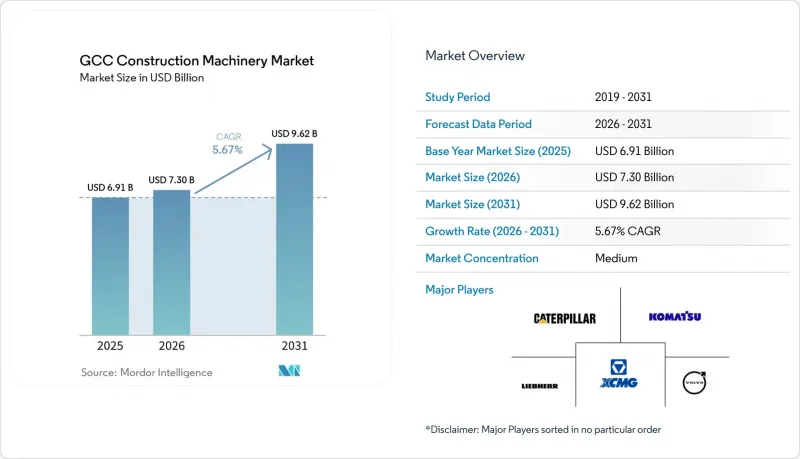
This report is Segmented by Machinery Type (Cranes, Excavators, and More), Propulsion Type (Internal Combustion Engine, Electric/Hybrid), Application Type (Concrete Construction Equipment, Road Construction Equipment, and More), End-User (Infrastructure, Commercial, and More), and Country. The Market Forecasts are Provided in Terms of Value (USD) and Volume (Units).
GCC Construction Machinery Market Trends and Insights
Vision-2030 Megaproject Pipeline Sustains Equipment Demand
Saudi Arabia's ambitious projects, including the NEOM development, The Line's 170 km linear city, and the Red Sea Project's islands, are ramping up labor demands. Starting in 2025, projections indicated significant growth over the following years. While The Line's modular construction curtails on-site concrete pours, it amplifies the need for telescopic handlers for vertical placements. Qiddiya's entertainment venues are spurring a surge in demand for seismic-compliant piling rigs. Environmental regulations, especially near coral reefs, are nudging contractors towards low-emission equipment. Meanwhile, heritage redevelopment at Diriyah Gate is bolstering the demand for graders in the adjacent road networks. However, a decline in project awards for 2025 hints at fiscal tightening. In response, OEMs are pivoting, bolstering aftermarket services and short-term rental programs to ensure steady revenue streams .
Rapid Urban Population Growth Intensifies Infrastructure Spend
Urban areas in the GCC are witnessing steady annual growth, with Riyadh, Dubai, and Doha set to welcome a significant number of additional residents between 2024 and 2026. This surge intensifies the strain on housing, transportation, and utility services. In response, Dubai has ramped up its construction activities, issuing more permits in 2024 compared to the previous year. Similarly, Abu Dhabi's construction permits have increased in the first half of 2024, driving a surge in heavy earth-moving and tunneling activities for metro extensions. In Saudi Arabia, an expansion of industrial zones is underway, part of a broader ambition to triple the manufacturing GDP by 2030. This expansion is fueling heightened equipment demand in Jubail, Yanbu, and Jazan. Concurrently, as Qatar gears up for the 2030 Asian Games, there's a renewed demand for machinery, particularly for stadium upgrades and metro extensions. Despite facing tighter fiscal balances due to declining oil prices, project sponsors are leaning towards equipment rentals as a strategy to conserve capital. This shift not only sustains equipment utilization but also curtails outright purchases.
Equipment-Rental Boom Suppresses New-Unit Sales
By 2026, regional rental turnover is expected to grow steadily, driven by contractors shifting toward variable costs over fixed ones. Market frontrunners, like Al Marwan Machinery, have significantly increased their reliance on rentals over the past five years. They're also securing substantial bulk OEM discounts. Meanwhile, digital exchanges are optimizing idle inventories and improving utilization rates. This improvement enables aggressive rate under-cutting, putting pressure on dealer margins. In response, OEMs are introducing captive rental divisions and certified pre-owned programs. However, their internal forecasts indicate a consistent annual decline in new-unit shipments throughout the forecast period.
Other drivers and restraints analyzed in the detailed report include:
- Electrification Mandates in Flagship Smart-City Projects (e.g., NEOM)
- Localization Incentives Spur Regional Assembly Investments
- Oil-Price Volatility Curbs Public Sector Capex Cycles
For complete list of drivers and restraints, kindly check the Table Of Contents.
Segment Analysis
Excavators held 55.02% of the GCC construction machinery market share in 2025 and will stay dominant through 2031 as giga-projects emphasize large-scale earth-moving. Loaders and backhoes follow, especially in urban infill zones, yet telescopic handlers are eroding their niche for high-rise assembly. Motor graders' 7.24% CAGR outpaces every other category, guided by rail and highway corridors that adopt GPS-controlled slope management to shave rework by one-fifth. Specialty amphibious excavators, winner of a 2025 regional innovation prize, extend workable terrain into coastal and dredging sites, a rising theme as Saudi and Omani ports expand. Crane volumes remain stable at roughly one-eighth of demand but skew heavily toward tower and mobile units rated above 100 tonnes for renewable component lifts.
A widening technology gap defines competitive positioning. Onboard telematics provide bucket-level output metrics that channel directly into BIM dashboards, and hybrid drivetrains lower fuel burn by 20-30% on stop-start urban cycles. Meanwhile, 3D-printed concrete pilots hint at a distant threat to traditional mixers and pumps, though code harmonization remains several years away. Rental fleets rotate core earth-moving models every three to five years, feeding a lucrative export pipeline into Africa and South Asia, where well-maintained GCC units command premium resale values. Continuous localization of undercarriage fabrication and cab assembly inside Saudi Arabia promises shorter lead times and tighter integration between after-sales and parts distribution networks.
Diesel still powers 96.25% of the GCC construction machinery market in 2025, thanks to high energy density, ubiquitous fuel logistics, and comparatively low capex. Yet electric and hybrid options are scaling from a small base at a 25.13% CAGR-the fastest within any segmentation-as flagship smart cities impose zero-emission mandates. Early adopters focus on wheel loaders and mini excavators where 8-hour cycles align with daytime grid availability, while hybrids that capture brake energy deliver a swift 20-30% fuel reduction without range anxiety.
Cost, battery-life degradation under extreme heat, and sparse charging topologies constrain widescale replacement until prices approach parity around 2030. OEMs and local utilities are piloting solar-plus-storage hubs that double as fleet depots, smoothing load on overstretched grids. Hydrogen remains experimental pending scale economics that can compress production significantly. In the interim, diesel-electric hybrids emerge as a bridge technology, helping end users meet tightening emissions codes without overhauling site logistics.
Complete Report Scope:
- By Machinery Type
- Cranes
- Excavators
- Loaders and Backhoes
- Motor Graders
- Telescopic Handlers
- Other Machinery
- By Propulsion Type
- Internal Combustion Engine (ICE)
- Electric / Hybrid
- By Application Type
- Concrete Construction Equipment
- Road Construction Equipment
- Earth-Moving Equipment
- Material Handling Equipment
- By End-User
- Infrastructure
- Commercial
- Residential
- Industrial
- By Country
- Saudi Arabia
- United Arab Emirates
- Kuwait
- Qatar
- Oman
- Bahrain
List of Companies Covered in this Report:
- Caterpillar Inc.
- Komatsu Ltd.
- AB Volvo (Volvo Construction Equipment)
- Xuzhou Construction Machinery Group Co., Ltd.
- Liebherr International AG
- Hitachi Construction Machinery Co. Ltd.
- Hyundai Construction Equipment Co.,Ltd.
- J.C. Bamford Excavators Ltd (JCB)
- Sany Heavy Industry Co. Ltd
- Deere & Company
- CNH Industrial N.V.(Case Construction)
- Kobelco Construction Machinery Co. Ltd
- Sumitomo Construction Machinery
- Doosan Bobcat (Develon)
- Terex Corporation
- Manitou Group
- Zoomlion Heavy Industry Science and Technology Co., Ltd
- Yanmar Holdings Co. Ltd
- Wacker Neuson SE
Additional Benefits:
- The market estimate (ME) sheet in Excel format
- 3 months of analyst support
TABLE OF CONTENTS
1 Introduction
- 1.1 Study Assumptions & Market Definition
- 1.2 Scope of the Study
2 Research Methodology
3 Executive Summary
4 Market Landscape
- 4.1 Market Overview
- 4.2 Market Drivers
- 4.2.1 Vision-2030 Megaproject Pipeline Sustains Equipment Demand
- 4.2.2 Rapid Urban Population Growth Intensifies Infrastructure Spend
- 4.2.3 Electrification Mandates in Flagship Smart-City Projects (e.g., NEOM)
- 4.2.4 Localization Incentives Spur Regional Assembly Investments
- 4.2.5 Mandatory BIM Adoption Boosts Demand for Connected Machinery
- 4.2.6 Green Hydrogen Build-Out Drives Specialized Heavy-Lift Needs
- 4.3 Market Restraints
- 4.3.1 Equipment-Rental Boom Suppresses New-Unit Sales
- 4.3.2 Oil-Price Volatility Curbs Public Sector Capex Cycles
- 4.3.3 Skilled-Operator Shortage Delays Fleet Expansions
- 4.3.4 Stringent Water-Use Regulations Raise Operating Costs
- 4.4 Value / Supply-Chain Analysis
- 4.5 Regulatory Landscape
- 4.6 Technological Outlook
- 4.7 Porter's Five Forces
- 4.7.1 Threat of New Entrants
- 4.7.2 Bargaining Power of Buyers
- 4.7.3 Bargaining Power of Suppliers
- 4.7.4 Threat of Substitutes
- 4.7.5 Competitive Rivalry
5 Market Size and Growth Forecasts (Value (USD) and Volume (Units))
- 5.1 By Machinery Type
- 5.1.1 Cranes
- 5.1.2 Excavators
- 5.1.3 Loaders and Backhoes
- 5.1.4 Motor Graders
- 5.1.5 Telescopic Handlers
- 5.1.6 Other Machinery
- 5.2 By Propulsion Type
- 5.2.1 Internal Combustion Engine (ICE)
- 5.2.2 Electric / Hybrid
- 5.3 By Application Type
- 5.3.1 Concrete Construction Equipment
- 5.3.2 Road Construction Equipment
- 5.3.3 Earth-Moving Equipment
- 5.3.4 Material Handling Equipment
- 5.4 By End-User
- 5.4.1 Infrastructure
- 5.4.2 Commercial
- 5.4.3 Residential
- 5.4.4 Industrial
- 5.5 By Country
- 5.5.1 Saudi Arabia
- 5.5.2 United Arab Emirates
- 5.5.3 Kuwait
- 5.5.4 Qatar
- 5.5.5 Oman
- 5.5.6 Bahrain
6 Competitive Landscape
- 6.1 Market Concentration
- 6.2 Strategic Moves
- 6.3 Market Share Analysis
- 6.4 Company Profiles (includes Global Level Overview, Market Level Overview, Core Segments, Financials as Available, Strategic Information, Market Rank/Share for Key Companies, Products and Services, SWOT Analysis, and Recent Developments)
- 6.4.1 Caterpillar Inc.
- 6.4.2 Komatsu Ltd.
- 6.4.3 AB Volvo (Volvo Construction Equipment)
- 6.4.4 Xuzhou Construction Machinery Group Co., Ltd.
- 6.4.5 Liebherr International AG
- 6.4.6 Hitachi Construction Machinery Co. Ltd.
- 6.4.7 Hyundai Construction Equipment Co.,Ltd.
- 6.4.8 J.C. Bamford Excavators Ltd (JCB)
- 6.4.9 Sany Heavy Industry Co. Ltd
- 6.4.10 Deere & Company
- 6.4.11 CNH Industrial N.V.(Case Construction)
- 6.4.12 Kobelco Construction Machinery Co. Ltd
- 6.4.13 Sumitomo Construction Machinery
- 6.4.14 Doosan Bobcat (Develon)
- 6.4.15 Terex Corporation
- 6.4.16 Manitou Group
- 6.4.17 Zoomlion Heavy Industry Science and Technology Co., Ltd
- 6.4.18 Yanmar Holdings Co. Ltd
- 6.4.19 Wacker Neuson SE
7 Market Opportunities & Future Outlook

