PUBLISHER: Mordor Intelligence | PRODUCT CODE: 2123748

PUBLISHER: Mordor Intelligence | PRODUCT CODE: 2123748
Edge Computing In Automotive - Market Share Analysis, Industry Trends & Statistics, Growth Forecasts (2026 - 2031)
According to Mordor Intelligence, the edge computing in automotive market size in 2026 is estimated at USD 15.17 billion, growing from 2025 value of USD 12.7 billion with 2031 projections showing USD 36.97 billion, growing at 19.48% CAGR over 2026-2031.
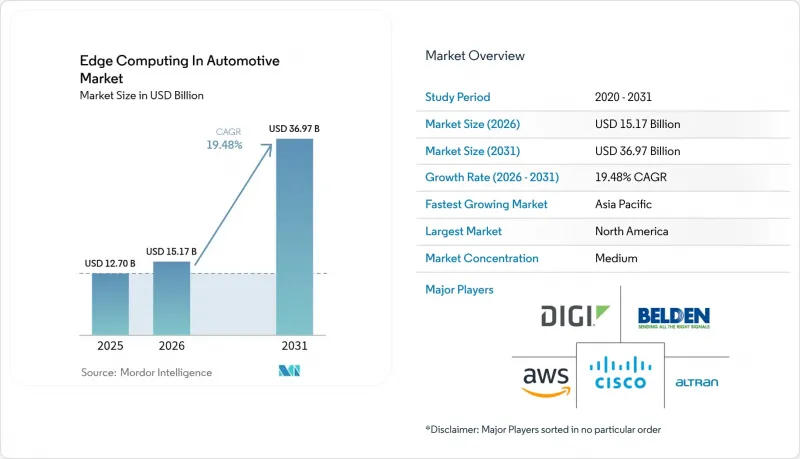
This report is Segmented by Component (Hardware, Software and More), Deployment Model (On-Board Vehicle Edge, Network/MEC Edge and More), Vehicle Type (Passenger Cars, Light Commercial Vehicles and More), Application (Connected Cars (Infotainment and OTA), ADAS and Autonomous Driving, Traffic Management and V2I, and More), and Geography. The Market Forecasts are Provided in Terms of Value (USD).
Global Edge Computing In Automotive Market Trends and Insights
Mainstream - Proliferation of Vehicle Sensors and 5G Rollouts
Modern cars host up to 200 sensors that stream 25 GB of data per hour, a volume that overwhelms legacy architectures. 5G radio access now delivers sub-10 ms latency, demonstrated when Deutsche Telekom and Nokia cut V2X delays below 30 ms in the Car2MEC trials. Carmakers therefore embed local processing to classify, compress, and react to hazards before forwarding essential insights to the cloud. The outcome is a decisive tilt from central to distributed compute, which underpins rising hardware demand and reinforces the edge computing in automotive market's rapid CAGR.
Mainstream - OEM Shift Toward Software-Defined Vehicles
Manufacturers rewrite their business models around code updates and digital features. Bosch and Volkswagen's Cariad arm assigned 1,000 engineers to co-develop AI platforms slated for 2025 vehicles. Always-connected cars now require secure, over-the-air software pipes plus high-performance in-vehicle compute to validate and roll back code safely. These workflows enlarge service revenue pools and elevate the edge computing in automotive market as a core monetization pillar.
Mainstream - High Upfront Infrastructure Capex
Complete edge stacks bundle compute nodes, private 5G, and hardened security, a combination that pushed Verizon and Audi's German test site budget past USD 10 million. Capital intensity deters smaller OEMs and stalls projects in price-sensitive regions. Consequently, deployments prioritize functions that yield immediate safety payback while broader optimization waits for cost curves to drop.
Other drivers and restraints analyzed in the detailed report include:
- Under-the-radar - Curb-side Micro-edge Nodes by Cities
- Under-the-radar - Battery-friendly In-vehicle AI Accelerators Cut TCO
- Mainstream - Cyber-security and Data-sovereignty Risks
For complete list of drivers and restraints, kindly check the Table Of Contents.
Segment Analysis
Hardware captured 43.45% revenue in 2025, underscoring the essential role of rugged processors, AI accelerators, and thermal solutions inside vehicles. This slice translates to the largest edge computing in automotive market share thanks to silicon that tolerates vibration and 125 °C ambient. In dollar terms the edge computing in automotive market size for hardware will still climb, yet services enjoy a steeper 24.89% CAGR as integrators manage over-the-air rollouts for mixed global fleets. Automakers gravitate toward turnkey services because the learning curve for functional safety, cybersecurity, and real-time scheduling is steep. Suppliers such as Intel-after absorbing Silicon Mobility-bundle chips with middleware and long-term update contracts. The shift channels margin away from pure-play hardware and pushes platform vendors to partner with cloud operators for joint lifecycle offerings, reinforcing service momentum.
On-board compute retained 46.02% of 2025 revenue, underlining OEM confidence in self-contained reliability. Still, infrastructure nodes are tracking a 21.55% CAGR as smart-city budgets finance roadside boxes that extend awareness beyond a single car. This growth enlarges the edge computing in automotive market size for public edge assets and invites telecom carriers and municipalities into revenue-sharing schemes. Hybrid topologies are emerging whereby vehicle, network, and curb-side processors cooperate. The Automotive Edge Computing Consortium promotes such split-compute frameworks to optimize cost and latency. Carmakers must now certify software across heterogeneous domains, elevating interoperability toolchains and driving standards activity.
Complete Report Scope:
- By Component
- Hardware
- Software
- Services
- By Deployment Model
- On-board Vehicle Edge
- Network/MEC Edge
- Infrastructure Edge (Road-side and Smart City)
- By Vehicle Type
- Passenger Cars
- Light Commercial Vehicles
- Heavy Commercial Vehicles
- Off-highway and Specialty Vehicles
- By Application
- Connected Cars (Infotainment and OTA)
- ADAS and Autonomous Driving
- Traffic Management and V2I
- Fleet and Logistics Optimisation
- Smart Cities Services
- By Geography
- North America
- United States
- Canada
- Mexico
- South America
- Brazil
- Argentina
- Chile
- Colombia
- Europe
- Germany
- United Kingdom
- France
- Italy
- Spain
- Russia
- Asia-Pacific
- China
- Japan
- India
- South Korea
- Australia
- Indonesia
- Middle East and Africa
- Middle East
- United Arab Emirates
- Saudi Arabia
- Turkey
- Israel
- Africa
- South Africa
- Nigeria
- Egypt
- Middle East
- North America
Geography Analysis
North America led with 34.95% revenue in 2025, supported by early 5G rollouts, orderly spectrum policy, and tight OEM-tech partnerships. Tesla, General Motors, and Ford pair with Intel, NVIDIA, and Qualcomm to co-design application-specific processors and testing regimes. Verizon's private-network program underscores the region's readiness to scale low-latency automotive workloads. Funding incentives at state and federal levels further anchor edge labs and pilot corridors. Asia-Pacific is forecast to register a 24.12% CAGR to 2031. China merges electric-vehicle subsidies, vast consumer volumes, and city-led smart-transport schemes, creating a fertile edge computing in automotive market. Huawei's launch of 100 autonomous 5G-A mine trucks in Inner Mongolia illustrates industrial-grade deployment under harsh conditions. Japan and South Korea supply advanced semiconductor nodes, while India positions talent hubs that write in-vehicle software for global OEMs. Europe maintains momentum through premium marques and strict safety law. UNECE WP.29 and GDPR force rigorous cybersecurity and data-localization, raising the baseline for edge solutions. Bosch and Microsoft now co-produce generative-AI toolchains that comply with ISO 26262 functional-safety standards. Pan-EU digital strategies and cross-border 5G corridors allow continuous roaming for autonomous trucks between Germany, Austria, and Italy.
- Amazon Web Services, Inc.
- Cisco Systems, Inc.
- Huawei Technologies Co., Ltd.
- Hewlett Packard Enterprise Development LP
- IBM Corporation
- Intel Corporation
- NVIDIA Corporation
- Qualcomm Technologies, Inc.
- Ericsson AB
- Siemens AG
- Robert Bosch GmbH
- Continental AG
- Verizon Communications Inc.
- Vodafone Group Plc
- Belden Inc.
- Digi International Inc.
- Litmus Automation Inc.
- Azion Technologies Ltd.
- Altran Technologies SA
Additional Benefits:
- The market estimate (ME) sheet in Excel format
- 3 months of analyst support
TABLE OF CONTENTS
1 INTRODUCTION
- 1.1 Study Assumptions and Market Definition
- 1.2 Scope of the Study
2 RESEARCH METHODOLOGY
3 EXECUTIVE SUMMARY
4 MARKET LANDSCAPE
- 4.1 Market Overview
- 4.2 Market Drivers
- 4.2.1 Mainstream Proliferation of Vehicle Sensors And 5G Rollouts
- 4.2.2 Mainstream OEM Shift Toward Software-Defined Vehicles
- 4.2.3 Mainstream Regulatory Support for V2X Safety Mandates
- 4.2.4 Mainstream Rising IoT Data Traffic Per Car
- 4.2.5 Deployment of Curb-Side Micro-Edge Nodes by Cities
- 4.2.6 Battery-Friendly In-Vehicle AI Accelerators Cut TCO
- 4.3 Market Restraints
- 4.3.1 Mainstream High Upfront Infrastructure Capex
- 4.3.2 Mainstream Cyber-Security and Data-Sovereignty Risks
- 4.3.3 Scarcity of Automotive-Grade Edge Silicon Supply
- 4.3.4 Fragmented MEC Interoperability Standards
- 4.4 Industry Value Chain Analysis
- 4.5 Regulatory Landscape
- 4.6 Technological Outlook
- 4.7 Porter's Five Forces Analysis
- 4.7.1 Bargaining Power of Buyers/Consumers
- 4.7.2 Bargaining Power of Suppliers
- 4.7.3 Threat of New Entrants
- 4.7.4 Threat of Substitute Products
- 4.7.5 Intensity of Competitive Rivalry
5 MARKET SIZE AND GROWTH FORECASTS (VALUE)
- 5.1 By Component
- 5.1.1 Hardware
- 5.1.2 Software
- 5.1.3 Services
- 5.2 By Deployment Model
- 5.2.1 On-board Vehicle Edge
- 5.2.2 Network/MEC Edge
- 5.2.3 Infrastructure Edge (Road-side and Smart City)
- 5.3 By Vehicle Type
- 5.3.1 Passenger Cars
- 5.3.2 Light Commercial Vehicles
- 5.3.3 Heavy Commercial Vehicles
- 5.3.4 Off-highway and Specialty Vehicles
- 5.4 By Application
- 5.4.1 Connected Cars (Infotainment and OTA)
- 5.4.2 ADAS and Autonomous Driving
- 5.4.3 Traffic Management and V2I
- 5.4.4 Fleet and Logistics Optimisation
- 5.4.5 Smart Cities Services
- 5.5 By Geography
- 5.5.1 North America
- 5.5.1.1 United States
- 5.5.1.2 Canada
- 5.5.1.3 Mexico
- 5.5.2 South America
- 5.5.2.1 Brazil
- 5.5.2.2 Argentina
- 5.5.2.3 Chile
- 5.5.2.4 Colombia
- 5.5.3 Europe
- 5.5.3.1 Germany
- 5.5.3.2 United Kingdom
- 5.5.3.3 France
- 5.5.3.4 Italy
- 5.5.3.5 Spain
- 5.5.3.6 Russia
- 5.5.4 Asia-Pacific
- 5.5.4.1 China
- 5.5.4.2 Japan
- 5.5.4.3 India
- 5.5.4.4 South Korea
- 5.5.4.5 Australia
- 5.5.4.6 Indonesia
- 5.5.5 Middle East and Africa
- 5.5.5.1 Middle East
- 5.5.5.1.1 United Arab Emirates
- 5.5.5.1.2 Saudi Arabia
- 5.5.5.1.3 Turkey
- 5.5.5.1.4 Israel
- 5.5.5.2 Africa
- 5.5.5.2.1 South Africa
- 5.5.5.2.2 Nigeria
- 5.5.5.2.3 Egypt
- 5.5.5.1 Middle East
- 5.5.1 North America
6 COMPETITIVE LANDSCAPE
- 6.1 Market Concentration
- 6.2 Strategic Moves
- 6.3 Market Share Analysis
- 6.4 Company Profiles (includes Global level Overview, Market level overview, Core Segments, Financials as available, Strategic Information, Market Rank/Share for key companies, Products and Services, and Recent Developments)
- 6.4.1 Amazon Web Services, Inc.
- 6.4.2 Cisco Systems, Inc.
- 6.4.3 Huawei Technologies Co., Ltd.
- 6.4.4 Hewlett Packard Enterprise Development LP
- 6.4.5 IBM Corporation
- 6.4.6 Intel Corporation
- 6.4.7 NVIDIA Corporation
- 6.4.8 Qualcomm Technologies, Inc.
- 6.4.9 Ericsson AB
- 6.4.10 Siemens AG
- 6.4.11 Robert Bosch GmbH
- 6.4.12 Continental AG
- 6.4.13 Verizon Communications Inc.
- 6.4.14 Vodafone Group Plc
- 6.4.15 Belden Inc.
- 6.4.16 Digi International Inc.
- 6.4.17 Litmus Automation Inc.
- 6.4.18 Azion Technologies Ltd.
- 6.4.19 Altran Technologies SA
7 MARKET OPPORTUNITIES AND FUTURE OUTLOOK
- 7.1 White-space and Unmet-need Assessment

