PUBLISHER: Mordor Intelligence | PRODUCT CODE: 2119764

PUBLISHER: Mordor Intelligence | PRODUCT CODE: 2119764
Child Care - Market Share Analysis, Industry Trends & Statistics, Growth Forecasts (2026 - 2031)
According to Mordor Intelligence, the child care market size is projected to expand from USD 263.86 billion in 2025 and USD 274.71 billion in 2026 to USD 354.81 billion by 2031, registering a CAGR of 5.25% between 2026 to 2031.
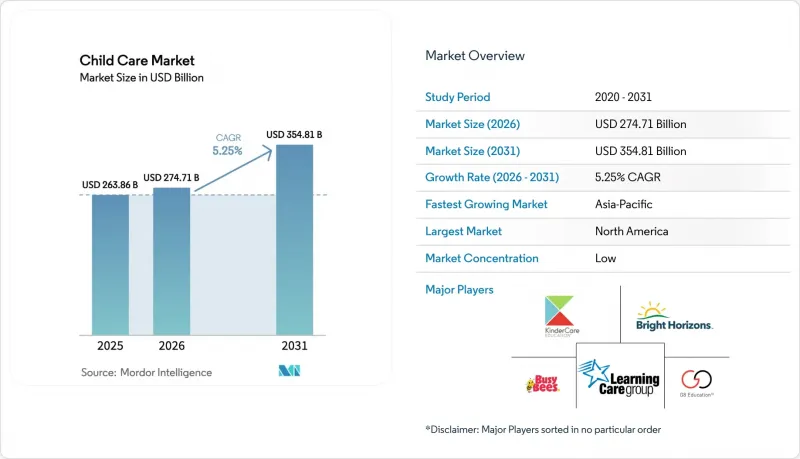
This report is Segmented by Service Type (Centre-Based Care, Home-Based Care, Digital & Hybrid Care), Age Group (Infant, Toddler, Preschool, School-Age, Special Needs), Payment Mode (Self-Pay, Government Subsidy, Employer-Sponsored, Philanthropy, PPP), Provider Ownership (For-Profit, Not-For-Profit, and More), and Geography (North America, and More). Market Forecasts are Provided in Terms of Value (USD).
Global Child Care Market Trends and Insights
Rising Dual-Income Households
Female labor-force participation in the United States climbed to 57.4% in 2025, and dual-earner families now account for 63% of households with children under six years. Canada's CAD 10-per-day policy produced a 22% jump in applications, while Australia's 90% subsidy ceiling added 15% more users. These shifts compress informal-care windows and lengthen wait lists in metro regions.
Government Affordability Programs & Subsidies
The U.S. dependent-care tax credit rose to USD 4,000 per child in 2025. The UK injected GBP 1.5 billion to extend thirty free hours weekly to infants. Germany eliminated municipal fees for low-income families, and Japan raised subsidy ceilings for part-time workers, each move tilting revenue mixes toward public reimbursement.
Chronic Early-Childhood Educator Shortages
Vacancy rates hit 12% in the U.S. during 2025 and 34% of UK nursery staff exit within two years of qualification. Australia introduced AUD 10,000 retention bonuses, yet supply still trails demand, limiting new-seat growth and raising wage bills.
Other drivers and restraints analyzed in the detailed report include:
- Corporate Demand for Employer-Sponsored Care
- Digital Platform Expansion & Enrollment Automation
- Rising Operating & Real-Estate Costs Outpacing Fees
For complete list of drivers and restraints, kindly check the Table Of Contents.
Segment Analysis
Center-based formats captured 66.36% of the child care market in 2025, propelled by curricula and peer socialization advantages. Digital programs' 8.14% CAGR reflects platform-enabled rural reach and blended hub-and-spoke models that shrink real-estate intensity. Outside-school-hours care gains from dual-earner schedules, whereas employer sites achieve 85% to 95% utilization, improving child care market size resilience. Home-based offerings serve price-sensitive families but scale poorly under tighter licensing rules. Nanny and au-pair care remains niche, hampered by visa ceilings. Virtual preschool, recognized by China's 2024 edict, externalizes content delivery and positions tech firms to claim incremental share.
Preschoolers accounted for 52.67% of 2025 enrollments due to universal pre-K mandates, yet growth plateaus where public systems mature. Infant care's 9.46% CAGR ties to abbreviated leave policies and corporate return-to-office mandates, enlarging the child care market size at younger age bands. Lower adult-to-child ratios inflate provider costs but justify 20% to 40% tuition premiums, supporting stable child care market share for full-service operators. Subsidy boosts in Japan and Canada channel funds to infants, while school-age programs compete with sports leagues, constraining after-school penetration.
Complete Report Scope:
- By Service Type
- Centre-based Care
- Long Day Care / Nursery Schools
- Preschool / Pre-Kindergarten
- Outside School-Hours Care (Before / After)
- Employer On-site / Near-site Centres
- Drop-in & Flexible Micro-Centres
- Home-based Care
- Licensed Family Day Care
- Unlicensed Family / Informal Care
- Nanny / Au Pair In-home Care
- In-home Care for Special Needs / Medical
- Digital & Hybrid Care
- Virtual Early-Learning Programs
- Marketplace & Booking Platforms
- Blended Hub-and-Spoke Models
- Centre-based Care
- By Age Group
- Infant (0-12 mo)
- Toddler (1-2 yr)
- Preschool (3-5 yr)
- School-Age (6-12 yr)
- Children with Special Needs (0-12 yr)
- By Payment / Funding Mode
- Self-Pay / Out-of-Pocket
- Government Subsidy / Voucher
- Employer-Sponsored
- Philanthropy / NGO Grants
- Public-Private Partnership (Mixed)
- By Provider Ownership
- For-profit
- Not-for-profit
- Government-Operated
- Cooperative / Parent-Led
- By Geography
- North America
- United States
- Canada
- Mexico
- Europe
- Germany
- France
- United Kingdom
- Italy
- Spain
- Rest of Europe
- Asia-Pacific
- China
- Japan
- India
- South Korea
- Australia
- Rest of Asia-Pacific
- Middle East & Africa
- GCC
- South Africa
- Rest of Middle East & Africa
- South America
- Brazil
- Argentina
- Rest of South America
- North America
Geography Analysis
North America generated 42.62% of global value in 2025. U.S. tuition averages USD 12,000 a year, but educator shortages and stricter HVAC rules limit expansion. Canada's subsidy sweep deepened the addressable base, though queue times stretch past twelve months in Toronto. Mexico's formal penetration lags 15%, but metropolitan dual-earner demand draws regional chains.
Asia-Pacific is on a 7.82% CAGR path through 2031. China's virtual preschool approvals add low-capex seats, while India's urban nuclear families pay up to INR 15,000 monthly, equal to 20% to 30% of median income. Japan widened subsidy ceilings for part-timers, and Australia lifted its top subsidy to 90%, both moving more parents into regulated networks.
Europe blends near-universal preschool with targeted private niches. The UK's 30 free weekly hours spiked enrollment but squeezed margins for 12% of operators. Germany's fee-free push removes price barriers below EUR 60,000 income, while France's public ecole maternelle caps the private-sector ceiling at infant and extended-hour services. Southern Europe's cultural reliance on grandparents slows uptake but urbanization is nudging change.
- Benesse Style Care
- Bright Horizons Family Solutions
- Busy Bees
- C.H.I.L.D. Center UAE
- Cadence Education
- Childcare Network
- CombiWith Corporation
- G8 Education
- Goddard Systems
- Goodstart Early Learning
- Kids & Company
- KinderCare Learning Companies
- Learning Care Group
- Nord Anglia Education
- Pigeon Hearts Co.
- Poppins Corporation
- Primrose Schools
- Smartkidz Educare Global
- Spring Education Group
- The Learning Experience
Additional Benefits:
- The market estimate (ME) sheet in Excel format
- 3 months of analyst support
TABLE OF CONTENTS
1 Introduction
- 1.1 Study Assumptions & Market Definition
- 1.2 Scope of the Study
2 Research Methodology
3 Executive Summary
4 Market Landscape
- 4.1 Market Overview
- 4.2 Market Drivers
- 4.2.1 Rising Dual-Income Households
- 4.2.2 Government Affordability Programs & Subsidies
- 4.2.3 Corporate Demand for Employer-Sponsored Care
- 4.2.4 Digital Platform Expansion & Enrollment Automation
- 4.2.5 AI-Enabled Adaptive Learning & Safety Analytics
- 4.2.6 Urban Micro-Centre Formats in Retail Real-Estate Voids
- 4.3 Market Restraints
- 4.3.1 Chronic Early-Childhood Educator Shortages
- 4.3.2 Rising Operating & Real-Estate Costs Outpacing Fees
- 4.3.3 Tightening Indoor-Air & Building Codes Post-COVID-19
- 4.3.4 Low Penetration of Child-Care Insurance Financing Tools
- 4.4 Value / Supply-Chain Analysis
- 4.5 Regulatory Landscape
- 4.6 Technological Outlook
- 4.7 Porter's Five Forces Analysis
- 4.7.1 Threat of New Entrants
- 4.7.2 Bargaining Power of Suppliers
- 4.7.3 Bargaining Power of Buyers
- 4.7.4 Threat of Substitutes
- 4.7.5 Intensity of Competitive Rivalry
5 Market Size & Growth Forecasts (Value in USD)
- 5.1 By Service Type
- 5.1.1 Centre-based Care
- 5.1.1.1 Long Day Care / Nursery Schools
- 5.1.1.2 Preschool / Pre-Kindergarten
- 5.1.1.3 Outside School-Hours Care (Before / After)
- 5.1.1.4 Employer On-site / Near-site Centres
- 5.1.1.5 Drop-in & Flexible Micro-Centres
- 5.1.2 Home-based Care
- 5.1.2.1 Licensed Family Day Care
- 5.1.2.2 Unlicensed Family / Informal Care
- 5.1.2.3 Nanny / Au Pair In-home Care
- 5.1.2.4 In-home Care for Special Needs / Medical
- 5.1.3 Digital & Hybrid Care
- 5.1.3.1 Virtual Early-Learning Programs
- 5.1.3.2 Marketplace & Booking Platforms
- 5.1.3.3 Blended Hub-and-Spoke Models
- 5.1.1 Centre-based Care
- 5.2 By Age Group
- 5.2.1 Infant (0-12 mo)
- 5.2.2 Toddler (1-2 yr)
- 5.2.3 Preschool (3-5 yr)
- 5.2.4 School-Age (6-12 yr)
- 5.2.5 Children with Special Needs (0-12 yr)
- 5.3 By Payment / Funding Mode
- 5.3.1 Self-Pay / Out-of-Pocket
- 5.3.2 Government Subsidy / Voucher
- 5.3.3 Employer-Sponsored
- 5.3.4 Philanthropy / NGO Grants
- 5.3.5 Public-Private Partnership (Mixed)
- 5.4 By Provider Ownership
- 5.4.1 For-profit
- 5.4.2 Not-for-profit
- 5.4.3 Government-Operated
- 5.4.4 Cooperative / Parent-Led
- 5.5 By Geography
- 5.5.1 North America
- 5.5.1.1 United States
- 5.5.1.2 Canada
- 5.5.1.3 Mexico
- 5.5.2 Europe
- 5.5.2.1 Germany
- 5.5.2.2 France
- 5.5.2.3 United Kingdom
- 5.5.2.4 Italy
- 5.5.2.5 Spain
- 5.5.2.6 Rest of Europe
- 5.5.3 Asia-Pacific
- 5.5.3.1 China
- 5.5.3.2 Japan
- 5.5.3.3 India
- 5.5.3.4 South Korea
- 5.5.3.5 Australia
- 5.5.3.6 Rest of Asia-Pacific
- 5.5.4 Middle East & Africa
- 5.5.4.1 GCC
- 5.5.4.2 South Africa
- 5.5.4.3 Rest of Middle East & Africa
- 5.5.5 South America
- 5.5.5.1 Brazil
- 5.5.5.2 Argentina
- 5.5.5.3 Rest of South America
- 5.5.1 North America
6 Competitive Landscape
- 6.1 Market Concentration
- 6.2 Market Share Analysis
- 6.3 Company Profiles (includes Global level Overview, Market level overview, Core Segments, Financials as available, Strategic Information, Market Rank/Share for key companies, Products and Services, and Recent Developments)
- 6.3.1 Benesse Style Care
- 6.3.2 Bright Horizons Family Solutions
- 6.3.3 Busy Bees
- 6.3.4 C.H.I.L.D. Center UAE
- 6.3.5 Cadence Education
- 6.3.6 Childcare Network
- 6.3.7 CombiWith Corporation
- 6.3.8 G8 Education
- 6.3.9 Goddard Systems
- 6.3.10 Goodstart Early Learning
- 6.3.11 Kids & Company
- 6.3.12 KinderCare Learning Companies
- 6.3.13 Learning Care Group
- 6.3.14 Nord Anglia Education
- 6.3.15 Pigeon Hearts Co.
- 6.3.16 Poppins Corporation
- 6.3.17 Primrose Schools
- 6.3.18 Smartkidz Educare Global
- 6.3.19 Spring Education Group
- 6.3.20 The Learning Experience
7 Market Opportunities & Future Outlook
- 7.1 White-space & Unmet-Need Assessment

