PUBLISHER: Mordor Intelligence | PRODUCT CODE: 2119768

PUBLISHER: Mordor Intelligence | PRODUCT CODE: 2119768
Europe Electric Fireplace - Market Share Analysis, Industry Trends & Statistics, Growth Forecasts (2026 - 2031)
According to Mordor Intelligence, the Europe electric fireplace market size was valued at USD 680 million in 2025 and estimated to grow from USD 713.59 million in 2026 to reach USD 908.14 million by 2031, at a CAGR of 4.94% during the forecast period (2026-2031).
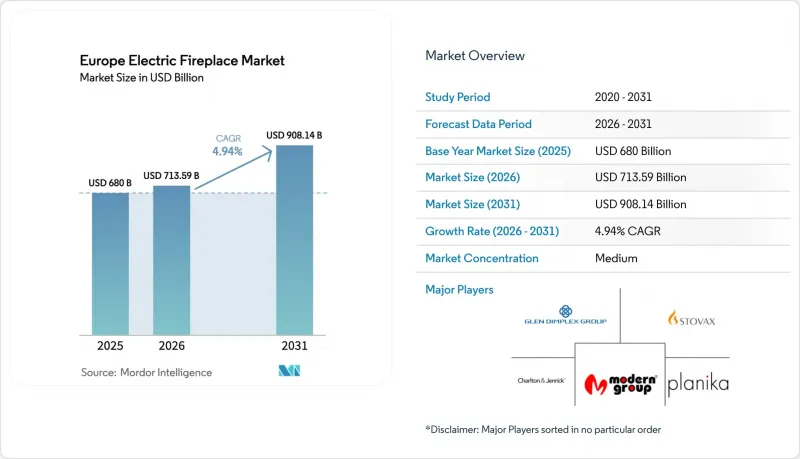
This report is Segmented by Type (Stove, Insert, Table-Top, Wall-Mounted, Freestanding), Size (Small Up To 35", Medium 36-42", Large 43-48", Extra Large 49" & Above), Application (Residential, Commercial), and Geography (UK, Germany, France, Spain, Italy, BENELUX, NORDICS, Rest of Europe). The Market Forecasts are Provided in Terms of Value (USD).
Europe Electric Fireplace Market Trends and Insights
Decarbonization Push and Electrification of Home Heating
European Union climate packages such as Fit for 55 obligate member states to reduce carbon emissions by 55% before 2030, and national bans on new gas boilers are accelerating the shift toward electric space-heating formats. Electric fireplaces qualify as zero-direct-emission appliances, which lets builders meet carbon-budget targets without installing costly flues or exhaust fans. Manufacturers are responding by redesigning heating elements to maximize radiant output per kilowatt so that operating costs stay manageable. Financial incentives that support heat-pump deployments are indirectly creating awareness of non-combustion heating, and that halo effect benefits decorative electric options in retrofit situations. Energy-labelling rules under ESPR, effective since 2024, award favorable ratings to products with integrated thermostats and timers, pushing brands to embed smart controllers in all mid-to-premium models. Over the long term, the regulatory environment is therefore expected to keep the Europe electric fireplace market on a stable expansion path.
Retrofit Demand from Chimney-less Dwellings
60% of EU apartment buildings erected after World War II were designed without chimneys, forcing homeowners to choose electric systems when they seek a flame effect. In dense cities such as Paris, Berlin, and Amsterdam, heritage preservation codes restrict new flue construction, making electric inserts the only realistic way to replicate a hearth. Insurance firms in multi-family buildings often discount premiums when occupants opt for non-combustion appliances, creating a measurable economic nudge. Product engineering has adapted by offering ultrathin wall-mounted frames that sit almost flush, allowing installations even in hallway corridors where space is tight. Retail chains promote these products aggressively during autumn renovation seasons, bundling them with quick-install mounting kits to widen the do-it-yourself addressable market. Because electric units plug into standard 230-volt outlets, landowners avoid the downtime and tenant disruption associated with gas-line extensions. The combined spatial and administrative conveniences sustain solid mid-term growth for the Europe electric fireplace market.
Rising Electricity Tariffs Inflate Running Costs
Average residential electricity prices reached USD 30.92 (EUR 28.9) per 100 kWh across the EU during the first half of 2024, a 14% year-over-year jump that compresses the cost advantage previously held over gas. German households now routinely pay more than USD 34.24 (EUR 32) per 100 kWh, turning electric fireplaces into discretionary rather than primary heating choices. Consumer forums increasingly advise pairing usage with off-peak tariff windows, but behaviour change remains inconsistent. Brands respond by adding eco-mode settings that throttle output once ambient temperatures stabilize, yet such technical fixes cannot fully offset macro-price pressures. Retailers have started to finance purchases with zero-interest installment plans to soften sticker shock, though high running costs may still limit repeat usage. In markets with dynamic pricing, integration with smart meters can automate on/off cycles, but adoption of those meters is uneven. Unless European wholesale power costs retreat, elevated tariffs will continue to weigh on short-term uptake.
Other drivers and restraints analyzed in the detailed report include:
- Smart-Home and LED Flame Realism Innovations
- Build-to-Rent and Micro-Apartment Boom
- Competition from Heat-Pump and Infrared Panels
For complete list of drivers and restraints, kindly check the Table Of Contents.
Segment Analysis
Wall-mounted configurations generated 31.78% of Europe's electric fireplace market share in 2025, underscoring their traction among apartment dwellers who favor installations that do not encroach upon floor area. These units often ship with slim brackets and can plug into existing sockets, sidestepping costly electrical rewiring. Designers value the clean lines that align with minimalist Scandinavian and German interior themes, and the segment is further boosted by hotel refurbishments where surface-mount units minimize construction downtime. Smart-home compatibility appears first on wall-mounted price lists, signaling a premium position that sustains attractive margins. While traditional stove-style products still resonate in rural France and Scandinavia, their aggregate shipment volume lags the highly urban wall-mounted category. Table-top models, projected to post a 12.03% CAGR, are emerging in short-term rental furnishings where landowners prefer portable solutions. Insert and freestanding formats together round out the portfolio, targeting heritage properties that already feature unused hearth cavities.
Second-generation wall-mounted designs now integrate variable-width air outlets that distribute warmth more uniformly, a feature praised in consumer reviews. Many models also allow users to deactivate heating and run flames for ambiance only, a flexibility that aligns with energy-saving behaviour when room temperatures are already comfortable. Suppliers differentiate on visual depth by layering LED panels behind reflective glass to create a sense of distance between logs and the backplate. Price bands stretch from USD 321(EUR 300) for entry-level plastic-trim units to well over USD 2,140 (EUR 2,000) for widescreen metal-framed systems with touch-panel controllers. Service networks partner with big-box retailers to offer white-glove delivery and wall-mounting packages, making ownership frictionless for busy urban professionals. As a result, the Europe electric fireplace market continues to find its volume anchor in the wall-mounted segment even while smaller niches grow around it.
Complete Report Scope:
- By Type
- Stove
- Insert
- Table-Top
- Wall-Mounted
- Freestanding
- By Size
- Small (Up To 35")
- Medium (36-42")
- Large (43-48")
- Extra Large (49" & Above)
- By Application
- Residential
- Commercial
- By Geography
- United Kingdom
- Germany
- France
- Spain
- Italy
- BENELUX (Belgium, Netherlands, Luxembourg)
- NORDICS (Denmark, Finland, Iceland, Norway, Sweden)
- Rest of Europe
List of Companies Covered in this Report:
- Glen Dimplex Group
- Be Modern Group
- Evonic Fires (CK Fires Ltd.)
- Planika Sp. z o.o.
- Flamerite Fires Ltd.
- Burley Appliances Ltd.
- Charlton & Jenrick Ltd.
- Stovax Heating Group
- Faber Fire
- BFM Europe Ltd.
- AGA Rangemaster Group
- Dovre NV
- Heta A/S
- Aduro A/S
- Hergom S.A.
- Nordpeis (Jotul Group)
- Wanders Fires & Stoves
- Twin-Star International
- The Bio Flame
- Nibe Industrier AB (Contura)
Additional Benefits:
- The market estimate (ME) sheet in Excel format
- 3 months of analyst support
TABLE OF CONTENTS
1 Introduction
- 1.1 Study Assumptions & Market Definition
- 1.2 Scope of the Study
2 Research Methodology
3 Executive Summary
4 Market Landscape
- 4.1 Market Overview
- 4.2 Market Drivers
- 4.2.1 Decarbonisation push & electrification of home-heating
- 4.2.2 Retrofit demand from chimney-less dwellings
- 4.2.3 Smart-home & LED-flame realism innovations
- 4.2.4 Build-to-Rent & micro-apartment boom
- 4.2.5 Fire-safety driven insurance incentives
- 4.2.6 3-D-printed customised fascia options
- 4.3 Market Restraints
- 4.3.1 Rising electricity tariffs inflate running costs
- 4.3.2 Competition from heat-pump & infrared panels
- 4.3.3 Grid-constrained historic city centres
- 4.3.4 Post-pandemic dip in hospitality refurb capex
- 4.4 Value / Supply-Chain Analysis
- 4.5 Regulatory Landscape
- 4.6 Technological Outlook
- 4.7 Porter's Five Forces
- 4.7.1 Threat of New Entrants
- 4.7.2 Bargaining Power of Suppliers
- 4.7.3 Bargaining Power of Buyers
- 4.7.4 Threat of Substitutes
- 4.7.5 Competitive Rivalry
5 Market Size & Growth Forecasts
- 5.1 By Type
- 5.1.1 Stove
- 5.1.2 Insert
- 5.1.3 Table-Top
- 5.1.4 Wall-Mounted
- 5.1.5 Freestanding
- 5.2 By Size
- 5.2.1 Small (Up To 35")
- 5.2.2 Medium (36-42")
- 5.2.3 Large (43-48")
- 5.2.4 Extra Large (49" & Above)
- 5.3 By Application
- 5.3.1 Residential
- 5.3.2 Commercial
- 5.4 By Geography
- 5.4.1 United Kingdom
- 5.4.2 Germany
- 5.4.3 France
- 5.4.4 Spain
- 5.4.5 Italy
- 5.4.6 BENELUX (Belgium, Netherlands, Luxembourg)
- 5.4.7 NORDICS (Denmark, Finland, Iceland, Norway, Sweden)
- 5.4.8 Rest of Europe
6 Competitive Landscape
- 6.1 Market Concentration
- 6.2 Strategic Moves
- 6.3 Market Share Analysis
- 6.4 Company Profiles (includes Global level Overview, Market level overview, Core Segments, Financials as available, Strategic Information, Market Rank/Share for key companies, Products & Services, and Recent Developments)
- 6.4.1 Glen Dimplex Group
- 6.4.2 Be Modern Group
- 6.4.3 Evonic Fires (CK Fires Ltd.)
- 6.4.4 Planika Sp. z o.o.
- 6.4.5 Flamerite Fires Ltd.
- 6.4.6 Burley Appliances Ltd.
- 6.4.7 Charlton & Jenrick Ltd.
- 6.4.8 Stovax Heating Group
- 6.4.9 Faber Fire
- 6.4.10 BFM Europe Ltd.
- 6.4.11 AGA Rangemaster Group
- 6.4.12 Dovre NV
- 6.4.13 Heta A/S
- 6.4.14 Aduro A/S
- 6.4.15 Hergom S.A.
- 6.4.16 Nordpeis (Jotul Group)
- 6.4.17 Wanders Fires & Stoves
- 6.4.18 Twin-Star International
- 6.4.19 The Bio Flame
- 6.4.20 Nibe Industrier AB (Contura)
7 Market Opportunities & Future Outlook
- 7.1 Demand for low-carbon, grid-interactive heaters in smart-energy-tariff schemes
- 7.2 Upselling of immersive multi-sensory electric fireplaces to luxury hospitality refurb projects

