PUBLISHER: Mordor Intelligence | PRODUCT CODE: 2125700

PUBLISHER: Mordor Intelligence | PRODUCT CODE: 2125700
Electric Fireplace - Market Share Analysis, Industry Trends & Statistics, Growth Forecasts (2026 - 2031)
According to Mordor Intelligence, the electric fireplace market size is expected to grow from USD 2.65 billion in 2025 to USD 2.76 billion in 2026 and is forecast to reach USD 3.38 billion by 2031 at a 4.13% CAGR over 2026-2031.
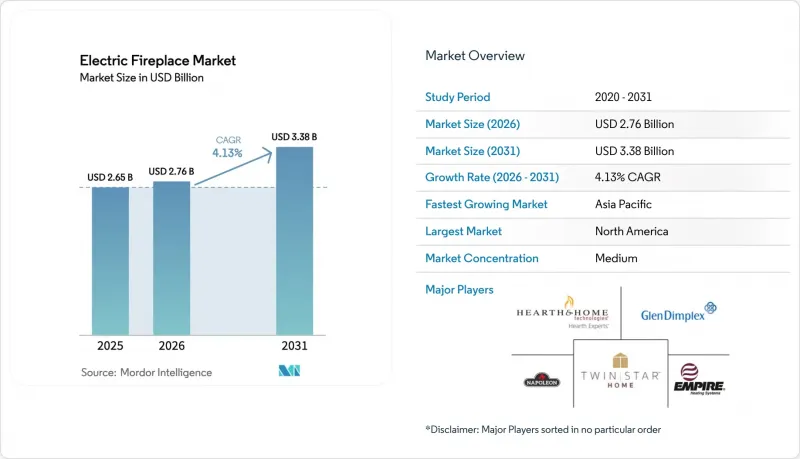
This report is Segmented by Product Type (Electric Stove, Insert Electric Fireplace, and More), Size (Small, Medium, Large, and More), Application (Residential, Commercial), Distribution Channel (B2C/Retail Channels and B2B/Project), and Geography (North America, South America, Europe, and More). The Market Forecasts are Provided in Terms of Value (USD).
Global Electric Fireplace Market Trends and Insights
Carbon-reduction mandates favoring electric heat
State and city regulations limiting fossil-fuel systems in new buildings are driving growth in the electric fireplace market, as developers increasingly plan all-electric layouts and incorporate decorative zone-heating solutions to maintain aesthetic and functional value. ACEEE's April 2025 analysis found that electrifying building energy uses with efficient electric heating is far more cost-effective than relying on alternative fuels, which are more expensive and limited in supply, making electrification the preferred strategy for decarbonizing buildings. In New York, all-electric mandates for many mid-rise projects beginning in 2026 are encouraging the substitution of gas inserts with electric fireplaces, aligning with emissions targets while preserving design intent for common areas and apartments. California's updated building codes and utility programs further strengthen the electric-first pathway, expanding the retrofit market for non-combustion space heating devices in dense urban areas. Air quality measures restricting wood-burning in sensitive regions support the adoption of electric fireplaces by eliminating the need for chimneys and reducing particulate compliance risks.
Worldwide Urban Remodeling Demanding Plug-and-Play Fireplaces
Remodeling activity and retrofit cycles are fueling demand for electric fireplaces, as plug-in or hardwired units can be integrated into existing interiors with minimal disruption and without the need for gas-line permits or flues. In the Netherlands, the share of homes heated without natural gas rose to about 11% in 2024, with hybrid gas-electric systems also increasing, reinforcing the shift away from gas boilers toward electric and district-heating solutions. In the United States, softer permit trends encouraged homeowners to prioritize upgrades and replacements over new construction, favoring electric units that fit media walls and masonry openings. Wood-to-electric inserts eliminate ash and soot while preserving the fireplace as a focal point and supporting compliance with stricter particulate regulations in urban areas. In Asia-Pacific's dense urban cores, compact apartments drive the adoption of slim, wall-mounted electric fireplaces aligned with entertainment-wall design trends. Brands that simplify recessed installation, standardize framing, and offer low-profile designs are well-positioned to capture demand across retrofit and remodeling projects.
Elevated power tariffs versus gas alternatives
Rising electricity prices influence operating costs and can reduce the attractiveness of using electric fireplaces for daily heating in regions with high power rates. The cost gap between electricity and natural gas varies by jurisdiction, and households in high-rate areas often limit usage to flame-only modes for ambiance, reducing heating operation. In Europe, persistent electricity-to-gas tariff differentials slow adoption of electric space heating, which also impacts demand for decorative electric fireplaces as buyers weigh total energy costs. At the same time, electric units offer safety, convenience, and low-maintenance benefits, but higher running costs temper repeat purchases among price-sensitive consumers who have access to cheaper gas alternatives. Features like eco modes, flame-only operation, and open-window detection help balance visual appeal with energy efficiency, allowing the market to maintain relevance despite tariff pressures.
Other drivers and restraints analyzed in the detailed report include:
- Post-pandemic renovation surge demanding plug-in hearths
- Carbon-reduction mandates favoring electric heat
- Skepticism over electric flame authenticity
For complete list of drivers and restraints, kindly check the Table Of Contents.
Segment Analysis
Wall-mounted electric fireplaces captured a 32.37% market share in 2025 and grew at a 7.24% CAGR, leading the category as developers and renovators pair them with media walls that do not require gas lines or flues. Buyers favor these models for their installation simplicity, with standard framing and plug-in 120V options that reduce labor and inspection costs. High-end three-sided bay configurations enhance flame visibility from multiple angles, positioning the fireplace as a sculptural element in living rooms and boutique hospitality spaces. The segment also benefits from decoupled heat modes, allowing ambiance without thermal load, which supports year-round use in warm climates or smaller apartments. Smart-home integration, including voice control and app scheduling, further increases appeal as fireplaces are incorporated into lighting scenes and daily routines. Overall, wall-mounted units combine ease of installation, aesthetic flexibility, and technology features, driving strong adoption among both new builds and renovations.
Insert and retrofit formats are increasingly popular as households convert from wood-burning to electric to eliminate ash cleanup and reduce particulate exposure in dense metropolitan areas. Log-set and linear insert options preserve the traditional focal-point look while enabling flame-only modes and on-demand heat, fitting renovation schedules without major structural changes. Freestanding models and mantel packages cater to renters or aging-in-place scenarios where permanent build-ins are not feasible, broadening market reach across diverse housing types. Portable and tabletop options serve niche needs in compact spaces or RVs, though their overall volume remains smaller than recessed or insert models. Smart integration remains a key differentiator, with connected units achieving higher engagement and sell-through online as buyers seek combined ambiance and convenience. Together, these varied formats allow electric fireplaces to meet a wide range of functional and aesthetic demands across residential markets.
Small electric fireplaces under 32 inches accounted for 38.37% of the market size in 2025, driven largely by first-time buyers and compact apartments that favor slim designs and simple wiring. Medium formats between 45 and 60 inches recorded the fastest growth at a 7.84% CAGR, reflecting their compatibility with 65-inch televisions and the visual balance they provide in open-plan living rooms. Online popularity of 50-inch smart models highlights the trend toward connected mid-size units featuring multiple flame colors, app control, and voice integration at accessible prices. Designers and installers have shifted from traditional 36 to 42-inch dimensions toward 55 to 65-inch formats to better align with modern TV sizes and wall proportions. These dynamics make mid-size fireplaces central to living-room design while reinforcing their practical role in everyday home life. Overall, small and mid-size units remain key drivers of adoption, combining convenience, aesthetics, and technology integration.
Large fireplaces ranging from 72 to 100 inches are primarily used in hospitality lobbies and upscale residential great rooms, where dramatic visuals justify higher prices and custom installations. Extra-large models over 100 inches rely on modular systems and dedicated circuits, making them more common in commercial and luxury projects rather than typical apartments. Across all sizes, price tiers generally reflect feature sets and installation complexity, with premium models offering advanced flame realism, materials, and smart connectivity. Mid-size adoption continues to grow as households prioritize value, installation simplicity, and the seamless integration of fireplace and media walls. These usage patterns help normalize electric fireplaces as both decorative and supplemental heating solutions. Collectively, the size-based dynamics strengthen the electric fireplace market as part of a broader trend toward electrified interiors in urban settings.
Complete Report Scope:
- By Product Type
- Electric Stove
- Insert Electric Fireplace
- Tabletop Electric Fireplace
- Wall-Mounted Electric Fireplace
- Freestanding Electric Fireplace
- By Size
- Small
- Medium
- Large
- Extra-Large
- By Application
- Residential
- Commercial
- By Distribution Channel
- B2C/Retail Channels
- Supermarkets and Hypermarkets
- Home Centers
- Specialty Stores/Fireplace Stores (Including Exclusive Brand Outlets)
- Online
- Other Distribution Channels
- B2B/Project
- B2C/Retail Channels
- By Geography
- North America
- Canada
- United States
- Mexico
- South America
- Brazil
- Peru
- Chile
- Argentina
- Rest of South America
- Europe
- United Kingdom
- Germany
- France
- Spain
- Italy
- BENELUX (Belgium, Netherlands, Luxembourg)
- NORDICS (Denmark, Finland, Iceland, Norway, Sweden)
- Rest of Europe
- Asia-Pacific
- India
- China
- Japan
- Australia
- South Korea
- South East Asia (Singapore, Malaysia, Thailand, Indonesia, Vietnam, and Philippines)
- Rest of Asia-Pacific
- Middle East & Africa
- United Arab Emirates
- Saudi Arabia
- South Africa
- Nigeria
- Rest of Middle East & Africa
- North America
Geography Analysis
North America accounted for 41.74% of the global electric fireplace market size in 2025, driven by higher average selling prices, a mature replacement cycle, and city-level air quality regulations limiting solid-fuel use in dense metropolitan areas. U.S. building-permit data indicated pressure in 2025, favoring remodeling over new construction and benefiting plug-and-play electric models in existing homes and condos. Electricity tariffs influence the use of heating modes, encouraging homeowners to rely on flame-only settings and timers or eco features that manage energy draw. Local wood-smoke rules and air-quality alert programs push consumers away from wood stoves toward non-combustion alternatives, eliminating particulate emissions and chimney maintenance. As municipal rules and building codes expand electrification, contractors and developers increasingly incorporate electric fireplaces in all-electric projects. These factors collectively support steady demand for electric fireplaces throughout the forecast period.
Asia-Pacific is the fastest-growing region, with an 8.27% CAGR projected through 2031, as urban apartments and air-quality priorities drive demand for decorative and supplemental electric heating solutions. Consumers favor small to medium-sized units that integrate with media walls, offer multi-color flames, and support app control, while local brands in Japan and Australia target early adopters with connected designs. High-density living and limited ventilation in many apartments make electric fireplaces practical for ambiance, while tech-forward buyers value integration with lighting and HVAC systems. Premium lines that emphasize realistic flames and multiple sizes indicate increased investment from regional suppliers seeking to balance style and performance. These regional conditions expand the reach of electric fireplaces in APAC's largest cities. Products are increasingly designed with slim profiles, quiet operation, and controllable heat to meet urban consumer needs.
Europe maintains meaningful adoption due to safety, ease of use, and low-maintenance features, although electricity tariffs and heat pump priorities position electric fireplaces primarily as decorative or supplemental heating options. Policy environments favor efficient electric systems in new buildings, with standards requiring electronic thermostats and open-window detection that align with higher-quality fireplace offerings. In Germany, the 2025 energy policy emphasizes decarbonizing building heat, creating tension between electricity costs and the desire for low-emission, simple indoor comfort. Consumers often rely on flame-only modes for year-round ambiance and activate heat on demand, supporting consistent use in living rooms and hospitality areas. Regional regulations restricting combustion help maintain steady traction for electric fireplaces. Property owners increasingly prioritize low-maintenance design features for modern interiors, further supporting market growth.
- Glen Dimplex Group
- Twin-Star Home
- Napoleon Fireplaces
- Empire Comfort Systems
- Amantii Electric Fireplaces
- Hearth & Home Technologies
- European Home
- Real Flame
- Modern Flames
- Touchstone Home Products
- BFM Europe
- Regency Fireplace Products
- Art Flame
- Superior Fireplaces
- GHP Group Inc.
- OER Fireplace
- R.W. Flame
- Giantex Inc.
- PuraFlame
- Dynasty Fireplaces
- Ningbo ANKE Electrical Technology Co., Ltd.
- Monessen Hearth Systems
Additional Benefits:
- The market estimate (ME) sheet in Excel format
- 3 months of analyst support
TABLE OF CONTENTS
1 Introduction
- 1.1 Study Assumptions & Market Definition
- 1.2 Scope of the Study
2 Research Methodology
3 Executive Summary
4 Market Landscape
- 4.1 Market Overview
- 4.2 Market Drivers
- 4.2.1 Carbon-reduction mandates favoring electric heat
- 4.2.2 Post-pandemic renovation surge demanding plug-in hearths
- 4.2.3 Smart-home integration uplift for connected fireplaces
- 4.2.4 Municipal bans on wood and gas hearths
- 4.2.5 Advanced flame visuals boosting premium sales
- 4.2.6 Expansion of e-commerce channels enhancing product reach
- 4.3 Market Restraints
- 4.3.1 Elevated power tariffs versus gas alternatives
- 4.3.2 Skepticism over electric flame authenticity
- 4.3.3 LED and chip supply instability
- 4.3.4 Limited consumer awareness in developing markets
- 4.4 Industry Value Chain Analysis
- 4.5 Porter's Five Forces Analysis
- 4.5.1 Threat of New Entrants
- 4.5.2 Bargaining Power of Suppliers
- 4.5.3 Bargaining Power of Buyers
- 4.5.4 Threat of Substitutes
- 4.5.5 Competitive Rivalry
- 4.6 Insights into the Latest Trends and Innovations in the Market
- 4.7 Insights on Recent Developments (New Product Launches, Strategic Initiatives, Investments, Partnerships, JVs, Expansion, M&As, etc.) in the Market
5 Market Size & Growth Forecasts (Value)
- 5.1 By Product Type
- 5.1.1 Electric Stove
- 5.1.2 Insert Electric Fireplace
- 5.1.3 Tabletop Electric Fireplace
- 5.1.4 Wall-Mounted Electric Fireplace
- 5.1.5 Freestanding Electric Fireplace
- 5.2 By Size
- 5.2.1 Small
- 5.2.2 Medium
- 5.2.3 Large
- 5.2.4 Extra-Large
- 5.3 By Application
- 5.3.1 Residential
- 5.3.2 Commercial
- 5.4 By Distribution Channel
- 5.4.1 B2C/Retail Channels
- 5.4.1.1 Supermarkets and Hypermarkets
- 5.4.1.2 Home Centers
- 5.4.1.3 Specialty Stores/Fireplace Stores (Including Exclusive Brand Outlets)
- 5.4.1.4 Online
- 5.4.1.5 Other Distribution Channels
- 5.4.2 B2B/Project
- 5.4.1 B2C/Retail Channels
- 5.5 By Geography
- 5.5.1 North America
- 5.5.1.1 Canada
- 5.5.1.2 United States
- 5.5.1.3 Mexico
- 5.5.2 South America
- 5.5.2.1 Brazil
- 5.5.2.2 Peru
- 5.5.2.3 Chile
- 5.5.2.4 Argentina
- 5.5.2.5 Rest of South America
- 5.5.3 Europe
- 5.5.3.1 United Kingdom
- 5.5.3.2 Germany
- 5.5.3.3 France
- 5.5.3.4 Spain
- 5.5.3.5 Italy
- 5.5.3.6 BENELUX (Belgium, Netherlands, Luxembourg)
- 5.5.3.7 NORDICS (Denmark, Finland, Iceland, Norway, Sweden)
- 5.5.3.8 Rest of Europe
- 5.5.4 Asia-Pacific
- 5.5.4.1 India
- 5.5.4.2 China
- 5.5.4.3 Japan
- 5.5.4.4 Australia
- 5.5.4.5 South Korea
- 5.5.4.6 South East Asia (Singapore, Malaysia, Thailand, Indonesia, Vietnam, and Philippines)
- 5.5.4.7 Rest of Asia-Pacific
- 5.5.5 Middle East & Africa
- 5.5.5.1 United Arab Emirates
- 5.5.5.2 Saudi Arabia
- 5.5.5.3 South Africa
- 5.5.5.4 Nigeria
- 5.5.5.5 Rest of Middle East & Africa
- 5.5.1 North America
6 Competitive Landscape
- 6.1 Market Concentration
- 6.2 Strategic Moves
- 6.3 Market Share Analysis
- 6.4 Company Profiles {(includes Global level Overview, Market level overview, Core Segments, Financials as available, Strategic Information, Market Rank/Share for key companies, Products & Services, and Recent Developments)}
- 6.4.1 Glen Dimplex Group
- 6.4.2 Twin-Star Home
- 6.4.3 Napoleon Fireplaces
- 6.4.4 Empire Comfort Systems
- 6.4.5 Amantii Electric Fireplaces
- 6.4.6 Hearth & Home Technologies
- 6.4.7 European Home
- 6.4.8 Real Flame
- 6.4.9 Modern Flames
- 6.4.10 Touchstone Home Products
- 6.4.11 BFM Europe
- 6.4.12 Regency Fireplace Products
- 6.4.13 Art Flame
- 6.4.14 Superior Fireplaces
- 6.4.15 GHP Group Inc.
- 6.4.16 OER Fireplace
- 6.4.17 R.W. Flame
- 6.4.18 Giantex Inc.
- 6.4.19 PuraFlame
- 6.4.20 Dynasty Fireplaces
- 6.4.21 Ningbo ANKE Electrical Technology Co., Ltd.
- 6.4.22 Monessen Hearth Systems
7 Market Opportunities & Future Outlook
- 7.1 Smart & IoT-Integrated Electric Fireplaces
- 7.2 Design Innovation & Aesthetic Versatility

