PUBLISHER: Mordor Intelligence | PRODUCT CODE: 2119769

PUBLISHER: Mordor Intelligence | PRODUCT CODE: 2119769
GCC Flat Glass - Market Share Analysis, Industry Trends & Statistics, Growth Forecasts (2026 - 2031)
According to Mordor Intelligence, the GCC flat glass market size was valued at 1.43 million tons in 2025 and estimated to grow from 1.49 million tons in 2026 to reach 1.81 million tons by 2031, at a CAGR of 3.98% during the forecast period (2026-2031).
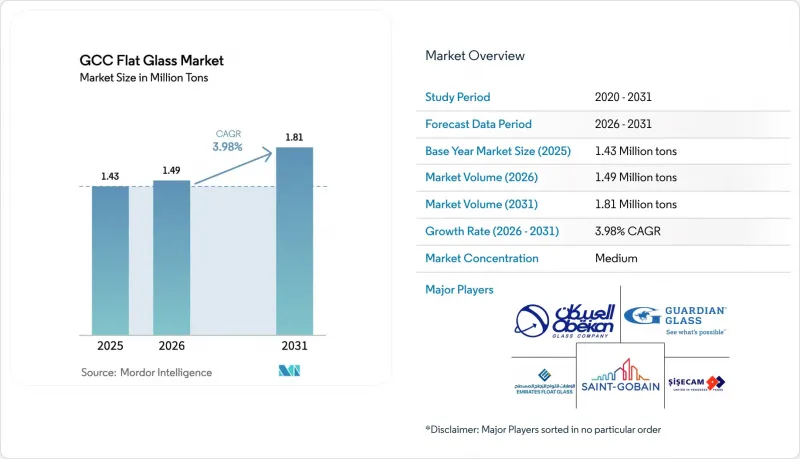
This report is Segmented by Product Type (Annealed Glass, Coated Glass, Processed Glass, Mirror Glass, and Patterned Glass), Application (Building and Construction, Automotive, Solar Glass, and Other End-User Industries), and Geography (Saudi Arabia, United Arab Emirates, Qatar, Oman, Kuwait, and Bahrain). The Market Forecasts are Provided in Terms of Volume (Tons).
GCC Flat Glass Market Trends and Insights
Boom In GCC Green-Building Mandates
Tighter building codes, introduced in 2024, require energy-saving glazing for large new projects. Saudi Arabia's Green Building Code requires structures exceeding 1,000 m2 to utilize glass configurations that meet stringent thermal-performance targets, which has prompted developers to adopt low-emissivity coatings. Dubai's Al Sa'fat framework enhances rating points for facades, ensuring solar heat-gain coefficients remain below 0.25 -a requirement that drives demand for coated or laminated units. Qatar and Kuwait have enacted parallel code updates capping allowable U-values, further widening the specification gap between annealed and processed products. Collectively, these rules support the 4.80% growth path for processed glass by channeling mainstream demand into higher-margin categories. Manufacturers capable of securing GSO 2663:2024 and GSO 2891:2024 certifications now enjoy preferred status in major tenders, giving established regional producers a competitive edge.
Mega-Projects (NEOM, Lusail, Expo-City) Unlocking Demand
Flagship schemes are multiplying overall square meters of glazing consumed. NEOM alone is estimated to need 50 million m2 of specialized glass for its linear city, industrial districts, and tourism assets. Saudi Arabia's Red Sea Amaala and Diriyah Gate clusters add thousands of hotel keys, each specified with high-performance facades. Qatar's post-World-Cup project slate in Lusail keeps specialty glass orders flowing, while Dubai's Expo City is committed to net-zero operations that depend on smart glazing. Developers favor local or regional suppliers to minimize logistics risk and comply with local-content rules, prompting manufacturers to expand their capacity near demand centers. Specifications often exceed commodity thresholds, favoring suppliers who can tailor optical, acoustic, and safety properties to meet project briefs.
Natural-Gas Price Volatility Affecting Furnace Economics
Glass furnaces run nonstop at nearly 1,600 °C and consume 80-87% of plant energy. When gas costs surge past 40% of total production expense, small producers face margin compression and may idle capacity. UAE and Qatar, which link gas tariffs to global LNG benchmarks, feel volatility more acutely than Saudi Arabia's administered system. Larger groups like Emirates Float Glass hedge exposure with long-term contracts and heat-recovery upgrades. Smaller players lacking scale or capital for efficiency retrofits risk market exit, a trend that accelerates capacity consolidation.
Other drivers and restraints analyzed in the detailed report include:
- Rise Of Integrated Facade Contracting (EPC-Glass Synergies)
- Localization Push For Float-Line Capacity (Saudi Vision 2030)
- Increasing Antidumping Probes On Imported Flat Glass
For complete list of drivers and restraints, kindly check the Table Of Contents.
Segment Analysis
Annealed glass remains the workhorse of the GCC flat glass market, accounting for 79.86% of the volume in 2025, thanks to its cost-efficient supply for mass residential and commercial builds. The rising popularity of curtain-wall facades with low-emissivity coatings is steering architects toward processed options. This shift is evident in procurement for NEOM's mixed-use towers, where coated units replace commodity clear glass to meet thermal comfort targets.
Processed glass, led by tempered and laminated categories, is on track for a 4.72% annual growth rate through 2031, signaling a structural upgrade cycle. Coated products benefit from low-solar-gain specifications, while mirror and decorated variants are used in hotel and luxury retail fit-outs in Dubai, Riyadh, and Doha. Investments by Saint-Gobain and Guardian in magnetron-sputter coating lines enable the local production of triple-silver low-e glass, which was previously imported. Domestic processors, such as Obeikan, are forming technical alliances with European firms to capture premium applications, thereby shrinking lead times and reducing currency exposure for contractors. As these capabilities scale, the GCC flat glass market will rely less on imported processed units, an inflection that supports the region's localization agenda.
Complete Report Scope:
- By Product Type
- Annealed Glass
- Coater Glass
- Processed Glass
- Mirror Glass
- Patterned Glass
- By Application
- Building and Construction
- Automotive
- Solar Glass
- Other End-user Industries
- By Geography
- Saudi Arabia
- United Arab Emirates
- Qatar
- Oman
- Kuwait
- Bahrain
List of Companies Covered in this Report:
- AGC Inc.
- Asahi India Glass Limited
- Burhani Group
- Corning Incorporated
- Emirates Glass LLC
- Fuyao Glass Industry Group Co.Ltd
- Guardian Industries
- Jinjing (Group) Co., Ltd.
- Manna Glass Co.
- Nippon Sheet Glass Co. Ltd.
- Obeikan Glass Company
- Saint-Gobain
- SCHOTT
- Sisecam
- Vitro
- Xinyi Glass Holdings Limited.
Additional Benefits:
- The market estimate (ME) sheet in Excel format
- 3 months of analyst support
TABLE OF CONTENTS
1 Introduction
- 1.1 Study Assumptions & Market Definition
- 1.2 Scope of the Study
2 Research Methodology
3 Executive Summary
4 Market Landscape
- 4.1 Market Overview
- 4.2 Market Drivers
- 4.2.1 Boom in GCC green-building mandates
- 4.2.2 Mega-projects (NEOM, Lusail, Expo-City) unlocking demand
- 4.2.3 Rise of integrated facade contracting (EPC-glass synergies)
- 4.2.4 Localization push for float-line capacity (Saudi Vision 2030)
- 4.2.5 Growth of solar-glass for CSP plants in United Arab Emirates and Saudi Arabia
- 4.3 Market Restraints
- 4.3.1 Natural-gas price volatility affecting furnace economics
- 4.3.2 Increasing antidumping probes on imported flat glass
- 4.3.3 Slow certification cycles for new glazing technologies
- 4.4 Value Chain Analysis
- 4.5 Porter's Five Forces
- 4.5.1 Bargaining Power of Suppliers
- 4.5.2 Bargaining Power of Buyers
- 4.5.3 Threat of New Entrants
- 4.5.4 Threat of Substitutes
- 4.5.5 Degree of Competition
5 Market Size & Growth Forecasts (Volume)
- 5.1 By Product Type
- 5.1.1 Annealed Glass
- 5.1.2 Coater Glass
- 5.1.3 Processed Glass
- 5.1.4 Mirror Glass
- 5.1.5 Patterned Glass
- 5.2 By Application
- 5.2.1 Building and Construction
- 5.2.2 Automotive
- 5.2.3 Solar Glass
- 5.2.4 Other End-user Industries
- 5.3 By Geography
- 5.3.1 Saudi Arabia
- 5.3.2 United Arab Emirates
- 5.3.3 Qatar
- 5.3.4 Oman
- 5.3.5 Kuwait
- 5.3.6 Bahrain
6 Competitive Landscape
- 6.1 Market Concentration
- 6.2 Strategic Moves
- 6.3 Market Share/Ranking Analysis
- 6.4 Company Profiles {(includes Global level Overview, Market level overview, Core Segments, Financials as available, Strategic Information, Market Rank/Share for key companies, Products & Services, and Recent Developments)}
- 6.4.1 AGC Inc.
- 6.4.2 Asahi India Glass Limited
- 6.4.3 Burhani Group
- 6.4.4 Corning Incorporated
- 6.4.5 Emirates Glass LLC
- 6.4.6 Fuyao Glass Industry Group Co.Ltd
- 6.4.7 Guardian Industries
- 6.4.8 Jinjing (Group) Co., Ltd.
- 6.4.9 Manna Glass Co.
- 6.4.10 Nippon Sheet Glass Co. Ltd.
- 6.4.11 Obeikan Glass Company
- 6.4.12 Saint-Gobain
- 6.4.13 SCHOTT
- 6.4.14 Sisecam
- 6.4.15 Vitro
- 6.4.16 Xinyi Glass Holdings Limited.
7 Market Opportunities & Future Outlook
- 7.1 White-space and Unmet-need Assessment

