PUBLISHER: Mordor Intelligence | PRODUCT CODE: 2119771

PUBLISHER: Mordor Intelligence | PRODUCT CODE: 2119771
Middle-East Industrial Gases - Market Share Analysis, Industry Trends & Statistics, Growth Forecasts (2026 - 2031)
According to Mordor Intelligence, the Middle-East industrial gases market size is expected to grow from 57.17 Million tons in 2025 to 59.09 Million tons in 2026 and is forecast to reach 69.68 Million tons by 2031 at 3.36% CAGR over 2026-2031.
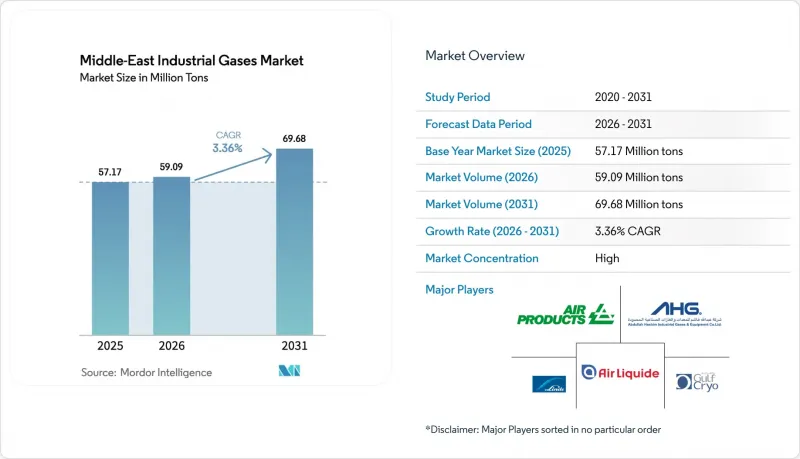
This report is Segmented by Product Type (Nitrogen, Oxygen, Carbon Dioxide, and More), End-User Industry (Chemical Processing and Refining, Electronics and Semiconductor, Food and Beverage Processing, and More), and Geography (Saudi Arabia, United Arab Emirates, and More). The Market Forecasts are Provided in Terms of Volume (Tons).
Middle-East Industrial Gases Market Trends and Insights
Surging Demand from Upstream and Mid-Stream Oil and Gas Operations
Enhanced recovery, sour-gas treatment, and new LNG trains are lifting usage of high-purity nitrogen, hydrogen, and CO2. Saudi Aramco and ADNOC add separation plants that inject nitrogen for pressure maintenance and hydrogen for hydrocracking, multiplying gas intensity per barrel processed. Qatar expects output to reach 244 billion m3 by 2030 with an extra 83 billion m3 of industrial gas needs, equal to 57% of forecast growth. Offshore projects such as Hail and Ghasha require 1.5 million t of captured CO2 each year, sharpening demand for purification units. Continuous upstream activities therefore cascade into on-site supply contracts across the value chain.
Expanding Regional Petrochemicals and Refinery CAPEX Pipeline
Projects like the USD 11 billion Amiral complex in Saudi Arabia integrate refining with chemicals, lifting gas demand per feedstock unit. The complex targets 1.65 million t of ethylene annually, calling for large volumes of nitrogen for inerting, oxygen for oxidation, and hydrogen for hydrotreating. New builds move product slates toward specialty polymers, which need ultra-high purity gases in compounding and quality control. Carbon capture modules inside these plants raise the call for purification and compression equipment, aligning environmental targets with operational efficiency.
Tightening EH&S Regulations and Compliance Costs
Regional laws are aligning with international benchmarks, requiring detailed environmental impact reviews and strict flaring limits. The UAE's Federal Law 24 mandates cradle-to-grave emission reporting, and satellite imagery shows regulators increasing enforcement against illegal venting. BBC investigations uncovered toxic plumes over several Gulf facilities, prompting faster adoption of sealed combustion and high-efficiency capture systems. Meeting >99% CO2 purity for storage elevates capital and operating costs for small suppliers, encouraging consolidation among firms with robust compliance infrastructure.
Other drivers and restraints analyzed in the detailed report include:
- Accelerated Build-Out of Healthcare Infrastructure (Medical Gases)
- Rise of Government-Backed Green-Hydrogen Mega-Projects
- Crude-Oil Price Volatility Curbing New Industrial Investments
For complete list of drivers and restraints, kindly check the Table Of Contents.
Segment Analysis
Oxygen accounted for 28.74% of Middle-East industrial gases market share in 2025, driven by steel mills, petrochemicals, and aluminum smelting. Nitrogen is set to grow fastest at a 4.44% CAGR to 2031 on expanded use in food packaging, electronics soldering, and inerting for oil recovery. Carbon dioxide volumes rise with enhanced oil recovery and beverage carbonation, while hydrogen sees tailwinds from refinery upgrades and electro-fuels. Argon supports welding during giga-project construction, and helium demand stems from MRI and semiconductor lithography. Air Liquide's helium liquefaction build in Qatar aims to ease chronic shortages. Linde commissioned 59 small on-site nitrogen and oxygen plants in 2024, highlighting a shift toward distributed production that tightens customer integration.
The segment's evolution shows a pivot from volume-driven commodity supply to purity-driven specialty demand. Construction, energy, and consumer goods shape oxygen and carbon dioxide sales, while clean fuels, electronics, and packaged food tilt growth toward nitrogen and hydrogen. The Middle-East industrial gases market continues to deepen on-site models that provide steady offtake and cost certainty for end users.
Complete Report Scope:
- By Product Type
- Nitrogen
- Oxygen
- Carbon Dioxide
- Hydrogen
- Helium
- Argon
- Ammonia
- Methane
- Propane
- Butane
- Other Product Types (Fluorine, Nitrous Oxide, Neon, Xenon)
- By End-User Industry
- Chemical Processing and Refining
- Electronics and Semiconductor
- Food and Beverage Processing
- Oil and Gas
- Metal Production and Fabrication
- Medical and Pharmaceutical
- Automotive and Transportation
- Energy and Power Generation
- Other Industries (Aerospace and Water and Waste Water Treatment)
- By Geography
- Saudi Arabia
- United Arab Emirates
- Qatar
- Kuwait
- Israel
- Rest of Middle East
List of Companies Covered in this Report:
- AHG
- Air Liquide
- Air Products and Chemicals Inc.
- BASF
- Buzwair Industrial Gases Factories
- Dubai Industrial Gases
- EIG
- Gulf Cryo
- Iwatani Corporation
- Linde PLC
- Messer SE & Co. KGaA
- PURE GAS SUPPLY LLC
- SABIC
- Sipchem Company
Additional Benefits:
- The market estimate (ME) sheet in Excel format
- 3 months of analyst support
TABLE OF CONTENTS
1 Introduction
- 1.1 Study Assumptions & Market Definition
- 1.2 Scope of the Study
2 Research Methodology
3 Executive Summary
4 Market Landscape
- 4.1 Market Overview
- 4.2 Market Drivers
- 4.2.1 Surging demand from upstream & mid-stream oil-and-gas operations
- 4.2.2 Expanding regional petrochemicals and refinery CAPEX pipeline
- 4.2.3 Accelerated build-out of healthcare infrastructure (medical gases)
- 4.2.4 Rise of government-backed green-hydrogen mega-projects
- 4.2.5 Large construction "giga-projects" (e.g., NEOM) boosting welding & cutting gases
- 4.3 Market Restraints
- 4.3.1 Tightening EH&S regulations and compliance costs
- 4.3.2 Crude-oil price volatility curbing new industrial investments
- 4.3.3 Scarce regional CO2-capture & purification infrastructure
- 4.4 Value Chain Analysis
- 4.5 Porter's Five Forces Analysis
- 4.5.1 Bargaining Power of Suppliers
- 4.5.2 Bargaining Power of Buyers
- 4.5.3 Threat of New Entrants
- 4.5.4 Threat of Substitute Products & Services
- 4.5.5 Degree of Competition
5 Market Size & Growth Forecasts (Volume)
- 5.1 By Product Type
- 5.1.1 Nitrogen
- 5.1.2 Oxygen
- 5.1.3 Carbon Dioxide
- 5.1.4 Hydrogen
- 5.1.5 Helium
- 5.1.6 Argon
- 5.1.7 Ammonia
- 5.1.8 Methane
- 5.1.9 Propane
- 5.1.10 Butane
- 5.1.11 Other Product Types (Fluorine, Nitrous Oxide, Neon, Xenon)
- 5.2 By End-User Industry
- 5.2.1 Chemical Processing and Refining
- 5.2.2 Electronics and Semiconductor
- 5.2.3 Food and Beverage Processing
- 5.2.4 Oil and Gas
- 5.2.5 Metal Production and Fabrication
- 5.2.6 Medical and Pharmaceutical
- 5.2.7 Automotive and Transportation
- 5.2.8 Energy and Power Generation
- 5.2.9 Other Industries (Aerospace and Water and Waste Water Treatment)
- 5.3 By Geography
- 5.3.1 Saudi Arabia
- 5.3.2 United Arab Emirates
- 5.3.3 Qatar
- 5.3.4 Kuwait
- 5.3.5 Israel
- 5.3.6 Rest of Middle East
6 Competitive Landscape
- 6.1 Market Concentration
- 6.2 Strategic Moves (M&A, JVs, Alliances)
- 6.3 Market Share Analysis
- 6.4 Company Profiles (includes Global level Overview, Market level overview, Core Segments, Financials as available, Strategic Information, Market Rank/Share, Products & Services, Recent Developments)
- 6.4.1 AHG
- 6.4.2 Air Liquide
- 6.4.3 Air Products and Chemicals Inc.
- 6.4.4 BASF
- 6.4.5 Buzwair Industrial Gases Factories
- 6.4.6 Dubai Industrial Gases
- 6.4.7 EIG
- 6.4.8 Gulf Cryo
- 6.4.9 Iwatani Corporation
- 6.4.10 Linde PLC
- 6.4.11 Messer SE & Co. KGaA
- 6.4.12 PURE GAS SUPPLY LLC
- 6.4.13 SABIC
- 6.4.14 Sipchem Company
7 Market Opportunities & Future Outlook
- 7.1 White-space & Unmet-need Assessment

