PUBLISHER: Mordor Intelligence | PRODUCT CODE: 2119774

PUBLISHER: Mordor Intelligence | PRODUCT CODE: 2119774
India Hydrogen Peroxide - Market Share Analysis, Industry Trends & Statistics, Growth Forecasts (2026 - 2031)
According to Mordor Intelligence, the India hydrogen peroxide market size in 2026 is estimated at 362.58 kilotons, growing from 2025 value of 345.81 kilotons with 2031 projections showing 459.34 kilotons, growing at 4.85% CAGR over 2026-2031.
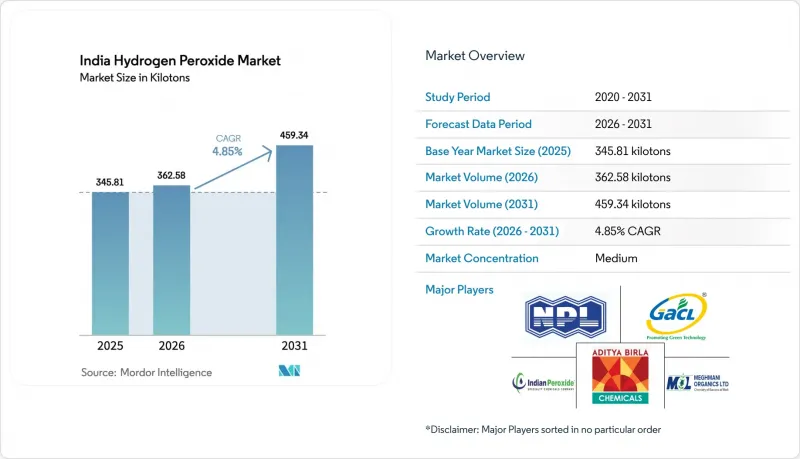
This report is Segmented by Product Function (Disinfectant, Bleaching, Oxidant, and Other Functions) and End-User Industry (Pulp and Paper, Chemical Synthesis, Wastewater Treatment, Mining, Food and Beverage, Cosmetics and Healthcare, Textiles, Other End-User Industries (Electronics and Packaging)). Market Forecasts are Provided in Terms of Volume (tons).
India Hydrogen Peroxide Market Trends and Insights
Growing Domestic Pulp-and-Paper Bleaching Demand
India's 25 million-tonne pulp and paper sector relies on 52-75% recycled fiber, which requires intensive peroxide bleaching to achieve ISO brightness levels. Bleaching already absorbs 62.23% of the hydrogen-peroxide volume, providing producers with a predictable base-load offtake aligned with mill locations in Gujarat, Tamil Nadu, Andhra Pradesh, and Odisha. Freight savings accrue when peroxide units are located near paper clusters, as UN 2014 regulations limit long-haul movements of solutions with concentrations greater than 35%. Incremental recycled-fiber capacity continues to grow, even as total paper output plateaus, ensuring that bleaching demand remains resilient against fluctuations in virgin-pulp imports.
Rising Wastewater AOP Installations in Tier-2/3 Cities (Under AMRUT 2.0)
Municipalities upgrading under AMRUT 2.0 are adopting advanced-oxidation systems that dose hydrogen peroxide with UV or ozone to degrade dyes, pharmaceuticals, and micro-pollutants. Textile centers, such as Tiruppur and Surat, are early movers because zero-liquid-discharge mandates penalize chlorinated effluents. Decentralized project roll-outs create numerous mid-sized demand nodes, favoring distributors with regional depots that can supply 35% grades safely. Service-oriented suppliers that help calibrate peroxide feed rates in AOP plants are capturing loyalty and commanding a premium above commodity bleaching prices.
Freight-Hazard Regulations Tightening Cylinder Transport Above 35 % Strength
UN 2014 rules classify hydrogen peroxide as an oxidizer with a corrosive sub-risk, limiting tanker loads to above 35% and banning concentrations above 40% on aircraft. Producers must either dilute before shipment, which raises the freight cost per active kilogram, or build regional depots, locking up working capital. Logistics expenses to Tier-3 textile towns now run 15-20% above those for bulk chemicals, favoring incumbents that own certified tanker fleets.
Other drivers and restraints analyzed in the detailed report include:
- Capacity Expansion by New Entrants Using Green-Hydrogen Feedstock
- Textile Mills' Switch from Chlorine to Peroxide for Zero-Liquid-Discharge Compliance
- Volatility in Anthraquinone Import Prices
For complete list of drivers and restraints, kindly check the Table Of Contents.
Segment Analysis
Bleaching captured 61.62% of the hydrogen-peroxide volume in 2025 because recycled-fiber paper mills dose higher loadings to meet brightness targets. Disinfectant usage, although smaller in tonnage, is rising at a 5.12% CAGR as hospitals deploy vapor-phase systems and pharmaceutical plants convert to low-residue sanitizers. Oxidant grades serve mining and chemical syntheses, enhancing gold and copper recovery by 10-15 %. Niche household, vegetable-wash, and dishwasher formulations round out demand, but require Food Chemical Codex compliance and attract premium pricing.
The India hydrogen peroxide market size for bleaching is projected to rise steadily in lockstep with the addition of recycled-paper capacity, while disinfectant demand is set to carve out a larger value share, despite its lower tonnage base. Oxidant applications will stay cyclical, mirroring metal prices, yet deliver attractive margins in up-cycles. High-purity vapor grades provide a bridgehead for suppliers pivoting from commodity bleaching. The India hydrogen peroxide industry participants that combine bulk output with specialty purification stand to widen EBITDA spreads as customer audits tighten.
Complete Report Scope:
- By Product Function
- Disinfectant
- Bleaching
- Oxidant
- Other Functions (Antiseptic, Dishwasher, and Vegetable Wash)
- By End-user Industry
- Pulp and Paper
- Chemical Synthesis
- Wastewater Treatment
- Mining
- Food and Beverage
- Cosmetics and Healthcare
- Textiles
- Other End-User Industries (Electronics and Packaging)
List of Companies Covered in this Report:
- Aditya Birla Chemicals
- AkzoNobel N.V.
- Arkema
- Chemplast Sanmar Limited
- Evonik Industries AG
- Gujarat Alkalies and Chemicals Limited
- HANSOLCHEMICAL
- Hindustan Organic Chemicals Ltd.
- Indian Peroxide Limited
- Meghmani Finechem Limited
- National Peroxide Ltd.
- Nilkanth Organics
- OCI Ltd.
- Prakash Chemicals International Private Ltd.
- RXCHEMICALS
- Solvay
Additional Benefits:
- The market estimate (ME) sheet in Excel format
- 3 months of analyst support
TABLE OF CONTENTS
1 Introduction
- 1.1 Study Assumptions & Market Definition
- 1.2 Scope of the Study
2 Research Methodology
3 Executive Summary
4 Market Landscape
- 4.1 Market Overview
- 4.2 Market Drivers
- 4.2.1 Growing domestic pulp-and-paper bleaching demand
- 4.2.2 Rising wastewater AOP installations in Tier-2/3 cities (under AMRUT 2.0)
- 4.2.3 Capacity expansion by new entrants using green-hydrogen feedstock
- 4.2.4 Textile mills' switch from chlorine to peroxide for zero-liquid-discharge compliance
- 4.2.5 Semiconductor-grade peroxide demand from upcoming Indian fabs
- 4.3 Market Restraints
- 4.3.1 Freight-hazard regulations tightening cylinder transport above 35 % strength
- 4.3.2 Volatility in anthraquinone import prices
- 4.3.3 Persistent sub-scale plants (<20 ktpa) struggling with power tariffs
- 4.4 Value Chain Analysis
- 4.5 Porter's Five Forces
- 4.5.1 Bargaining Power of Suppliers
- 4.5.2 Bargaining Power of Buyers
- 4.5.3 Threat of New Entrants
- 4.5.4 Threat of Substitutes
- 4.5.5 Degree of Competition
5 Market Size & Growth Forecasts (Volume)
- 5.1 By Product Function
- 5.1.1 Disinfectant
- 5.1.2 Bleaching
- 5.1.3 Oxidant
- 5.1.4 Other Functions (Antiseptic, Dishwasher, and Vegetable Wash)
- 5.2 By End-user Industry
- 5.2.1 Pulp and Paper
- 5.2.2 Chemical Synthesis
- 5.2.3 Wastewater Treatment
- 5.2.4 Mining
- 5.2.5 Food and Beverage
- 5.2.6 Cosmetics and Healthcare
- 5.2.7 Textiles
- 5.2.8 Other End-User Industries (Electronics and Packaging)
6 Competitive Landscape
- 6.1 Market Concentration
- 6.2 Strategic Moves
- 6.3 Market Share (%)/ Ranking Analysis
- 6.4 Company Profiles (includes Global level Overview, Market level overview, Core Segments, Financials as available, Strategic Information, Market Rank/Share, Products & Services, Recent Developments)
- 6.4.1 Aditya Birla Chemicals
- 6.4.2 AkzoNobel N.V.
- 6.4.3 Arkema
- 6.4.4 Chemplast Sanmar Limited
- 6.4.5 Evonik Industries AG
- 6.4.6 Gujarat Alkalies and Chemicals Limited
- 6.4.7 HANSOLCHEMICAL
- 6.4.8 Hindustan Organic Chemicals Ltd.
- 6.4.9 Indian Peroxide Limited
- 6.4.10 Meghmani Finechem Limited
- 6.4.11 National Peroxide Ltd.
- 6.4.12 Nilkanth Organics
- 6.4.13 OCI Ltd.
- 6.4.14 Prakash Chemicals International Private Ltd.
- 6.4.15 RXCHEMICALS
- 6.4.16 Solvay
7 Market Opportunities and Future Outlook
- 7.1 White-space and Unmet-need Assessment

