PUBLISHER: Mordor Intelligence | PRODUCT CODE: 2119806

PUBLISHER: Mordor Intelligence | PRODUCT CODE: 2119806
Bridge Construction - Market Share Analysis, Industry Trends & Statistics, Growth Forecasts (2026 - 2031)
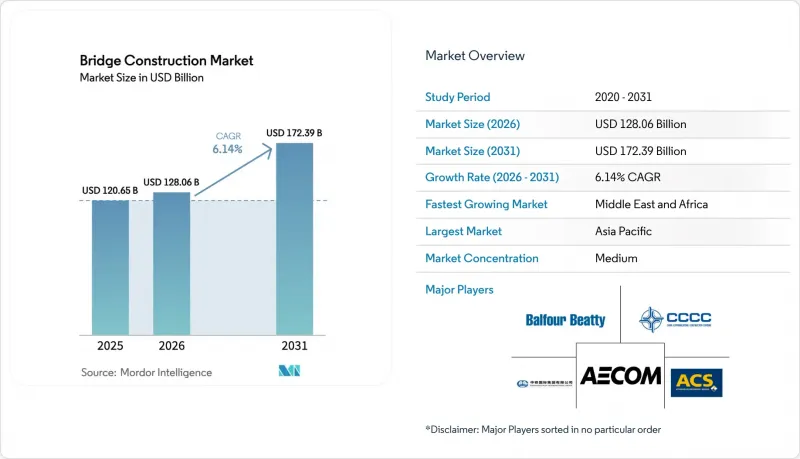
According to Mordor Intelligence, bridge construction market size in 2026 is estimated at USD 128.06 billion, growing from 2025 value of USD 120.65 billion with 2031 projections showing USD 172.39 billion, growing at 6.14% CAGR over 2026-2031.
This report is Segmented by Bridge Type (Beam Bridge, Truss Bridge, Arch Bridge, Suspension Bridge, and More), by Material (Steel, Prestressed Concrete, Composite Material, Advanced Materials), by Application (Road & Highway, Railway, Others), and by Geography (North America, South America, Europe, Asia-Pacific, Middle East & Africa). The Market Forecasts are Provided in Terms of Value (USD).
Global Bridge Construction Market Trends and Insights
Surge in Mega-Infrastructure Spending Plans (2025-2030)
Historic funding waves underpin the bridge construction market. The IIJA directs USD 110 billion to roads and bridges, including dedicated Bridge Investment and Formula programs. China's public-works outlays follow its current Five-Year Plan, while Mexico's National Infrastructure Program budgets USD 12.6 billion for 551 transport projects. Multi-region synchronicity lets contractors scale prefabrication factories and workforce training, locking in supply-chain efficiencies. Long-dated visibility also attracts private capital, evident in a 40% share of 2024 AEC M&A deals funded by private equity.
Growing Preference for Accelerated Bridge Construction (ABC) Methods
ABC shrinks on-site activity, curbs traffic disruption, and improves safety. FHWA pilot states report 20-50% faster completions and quality gains from factory-controlled modules. UHPC joints extend spans 30-40%, cutting lifecycle maintenance. Missouri's I-70 Missouri River crossing finished ahead of schedule by staging prefabricated segments while live lanes stayed open. Contractors investing in digital twins and logistics simulation capture procurement preference as 47 state DOTs embed ABC scoring into tenders.
Skilled-Labor Shortages in Advanced Bridge Engineering
ABC counts 439,000 extra U.S. construction workers needed in 2025, rising to 499,000 in 2026. Australia's pipeline needs 130,000 new hires, while the U.K. targets 500,000 across major projects. Wage premiums escalate 15-20% for segmental-bridge carpenters and UHPC specialists. Automation, robotic rebar tying, and 3-D printed formwork offset but cannot fully bridge the gap, prompting firms to establish training academies and global talent exchanges.
Other drivers and restraints analyzed in the detailed report include:
- Resilience Upgrades for Climate-Change-Exposed Bridges
- Smart-Sensor-Enabled Structural-Health-Monitoring Mandates
- Inflation-Driven Spikes in Steel & Cement Input Costs
For complete list of drivers and restraints, kindly check the Table Of Contents.
Segment Analysis
Cable-stayed structures post a 7.62% CAGR, the swiftest inside the bridge construction market, as governments prefer their span-to-cost efficiency and visual appeal. Beam bridges continued to dominate with 42.98% of 2025 revenue, reflecting their unmatched value for medium-length highway crossings and the well-established contractor base maintaining this format. The Peljesac Bridge's 285-m main spans were erected through balanced cantilever, proving how stay-cables can speed construction while minimizing temporary falsework.
The segment's outlook hinges on digital tools such as BIM Level 3, highlighted by Norway's New Sotra Bridge, which modeled 1 million objects to optimize sequencing. Suspension alternatives still command niche demand for spans greater than 1,000-m, but higher insurance premiums in seismic belts tilt some owners toward cable-stays. Movable and arch formats continue to find specialized urban or maritime use when navigational clearance or heritage aesthetics are decisive.
Complete Report Scope:
- By Bridge Type
- Beam Bridge
- Truss Bridge
- Arch Bridge
- Suspension Bridge
- Cable-Stayed Bridge
- Others
- By Material
- Steel
- Prestressed Concrete
- Composite Material
- Advanced Materials (FRP, UHPC)
- By Application
- Road & Highway
- Railway
- Others(Pedestrian & Cycle, Pipeline & Utility, etc.)
- By Geography
- North America
- United States
- Canada
- Mexico
- South America
- Brazil
- Argentina
- Chile
- Rest of South America
- Europe
- Germany
- United Kingdom
- France
- Italy
- Spain
- Rest of Europe
- Asia-Pacific
- China
- India
- Japan
- South Korea
- Australia
- Rest of Asia-Pacific
- Middle East & Africa
- United Arab Emirates
- Saudi Arabia
- South Africa
- Nigeria
- Rest of Middle East and Africa
- North America
Geography Analysis
Asia-Pacific commanded 46.12% of global spending in 2025, anchored by China's Belt and Road extensions and India's USD 1.2 trillion National Infrastructure Pipeline. Japan's USD 2.11 billion freight-link package and Australia's climate-resilient bridge replacements reinforce regional momentum. Embedded manufacturing capacity for steel girder fabrication accelerates project execution, and governments increasingly mandate BIM, bringing digital parity with Western peers.
Middle East & Africa leads growth with a 7.63% CAGR forecast as the African Development Bank mobilizes USD 635.8 million for the ECOWAS cross-border bridge and targets USD 130-170 billion annually to close the region's infrastructure gap. Nigeria and Egypt award EPC contracts that bundle ABC methods with seismic detailing, reflecting both schedule urgency and performance expectations.
North America benefits from the IIJA's USD 110 billion bridge allocation, unleashing dozens of design-build tenders that prioritize prefabrication capacity. Canada's Pattullo Bridge replacement highlights the rise of public-private partnerships, while Mexico's USD 12.6 billion bridge backlog advances economic integration goals. Europe, focused on decarbonization, invests in digital twins and low-carbon materials, aligning procurement with the EU Green Deal.
- ACS Group
- AECOM
- Balfour Beatty
- China Communications Construction Co. (CCCC)
- China Railway Group
- VINCI
- Bechtel
- HOCHTIEF
- Skanska
- Bouygues Construction
- Fluor
- Kiewit
- Samsung C&T
- Strabag
- Ferrovial
- Larsen & Toubro
- Obayashi
- PCL Construction
- Webuild (Salini Impregilo)
- Gammon Construction
Additional Benefits:
- The market estimate (ME) sheet in Excel format
- 3 months of analyst support
TABLE OF CONTENTS
1 Introduction
- 1.1 Study Assumptions & Market Definition
- 1.2 Scope of the Study
2 Research Methodology
3 Executive Summary
4 Market Landscape
- 4.1 Market Overview
- 4.2 Market Drivers
- 4.2.1 Surge in mega-infrastructure spending plans (2025-2030)
- 4.2.2 Growing preference for accelerated bridge construction (ABC) methods
- 4.2.3 Shift toward low-carbon and recycled structural materials
- 4.2.4 Resilience upgrades for climate-change-exposed bridges
- 4.2.5 Smart-sensor-enabled structural-health-monitoring mandates
- 4.3 Market Restraints
- 4.3.1 Inflation-driven spikes in steel & cement input costs
- 4.3.2 Skilled-labor shortages in advanced bridge engineering
- 4.3.3 Lengthy environmental-impact permitting cycles
- 4.3.4 Rising insurance premiums for long-span projects in seismic zones
- 4.4 Value / Supply-Chain Analysis
- 4.5 Regulatory Landscape
- 4.6 Technological Outlook
- 4.7 Industry Attractiveness - Porter's Five Forces Analysis
- 4.7.1 Bargaining Power of Suppliers
- 4.7.2 Bargaining Power of Buyers
- 4.7.3 Threat of New Entrants
- 4.7.4 Threat of Substitutes
- 4.7.5 Intensity of Competitive Rivalry
- 4.8 Major Infrastructure Development Projects
- 4.8.1 Existing Infrastructure
- 4.8.2 Ongoing Projects
- 4.8.3 Upcoming Projects
5 Market Size & Growth Forecasts (Value, In USD Billion)
- 5.1 By Bridge Type
- 5.1.1 Beam Bridge
- 5.1.2 Truss Bridge
- 5.1.3 Arch Bridge
- 5.1.4 Suspension Bridge
- 5.1.5 Cable-Stayed Bridge
- 5.1.6 Others
- 5.2 By Material
- 5.2.1 Steel
- 5.2.2 Prestressed Concrete
- 5.2.3 Composite Material
- 5.2.4 Advanced Materials (FRP, UHPC)
- 5.3 By Application
- 5.3.1 Road & Highway
- 5.3.2 Railway
- 5.3.3 Others(Pedestrian & Cycle, Pipeline & Utility, etc.)
- 5.4 By Geography
- 5.4.1 North America
- 5.4.1.1 United States
- 5.4.1.2 Canada
- 5.4.1.3 Mexico
- 5.4.2 South America
- 5.4.2.1 Brazil
- 5.4.2.2 Argentina
- 5.4.2.3 Chile
- 5.4.2.4 Rest of South America
- 5.4.3 Europe
- 5.4.3.1 Germany
- 5.4.3.2 United Kingdom
- 5.4.3.3 France
- 5.4.3.4 Italy
- 5.4.3.5 Spain
- 5.4.3.6 Rest of Europe
- 5.4.4 Asia-Pacific
- 5.4.4.1 China
- 5.4.4.2 India
- 5.4.4.3 Japan
- 5.4.4.4 South Korea
- 5.4.4.5 Australia
- 5.4.4.6 Rest of Asia-Pacific
- 5.4.5 Middle East & Africa
- 5.4.5.1 United Arab Emirates
- 5.4.5.2 Saudi Arabia
- 5.4.5.3 South Africa
- 5.4.5.4 Nigeria
- 5.4.5.5 Rest of Middle East and Africa
- 5.4.1 North America
6 Competitive Landscape
- 6.1 Market Concentration
- 6.2 Strategic Moves
- 6.3 Market Share Analysis
- 6.4 Company Profiles {(includes Global level Overview, Market level overview, Core Segments, Financials as available, Strategic Information, Products & Services, and Recent Developments)}
- 6.4.1 ACS Group
- 6.4.2 AECOM
- 6.4.3 Balfour Beatty
- 6.4.4 China Communications Construction Co. (CCCC)
- 6.4.5 China Railway Group
- 6.4.6 VINCI
- 6.4.7 Bechtel
- 6.4.8 HOCHTIEF
- 6.4.9 Skanska
- 6.4.10 Bouygues Construction
- 6.4.11 Fluor
- 6.4.12 Kiewit
- 6.4.13 Samsung C&T
- 6.4.14 Strabag
- 6.4.15 Ferrovial
- 6.4.16 Larsen & Toubro
- 6.4.17 Obayashi
- 6.4.18 PCL Construction
- 6.4.19 Webuild (Salini Impregilo)
- 6.4.20 Gammon Construction
7 Market Opportunities & Future Outlook
- 7.1 White-space & Unmet-Need Assessment

