PUBLISHER: Mordor Intelligence | PRODUCT CODE: 2119815

PUBLISHER: Mordor Intelligence | PRODUCT CODE: 2119815
Gold - Market Share Analysis, Industry Trends & Statistics, Growth Forecasts (2026 - 2031)
According to Mordor Intelligence, the gold market size market is expected to grow from 4.75 kilotons in 2025 to 5.1 kilotons in 2026 and is forecast to reach 7.25 kilotons by 2031 at 7.30% CAGR over 2026-2031.
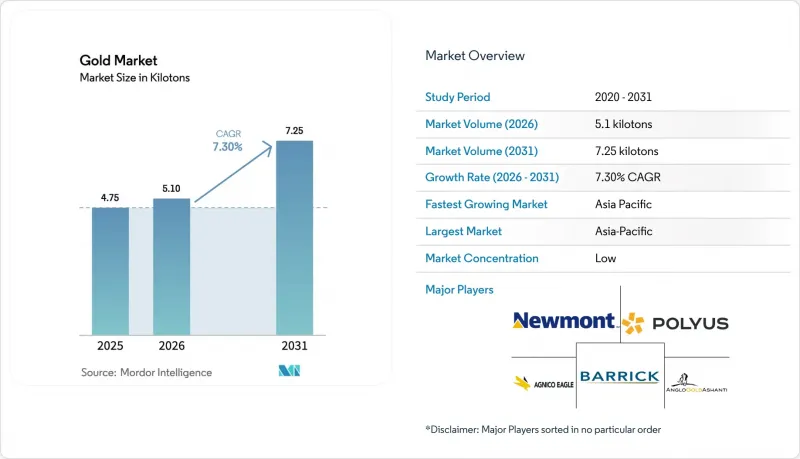
This report is Segmented by Source (Primary Mining and Recycled Gold), Type (Alloyed Gold and Layered Gold), Application (Jewellery, Electronics, Awards and Status Symbols, and Other Applications (Dental, Aerospace, Etc. )), and Geography (Production and Consumption Analysis Across Major Regions). The Market Forecasts are Provided in Terms of Volume (tons).
Global Gold Market Trends and Insights
Surging Retail and ETF Investment Demand in Inflation-Hedge Environments
Persistently high consumer-price levels and doubts over monetary-policy effectiveness have re-anchored gold in diversified portfolios. Gold exchange-traded funds in India attracted INR 112 Billion (USD 1.3 Billion) of net inflows during 2024, the highest annual tally on record . The metal out-performed local equities by 21 percentage points that year, reinforcing its safe-haven status. Portfolio managers in the United States and Europe lifted strategic allocations as real yields turned negative, and survey data show a rising preference for gold when inflation exceeds 4%. Coins and bars remain popular among retail savers seeking physical hedges, and demand proved remarkably inelastic after spot prices broke above USD 2,300 /oz. The structural shift in investment behaviour is expected to keep the market well bid whenever macro volatility spikes.
Central-Bank De-Dollarization Strategies Accelerating Reserve Diversification
Central banks bought more than 1,000 tons of gold in each of the past three calendar years, a historic streak that underscores growing skepticism toward the US dollar's future dominance. In the World Gold Council's 2025 survey, 95% of respondents said they would either maintain or increase their bullion holdings, and 43% plan outright additions. China, India, and Turkey led net purchases that together topped 600 tons since 2021, reflecting policy moves to mitigate sanction risk and currency volatility. The dollar's share of global foreign-exchange reserves slipped to 58.9% by March 2024, its lowest level since modern records began, increasing the attractiveness of gold as a neutral store of value. Active bullion management grew from 37% to 44% of official holdings over 2024-2025, signalling a longer-run structural bid beneath the gold industry.
Declining Mined Ore Grades Raising AISC Beyond USD 1,450 /oz
Ore grades continue to fall at mature deposits, forcing operators to process more material to maintain output. Newmont reported its highest cost base in nine years, with all-in sustaining costs at USD 1,651 /oz in Q1 2025, a 29% jump from 2022. Industry-wide all-in sustaining costs (AISC) averaged USD 1,388 /oz in Q2 2024, and North American producers faced an even steeper USD 1,522 /oz. Labour shortages, rising energy prices, and royalty escalators linked to spot quotations intensify cost pressures. Although a record spot price shields margins today, sustained cost inflation squeezes feasibility for marginal pits and accelerates mine closures. Over the medium term, higher cost curves could temper fresh supply and lift the floor under the gold industry.
Other drivers and restraints analyzed in the detailed report include:
- Rising Middle-Class Jewellery Demand in India and ASEAN
- AI-Enabled Electronics Driving Ultra-Fine Gold Bonding-Wire Usage
- ESG-Driven Financing Constraints for New Green-Field Mines
For complete list of drivers and restraints, kindly check the Table Of Contents.
Segment Analysis
Primary extraction occupied 72.05% of the Gold market share in 2025, confirming that large-scale open-pit and underground mines remain the backbone of supply. The segment benefits from established logistics, skilled labour pools, and long-term offtake contracts that stabilise throughput even when ore grades erode. However, all-in sustaining costs rising above USD 1,388 /oz signal diminishing returns on fresh capital, and companies have intensified exploration around existing hubs to leverage sunk infrastructure.
Recycling, though only 27.95% of supply, is marching forward at an 7.98% CAGR to 2031, the fastest rate of any source segment. The Royal Mint's South Wales facility processes 4,000 tons of circuit boards annually using patented hydrometallurgical techniques with 99% recovery efficiency . Energy demand for recycling is roughly 300 times lower than for green-field mining, lowering carbon intensity and aligning with Environmental, Social, and Governance (ESG) mandates. Luxury-goods leader Pandora pledged to use 100% recycled precious metals by 2025, creating pull for scrap flows. As more jurisdictions tighten e-waste rules, secondary feedstock will become a strategic pillar in the Gold industry.
Complete Report Scope:
- By Source
- Primary Mining
- Recycled Gold
- By Type
- Alloyed Gold
- Layered Gold
- By Application
- Jewellery
- Electronics
- Awards and Status Symbols
- Other Applications (Dental, Aerospace, etc.)
- By Geography
- Production Analysis
- United States
- Australia
- Brazil
- Burkina Faso
- Canada
- China
- Colombia
- Ghana
- Indonesia
- Kazakhstan
- Mali
- Mexico
- Papua New Guinea
- Peru
- Russia
- South Africa
- Sudan
- Tanzania
- Uzbekistan
- Other countries
- Consumption Analysis
- Asia-Pacific
- China
- India
- Japan
- South Korea
- Rest of Asia-Pacific
- North America
- United States
- Canada
- Mexico
- Europe
- Germany
- United Kingdom
- Italy
- France
- Rest of Europe
- South America
- Brazil
- Argentina
- Rest of South America
- Middle East and Africa
- Saudi Arabia
- South Africa
- Rest of Middle East and Africa
- Asia-Pacific
- Production Analysis
Geography Analysis
Asia-Pacific held 59.85% of the Gold industry in 2025 and is projected to grow with a 8.95% CAGR through 2031. China mined 403 tons in 2024, retaining pole position in production while its central bank lifted official holdings for the 19th consecutive month. India's Reserve Bank expanded bullion reserves to 880 tons by July 2025, and consumer demand rebounded once import duties fell. Indonesia, Thailand, and Vietnam posted double-digit percentage gains in jewelry offtake, reflecting rising disposable income and a preference for gold as a liquid savings vehicle.
North America and Europe exhibit mature demand profiles yet see renewed investor interest as real yields gyrate. US-listed gold Exchange Traded Funds (ETFs) added 152 tons during 2024, reversing two years of net outflows, while European funds absorbed 98 tons amid heightened energy-price volatility. Canadian mines contributed 175 t of output, led by the Detour Lake expansion that reached full capacity in Q4 2024. Within the gold industry, the region's regulatory stability and access to capital markets encourage brownfield expansions that help offset grade decline elsewhere. Latin America and Africa remain pivotal on the supply side. Peru and Brazil delivered a combined 290 tons in 2024, though social protests in Peru intermittently halted logistics movements. Ghana overtook South Africa as the continent's top producer, shipping 129 tons, aided by streamlined permitting under its 2024 Mining Investment Bill. Several African central banks announced plans to raise gold holdings to at least 10% of reserves, a move that could redirect part of regional output toward domestic vaults rather than export channels. Middle Eastern demand ticked higher as Gulf Cooperation Council states promoted gold-based savings products aligned with Sharia principles, enhancing retail participation in the Gold industry.
- Agnico Eagle Mines Limited
- AnglogoldAshanti
- B2Gold Corp.
- Barrick Mining Corporation
- China Gold International Resources Corp., Ltd.
- Endeavour Mining plc
- Equinox Gold Corp.
- Franco-Nevada Corporation
- FURUKAWA CO., LTD.
- Gabriel Resources
- Gold Fields Limited
- Harmony Gold Mining Company Limited
- Johnson Matthey
- Kinross Gold Corporation
- Lundin Gold Inc.
- Newmont Corporation
- PJSC Polyus
- Zijin Mining Group Co., Ltd.
Additional Benefits:
- The market estimate (ME) sheet in Excel format
- 3 months of analyst support
TABLE OF CONTENTS
1 Introduction
- 1.1 Study Assumptions & Market Definition
- 1.2 Scope of the Study
2 Research Methodology
3 Executive Summary
4 Market Landscape
- 4.1 Market Overview
- 4.2 Market Drivers
- 4.2.1 Surging Retail and ETF Investment Demand in Inflation-hedge Environments
- 4.2.2 Central-bank De-dollarization Strategies Accelerating Reserve Diversification
- 4.2.3 Rising Middle-class Jewellery Demand in India and Asean
- 4.2.4 AI-Enabled Electronics Driving Ultra-fine Gold Bonding Wire Usage
- 4.2.5 Tokenised Gold Products Expanding Digital Asset Adoption
- 4.3 Market Restraints
- 4.3.1 Declining Mined Ore-grades Raising AISC Beyond USD 1,450/oz
- 4.3.2 ESG-driven Financing Constraints for New Green-field Mines
- 4.3.3 Volatile Import Duties in Key Consuming Nations Curb Jewellery Demand
- 4.4 Value Chain Analysis
- 4.5 Porter's Five Forces
- 4.5.1 Bargaining Power of Suppliers
- 4.5.2 Bargaining Power of Buyers
- 4.5.3 Threat of New Entrants
- 4.5.4 Threat of Substitutes
- 4.5.5 Degree of Competition
5 Market Size & Growth Forecasts (Volume)
- 5.1 By Source
- 5.1.1 Primary Mining
- 5.1.2 Recycled Gold
- 5.2 By Type
- 5.2.1 Alloyed Gold
- 5.2.2 Layered Gold
- 5.3 By Application
- 5.3.1 Jewellery
- 5.3.2 Electronics
- 5.3.3 Awards and Status Symbols
- 5.3.4 Other Applications (Dental, Aerospace, etc.)
- 5.4 By Geography
- 5.4.1 Production Analysis
- 5.4.1.1 United States
- 5.4.1.2 Australia
- 5.4.1.3 Brazil
- 5.4.1.4 Burkina Faso
- 5.4.1.5 Canada
- 5.4.1.6 China
- 5.4.1.7 Colombia
- 5.4.1.8 Ghana
- 5.4.1.9 Indonesia
- 5.4.1.10 Kazakhstan
- 5.4.1.11 Mali
- 5.4.1.12 Mexico
- 5.4.1.13 Papua New Guinea
- 5.4.1.14 Peru
- 5.4.1.15 Russia
- 5.4.1.16 South Africa
- 5.4.1.17 Sudan
- 5.4.1.18 Tanzania
- 5.4.1.19 Uzbekistan
- 5.4.1.20 Other countries
- 5.4.2 Consumption Analysis
- 5.4.2.1 Asia-Pacific
- 5.4.2.1.1 China
- 5.4.2.1.2 India
- 5.4.2.1.3 Japan
- 5.4.2.1.4 South Korea
- 5.4.2.1.5 Rest of Asia-Pacific
- 5.4.2.2 North America
- 5.4.2.2.1 United States
- 5.4.2.2.2 Canada
- 5.4.2.2.3 Mexico
- 5.4.2.3 Europe
- 5.4.2.3.1 Germany
- 5.4.2.3.2 United Kingdom
- 5.4.2.3.3 Italy
- 5.4.2.3.4 France
- 5.4.2.3.5 Rest of Europe
- 5.4.2.4 South America
- 5.4.2.4.1 Brazil
- 5.4.2.4.2 Argentina
- 5.4.2.4.3 Rest of South America
- 5.4.2.5 Middle East and Africa
- 5.4.2.5.1 Saudi Arabia
- 5.4.2.5.2 South Africa
- 5.4.2.5.3 Rest of Middle East and Africa
- 5.4.2.1 Asia-Pacific
- 5.4.1 Production Analysis
6 Competitive Landscape
- 6.1 Market Concentration
- 6.2 Strategic Moves
- 6.3 Market Share(%)/Ranking Analysis
- 6.4 Company Profiles (includes Global level Overview, Market level overview, Core Segments, Financials as available, Strategic Information, Market Rank/Share for key companies, Products & Services, and Recent Developments)
- 6.4.1 Agnico Eagle Mines Limited
- 6.4.2 AnglogoldAshanti
- 6.4.3 B2Gold Corp.
- 6.4.4 Barrick Mining Corporation
- 6.4.5 China Gold International Resources Corp., Ltd.
- 6.4.6 Endeavour Mining plc
- 6.4.7 Equinox Gold Corp.
- 6.4.8 Franco-Nevada Corporation
- 6.4.9 FURUKAWA CO., LTD.
- 6.4.10 Gabriel Resources
- 6.4.11 Gold Fields Limited
- 6.4.12 Harmony Gold Mining Company Limited
- 6.4.13 Johnson Matthey
- 6.4.14 Kinross Gold Corporation
- 6.4.15 Lundin Gold Inc.
- 6.4.16 Newmont Corporation
- 6.4.17 PJSC Polyus
- 6.4.18 Zijin Mining Group Co., Ltd.
7 Market Opportunities & Future Outlook
- 7.1 White-space & Unmet-need Assessment
- 7.2 Use of Cyanide Leaching for Extracting Gold

