PUBLISHER: Mordor Intelligence | PRODUCT CODE: 2119835

PUBLISHER: Mordor Intelligence | PRODUCT CODE: 2119835
Search And Rescue (SAR) Equipment - Market Share Analysis, Industry Trends & Statistics, Growth Forecasts (2026 - 2031)
According to Mordor Intelligence, the search and rescue equipment market size was valued at USD 115.51 billion in 2025 and estimated to grow from USD 119.51 billion in 2026 to reach USD 141.69 billion by 2031, at a CAGR of 3.46% during the forecast period (2026-2031).
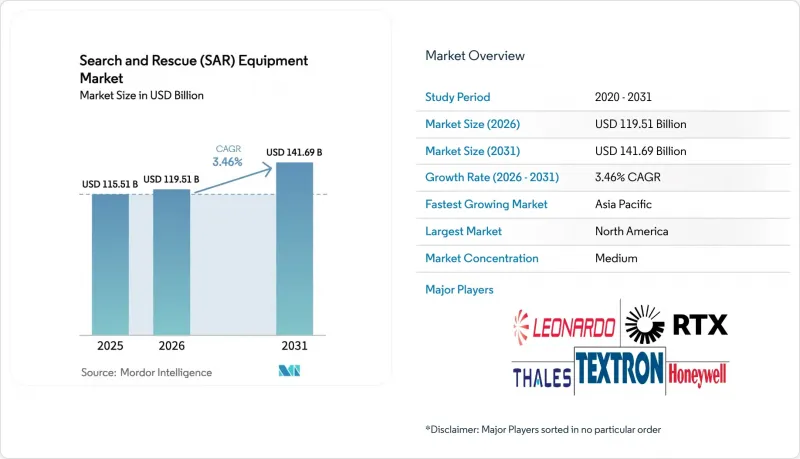
This report is Segmented by Platform (Airborne, Marine, and Ground-Based), Equipment Type (Rescue Equipment, Search Equipment, and More), Application (Combat SAR, Urban SAR, and Industrial SAR), End-User (Defense and Military Agencies, Industrial Operators, and More), and Geography (North America, Europe, Asia-Pacific, and More). The Market Forecasts are Provided in Terms of Value (USD).
Global Search And Rescue (SAR) Equipment Market Trends and Insights
Rising frequency and severity of climate-driven disasters boosting multi-domain SAR procurement
Severe weather caused USD 380 billion in global economic losses during 2024, leaving a 69% protection gap in insurance coverage. Governments are responding by shifting funding from post-event relief to proactive capability build-outs. Natural Resources Canada earmarked USD 346.1 million for wildfire equipment and training, and similar commitments appear in FEMA's USD 33.1 billion FY 2025 budget. More billion-dollar storms heighten the need for multi-domain assets that can deploy rapidly across forests, coasts, and urban centers, moving the search and rescue equipment market toward fleet renewals and higher-technology payloads.
Proliferation of UAVs and autonomous platforms for wide-area imaging
Thermal-equipped drones now deliver 95% precision in human-detection trials, and YOLOv8 inference models allow real-time target confirmation. As defense drone spending scales, cost curves favor civilian SAR agencies adopting "drone-as-a-service" contracting. Mixed fleets, such as the Queensland Police's Bell 429 helicopters and rotary-wing UAS, illustrate operational optimisation in dense urban terrain.
Stringent multi-agency certification requirements
Complying with IMO, FAA, EASA, and Cospas-Sarsat mandates extends product cycles and raises testing costs, particularly for dual-use payloads needing separate military and civilian approvals. The IAMSAR Manual amendments add equipment tracking obligations, and FCC rule changes in 70/80/90 GHz bands require coordination across maritime and aviation domains, reinforcing the barrier for small entrants.
Other drivers and restraints analyzed in the detailed report include:
- LEO-satellite and IoT convergence enabling real-time situational awareness
- Expansion of offshore energy, remote mining and polar logistics hubs
- Scarcity of certified training for urban robotics SAR crews
For complete list of drivers and restraints, kindly check the Table Of Contents.
Segment Analysis
Airborne assets generated 57.74% of 2025 revenue, underscoring the search and rescue equipment market's reliance on helicopters, fixed-wing aircraft, and UAS. Airbus's RACER demonstrator delivers 400 km/h cruise and 20% fuel-burn gains, widening the mission envelope for high-speed extractions. Fixed-wing models augment range for open-ocean operations, while long-endurance UAS equipped with synthetic-aperture radar fill detection gaps over rough seas. Blended manned-unmanned tasking reduces sortie cycles and directs crewed platforms to confirmed survivor sites.
Ground-based platforms, however, hold the fastest CAGR at 6.05% as urbanisation and industrial corridors demand all-terrain vehicles, robotic crawlers, and wearable exoskeletons for confined-space rescues. Integration with 5G and edge-computing nodes allows near-instant video offload to command posts. The search and rescue equipment market size for ground solutions is expected to climb steadily as cities harden critical infrastructure and private operators mandate on-site response fleets.
Migration from VHF analog radios to software-defined, multi-band devices drives a 7.12% CAGR for communication equipment. FCC approval for high-frequency air-to-surface links unlocks gigabit channels for sensor fusion, while MEOSAR readiness deadlines push beacon refresh cycles. In 2025, rescue equipment still led overall revenue at 32.10%, covering stretchers, power cutters, and evacuation kits. Yet, as agencies prioritise real-time data exchange, the market share for communication suites will witness faster growth.
Search sensors benefit from improved uncooled IR arrays, and rescue radars adopt phased-array steering for clutter rejection. Technical equipment-planning, analytics, and 3D mapping software-leverages AI to automate crew-task pairing and stock-level alerts. Other categories capture emerging IoT beacons and autonomous tenders aimed at hazardous-material scenarios, diversifying supplier opportunities within the broader search and rescue equipment industry.
Complete Report Scope:
- By Platform
- Airborne
- Helicopters
- Fixed-Wing Aircraft
- Unmanned Aerial Vehicles (UAVs)
- Marine
- Ground-Based
- Airborne
- By Equipment
- Rescue Equipment
- Power Rescue Tools
- Medical and Evacuation Kits
- Search Equipment
- Thermal / IR Sensors
- Rescue Radars
- Communication Equipment
- SATCOM Terminals
- Software-Defined Radios
- Technical Equipment
- Planning and Command Systems
- Other Equipment
- Rescue Equipment
- By Application
- Combat SAR
- Urban SAR
- Industrial SAR
- By End-User
- Defense and Military Agencies
- Public Safety and Law-Enforcement
- Industrial Operators
- By Geography
- North America
- United States
- Canada
- Mexico
- Europe
- United Kingdom
- Germany
- France
- Italy
- Russia
- Rest of Europe
- Asia-Pacific
- China
- India
- Japan
- South Korea
- Rest of Asia-Pacific
- South America
- Brazil
- Argentina
- Rest of South America
- Middle East and Africa
- Middle East
- Saudi Arabia
- United Arab Emirates
- Israel
- Rest of Middle East
- Africa
- South Africa
- Rest of Africa
- Middle East
- North America
Geography Analysis
North America controlled 38.12% of 2025 turnover, anchored by FEMA's USD 33.1 billion fiscal-year budget and sustained Coast Guard, Air Force, and state wildfire outlays. The region's integrated aerospace-industrial base accelerates the fielding of hybrid-electric propulsion, polar hardening kits, and cloud-based command software, keeping the search and rescue equipment market ahead in capability.
Europe maintains a sizable share through rescEU pooled assets and Galileo's mature SAR payload. Joint procurement drives volume discounts, while Arctic member states channel funds into ice-class hulls and long-range drones. Europe's regulatory emphasis on green aviation also nudges suppliers to develop biofuel-compatible engines and recyclable composite structures.
Asia-Pacific is the fastest-growing theatre at 5.57% CAGR. Rapid coastal urbanisation, frequent typhoons, and seismic hazards force governments to upscale inventories-from Japan's satellite-enabled command upgrade to Australia's Disaster Ready Fund. Industrial SAR revenues grow as LNG carriers, offshore rigs, and mountain mining sites purchase bespoke kits. Cross-border disaster-relief exercises foster doctrine convergence and shore up regional demand for interoperable systems.
- RTX Corporation
- Textron Inc.
- Leonardo S.p.A.
- Elbit Systems Ltd.
- Honeywell International Inc.
- Thales Group
- General Dynamics Mission Systems (General Dynamics Corporation)
- BAE Systems plc
- L3Harris Technologies, Inc.
- Garmin Ltd.
- ACR Electronics Inc.
- Cobham Limited
- Savox Communications Oy Ab (Ltd)
- Trakka Systems
- Safran SA
- Iridium Satellite LLC
Additional Benefits:
- The market estimate (ME) sheet in Excel format
- 3 months of analyst support
TABLE OF CONTENTS
1 INTRODUCTION
- 1.1 Study Assumptions and Market Definition
- 1.2 Scope of the Study
2 RESEARCH METHODOLOGY
3 EXECUTIVE SUMMARY
4 MARKET LANDSCAPE
- 4.1 Market Overview
- 4.2 Market Drivers
- 4.2.1 Rising frequency and severity of climate-driven disasters boosting multi-domain SAR procurement
- 4.2.2 Proliferation of UAVs and autonomous platforms for wide-area imaging
- 4.2.3 LEO-satellite and IoT convergence enabling real-time situational awareness
- 4.2.4 Expansion of offshore energy, remote mining and polar logistics hubs
- 4.2.5 Mandatory migration to 2nd-generation Cospas-Sarsat MEOSAR beacons
- 4.2.6 Global replacement cycle of aging SAR rotorcraft and fixed-wing fleets
- 4.3 Market Restraints
- 4.3.1 Stringent multi-agency certification (Cospas-Sarsat, IMO, FAA, EASA)
- 4.3.2 Scarcity of certified training for urban robotics SAR crews
- 4.3.3 Post-pandemic fiscal tightening delaying capital procurements
- 4.3.4 Interoperability gaps between legacy analog radios and next-gen digital/AI systems
- 4.4 Value/Supply-Chain Analysis
- 4.5 Regulatory Outlook
- 4.6 Technological Outlook
- 4.7 Porter's Five Forces Analysis
- 4.7.1 Bargaining Power of Buyers/Consumers
- 4.7.2 Bargaining Power of Suppliers
- 4.7.3 Threat of New Entrants
- 4.7.4 Threat of Substitute Products
- 4.7.5 Intensity of Competitive Rivalry
5 MARKET SIZE AND GROWTH FORECASTS (VALUE)
- 5.1 By Platform
- 5.1.1 Airborne
- 5.1.1.1 Helicopters
- 5.1.1.2 Fixed-Wing Aircraft
- 5.1.1.3 Unmanned Aerial Vehicles (UAVs)
- 5.1.2 Marine
- 5.1.3 Ground-Based
- 5.1.1 Airborne
- 5.2 By Equipment
- 5.2.1 Rescue Equipment
- 5.2.1.1 Power Rescue Tools
- 5.2.1.2 Medical and Evacuation Kits
- 5.2.2 Search Equipment
- 5.2.2.1 Thermal / IR Sensors
- 5.2.2.2 Rescue Radars
- 5.2.3 Communication Equipment
- 5.2.3.1 SATCOM Terminals
- 5.2.3.2 Software-Defined Radios
- 5.2.4 Technical Equipment
- 5.2.5 Planning and Command Systems
- 5.2.6 Other Equipment
- 5.2.1 Rescue Equipment
- 5.3 By Application
- 5.3.1 Combat SAR
- 5.3.2 Urban SAR
- 5.3.3 Industrial SAR
- 5.4 By End-User
- 5.4.1 Defense and Military Agencies
- 5.4.2 Public Safety and Law-Enforcement
- 5.4.3 Industrial Operators
- 5.5 By Geography
- 5.5.1 North America
- 5.5.1.1 United States
- 5.5.1.2 Canada
- 5.5.1.3 Mexico
- 5.5.2 Europe
- 5.5.2.1 United Kingdom
- 5.5.2.2 Germany
- 5.5.2.3 France
- 5.5.2.4 Italy
- 5.5.2.5 Russia
- 5.5.2.6 Rest of Europe
- 5.5.3 Asia-Pacific
- 5.5.3.1 China
- 5.5.3.2 India
- 5.5.3.3 Japan
- 5.5.3.4 South Korea
- 5.5.3.5 Rest of Asia-Pacific
- 5.5.4 South America
- 5.5.4.1 Brazil
- 5.5.4.2 Argentina
- 5.5.4.3 Rest of South America
- 5.5.5 Middle East and Africa
- 5.5.5.1 Middle East
- 5.5.5.1.1 Saudi Arabia
- 5.5.5.1.2 United Arab Emirates
- 5.5.5.1.3 Israel
- 5.5.5.1.4 Rest of Middle East
- 5.5.5.2 Africa
- 5.5.5.2.1 South Africa
- 5.5.5.2.2 Rest of Africa
- 5.5.5.1 Middle East
- 5.5.1 North America
6 COMPETITIVE LANDSCAPE
- 6.1 Market Concentration
- 6.2 Strategic Moves
- 6.3 Market Share Analysis
- 6.4 Company Profiles (includes Global Level Overview, Market Level Overview, Core Segments, Financials as available, Strategic Information, Market Rank/Share for key companies, Products and Services, and Recent Developments)
- 6.4.1 RTX Corporation
- 6.4.2 Textron Inc.
- 6.4.3 Leonardo S.p.A.
- 6.4.4 Elbit Systems Ltd.
- 6.4.5 Honeywell International Inc.
- 6.4.6 Thales Group
- 6.4.7 General Dynamics Mission Systems (General Dynamics Corporation)
- 6.4.8 BAE Systems plc
- 6.4.9 L3Harris Technologies, Inc.
- 6.4.10 Garmin Ltd.
- 6.4.11 ACR Electronics Inc.
- 6.4.12 Cobham Limited
- 6.4.13 Savox Communications Oy Ab (Ltd)
- 6.4.14 Trakka Systems
- 6.4.15 Safran SA
- 6.4.16 Iridium Satellite LLC
7 MARKET OPPORTUNITIES AND FUTURE OUTLOOK
- 7.1 White-Space and Unmet-Need Assessment

