PUBLISHER: Mordor Intelligence | PRODUCT CODE: 2119848

PUBLISHER: Mordor Intelligence | PRODUCT CODE: 2119848
Antimicrobial Resistance Surveillance - Market Share Analysis, Industry Trends & Statistics, Growth Forecasts (2026 - 2031)
According to Mordor Intelligence, the antimicrobial resistance surveillance market size is expected to grow from USD 6.24 billion in 2025 to USD 6.59 billion in 2026 and is forecast to reach USD 8.66 billion by 2031 at 5.62% CAGR over 2026-2031.
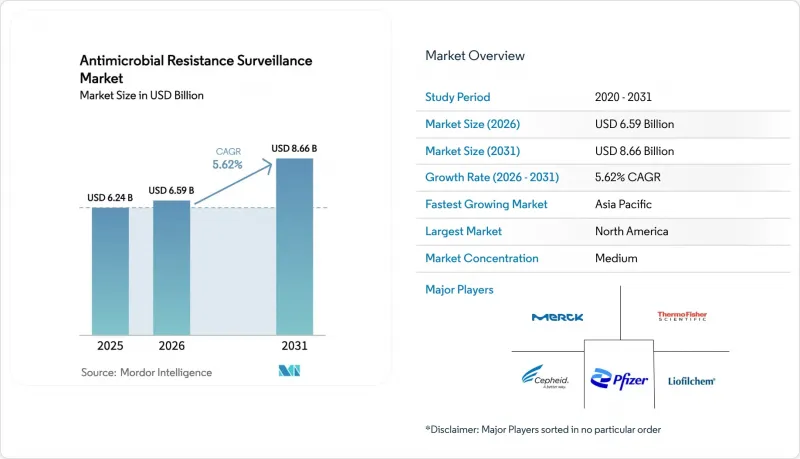
This report is Segmented by Solution (Kits, Systems, and More), Technology (Culture-Based Methods, and More), Application (Clinical Diagnostics, Public-Health Surveillance, and More), End-User (Hospitals and Clinics, Diagnostic Laboratories, Other End-Users), and Geography (North America, and More). The Market Forecasts are Provided in Terms of Value (USD).
Global Antimicrobial Resistance Surveillance Market Trends and Insights
Rising Prevalence of Drug-Resistant Infections
Alarmingly high resistance rates reported across all WHO regions in 2024 continue to fuel the antimicrobial resistance surveillance market. Hypervirulent carbapenem-resistant Klebsiella pneumoniae sequence type 23 is now documented in 16 countries and infects both healthy and immunocompromised individuals, prompting urgent surveillance upgrades. Southeast Asian studies show carbapenem-resistant E. coli and Klebsiella in 8 and 9 of 11 nations respectively, with the heaviest burden in Indonesia, Philippines, Thailand, and Vietnam. The WHO forecasts 5.2 million deaths in the Western Pacific from AMR by 2030, with USD148 billion in economic losses, compelling health systems to invest in advanced monitoring.
Government Initiatives & Funding for AMR Programmes
The International Pathogen Surveillance Network introduced a USD4 million catalytic fund in 2024 to strengthen genomic monitoring in LMICs. The UK extended its real-time sequencing program with Oxford Nanopore from 10 to 30 NHS sites, redefining proactive outbreak response . In the United States, the draft PASTEUR Act allocates USD6 billion to antimicrobial innovation and CDC surveillance upgrades, while BARDA partners with Pattern Bioscience and BugSeq on AI-based diagnostics. FAO's AMR multi-partner trust fund, active to 2030, underscores global coordination by supporting integrated surveillance across ten nations.
High Capital & Operating Cost of AMR Surveillance Systems
Whole-genome sequencing platforms can demand start-up investments topping USD 500,000, with ongoing reagent and maintenance costs near USD 200,000 per site annually, creating adoption hurdles in resource-constrained settings. Networked surveillance compounds expenses as multiple facilities integrate standardized protocols, data warehouses, and quality systems. The WHO now offers catalytic grants of USD 50,000-250,000 to LMIC projects, while developers explore paper-based sensors that satisfy REASSURED criteria at lower cost.
Other drivers and restraints analyzed in the detailed report include:
- Emergence of Multi-Drug Resistance from Antibiotic Misuse
- AI-Driven Predictive Analytics Adoption in AMR Platforms
- Shortage of Skilled Microbiologists & Bioinformaticians
For complete list of drivers and restraints, kindly check the Table Of Contents.
Segment Analysis
Surveillance software held 41.63% revenue in 2025, reflecting its central role in data orchestration across laboratories, hospitals, and public health agencies. Hospitals increasingly offload daily analytics, regulatory reporting, and compliance tasks to external experts, propelling surveillance services at a 6.08% CAGR. This shift toward managed solutions aligns with post-2024 FDA rules that heighten oversight of laboratory-developed tests and require continuous quality documentation, tasks that cloud-based providers handle at scale.
Growth in services signals broader movement from product sales to subscription revenue, enabling vendors to lock in long-term contracts and provide continuous algorithm updates. The antimicrobial resistance surveillance market benefits as AI modules, outbreak alerts, and regulatory dashboards integrate seamlessly within cloud environments, giving smaller hospitals sophisticated capabilities without large local IT footprints. bioMerieux's acquisition of LUMED illustrates how diagnostics firms now marry hardware with stewardship software to deliver end-to-end offerings.
Molecular diagnostics commanded 38.55% of 2025 revenue as PCR and NGS methods offered rapid gene-based detection. Yet AI and data-analytics platforms are climbing fastest at 6.15% CAGR. These systems merge clinical, genomic, and epidemiological data to forecast resistance, a value proposition extending beyond laboratory walls. Integrated solutions that couple PCR detection with AI prediction now achieve >90% categorical agreement in susceptibility testing, positioning hybrids to erode the longstanding dominance of pure molecular workflows.
The antimicrobial resistance surveillance industry is witnessing portable sequencers such as Oxford Nanopore's MinION that feed real-time reads into cloud AI engines for on-site decisions. Whole-genome sequencing remains a premium tool for cluster investigation, while culture-based and immunoassay methods retreat to niche roles where cost or infrastructure limit advanced options.
Complete Report Scope:
- By Solution
- Kits
- Systems
- Surveillance Software
- Surveillance Services
- By Technology
- Culture-based Methods
- Molecular Diagnostics
- Whole-Genome Sequencing
- AI and Data-Analytics Platforms
- Others
- By Application
- Clinical Diagnostics
- Public-Health Surveillance
- Antimicrobial Stewardship Programmes
- Pharma & Biotech R&D
- Others
- By End-User
- Hospitals and Clinics
- Diagnostic Laboratories
- Other End-Users
- By Geography
- North America
- United States
- Canada
- Mexico
- Europe
- Germany
- United Kingdom
- France
- Italy
- Spain
- Rest of Europe
- Asia-Pacific
- China
- Japan
- India
- Australia
- South Korea
- Rest of Asia-Pacific
- Middle East and Africa
- GCC
- South Africa
- Rest of Middle East and Africa
- South America
- Brazil
- Argentina
- Rest of South America
- North America
Geography Analysis
North America retains leadership with 42.15% revenue in 2025, backed by USD650 million in project funding through the CDC Antimicrobial Resistance Solutions Initiative and favorable FDA policies that accelerate diagnostic approvals. Continuous collaboration among CDC, BARDA, and industry sustains a robust pipeline of AI-enabled tools and integrated reporting platforms that feed directly into national dashboards for real-time situational awareness.
Asia-Pacific is the fastest-expanding territory at 6.41% CAGR as growing AMR burden prompts governments to digitize surveillance. China's national networks, operational since 2005, now combine hospital and agricultural data while India's i-AMRSS provides modular, open-source software to more than 100 sentinel sites. Regional joint funding between India and Japan accelerates applied research, while Singapore's One-Health-aligned Roadmap integrates human, animal, and environmental inputs. Local private-public partnerships import portable sequencers and cloud analytics to underserved provinces, enlarging the antimicrobial resistance surveillance market.
Europe shows steady uptake supported by EU-wide surveillance frameworks that harmonize laboratory methods and enable rapid cross-border notification of emerging strains. Latin America, Middle East, and Africa remain nascent but gain momentum as WHO's GLASS increases country participation to 92 and multi-partner grants finance early-stage network rollouts. In these regions, cost-efficient AI models paired with portable devices promise to leapfrog legacy infrastructure hurdles and expand the antimicrobial resistance surveillance market share among LMICs.
- Accelerate Diagnostics
- Beckton Dickinson
- bioMerieux
- Bruker Corp.
- Cepheid (Danaher)
- DiaSorin
- Illumina
- Liofilchem Srl
- Merck
- Oxford Nanopore Technologies
- Pfizer
- QIAGEN
- Roche
- Thermo Fisher Scientific
- T2 Biosystems
- Luminex (Diasorin)
- Abbott Laboratories
- Seegene
- OpGen Inc.
- SyntBioLab Inc.
Additional Benefits:
- The market estimate (ME) sheet in Excel format
- 3 months of analyst support
TABLE OF CONTENTS
1 Introduction
- 1.1 Study Assumptions & Market Definition
- 1.2 Scope of the Study
2 Research Methodology
3 Executive Summary
4 Market Landscape
- 4.1 Market Overview
- 4.2 Market Drivers
- 4.2.1 Rising Prevalence of Drug-Resistant Infections
- 4.2.2 Government Initiatives & Funding for AMR Programmes
- 4.2.3 Emergence Of Multi-Drug Resistance from Antibiotic Misuse
- 4.2.4 Accreditation-Driven Uptake of Hospital Infection-Tracking Tools
- 4.2.5 AI-Driven Predictive Analytics Adoption in AMR Platforms
- 4.2.6 Portable Genomic Sequencers Enabling LMIC Field Surveillance
- 4.3 Market Restraints
- 4.3.1 High Capital & Operating Cost of AMR Surveillance Systems
- 4.3.2 Shortage Of Skilled Microbiologists & Bioinformaticians
- 4.3.3 Cross-Border Genomic-Data-Sharing Ethical Barriers
- 4.3.4 Lower Awareness in Developing Regions
- 4.4 Regulatory Landscape
- 4.5 Technological Outlook
- 4.6 Porters Five Forces Analysis
- 4.6.1 Bargaining Power of Suppliers
- 4.6.2 Bargaining Power of Buyers/Consumers
- 4.6.3 Threat of New Entrants
- 4.6.4 Threat of Substitute Products
- 4.6.5 Intensity of Competitive Rivalry
5 Market Size & Growth Forecasts (Value, USD)
- 5.1 By Solution
- 5.1.1 Kits
- 5.1.2 Systems
- 5.1.3 Surveillance Software
- 5.1.4 Surveillance Services
- 5.2 By Technology
- 5.2.1 Culture-based Methods
- 5.2.2 Molecular Diagnostics
- 5.2.3 Whole-Genome Sequencing
- 5.2.4 AI and Data-Analytics Platforms
- 5.2.5 Others
- 5.3 By Application
- 5.3.1 Clinical Diagnostics
- 5.3.2 Public-Health Surveillance
- 5.3.3 Antimicrobial Stewardship Programmes
- 5.3.4 Pharma & Biotech R&D
- 5.3.5 Others
- 5.4 By End-User
- 5.4.1 Hospitals and Clinics
- 5.4.2 Diagnostic Laboratories
- 5.4.3 Other End-Users
- 5.5 By Geography
- 5.5.1 North America
- 5.5.1.1 United States
- 5.5.1.2 Canada
- 5.5.1.3 Mexico
- 5.5.2 Europe
- 5.5.2.1 Germany
- 5.5.2.2 United Kingdom
- 5.5.2.3 France
- 5.5.2.4 Italy
- 5.5.2.5 Spain
- 5.5.2.6 Rest of Europe
- 5.5.3 Asia-Pacific
- 5.5.3.1 China
- 5.5.3.2 Japan
- 5.5.3.3 India
- 5.5.3.4 Australia
- 5.5.3.5 South Korea
- 5.5.3.6 Rest of Asia-Pacific
- 5.5.4 Middle East and Africa
- 5.5.4.1 GCC
- 5.5.4.2 South Africa
- 5.5.4.3 Rest of Middle East and Africa
- 5.5.5 South America
- 5.5.5.1 Brazil
- 5.5.5.2 Argentina
- 5.5.5.3 Rest of South America
- 5.5.1 North America
6 Competitive Landscape
- 6.1 Market Concentration
- 6.2 Market Share Analysis
- 6.3 Company Profiles (includes Global level Overview, Market level overview, Core Segments, Financials as available, Strategic Information, Market Rank/Share, Products & Services, Recent Developments)
- 6.3.1 Accelerate Diagnostics
- 6.3.2 Becton, Dickinson & Co.
- 6.3.3 bioMerieux SA
- 6.3.4 Bruker Corp.
- 6.3.5 Cepheid (Danaher)
- 6.3.6 DiaSorin SpA
- 6.3.7 Illumina Inc.
- 6.3.8 Liofilchem Srl
- 6.3.9 Merck KGaA
- 6.3.10 Oxford Nanopore Technologies
- 6.3.11 Pfizer Inc.
- 6.3.12 Qiagen NV
- 6.3.13 Roche Diagnostics
- 6.3.14 Thermo Fisher Scientific
- 6.3.15 T2 Biosystems
- 6.3.16 Luminex (Diasorin)
- 6.3.17 Abbott Laboratories
- 6.3.18 Seegene Inc.
- 6.3.19 OpGen Inc.
- 6.3.20 SyntBioLab Inc.
7 Market Opportunities & Future Outlook
- 7.1 White-space & Unmet-need Assessment

