PUBLISHER: Mordor Intelligence | PRODUCT CODE: 2119851

PUBLISHER: Mordor Intelligence | PRODUCT CODE: 2119851
Asia-Pacific Less-than-Container-Load (LCL) - Market Share Analysis, Industry Trends & Statistics, Growth Forecasts (2026 - 2031)
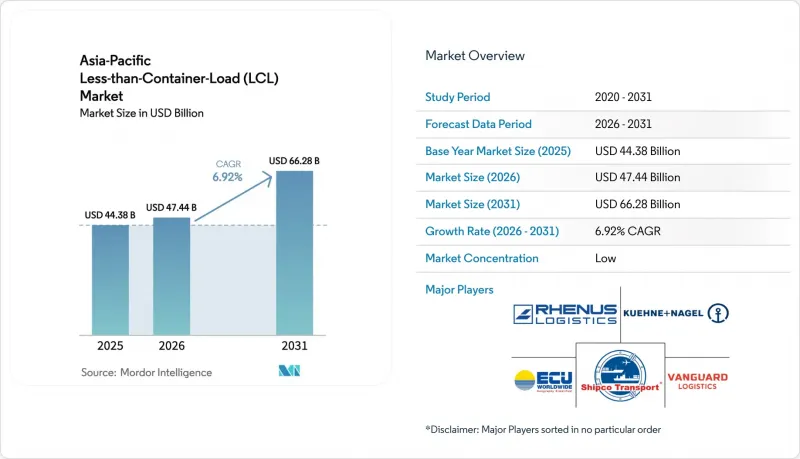
According to Mordor Intelligence, the Asia-Pacific less-than-Container-Load market size was valued at USD 44.38 billion in 2025 and estimated to grow from USD 47.44 billion in 2026 to reach USD 66.28 billion by 2031, at a CAGR of 6.92% during the forecast period (2026-2031).
This report is Segmented by Service Type (Consolidation Services and De-Consolidation & Distribution), Destination (Domestic and International), Nature of Business (Freight Forwarding and NVOCCs), End User (Manufacturing and Automotive, Retail & E-Commerce, and More), Country (China, India, Indonesia, Malaysia, and More). The Market Forecasts are Provided in Terms of Value (USD).
Asia-Pacific Less-than-Container-Load (LCL) Market Trends and Insights
E-commerce boom & cross-border parcel trade
Retail e-commerce sales in Southeast Asia are expected to hit USD 193 billion by 2028, equal to 17.4% of total retail spend. Rising online orders require smaller, more frequent shipments that suit LCL economics. The Philippines and Vietnam each anticipate online-retail CAGRs above 20%, creating constant demand spikes that traditional full-container contracts cannot match. RCEP customs simplification lowers transaction costs, speeding up small-batch clearances and pushing merchants toward regional inventory hubs. Omnichannel models mean inventory must be replenished across multiple markets simultaneously, reinforcing LCL's role in synchronized stock flows. As marketplaces promote same-week delivery promises, shippers prioritize flexible sailings over absolute rate minimization.
Supply-chain diversification of Asia-Pacific manufacturing
Foreign direct investment began shifting toward Southeast Asia during 2024 as firms executed "China + 1" strategies. Smaller production footprints scattered across India, Vietnam, and Indonesia require multi-origin pick-ups for final assembly or direct export, thereby elevating LCL volumes. Japanese electronics groups moved auxiliary lines to Thailand and the Philippines, contracting specialist consolidators to synchronize outbound flows. The region needs an additional USD 60 billion in logistics assets to handle this dispersed output, further magnifying consolidation demand. Heightened geopolitical tension accelerates relocation timelines, making agile LCL nodes attractive stopgaps while multi-country plants scale. As buyers diversify suppliers, consolidation centers emerge in secondary ports, shortening inland haulage and improving turnaround.
Port congestion & capacity constraints
Singapore and Colombo experienced extended vessel waits after Red Sea diversions in early 2025. Berth shortages ripple into feeder schedules, delaying container de-stuffing deadlines that underpin LCL cut-off times. Feeder operators imposed congestion surcharges that directly lift LCL unit costs. Labor shortages and limited night-gate hours further restrict throughput, especially for temperature-sensitive cargo needing priority handling. Automation projects promise capacity relief, but near-term mismatches between container arrivals and yard slots will continue disrupting LCL consolidation windows. Stakeholders advocate for better berth-allocation algorithms and data-sharing to smooth peaks.
Other drivers and restraints analyzed in the detailed report include:
- Cost-efficiency of LCL over air freight for SMEs
- Digital freight platforms offering LCL spot rates
- Volatility in ocean-freight rates
For complete list of drivers and restraints, kindly check the Table Of Contents.
Segment Analysis
Consolidation services commanded 64.45% of 2025 revenue. Their dominance stems from the Asia-Pacific Less-than-Container-Load market economics in which cargo aggregation into shared containers drives lower per-unit costs and faster sailing frequency. Maersk's Shanghai gateway with more than 200 direct lanes evidences the scale required to sustain daily consolidations. De-consolidation and distribution, though smaller, post a 4.21% CAGR to 2031 as retailers seek destination-side break-bulk for rapid e-commerce fulfillment. Integrated providers bundle in-country distribution with upstream consolidation to secure door-to-door contracts.
Demand for consolidation services rises with each additional omnichannel stock-point merchant set up across Asia. The Asia-Pacific Less-than-Container-Load market responds by opening new hub-and-spoke facilities in Penang, Cebu, and Surabaya. De-consolidation growth also mirrors the adoption of bonded e-commerce warehouses, where shipment splitting, labeling, and returns handling occur inside free-trade zones. Value-added distribution tasks, such as kitting or light assembly, allow consolidators to move up the service ladder, capturing higher margins.
International shipments generated 60.40% of the 2025 value, illustrating the export-oriented nature of many Asian production centers. The Asia-Pacific Less-than-Container-Load market size tied to overseas routes remains anchored by North American and European consumption cycles. Nevertheless, domestic LCL lanes are expected to post a faster 4.66% CAGR (2026-2031) as intra-Asia sourcing spreads. RCEP's common rule of origin is forecast to add USD 90 billion to regional trade and feed domestic consolidation flows.
Domestic LCL expansion pairs with rising middle-class demand for imported components assembled locally. This trend supports multi-country production chains in electronics and automotive, triggering back-and-forth movements of semi-finished goods. Consolidators refine trucking alliances for first-mile pick-ups to ensure container stuffing deadlines remain intact when origin points multiply. Forwarders also renegotiate depot leases in land-constrained metro areas to shorten drayage.
Complete Report Scope:
- By Service Type
- Consolidation Services
- De-consolidation & Distribution
- By Destination
- Domestic
- International
- By Nature of Business
- Freight Forwarding
- NVOCCs
- By End User
- Manufacturing and Automotive
- Retail & E-commerce
- Healthcare & Pharmaceuticals
- Agriculture & Forestry
- Other End Users
- By Country
- China
- India
- Indonesia
- Japan
- Malaysia
- Thailand
- Vietnam
- Australia
- Rest of Asia-Pacific
List of Companies Covered in this Report:
- ECU Worldwide (Part of All Cargo Logistics)
- Shipco
- Vanguard Logistics
- Rhenus Logistics
- Kuehne + Nagel
- DHL Global Forwarding
- DSV
- CEVA Logistics
- Rohlig Logistics
- GEODIS
- Gulf Agency Company (GAC)
- Kerry Logistics Network
- Sinotrans
- Nippon Express
- CJ Logistics
- JAS Worldwide
- APL Logistics
- Dimerco Express Group
- Yusen Logistics (Part of NYK Line)
- Toll Group
Additional Benefits:
- The market estimate (ME) sheet in Excel format
- 3 months of analyst support
TABLE OF CONTENTS
1 Introduction
- 1.1 Study Assumptions & Market Definition
- 1.2 Scope of the Study
2 Research Methodology
3 Executive Summary
4 Market Landscape
- 4.1 Market Overview
- 4.2 Market Drivers
- 4.2.1 E-commerce boom & cross-border parcel trade
- 4.2.2 Supply-chain diversification of Asia-Pacific manufacturing
- 4.2.3 Cost-efficiency of LCL over air-freight for SMEs
- 4.2.4 Port infrastructure expansion & FTAs
- 4.2.5 Digital freight platforms offering LCL spot rates
- 4.2.6 Green-shipping initiatives favouring load optimisation
- 4.3 Market Restraints
- 4.3.1 Port congestion & capacity constraints
- 4.3.2 Volatility in ocean-freight rates
- 4.3.3 Limited cold-chain LCL infrastructure
- 4.3.4 Emerging ESG compliance burdens
- 4.4 Value / Supply-Chain Analysis
- 4.5 Regulatory Landscape
- 4.6 Technological Outlook
- 4.7 Porter's Five Forces Analysis
- 4.7.1 Bargaining Power of Suppliers
- 4.7.2 Bargaining Power of Buyers
- 4.7.3 Threat of New Entrants
- 4.7.4 Threat of Substitutes
- 4.7.5 Intensity of Competitive Rivalry
- 4.8 Impact of COVID-19 & Geo-Political Events
5 Market Size & Growth Forecasts
- 5.1 By Service Type
- 5.1.1 Consolidation Services
- 5.1.2 De-consolidation & Distribution
- 5.2 By Destination
- 5.2.1 Domestic
- 5.2.2 International
- 5.3 By Nature of Business
- 5.3.1 Freight Forwarding
- 5.3.2 NVOCCs
- 5.4 By End User
- 5.4.1 Manufacturing and Automotive
- 5.4.2 Retail & E-commerce
- 5.4.3 Healthcare & Pharmaceuticals
- 5.4.4 Agriculture & Forestry
- 5.4.5 Other End Users
- 5.5 By Country
- 5.5.1 China
- 5.5.2 India
- 5.5.3 Indonesia
- 5.5.4 Japan
- 5.5.5 Malaysia
- 5.5.6 Thailand
- 5.5.7 Vietnam
- 5.5.8 Australia
- 5.5.9 Rest of Asia-Pacific
6 Competitive Landscape
- 6.1 Market Concentration
- 6.2 Strategic Moves
- 6.3 Market Share Analysis
- 6.4 Company Profiles {(includes Global level Overview, Market level overview, Core Segments, Financials as available, Strategic Information, Market Rank/Share for key companies, Products & Services, and Recent Developments)}
- 6.4.1 ECU Worldwide (Part of All Cargo Logistics)
- 6.4.2 Shipco
- 6.4.3 Vanguard Logistics
- 6.4.4 Rhenus Logistics
- 6.4.5 Kuehne + Nagel
- 6.4.6 DHL Global Forwarding
- 6.4.7 DSV
- 6.4.8 CEVA Logistics
- 6.4.9 Rohlig Logistics
- 6.4.10 GEODIS
- 6.4.11 Gulf Agency Company (GAC)
- 6.4.12 Kerry Logistics Network
- 6.4.13 Sinotrans
- 6.4.14 Nippon Express
- 6.4.15 CJ Logistics
- 6.4.16 JAS Worldwide
- 6.4.17 APL Logistics
- 6.4.18 Dimerco Express Group
- 6.4.19 Yusen Logistics (Part of NYK Line)
- 6.4.20 Toll Group
7 Market Opportunities & Future Outlook
- 7.1 White-space & Unmet-need Assessment

