PUBLISHER: Mordor Intelligence | PRODUCT CODE: 2124788

PUBLISHER: Mordor Intelligence | PRODUCT CODE: 2124788
North America Insulated Shipping Containers - Market Share Analysis, Industry Trends & Statistics, Growth Forecasts (2026 - 2031)
According to Mordor Intelligence, North America insulated shipping containers market size in 2026 is estimated at USD 1.97 billion, growing from 2025 value of USD 1.85 billion with 2031 projections showing USD 2.68 billion, growing at 6.37% CAGR over 2026-2031.
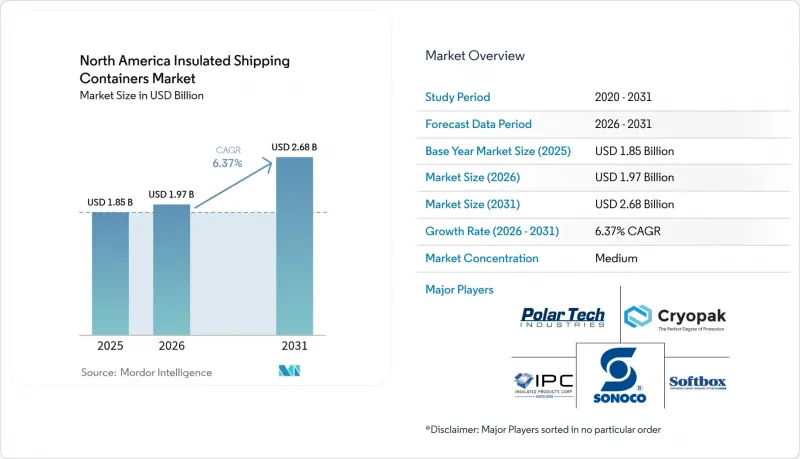
This report is Segmented by Material Type (Expanded Polystyrene, Polyurethane Foam, Expanded Polypropylene, and More), End-User Application (Life Sciences and Pharmaceutical, Fresh Produce, and More), Product Type (Single-Use Rigid Box, Reusable Rigid Box, and More), Capacity Range (<=5L, 5-20L, and More), and Country. The Market Forecasts are Provided in Terms of Value (USD).
North America Insulated Shipping Containers Market Trends and Insights
E-commerce Surge in Temperature-Sensitive Meal Kits
Temperature-sensitive meal kit services are scaling quickly and require compact, high-performance packaging that sustains 48-72-hour transit windows. Technology such as SeaWell active packaging lengthens shelf life and supports quality claims. Cost-conscious operators use smaller, lighter containers that cut freight expenses, and biodegradable foams help brands communicate sustainability commitments. Adoption peaks within two years as consolidation reduces operator count, yet installed volumes of small containers keep rising. The North America insulated shipping containers market responds with thinner wall profiles that still meet last-mile thermal targets.
Growth in Pharmaceutical Cold-Chain Expansion
Biologics, cell therapies, and personalized medicine demand precise 2-8 °C shipping, expanding beyond routine vaccine lanes. Merck's USD 1.5 billion cold-chain build-out in 2024 underscores the long-term capital push. Vacuum insulated panels (VIPs) and phase change materials (PCMs) safeguard payloads during extended transit and reduce excursion risk. Direct-to-patient delivery fuels the need for small, validated shippers with data-logging features. As distribution networks mature, the North America insulated shipping containers market embeds real-time monitoring to satisfy audit requirements across borders.
Escalating Cost of Bio-Based Insulation Resins
Bio-based resins cost 15-25% more than petroleum equivalents, eroding margins for eco-focused converters. Limited feedstock capacity and agricultural price swings magnify volatility. Smaller vendors struggle to absorb surcharges and must pass them to customers, risking order deferrals. Technology learning curves and scale economies could narrow the gap, yet near-term headwinds remain, slowing the wholesale shift away from EPS.
Other drivers and restraints analyzed in the detailed report include:
- Tightening U.S. FDA Biologics Stability Guidance
- Retailer Sustainability Mandates for Reusable Shippers
- Limited Reverse-Logistics Infrastructure for Returns
For complete list of drivers and restraints, kindly check the Table Of Contents.
Segment Analysis
Expanded polystyrene holds a 43.35% share within the North America insulated shipping containers market size in 2025 because its insulation value per dollar remains unmatched for broad food and pharma use cases. Polyurethane foam secures high-value biologics shipping through its density tunability, and EPP gains favor in reuse programs that demand higher drop resistance. Biodegradable starch-blend foams, though at a modest base, rise at a 6.74% CAGR thanks to regulatory incentives and brand stewardship. VIP and aerogel technologies serve premium payloads that justify elevated cost structures, supporting the total value pool of the North America insulated shipping containers market.
Thermal performance standards are tightening, spurred by FDA validation protocols and EPA recycling guidance. Vendors such as Sealed Air deliver thinner VIP panels that shrink package footprints by 30% while maintaining temperature hold times. EPS suppliers pilot recycled content formulations to comply with state plastics statutes. The result is an increasingly segmented material choice matrix where purchasers weigh acquisition costs against reverse-logistics savings, disposal fees, and customer sustainability expectations.
Life sciences and pharmaceuticals account for 37.45% of North America's insulated shipping containers market share in 2025 and typically specify leak-proof, data-ready containers validated for 2-8 °C lanes. Compliance burdens extend sales cycles but also sustain premium price points and predictable reorder cadence. Direct-to-consumer protein services push fresh meat and seafood shipping, growing at a 6.79% CAGR, and require containers that balance ice-pack mass with box wall thickness to meet overnight timelines.
Meal kit operators maintain demand for mid-capacity EPS boxes fitted with gel packs, while frozen food categories sustain a baseline for rigid boxes capable of dry-ice payloads. Specialty niches like floral logistics rely on humidity-resilient liners to mitigate wilting risk. Pharmaceutical dominance is anchored in higher cost tolerance and stringent validation, even as diversified food verticals broaden the total addressable volume for the North America insulated shipping containers market.
Complete Report Scope:
- By Material Type
- Expanded Polystyrene (EPS)
- Polyurethane Foam (PU)
- Expanded Polypropylene (EPP)
- Biodegradable Starch-blend Foams
- Other Materials (VIPs, Gel Packs)
- By End-User Application
- Life Sciences and Pharmaceutical
- Pre-cooked and Frozen Food
- Fresh Produce
- Fresh Meat and Seafood
- Bakery, Plants and Flowers
- Other (Cosmetics, Wine, Beverages)
- By Product Type
- Single-Use Rigid Box Shippers
- Reusable Rigid Box Shippers
- Single-Use Pouch and Mailer Shippers
- Pallet-sized Bulk Shippers
- By Capacity Range
- Upto 5 L
- 5 - 20 L
- 20 - 60 L
- Greater than 60 L (Pallet)
- By Country
- United States
- Canada
List of Companies Covered in this Report:
- Sonoco Products Company
- TemperPack Technologies Inc.
- Polar Tech Industries Inc.
- Intelsius Ltd. (DGP Intelsius)
- Cascades Inc.
- Sofrigam SA
- Softbox Systems US LLC
- Cold Chain Technologies LLC
- Cryopak Industries Inc.
- Insulated Products Corporation
- KodiaKooler, a division of Airlite Plastics Co.
- Packaging Technology Group Inc.
- Therapak LLC (Avantor, Inc.)
- NanoCool LLC (part of UPS Healthcare)
- Chill-Pak Inc.
- va-Q-tec AG
- Envirotainer AB
- Pelican BioThermal LLC
- Emball'iso S.A.
- InsulTote LLC
Additional Benefits:
- The market estimate (ME) sheet in Excel format
- 3 months of analyst support
TABLE OF CONTENTS
1 INTRODUCTION
- 1.1 Study Assumptions and Market Definition
- 1.2 Scope of the Study
2 RESEARCH METHODOLOGY
3 EXECUTIVE SUMMARY
4 MARKET LANDSCAPE
- 4.1 Market Overview
- 4.2 Market Drivers
- 4.2.1 E-commerce surge in temperature-sensitive meal kits
- 4.2.2 Growth in pharmaceutical cold-chain expansion
- 4.2.3 Tightening U.S. FDA biologics stability guidance
- 4.2.4 Retailer sustainability mandates for reusable shippers
- 4.2.5 USDA grants for food-loss reduction programs
- 4.2.6 Venture capital entering direct-to-patient logistics
- 4.3 Market Restraints
- 4.3.1 Escalating cost of bio-based insulation resins
- 4.3.2 Limited reverse-logistics infrastructure for returns
- 4.3.3 Volatile recycled EPS feedstock availability
- 4.3.4 State-level EPR (extended-producer-responsibility) fees
- 4.4 Value / Supply-Chain Analysis
- 4.5 Regulatory Landscape
- 4.6 Technological Outlook
- 4.7 Porter's Five Forces Analysis
- 4.7.1 Bargaining Power of Suppliers
- 4.7.2 Bargaining Power of Buyers
- 4.7.3 Threat of New Entrants
- 4.7.4 Threat of Substitutes
- 4.7.5 Competitive Rivalry
5 MARKET SIZE AND GROWTH FORECASTS (VALUE)
- 5.1 By Material Type
- 5.1.1 Expanded Polystyrene (EPS)
- 5.1.2 Polyurethane Foam (PU)
- 5.1.3 Expanded Polypropylene (EPP)
- 5.1.4 Biodegradable Starch-blend Foams
- 5.1.5 Other Materials (VIPs, Gel Packs)
- 5.2 By End-User Application
- 5.2.1 Life Sciences and Pharmaceutical
- 5.2.2 Pre-cooked and Frozen Food
- 5.2.3 Fresh Produce
- 5.2.4 Fresh Meat and Seafood
- 5.2.5 Bakery, Plants and Flowers
- 5.2.6 Other (Cosmetics, Wine, Beverages)
- 5.3 By Product Type
- 5.3.1 Single-Use Rigid Box Shippers
- 5.3.2 Reusable Rigid Box Shippers
- 5.3.3 Single-Use Pouch and Mailer Shippers
- 5.3.4 Pallet-sized Bulk Shippers
- 5.4 By Capacity Range
- 5.4.1 Upto 5 L
- 5.4.2 5 - 20 L
- 5.4.3 20 - 60 L
- 5.4.4 Greater than 60 L (Pallet)
- 5.5 By Country
- 5.5.1 United States
- 5.5.2 Canada
6 COMPETITIVE LANDSCAPE
- 6.1 Market Concentration
- 6.2 Strategic Moves
- 6.3 Market Share Analysis
- 6.4 Company Profiles (includes Global level Overview, Market level overview, Core Segments, Financials as available, Strategic Information, Market Rank/Share for key companies, Products and Services, and Recent Developments)
- 6.4.1 Sonoco Products Company
- 6.4.2 TemperPack Technologies Inc.
- 6.4.3 Polar Tech Industries Inc.
- 6.4.4 Intelsius Ltd. (DGP Intelsius)
- 6.4.5 Cascades Inc.
- 6.4.6 Sofrigam SA
- 6.4.7 Softbox Systems US LLC
- 6.4.8 Cold Chain Technologies LLC
- 6.4.9 Cryopak Industries Inc.
- 6.4.10 Insulated Products Corporation
- 6.4.11 KodiaKooler, a division of Airlite Plastics Co.
- 6.4.12 Packaging Technology Group Inc.
- 6.4.13 Therapak LLC (Avantor, Inc.)
- 6.4.14 NanoCool LLC (part of UPS Healthcare)
- 6.4.15 Chill-Pak Inc.
- 6.4.16 va-Q-tec AG
- 6.4.17 Envirotainer AB
- 6.4.18 Pelican BioThermal LLC
- 6.4.19 Emball'iso S.A.
- 6.4.20 InsulTote LLC
7 MARKET OPPORTUNITIES AND FUTURE OUTLOOK
- 7.1 White-space and Unmet-Need Assessment

