PUBLISHER: Mordor Intelligence | PRODUCT CODE: 2119852

PUBLISHER: Mordor Intelligence | PRODUCT CODE: 2119852
United States Fourth-Party Logistics (4PL) - Market Share Analysis, Industry Trends & Statistics, Growth Forecasts (2026 - 2031)
According to Mordor Intelligence, the United States fourth-Party logistics market size was valued at USD 16.07 billion in 2025 and estimated to grow from USD 16.81 billion in 2026 to reach USD 21.09 billion by 2031, at a CAGR of 4.62% during the forecast period (2026-2031).
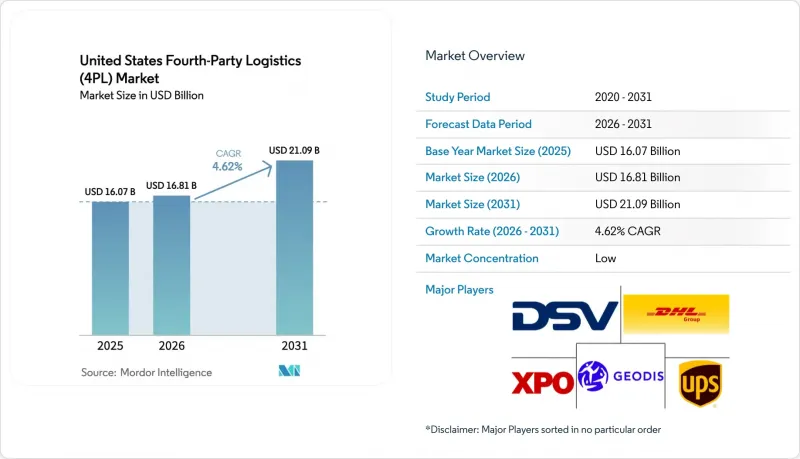
This report is Segmented by Operating Model (Lead Logistics Provider, Solution Integrator, Digital Platform 4PL), End-User Industry (FMCG, Retail & E-Commerce, Fashion & Lifestyle, Technology & Electronics, Refrigerated & Pharma, Automotive & Mobility, Industrial Manufacturing, Others), and Geography. The Market Forecasts are Provided in Terms of Value (USD).
United States Fourth-Party Logistics (4PL) Market Trends and Insights
Rising Complexity of Omnichannel Supply Chains
Retailers deploying omnichannel strategies must synchronize store, online, and marketplace inventory simultaneously, creating orchestration requirements beyond traditional 3PL capabilities. Walmart's AI-driven network shows how real-time demand sensing, dynamic routing, and predictive replenishment cut stock-outs while maintaining low safety inventory. Amazon's inbound cross-dock facilities illustrate infrastructure commitments needed to scale unified fulfillment networks. Such complexity elevates digital platform 4PL providers that leverage machine learning for inventory placement and order orchestration. Regulatory frameworks remain permissive, yet emerging data-privacy statutes may constrain how 4PLs aggregate shopper insights across channels. Overall, omnichannel growth locks in structural demand for nationwide control-tower solutions that optimize transport, labor, and inventory concurrently.
Increasing Adoption of Lead-Logistics-Provider Cost-Out Models
Inflation and supply-chain disruption make logistics cost control a board-level priority. Consolidating disparate 3PL contracts under a single LLP generates immediate scale efficiencies and reduces vendor-management overhead. A U.S. manufacturer documented USD 260 million in logistics savings and a 15% cut in transportation spend by embracing an LLP framework. Asset-light providers also shoulder freight-rate volatility, shifting working-capital and capacity risks off corporate balance sheets. Manufacturing firms in automotive and durable goods are leading adopters, but services sectors now view LLPs as strategic hedges against unpredictable capacity markets. Centralized compliance management further appeals to multistate operators wrestling with fragmented labor and safety rules.
Cyber-security and Data-ownership Concerns
Supply chain digitization creates significant cybersecurity vulnerabilities that constrain fourth party logistics adoption, especially in regulated industries. The World Economic Forum reports 54% of large organizations cite supply chains as major barriers to cyber resilience, with the 2024 global IT outage exposing critical third-party dependencies. Fourth-party logistics providers face unique challenges because they operate without direct oversight of many vendors in their networks, creating potential attack vectors that traditional risk management approaches cannot adequately address. The logistics sector experienced 27 cyber incidents between July 2023 and July 2024, with the cybersecurity market in logistics projected to grow at 12% CAGR from 2024 to 2037, reaching USD 36.6 billion. Data ownership concerns become particularly acute when 4PL providers aggregate information across multiple clients, creating potential conflicts over proprietary business intelligence.
Other drivers and restraints analyzed in the detailed report include:
- E-commerce-Driven Demand for Nationwide Control-Tower Orchestration
- Integrated Control-Tower IT Platforms (AI/IoT) Become Table-Stakes
- High Implementation Cost and Change-Management Burden
For complete list of drivers and restraints, kindly check the Table Of Contents.
Segment Analysis
Lead Logistics Provider (LLP) commanded 42.35% of the fourth party logistics market size in 2025, reflecting enterprises' preference for comprehensive supply chain management through single-provider relationships that reduce complexity and enhance accountability. The LLP model's dominance stems from its ability to deliver cost synergies through economies of scale while transferring operational risk to specialized providers with deeper logistics expertise. Solution Integrator models occupy the middle ground, focusing on technology-enabled coordination across multiple logistics providers without assuming direct operational responsibility. Digital Platform 4PL emerges as the fastest-growing segment at 4.96% CAGR through 2031, driven by enterprises seeking AI-powered visibility and autonomous decision-making capabilities that traditional models cannot deliver.
The Digital Platform 4PL segment's growth acceleration reflects the fourth party logistics market evolution toward data-driven supply chain orchestration, where real-time analytics and predictive modeling become competitive differentiators rather than operational luxuries. Blue Yonder's Network Ops Agent demonstrates how AI agents can autonomously manage logistics operations, predicting arrival times, clustering shipments, and maximizing resource utilization without human intervention. Solution Integrator models face increasing pressure to differentiate through specialized industry expertise or geographic coverage, as pure coordination functions become commoditized through automation. The regulatory landscape favors platform models that can demonstrate transparency and auditability in their decision-making processes, particularly as data privacy and algorithmic accountability requirements evolve.
Complete Report Scope:
- By Operating Model
- Lead Logistics Provider (LLP)
- Solution Integrator
- Digital Platform 4PL
- By End-User Industry
- FMCG
- Retail and E-commerce
- Fashion and Lifestyle
- Technology and Electronics
- Refrigerated and Pharma
- Automotive and Mobility
- Industrial Manufacturing
- Others
- By US Region
- Northeast
- Midwest
- South
- West
List of Companies Covered in this Report:
- United Parcel Service, Inc.
- DSV
- Geodis
- XPO Inc.
- DHL Supply Chain
- C.H. Robinson
- Kuehne + Nagel
- FedEx
- Ryder Supply Chain Solutions
- Penske Logistics
- CEVA Logistics
- Rhenus Group
- Logistics Plus
- Allyn International Services
- Covenant Logistics Group
- Redwood Logistics
- Odyssey
- Yusen Logistics
- 4PL Central Station Group
- Toll Group
Additional Benefits:
- The market estimate (ME) sheet in Excel format
- 3 months of analyst support
TABLE OF CONTENTS
1 Introduction
- 1.1 Study Assumptions and Market Definition
- 1.2 Scope of the Study
2 Research Methodology
3 Executive Summary
4 Market Landscape
- 4.1 Market Overview
- 4.2 Market Drivers
- 4.2.1 Rising complexity of omnichannel supply chains
- 4.2.2 Increasing adoption of Lead-Logistics-Provider cost-out models
- 4.2.3 E-commerce-driven demand for nationwide control-tower orchestration
- 4.2.4 Integrated control-tower IT platforms (AI/IoT) become table-stakes
- 4.2.5 Near-shoring wave requires domestic network re-design
- 4.2.6 Freight-rate volatility pushes shippers toward asset-light risk transfer
- 4.3 Market Restraints
- 4.3.1 Cyber-security and data-ownership concerns
- 4.3.2 High implementation cost and change-management burden
- 4.3.3 Scarcity of supply-chain data-science talent for control towers (under-radar)
- 4.3.4 Channel conflict with large incumbent 3PLs (under-radar)
- 4.4 Value / Supply-Chain Analysis
- 4.5 Regulatory Landscape
- 4.6 Technological Outlook
- 4.7 Porter's Five Forces Analysis
- 4.7.1 Threat of New Entrants
- 4.7.2 Bargaining Power of Buyers
- 4.7.3 Bargaining Power of Suppliers
- 4.7.4 Threat of Substitutes
- 4.7.5 Competitive Rivalry
- 4.8 Impact of COVID-19 and Post-Pandemic Reset
- 4.9 Impact of Inflationary Freight Cycles and Near-shoring
5 Market Size and Growth Forecasts (Value, USD Bn)
- 5.1 By Operating Model
- 5.1.1 Lead Logistics Provider (LLP)
- 5.1.2 Solution Integrator
- 5.1.3 Digital Platform 4PL
- 5.2 By End-User Industry
- 5.2.1 FMCG
- 5.2.2 Retail and E-commerce
- 5.2.3 Fashion and Lifestyle
- 5.2.4 Technology and Electronics
- 5.2.5 Refrigerated and Pharma
- 5.2.6 Automotive and Mobility
- 5.2.7 Industrial Manufacturing
- 5.2.8 Others
- 5.3 By US Region
- 5.3.1 Northeast
- 5.3.2 Midwest
- 5.3.3 South
- 5.3.4 West
6 Competitive Landscape
- 6.1 Market Concentration
- 6.2 Strategic Moves
- 6.3 Market Share Analysis
- 6.4 Company Profiles (includes Global-level Overview, Market-level Overview, Core Segments, Financials as available, Strategic Information, Market Rank/Share, Products and Services, Recent Developments)
- 6.4.1 United Parcel Service, Inc.
- 6.4.2 DSV
- 6.4.3 Geodis
- 6.4.4 XPO Inc.
- 6.4.5 DHL Supply Chain
- 6.4.6 C.H. Robinson
- 6.4.7 Kuehne + Nagel
- 6.4.8 FedEx
- 6.4.9 Ryder Supply Chain Solutions
- 6.4.10 Penske Logistics
- 6.4.11 CEVA Logistics
- 6.4.12 Rhenus Group
- 6.4.13 Logistics Plus
- 6.4.14 Allyn International Services
- 6.4.15 Covenant Logistics Group
- 6.4.16 Redwood Logistics
- 6.4.17 Odyssey
- 6.4.18 Yusen Logistics
- 6.4.19 4PL Central Station Group
- 6.4.20 Toll Group
7 Market Opportunities and Future Outlook
- 7.1 White-space and Unmet-need Assessment

