PUBLISHER: Mordor Intelligence | PRODUCT CODE: 2119882

PUBLISHER: Mordor Intelligence | PRODUCT CODE: 2119882
Europe Industrial Waste Management - Market Share Analysis, Industry Trends & Statistics, Growth Forecasts (2026 - 2031)
According to Mordor Intelligence, the European industrial waste management market size in 2026 is estimated at USD 56.65 billion, growing from 2025 value of USD 53.65 billion with 2031 projections showing USD 74.36 billion, growing at 5.59% CAGR over 2026-2031.
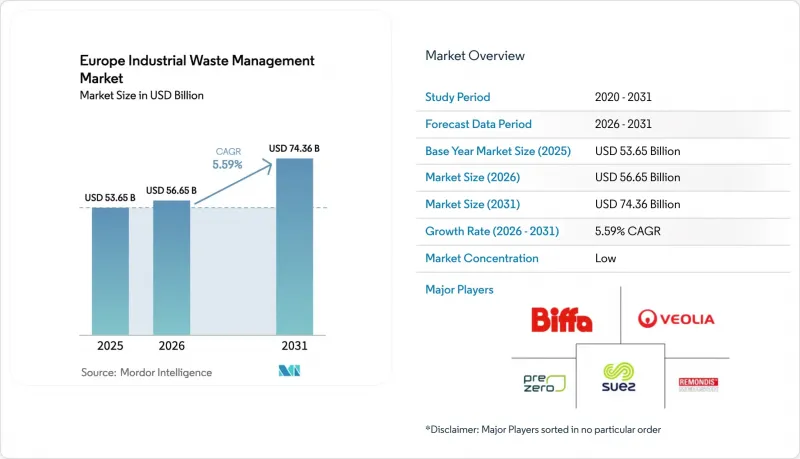
This report is Segmented by Service (Collection, Transportation & Logistics, and More), by Disposal Method (Landfill, Recycling and Incineration & Energy Recovery), by Waste Type (Non-Hazardous and Hazardous), by Industry (Chemicals & Petrochemicals, Oil & Gas, and More), and by Geography (United Kingdom, Germany, and More). The Market Forecasts are Provided in Terms of Value (USD).
Europe Industrial Waste Management Market Trends and Insights
Stringent EU Waste Management Directives
New EU rules create a decisive pull toward higher recovery rates and full traceability. The Packaging and Packaging Waste Regulation, effective February 2025, requires all packaging to be recyclable by 2030 and sets a 15% reuse mandate by 2040. The updated Waste Framework Directive tightens extended-producer-responsibility schemes and standardizes classification codes to ease cross-border movements. Meanwhile, the Waste Shipments Regulation bans exports of plastic waste to non-OECD states from November 2026 and enforces digital tracking via the DIWASS system. These laws push industrial generators to partner with certified providers capable of meeting stringent targets, which directly expands high-value segments such as recycling, energy recovery, and hazardous-waste neutralization. Although enforcement still varies across member states, the cumulative regulatory push adds 1.8 percentage points to the forecast CAGR of the European industrial waste management market.
Increasing Industrial Waste Generation Volumes
Europe's factories, chemical parks, and construction sites continue to produce larger waste streams as output grows and product cycles shorten. Hazardous waste climbed 2.25% per year between 2010 and 2024, with chemical and petrochemical hubs in Germany's Rhine-Ruhr region and the Netherlands generating the bulk of complex by-products requiring specialized treatment. Construction-material manufacturing alone discharges close to 400 million tonnes of largely non-hazardous debris annually, reinforcing demand for advanced sorting and recovery services. Electronics producers amplify the trend by releasing difficult-to-process miniaturized components rich in rare earth elements and precious metals. Although the Industrial Emissions Directive obliges plants to adopt best available techniques for waste minimization, the build-out of battery and renewable-energy supply chains offsets reduction gains. Overall, greater industrial output directly fuels volume growth in the European industrial waste management market, prompting operators to expand capacity, upgrade technology, and refine logistics networks.
High CAPEX for Advanced Treatment Facilities
Building state-of-the-art recycling or waste-to-energy assets is capital-intensive. A typical plant costs USD 4-10 million per MW, while advanced recycling installations run USD 54-218 million (EUR 50-200 million) depending on scale. LyondellBasell's German chemical-recycling project secured USD 43.6 million (EUR 40 million) in EU funding, and CIRCTEC raised USD 163.5 million (EUR 150 million) for Europe's largest tire-pyrolysis unit. Carbon-capture retrofits add USD 109-164 per tonne of CO2 capacity. Eastern Europe struggles to mobilize such funding because local financiers view waste assets as higher-risk, slowing deployment, and shaving 0.8 percentage points off the European industrial waste management market growth rate.
Other drivers and restraints analyzed in the detailed report include:
- Demand for Secondary Raw Materials in EV Battery Supply Chains
- Growing Corporate Sustainability & ESG Pressure
- Skilled-Labor Shortage in Eastern Europe
For complete list of drivers and restraints, kindly check the Table Of Contents.
Segment Analysis
Treatment & Disposal accounted for 53.78% of the European industrial waste management market share in 2025, cementing its role as the backbone of hazardous-waste neutralization and legacy infrastructure. This dominance stems from significant sunk investment in incinerators, physicochemical plants, and secure landfills that serve Germany, the Netherlands, and Belgium. Large chemical clusters rely on these facilities to comply with EU directives that forbid untreated hazardous output. Steady upgrades such as flue-gas cleaning and carbon-capture units maintain regulatory conformity and underpin stable cash flows. Collection and logistics services, though smaller, benefit from rising volume and specialized transport mandates for toxic streams. Digital route optimization and the impending DIWASS platform streamline cross-border documentation and elevate service value across the European industrial waste management market.
Recycling & Material Recovery is the fastest-growing service at a 6.72% CAGR through 2031, reflecting the pivot to circular models. Projects like LyondellBasell's German chemical-recycling plant and CIRCTEC's tire-pyrolysis unit illustrate capital intensity and innovation depth needed to unlock polymer and rubber value. Industrial symbiosis networks multiply feedstock availability by turning one firm's waste into another's input, especially in chemical parks. EU extended-producer-responsibility schemes under the PPWR mandate minimum recycled content in packaging, driving sustained demand. These dynamics propel the segment's share upward across the European industrial waste management market and attract equity capital despite high technical hurdles.
Landfill maintained a 44.32% slice of the European industrial waste management market size in 2025, anchored in historical capacity, simple permitting, and lower gate fees in parts of Eastern Europe. Yet escalating landfill taxes, stricter contamination thresholds, and public opposition have begun to erode its long-held lead. Operators face mounting obligations to capture methane and monitor leachate, inflating operational expenditures. Some choose to downsize or retrofit inactive cells into solar farms, diversifying revenue but shrinking pure landfill tonnage within the European industrial waste management market.
Incineration & Energy Recovery displays the quickest expansion at 7.31% CAGR, buoyed by more than USD 2.18 billion (EUR 2 billion) invested annually in new waste-to-energy units across the continent. SUEZ's USD 1.53 billion (EUR 1.4 billion) Toulouse facility, which integrates carbon capture, showcases evolving emission standards and added revenue through renewable-electricity certificates. Refuse-derived-fuel programs supply cement kilns, potentially displacing up to 85% of fossil heat needs. Enhanced thermal-plant efficiencies and co-location with district-heating networks boost attractiveness, progressively drawing volumes away from landfill and raising the profile of energy-recovery routes within the European industrial waste management market.
Complete Report Scope:
- By Service
- Collection
- Transportation & Logistics
- Treatment & Disposal
- Recycling & Material Recovery
- By Disposal Method
- Landfill
- Recycling
- Incineration & Energy Recovery (RDF, SRF, WtE)
- By Waste Type
- Non-hazardous
- Hazardous
- By Industry
- Chemicals & Petrochemicals
- Oil & Gas
- Power Generation
- Metal & Mining
- Food & Beverage Processing
- Pharmaceuticals
- Electrical & Electronics
- Construction Materials
- By Geography
- United Kingdom
- Germany
- France
- Italy
- Spain
- BENELUX (Belgium, Netherlands, and Luxembourg)
- NORDICS (Denmark, Finland, Iceland, Norway, and Sweden)
- Rest of Europe
List of Companies Covered in this Report:
- Veolia
- Suez
- Remondis
- PreZero International
- Biffa PLC
- Urbaser
- FCC Environment
- AVR
- Renewi
- Indaver
- ALBA Group
- Viridor
- Saubermacher Dienstleistungs AG
- Ragn-Sells
- Norsk Gjenvinning
- Paprec Group
- SARP Industries
- Derichebourg Environnement
- Tradebe
Additional Benefits:
- The market estimate (ME) sheet in Excel format
- 3 months of analyst support
TABLE OF CONTENTS
1 Introduction
- 1.1 Study Assumptions & Market Definition
- 1.2 Scope of the Study
2 Research Methodology
3 Executive Summary
4 Market Landscape
- 4.1 Market Overview
- 4.2 Market Drivers
- 4.2.1 Increasing industrial waste generation volumes
- 4.2.2 Stringent EU waste-management directives
- 4.2.3 Growing corporate sustainability & ESG pressure
- 4.2.4 Digital tracking & blockchain for waste traceability
- 4.2.5 Industrial symbiosis parks for waste-to-input exchange
- 4.2.6 Demand for secondary raw materials in EV battery supply chains
- 4.3 Market Restraints
- 4.3.1 High CAPEX for advanced treatment facilities
- 4.3.2 Fragmented regulatory enforcement across EU
- 4.3.3 Skilled-labour shortage in Eastern Europe
- 4.3.4 Volatile prices for recycled industrial materials
- 4.4 Value / Supply-Chain Analysis
- 4.5 Regulatory Landscape & Government Initiatives
- 4.6 Technological Outlook
- 4.7 Industry Attractiveness - Porter's Five Force Analysis
- 4.7.1 Threat of New Entrants
- 4.7.2 Bargaining Power of Suppliers
- 4.7.3 Bargaining Power of Buyers
- 4.7.4 Threat of Substitutes
- 4.7.5 Intensity of Competitive Rivalry
- 4.8 Insights on Industrial Waste Production
5 Market Size & Growth Forecasts (Values, In USD Billion)
- 5.1 By Service
- 5.1.1 Collection
- 5.1.2 Transportation & Logistics
- 5.1.3 Treatment & Disposal
- 5.1.4 Recycling & Material Recovery
- 5.2 By Disposal Method
- 5.2.1 Landfill
- 5.2.2 Recycling
- 5.2.3 Incineration & Energy Recovery (RDF, SRF, WtE)
- 5.3 By Waste Type
- 5.3.1 Non-hazardous
- 5.3.2 Hazardous
- 5.4 By Industry
- 5.4.1 Chemicals & Petrochemicals
- 5.4.2 Oil & Gas
- 5.4.3 Power Generation
- 5.4.4 Metal & Mining
- 5.4.5 Food & Beverage Processing
- 5.4.6 Pharmaceuticals
- 5.4.7 Electrical & Electronics
- 5.4.8 Construction Materials
- 5.5 By Geography
- 5.5.1 United Kingdom
- 5.5.2 Germany
- 5.5.3 France
- 5.5.4 Italy
- 5.5.5 Spain
- 5.5.6 BENELUX (Belgium, Netherlands, and Luxembourg)
- 5.5.7 NORDICS (Denmark, Finland, Iceland, Norway, and Sweden)
- 5.5.8 Rest of Europe
6 Competitive Landscape
- 6.1 Market Concentration
- 6.2 Strategic Moves
- 6.3 Market Share Analysis
- 6.4 Company Profiles (includes Global level Overview, Market level overview, Core Segments, Financials as available, Strategic Information, Products & Services, and Recent Developments)
- 6.4.1 Veolia
- 6.4.2 Suez
- 6.4.3 Remondis
- 6.4.4 PreZero International
- 6.4.5 Biffa PLC
- 6.4.6 Urbaser
- 6.4.7 FCC Environment
- 6.4.8 AVR
- 6.4.9 Renewi
- 6.4.10 Indaver
- 6.4.11 ALBA Group
- 6.4.12 Viridor
- 6.4.13 Saubermacher Dienstleistungs AG
- 6.4.14 Ragn-Sells
- 6.4.15 Norsk Gjenvinning
- 6.4.16 Paprec Group
- 6.4.17 SARP Industries
- 6.4.18 Derichebourg Environnement
- 6.4.19 Tradebe
7 Market Opportunities & Future Outlook
- 7.1 White-space & Unmet-need Assessment

