PUBLISHER: Mordor Intelligence | PRODUCT CODE: 2119898

PUBLISHER: Mordor Intelligence | PRODUCT CODE: 2119898
Adhesive Dispensing System - Market Share Analysis, Industry Trends & Statistics, Growth Forecasts (2026 - 2031)
According to Mordor Intelligence, the adhesive dispensing system market size is projected to be USD 6.24 billion in 2025, USD 6.59 billion in 2026, and reach USD 8.66 billion by 2031, growing at a CAGR of 4.85% from 2026 to 2031.
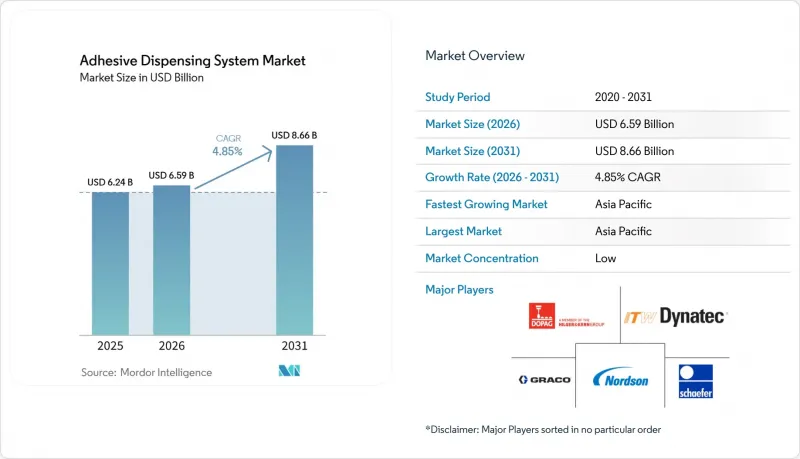
This report is Segmented by Product Type (Volumetric Dispensing Systems, Jetting and Micro-Dispensing Systems, and More), End-Use Industry (Packaging, Electronics and Semiconductors, and More), Technology (Pneumatic Systems, Electric Servo Systems, and More), Automation Level (Bench-top/Manual, and More), and by Geography. The Market Forecasts are Provided in Terms of Value (USD).
Global Adhesive Dispensing System Market Trends and Insights
EV Battery-Pack Growth Demands Micro-Metering Accuracy
Gigafactory build-out places stringent accuracy targets on thermal-interface material placement, with many lines now demanding bond-line thickness below 25 µm to manage heat and improve vehicle range. Progressive cavity pumps and piezo-jet modules deliver shot-to-shot repeatability within +-0.5% tolerance, enabling weight savings of up to 15% when structural adhesives replace mechanical fasteners. EV leaders in Asia-Pacific deploy plasma-based surface activation that boosts adhesion without chemical primers, further elevating demand for precise dispensers . Graco's dedicated EV battery platforms underscore how the adhesive dispensing system market pivots around cell-to-carrier bonding and fireproof coatings . As a result, battery OEMs view best-in-class dispensers as core yield enablers, not auxiliary tooling, sustaining long-term investment momentum for the adhesive dispensing system market.
Electronics Miniaturization Pushes Jet-Dispense Adoption
Next-generation wearables and implantable sensors now require deposits as tiny as 0.1 nL, levels unreachable with legacy pneumatic needles. Piezo-driven jetting systems enable touch-free placement onto features under 25 µm wide while operating at cycle rates exceeding 1,000 Hz. Ball Grid Array and Chip-on-Board architectures boost demand for dispensers that manage rising thermal profiles without sacrificing speed Nordson's PICO Nexus, featuring Industrial Ethernet and web-based dashboards, showcases how the adhesive dispensing system market integrates IIoT for remote programming and in-process analytics . ViscoTec's endless piston principle addresses bubble-free delivery for optical bonding, proving essential for AR/VR displays.
High Capex of Multi-Component Dispensing Cells
High-precision two-part metering lines with advanced gear pumps and static mix heads often top USD 100,000 per cell, slowing adoption among small and medium manufacturers. Zenith 2K precision systems exemplify the cost obstacle despite their unrivaled ratio control, and although modular leasing models and pay-per-shot contracts are emerging to spread the financial burden, many buyers defer investment until volumes justify the spend. Capital constraints restrain the adhesive dispensing system market in developing regions where financing terms remain prohibitive.
Other drivers and restraints analyzed in the detailed report include:
- Packaging Shift to Hot-Melt Tank-Free Applicators
- Factory-Floor Automation and Industry 4.0 Integration
- Complex Chemistries Raise Maintenance/Clean-Out Time
For complete list of drivers and restraints, kindly check the Table Of Contents.
Segment Analysis
Volumetric platforms held 56.02% of the adhesive dispensing system market in 2025 amid proven reliability across packaging, automotive, and consumer-goods lines. Jetting and micro-dispensing units are forecast to expand at 8.21% CAGR as miniaturization propels demand for non-contact, nanoliter accuracy. The adhesive dispensing system market size for volumetric machines is expected to widen steadily, supported by large installed bases and recurring parts revenue.
The shift toward piezo-jet modules like Nordson's Vulcan Jet, featuring dual heat zones and modular drive stacks, illustrates how precision challenges catalyze innovation. ITW Dynatec's Vector platform enables slot, spray, or bead exchange within five minutes, enhancing line agility. Unity gantry cells combine vision guidance with +-0.02 mm repeatability, cementing value in high-performance sectors. Consumables such as nozzles and static mixers represent nearly 25% of lifecycle cost, providing vendors with stable aftermarket revenue streams and reinforcing the adhesive dispensing system market.
Automotive and e-mobility retained 32.05% of the adhesive dispensing system market share in 2025 as battery pack designs embraced structural adhesives for weight savings. Medical devices, advancing at 7.46% CAGR, rely on nanoliter deposition for continuous glucose monitors, catheters, and diagnostic cartridges. Electronics, packaging, construction, and aerospace each contribute distinct performance demands, diversifying revenue drivers for the adhesive dispensing system market.
Medical-device OEMs adopt closed-loop dispensers validated under FDA guidelines, reinforcing sales of high-precision robots and in-line vision. Aerospace firms automate sealing and coating for extreme-temperature zones, widening the adhesive dispensing system market size among high-mix, low-volume niches. Packaging converters fuel hot-melt upgrades, while construction players focus on glazing beads and weatherproofing. Collectively, diverse end-user requirements sustain innovation pipelines across the adhesive dispensing system market.
Complete Report Scope:
- By Product Type
- Volumetric Dispensing Systems
- Jetting and Micro-Dispensing Systems
- Hot Melt Applicators
- Valve-Based Dispensing Systems
- Accessories and Consumables
- By End-Use Industry
- Packaging
- Electronics and Semiconductors
- Automotive and e-Mobility
- Industrial Assembly and General Manufacturing
- Construction
- Medical Devices
- Aerospace
- Other End-Use Industry
- By Technology
- Pneumatic Systems
- Electric Servo Systems
- Piezo-Jet Systems
- Progressive Cavity Pumps
- Digital Flow-Control Platforms
- By Automation Level
- Bench-top/Manual
- Semi-Automatic
- Fully Robotic in-Line Systems
- By Geography
- North America
- United States
- Canada
- Mexico
- Europe
- Germany
- United Kingdom
- France
- Italy
- Spain
- Russia
- Rest of Europe
- Asia-Pacific
- China
- India
- Japan
- South Korea
- Australia and New Zealand
- Rest of Asia-Pacific
- Middle East and Africa
- Middle East
- United Arab Emirates
- Saudi Arabia
- Turkey
- Rest of Middle East
- Africa
- South Africa
- Nigeria
- Egypt
- Rest of Africa
- Middle East
- South America
- Brazil
- Argentina
- Rest of South America
- North America
Geography Analysis
Asia-Pacific commanded 39.12% of the adhesive dispensing system market in 2025 and is forecast to compound at 7.98% CAGR to 2031, buoyed by surging EV, smartphone, and consumer-goods manufacturing. China's giga-scale battery lines from CATL and BYD integrate plasma-assisted bonding and precision dispensers that sustain multi-shift output. India's production-linked incentives catalyze micro-dispensing adoption in handset assembly, while Japan and South Korea leverage semiconductor know-how to pilot next-generation jetting.
North America ranks second, supported by aerospace, medical device, and advanced automotive programs requiring strict validation. United States FDA mandates for device traceability drive uptake of vision-guided dispensing robots capable of nanoliter deposits. Canada's composite-rich aerospace sector and Mexico's vehicle platforms further enlarge regional demand. Broad Industry 4.0 adoption favors connected dispensers broadcasting OEE metrics to enterprise dashboards.
- Nordson Corporation
- Graco Inc.
- ITW Dynatec
- Dopag Group
- Robatech AG
- Schaefer Technologie GmbH
- Dymax Corporation
- Valco Melton
- Musashi Engineering
- Viscotec (Preeflow)
- RAMPF Production Systems
- Scheugenpflug GmbH
- Henkel LOCTITE Equipment
- Atlas Copco (SCA Schucker)
- Fisnar Inc.
- Buhnen GmbH
- Hernon Manufacturing
- Glue Dispensing Ltd
- Sulzer Mixpac
- Shenzhen Second Intelligent Equipment
- Gulf Coast Robotics
- Techcon Systems
Additional Benefits:
- The market estimate (ME) sheet in Excel format
- 3 months of analyst support
TABLE OF CONTENTS
1 INTRODUCTION
- 1.1 Study Assumptions and Market Definition
- 1.2 Scope of the Study
2 RESEARCH METHODOLOGY
3 EXECUTIVE SUMMARY
4 MARKET LANDSCAPE
- 4.1 Market Overview
- 4.2 Market Drivers
- 4.2.1 EV battery-pack growth demands micro-metering accuracy
- 4.2.2 Electronics miniaturisation pushes jet-dispense adoption
- 4.2.3 Packaging shift to hot-melt tank-free applicators
- 4.2.4 Factory-floor automation and Industry 4.0 integration
- 4.2.5 Thermal-interface materials for data-centres and ADAS
- 4.2.6 EU EPR rules drive refillable cartridge innovations
- 4.3 Market Restraints
- 4.3.1 High capex of multi-component dispensing cells
- 4.3.2 Complex chemistries raise maintenance/clean-out time
- 4.3.3 Scarcity of calibration-skilled technicians
- 4.3.4 Recycling hurdles for adhesive-bonded assemblies
- 4.4 Supply-Chain Analysis
- 4.5 Regulatory Landscape
- 4.6 Technological Outlook
- 4.7 Recycling and Sustainability Landscape
- 4.8 Porter's Five Forces Analysis
- 4.8.1 Bargaining Power of Suppliers
- 4.8.2 Bargaining Power of Buyers
- 4.8.3 Threat of New Entrants
- 4.8.4 Threat of Substitutes
- 4.8.5 Intensity of Competitive Rivalry
5 MARKET SIZE AND GROWTH FORECASTS (VALUE)
- 5.1 By Product Type
- 5.1.1 Volumetric Dispensing Systems
- 5.1.2 Jetting and Micro-Dispensing Systems
- 5.1.3 Hot Melt Applicators
- 5.1.4 Valve-Based Dispensing Systems
- 5.1.5 Accessories and Consumables
- 5.2 By End-Use Industry
- 5.2.1 Packaging
- 5.2.2 Electronics and Semiconductors
- 5.2.3 Automotive and e-Mobility
- 5.2.4 Industrial Assembly and General Manufacturing
- 5.2.5 Construction
- 5.2.6 Medical Devices
- 5.2.7 Aerospace
- 5.2.8 Other End-Use Industry
- 5.3 By Technology
- 5.3.1 Pneumatic Systems
- 5.3.2 Electric Servo Systems
- 5.3.3 Piezo-Jet Systems
- 5.3.4 Progressive Cavity Pumps
- 5.3.5 Digital Flow-Control Platforms
- 5.4 By Automation Level
- 5.4.1 Bench-top/Manual
- 5.4.2 Semi-Automatic
- 5.4.3 Fully Robotic in-Line Systems
- 5.5 By Geography
- 5.5.1 North America
- 5.5.1.1 United States
- 5.5.1.2 Canada
- 5.5.1.3 Mexico
- 5.5.2 Europe
- 5.5.2.1 Germany
- 5.5.2.2 United Kingdom
- 5.5.2.3 France
- 5.5.2.4 Italy
- 5.5.2.5 Spain
- 5.5.2.6 Russia
- 5.5.2.7 Rest of Europe
- 5.5.3 Asia-Pacific
- 5.5.3.1 China
- 5.5.3.2 India
- 5.5.3.3 Japan
- 5.5.3.4 South Korea
- 5.5.3.5 Australia and New Zealand
- 5.5.3.6 Rest of Asia-Pacific
- 5.5.4 Middle East and Africa
- 5.5.4.1 Middle East
- 5.5.4.1.1 United Arab Emirates
- 5.5.4.1.2 Saudi Arabia
- 5.5.4.1.3 Turkey
- 5.5.4.1.4 Rest of Middle East
- 5.5.4.2 Africa
- 5.5.4.2.1 South Africa
- 5.5.4.2.2 Nigeria
- 5.5.4.2.3 Egypt
- 5.5.4.2.4 Rest of Africa
- 5.5.4.1 Middle East
- 5.5.5 South America
- 5.5.5.1 Brazil
- 5.5.5.2 Argentina
- 5.5.5.3 Rest of South America
- 5.5.1 North America
6 COMPETITIVE LANDSCAPE
- 6.1 Market Concentration
- 6.2 Strategic Moves
- 6.3 Market Share Analysis
- 6.4 Company Profiles (includes Global Level Overview, Market Level Overview, Core Segments, Financials, Strategic Information, Market Rank/Share, Products and Services, Recent Developments)
- 6.4.1 Nordson Corporation
- 6.4.2 Graco Inc.
- 6.4.3 ITW Dynatec
- 6.4.4 Dopag Group
- 6.4.5 Robatech AG
- 6.4.6 Schaefer Technologie GmbH
- 6.4.7 Dymax Corporation
- 6.4.8 Valco Melton
- 6.4.9 Musashi Engineering
- 6.4.10 Viscotec (Preeflow)
- 6.4.11 RAMPF Production Systems
- 6.4.12 Scheugenpflug GmbH
- 6.4.13 Henkel LOCTITE Equipment
- 6.4.14 Atlas Copco (SCA Schucker)
- 6.4.15 Fisnar Inc.
- 6.4.16 Buhnen GmbH
- 6.4.17 Hernon Manufacturing
- 6.4.18 Glue Dispensing Ltd
- 6.4.19 Sulzer Mixpac
- 6.4.20 Shenzhen Second Intelligent Equipment
- 6.4.21 Gulf Coast Robotics
- 6.4.22 Techcon Systems
7 MARKET OPPORTUNITIES AND FUTURE OUTLOOK
- 7.1 White-Space and Unmet-Need Assessment

