PUBLISHER: Mordor Intelligence | PRODUCT CODE: 2119902

PUBLISHER: Mordor Intelligence | PRODUCT CODE: 2119902
3D Camera - Market Share Analysis, Industry Trends & Statistics, Growth Forecasts (2026 - 2031)
According to Mordor Intelligence, the 3D camera market size is expected to grow from USD 34.63 billion in 2025 to USD 41.08 billion in 2026 and is forecast to reach USD 96.45 billion by 2031 at 18.62% CAGR over 2026-2031.
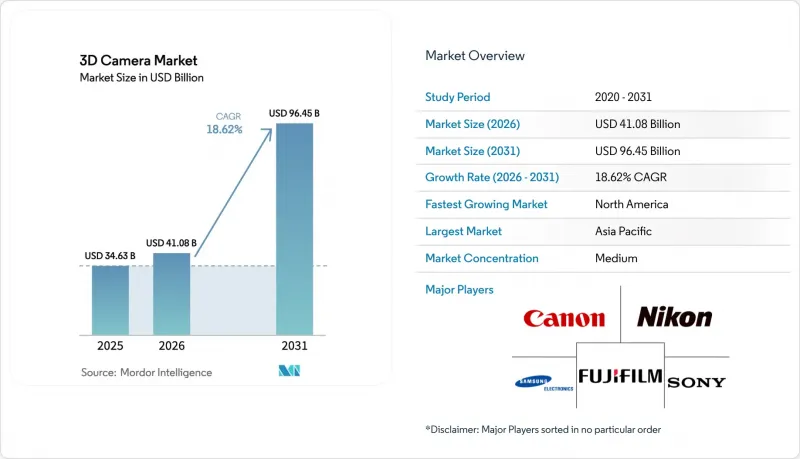
This report is Segmented by Technology (Time-Of-Flight, Stereo Vision, and More), Type (Target Camera, and Target-Free Camera), Resolution (Less Than 8 MP, 8-16 MP, and Above 16 MP), Interface (GigE, Cameralink, and More), Application/Device (Smartphones and Tablets, and More), End-Use Industry (Automotive, Industrial, and More), and Geography. The Market Forecasts are Provided in Terms of Value (USD).
Global 3D Camera Market Trends and Insights
Integration of LiDAR-based ToF Sensors into Flagship Smartphones
Apple's LiDAR debut on the iPhone 12 Pro catalysed depth-sensing uptake, and the iPhone 15 series refines power efficiency for augmented-reality (AR) tasks. Samsung's System LSI unit now supplies 200-MP image sensors to multiple brands, accelerating Asian OEM adoption. Depth data elevates autofocus and portrait modes, making computational photography a chief differentiator. Supply-chain realignment that shifts VCSEL sourcing from Coherent to Sony underscores vendor volatility. Balancing thermal limits and component costs in sub-premium phones will dictate medium-term penetration.
Automotive OEM Mandates for In-Cabin Driver Monitoring
Euro NCAP rules require driver-state sensing, pushing carmakers to integrate 3D cameras that detect distraction and impairment. Sony forecasts six-fold growth in automotive CMOS imagers, expecting 12 cameras per vehicle by FY 2028 compared with eight in 2024. Niche suppliers such as Smart Eye and Seeing Machines layer AI analytics onto depth input, creating a captive market despite economic cycles. Europe leads compliance, but U.S. regulatory alignment is likely, reinforcing short-term demand.
Lack of Mass-Market 3D Content Standards
Fragmented EU technical protocols force creators to encode multiple volumetric formats, inflating production budgets and stalling investment in capture hardware. Dual-use export rules further slow knowledge exchange among developers. Without unified testing metrics, buyers hesitate, trimming the long-term growth outlook for the 3D camera market.
Other drivers and restraints analyzed in the detailed report include:
- Smart-Manufacturing QA Demand for 3D Vision
- Volumetric Content Production for XR Headsets
- Thermal and Power Limits in Sub-USD 300 Phones
For complete list of drivers and restraints, kindly check the Table Of Contents.
Segment Analysis
Stereo Vision held 63.02% of 3D camera market share in 2025 on the strength of low-cost dual-lens rigs. The segment suits professional DSLRs and industrial pick-and-place arms that prefer passive depth estimation. Time-of-Flight, however, is growing at 21.95% CAGR, enlarging the 3D camera market size for smartphones and driver-monitoring modules. Superior low-light performance and single-lens packaging underpin ToF's rapid uptake. Structured-light remains essential for facial unlock and dental scanning, while emerging hybrid stacks blend ToF with stereo feeds for redundancy.
Manufacturers such as Infineon and pmdtechnologies showcase under-display ToF imagers that preserve bezel-less designs. onsemi's indirect ToF roadmap extends maximum range to factory-floor distances, expanding industrial prospects. Stereo solutions still appeal in static-scene robotics thanks to lower power draw, yet the performance gap narrows each product cycle.
Target-free designs captured 53.88% of 3D camera market share in 2025 and are projected to log a 18.96% CAGR as plug-and-play expectations dominate consumer electronics. Eliminating calibration markers simplifies installation in smartphones, robots and smart-home devices, enlarging overall 3D camera market size. Target-based rigs survive in precision metrology, where reference patterns secure micron-level accuracy.
Roborock's Qrevo Slim robot uses Infineon's hybrid ToF imager to navigate tight furniture clearances without environmental stickers. Industrial adopters weigh the higher upfront accuracy of target-cameras against downtime from marker alignment. Advances in AI-driven self-calibration are set to narrow that trade-off.
Complete Report Scope:
- By Technology
- Time-of-Flight
- Stereo Vision
- Structured Light
- Hybrid Multi-Sensor
- By Type
- Target Camera
- Target-Free Camera
- By Resolution
- Less than 8 MP
- 8 - 16 MP
- Above 16 MP
- By Interface
- GigE
- CameraLink
- USB and CSI
- Other Interfaces
- By Application/Device
- Professional Cameras
- Smartphones and Tablets
- Computers and Laptops
- AR/VR Headsets
- Robotics and Drones
- Other Applications/Devices
- By End-use Industry
- Consumer Electronics
- Automotive
- Security and Surveillance
- Industrial and Manufacturing
- Media and Entertainment
- Healthcare
- Aerospace and Defense
- Other End-use Industry
- By Geography
- North America
- United States
- Canada
- Mexico
- Europe
- Germany
- United Kingdom
- France
- Nordics
- Rest of Europe
- South America
- Brazil
- Rest of South America
- Asia Pacific
- China
- Japan
- India
- South East Asia
- Rest of Asia Pacific
- Middle East and Africa
- Middle East
- Gulf Cooperation Council Countries
- Turkey
- Rest of Middle East
- Africa
- South Africa
- Rest of Africa
- Middle East
- North America
Geography Analysis
Asia-Pacific commanded 38.07% of 3D camera market share in 2025 thanks to China's factory automation, Japan's robotics and Korea's handset giants. Government incentives drive local sensor fabs, though export controls on germanium and gallium raise price volatility. Orbbec's 70% stake in China's service-robot cameras shows the depth of regional specialisation.
North America is set to record 21.28% CAGR, buoyed by Euro-aligned safety mandates and XR content studios. Intel's RealSense spin-off reveals a commitment to dedicated go-to-market models. Canada exploits mining automation, while Mexico's vehicle exports incorporate driver-monitoring cams.
Europe grows steadily on the back of strong automotive tier-ones and industrial machine builders. Middle East & Africa adopt 3D vision in GCC smart-city grids, focusing on crowd analytics, whereas South America leans toward security and mining use cases amid fiscal constraints.
- Sony Corporation
- Canon Inc.
- Panasonic Corporation
- Samsung Electronics Co., Ltd.
- Nikon Corporation
- Fujifilm Holdings Corporation
- LG Electronics Inc.
- Intel Corporation (RealSense)
- Apple Inc.
- Infineon Technologies AG
- STMicroelectronics N.V.
- pmdtechnologies AG
- Orbbec 3D Technology International, Inc.
- Basler AG
- Cognex Corporation
- OmniVision Technologies Inc.
- Sharp Corporation
- Matterport Inc.
- GoPro Inc.
- Microsoft Corporation
- Qualcomm Technologies Inc.
- Lumentum Holdings Inc.
- ams-OSRAM AG
- Teledyne Technologies Inc.
- Xiaomi Corporation
Additional Benefits:
- The market estimate (ME) sheet in Excel format
- 3 months of analyst support
TABLE OF CONTENTS
1 INTRODUCTION
- 1.1 Study Assumptions and Market Definition
- 1.2 Scope of the Study
2 RESEARCH METHODOLOGY
3 EXECUTIVE SUMMARY
4 MARKET LANDSCAPE
- 4.1 Market Overview
- 4.2 Market Drivers
- 4.2.1 Integration of LiDAR-based ToF Sensors into Flagship Smartphones (Asia)
- 4.2.2 Automotive OEM Mandates for In-Cabin Driver Monitoring (Europe)
- 4.2.3 Smart-Manufacturing QA Demand for 3D Vision (China)
- 4.2.4 Volumetric Content Production for XR Headsets (U.S.)
- 4.2.5 Gulf Smart-City Budgets for 3D Surveillance Cameras (Gulf Cooperation Council Countries)
- 4.2.6 Falling BOM Cost of CMOS Depth Modules (Less than USD 4)
- 4.3 Market Restraints
- 4.3.1 Lack of Mass-Market 3D Content Standards (EU)
- 4.3.2 Thermal and Power Limits in Sub-USD 300 Phones
- 4.3.3 Export-Control Curbs on Optical Chips (China)
- 4.3.4 Stereo-Vision Re-Calibration Downtime (Nordic Robots)
- 4.4 Industry Ecosystem Analysis
- 4.5 Technological Outlook
- 4.6 Porter's Five Forces Analysis
- 4.6.1 Bargaining Power of Suppliers
- 4.6.2 Bargaining Power of Buyers
- 4.6.3 Threat of New Entrants
- 4.6.4 Threat of Substitutes
- 4.6.5 Intensity of Rivalry
5 MARKET SIZE AND GROWTH FORECASTS (VALUES)
- 5.1 By Technology
- 5.1.1 Time-of-Flight
- 5.1.2 Stereo Vision
- 5.1.3 Structured Light
- 5.1.4 Hybrid Multi-Sensor
- 5.2 By Type
- 5.2.1 Target Camera
- 5.2.2 Target-Free Camera
- 5.3 By Resolution
- 5.3.1 Less than 8 MP
- 5.3.2 8 - 16 MP
- 5.3.3 Above 16 MP
- 5.4 By Interface
- 5.4.1 GigE
- 5.4.2 CameraLink
- 5.4.3 USB and CSI
- 5.4.4 Other Interfaces
- 5.5 By Application/Device
- 5.5.1 Professional Cameras
- 5.5.2 Smartphones and Tablets
- 5.5.3 Computers and Laptops
- 5.5.4 AR/VR Headsets
- 5.5.5 Robotics and Drones
- 5.5.6 Other Applications/Devices
- 5.6 By End-use Industry
- 5.6.1 Consumer Electronics
- 5.6.2 Automotive
- 5.6.3 Security and Surveillance
- 5.6.4 Industrial and Manufacturing
- 5.6.5 Media and Entertainment
- 5.6.6 Healthcare
- 5.6.7 Aerospace and Defense
- 5.6.8 Other End-use Industry
- 5.7 By Geography
- 5.7.1 North America
- 5.7.1.1 United States
- 5.7.1.2 Canada
- 5.7.1.3 Mexico
- 5.7.2 Europe
- 5.7.2.1 Germany
- 5.7.2.2 United Kingdom
- 5.7.2.3 France
- 5.7.2.4 Nordics
- 5.7.2.5 Rest of Europe
- 5.7.3 South America
- 5.7.3.1 Brazil
- 5.7.3.2 Rest of South America
- 5.7.4 Asia Pacific
- 5.7.4.1 China
- 5.7.4.2 Japan
- 5.7.4.3 India
- 5.7.4.4 South East Asia
- 5.7.4.5 Rest of Asia Pacific
- 5.7.5 Middle East and Africa
- 5.7.5.1 Middle East
- 5.7.5.1.1 Gulf Cooperation Council Countries
- 5.7.5.1.2 Turkey
- 5.7.5.1.3 Rest of Middle East
- 5.7.5.2 Africa
- 5.7.5.2.1 South Africa
- 5.7.5.2.2 Rest of Africa
- 5.7.5.1 Middle East
- 5.7.1 North America
6 COMPETITIVE LANDSCAPE
- 6.1 Market Concentration
- 6.2 Strategic Moves
- 6.3 Market Share Analysis
- 6.4 Company Profiles (includes Global level Overview, Market level overview, Core Segments, Financials as available, Strategic Information, Market Rank/Share, Products and Services, Recent Developments)
- 6.4.1 Sony Corporation
- 6.4.2 Canon Inc.
- 6.4.3 Panasonic Corporation
- 6.4.4 Samsung Electronics Co., Ltd.
- 6.4.5 Nikon Corporation
- 6.4.6 Fujifilm Holdings Corporation
- 6.4.7 LG Electronics Inc.
- 6.4.8 Intel Corporation (RealSense)
- 6.4.9 Apple Inc.
- 6.4.10 Infineon Technologies AG
- 6.4.11 STMicroelectronics N.V.
- 6.4.12 pmdtechnologies AG
- 6.4.13 Orbbec 3D Technology International, Inc.
- 6.4.14 Basler AG
- 6.4.15 Cognex Corporation
- 6.4.16 OmniVision Technologies Inc.
- 6.4.17 Sharp Corporation
- 6.4.18 Matterport Inc.
- 6.4.19 GoPro Inc.
- 6.4.20 Microsoft Corporation
- 6.4.21 Qualcomm Technologies Inc.
- 6.4.22 Lumentum Holdings Inc.
- 6.4.23 ams-OSRAM AG
- 6.4.24 Teledyne Technologies Inc.
- 6.4.25 Xiaomi Corporation
7 MARKET OPPORTUNITIES AND FUTURE OUTLOOK
- 7.1 White-space and Unmet-Need Assessment

