PUBLISHER: Mordor Intelligence | PRODUCT CODE: 2120350

PUBLISHER: Mordor Intelligence | PRODUCT CODE: 2120350
Small Molecule Drug Discovery - Market Share Analysis, Industry Trends & Statistics, Growth Forecasts (2026 - 2031)
According to Mordor Intelligence, the small molecule drug discovery market size is expected to grow from USD 61.93 billion in 2025 to USD 67.42 billion in 2026 and is forecast to reach USD 103.06 billion by 2031 at 8.86% CAGR over 2026-2031.
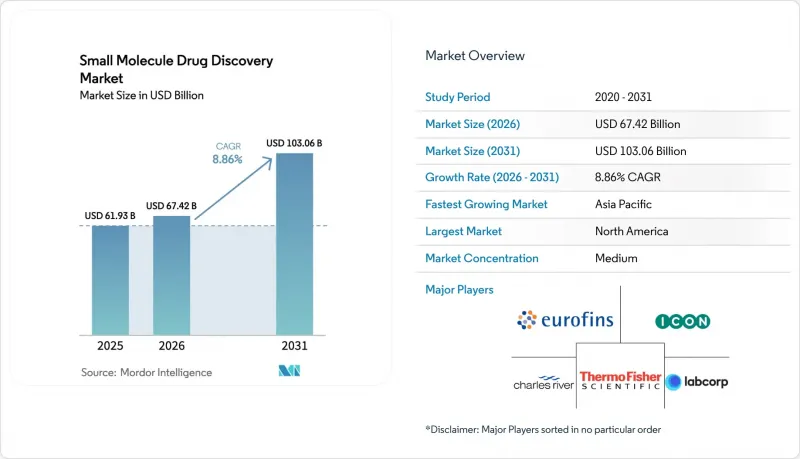
This report is Segmented by Therapeutic Area (Oncology, Cardiovascular, and More), Discovery Phase (Target Identification & Validation and More), Drug Type (Synthetic Small Molecules and More), Technology (High-Throughput Screening (HTS) and More), End User (Pharmaceutical Companies, and More) and Geography (North America and More). The Market and Forecasts are Provided in Terms of Value (USD).
Global Small Molecule Drug Discovery Market Trends and Insights
Growing Chronic & Age-Related Disease Burden
Cancer, cardiovascular, and metabolic disorders dominate new molecular-entity filings, illustrated by the FDA's 2024 approval of zanubrutinib for chronic lymphocytic leukemia. North America and Europe will each exceed 20% population aged >=65 by 2030, ensuring sustained demand for therapeutics that address neurodegeneration, osteoarthritis, and comorbid conditions. Sponsors now integrate geriatric pharmacokinetics and comorbidity modeling earlier, which raises pre-clinical spend but lowers late-stage attrition. Autoimmune programs profit from accelerated approvals of JAK inhibitors and S1P modulators, signaling a clear regulatory path. Together these factors anchor double-digit growth in autoimmune-focused pipelines through 2031.
Superior Manufacturability & Cost-Efficiency vs Biologics
Small molecules avoid cold-chain cost, infusion infrastructure, and high-volume bioreactors, lowering total cost of care by 40-60% for chronic diseases. Pfizer disclosed operating margins 15 percentage points higher for its small-molecule portfolio versus biologics in 2024. Asia-Pacific payers prioritize essential-medicine lists that favor orally dosed generics, reinforcing volume expansion. Large pharmaceutical firms are rebalancing R&D toward oral agents for high-prevalence disorders to optimize capital productivity, a shift that supports the 8.86% CAGR.
Escalating Late-Stage Failure & Cost Inflation
Phase 3 attrition remains stubbornly high, with several oncology candidates receiving complete response letters in 2024-2025 due to safety or efficacy gaps. Sponsors now demand robust in-vivo data and translational biomarkers before IND, raising pre-clinical spend yet lowering downstream risk. Smaller biotechnology firms, unable to absorb late-stage failures, face consolidation pressure.
Other drivers and restraints analyzed in the detailed report include:
- Rapid Progress in AI-Driven Hit-to-Lead Modeling
- Regulatory Fast-Track Designations Accelerating Approvals
- Capital Diversion Toward Biologics & Advanced Therapies
For complete list of drivers and restraints, kindly check the Table Of Contents.
Segment Analysis
Oncology commanded 31.56% of 2025 revenue, underscoring its status as the largest slice of the small-molecule drug discovery market. Autoimmune disorders are projected to outpace all other indications at a 12.25% CAGR, supported by approvals of next-generation JAK inhibitors and S1P receptor modulators. The small-molecule drug discovery market size for autoimmune disorders is set to expand quickly as tissue-selective immunosuppression improves safety profiles. Meanwhile, central nervous system pipelines target NMDA modulation and neuro-inflammation to treat Alzheimer's and resistant depression, and cardiovascular programs leverage SGLT2 and GLP-1 mechanisms to deliver cardio-metabolic benefits.
Respiratory research is rising, focusing on airway remodeling in COPD and cystic fibrosis, and gastrointestinal projects pursue microbiome-modulating compounds for IBS and Crohn's. Infectious-disease tables re-entered strategic plans because of antimicrobial resistance, pushing broad-spectrum antivirals into earlier stages. Altogether, indication choices align with regulatory incentives and biomarker availability, positioning autoimmune pipelines as the fastest-growing cohort.
Lead identification held 24.53% of spending in 2025, but pre-clinical candidate selection is forecast to rise at a 13.85% CAGR through 2031. Sponsors funnel more resources into ADMET, toxicology, and formulation to de-risk late stages, and stage-gate governance now demands in-vivo efficacy before IND. The small-molecule drug discovery market size for pre-clinical candidate selection is therefore on a steeper growth curve. DNA-encoded libraries boost hit diversity at low cost, AlphaFold2 supports structure-based design, and CRISPR validation informs target essentiality. This disciplined shift slows project starts yet trims costly phase 3 failures.
Complete Report Scope:
- By Therapeutic Area
- Oncology
- Central Nervous System
- Cardiovascular
- Respiratory
- Metabolic Disorders
- Gastrointestinal
- Infectious Diseases
- Autoimmune Disorders
- Other Therapeutic Areas
- By Discovery Phase
- Target Identification & Validation
- Hit Generation & Selection
- Lead Identification
- Lead Optimization
- Pre-clinical Candidate Selection
- By Drug Type
- Synthetic Small Molecules
- Natural-Product Derivatives
- Peptide Mimetics
- PROTACs & Molecular Glues
- Nucleoside Analogues
- By Technology
- High-Throughput Screening (HTS)
- Fragment-Based Drug Discovery (FBDD)
- Structure-Based Drug Design (SBDD)
- Computational / AI-Driven Design
- DNA-Encoded Library Screening
- CRISPR-Based Target Validation
- Bioassay Development & Cell-based Platforms
- By End User
- Pharmaceutical Companies
- Biotechnology Companies
- Academic & Research Institutes
- Contract Research Organizations (CROs)
- By Geography
- North America
- United States
- Canada
- Mexico
- Europe
- Germany
- United Kingdom
- France
- Italy
- Spain
- Rest of Europe
- Asia-Pacific
- China
- Japan
- India
- South Korea
- Australia
- Rest of Asia-Pacific
- Middle East and Africa
- GCC
- South Africa
- Rest of Middle East and Africa
- South America
- Brazil
- Argentina
- Rest of South America
- North America
Geography Analysis
North America generated 39.53% of 2025 revenue, buoyed by FDA expedited pathways, deep AI talent pools in Boston and San Francisco, and robust venture financing. Fifty-five novel drugs cleared the FDA in 2025, with small molecules dominating. Canada and Mexico added cost-efficient trial sites under reliance frameworks, extending regional capacity. The small-molecule drug discovery market size in North America is therefore expected to grow steadily, albeit slower than in Asia-Pacific, as the ecosystem focuses on differentiated first-in-class assets.
Europe maintained meaningful scale, enabled by EMA PRIME designations and a dense academic network. Twelve PRIME-eligible small-molecule programs entered the pipeline in 2024. Germany, the United Kingdom, and France excel in structure-based and fragment-based discovery, while Italy and Spain attract outsourced chemistry work. Reimbursement fragmentation and slower AI adoption temper the growth outlook, yet the region's scientific base secures ongoing participation.
Asia-Pacific is the fastest climber with an 11.21% CAGR projection. China's NMPA issued conditional approvals for locally developed oncology and rare-disease molecules, spurring indigenous innovation. India's Syngene and Jubilant scaled hit-to-lead services, and Japan's pharmaceutical industry invested in AI to revitalize pipelines. South Korea, Australia, and Singapore funneled public grants into early discovery, while Southeast Asian states expanded manufacturing and trial infrastructure. These initiatives collectively lift the small-molecule drug discovery market in the region above global averages.
- AstraZeneca
- Atomwise Inc.
- Benevolent AI
- Charles River
- ChemPartner
- Curia Global Inc.
- Domainex Ltd.
- Eurofins
- Evotec
- Exscientia plc
- GenScript Biotech
- ICON
- Insilico Medicine
- Jubilant Group
- LabCorp
- Pfizer
- Recursion Pharmaceuticals
- Relay Therapeutics
- Schrodinger Inc.
- Syngene International Ltd.
- Thermo Fisher Scientific
- WuXi App Tec
Additional Benefits:
- The market estimate (ME) sheet in Excel format
- 3 months of analyst support
TABLE OF CONTENTS
1 Introduction
- 1.1 Study Assumptions & Market Definition
- 1.2 Scope of the Study
2 Research Methodology
3 Executive Summary
4 Market Landscape
- 4.1 Market Overview
- 4.2 Market Drivers
- 4.2.1 Growing chronic & age-related disease burden
- 4.2.2 Superior manufacturability & cost-efficiency vs biologics
- 4.2.3 Rapid progress in AI-driven hit-to-lead modeling
- 4.2.4 Regulatory fast-track designations accelerating approvals
- 4.2.5 Mini-flow chemistry enabling on-demand GMP synthesis
- 4.2.6 Quantum-computing molecular simulation breakthroughs
- 4.3 Market Restraints
- 4.3.1 Escalating late-stage failure & cost inflation
- 4.3.2 Capital diversion toward biologics & advanced therapies
- 4.3.3 ESG scrutiny over solvent emissions in synthesis
- 4.3.4 Supply risk for scarce photoredox catalysts
- 4.4 Regulatory Landscape
- 4.5 Technological Outlook
- 4.6 Porter's Five Forces
- 4.6.1 Threat of New Entrants
- 4.6.2 Bargaining Power of Buyers
- 4.6.3 Bargaining Power of Suppliers
- 4.6.4 Threat of Substitutes
- 4.6.5 Intensity of Competitive Rivalry
5 Market Size & Growth Forecasts (Value, USD)
- 5.1 By Therapeutic Area
- 5.1.1 Oncology
- 5.1.2 Central Nervous System
- 5.1.3 Cardiovascular
- 5.1.4 Respiratory
- 5.1.5 Metabolic Disorders
- 5.1.6 Gastrointestinal
- 5.1.7 Infectious Diseases
- 5.1.8 Autoimmune Disorders
- 5.1.9 Other Therapeutic Areas
- 5.2 By Discovery Phase
- 5.2.1 Target Identification & Validation
- 5.2.2 Hit Generation & Selection
- 5.2.3 Lead Identification
- 5.2.4 Lead Optimization
- 5.2.5 Pre-clinical Candidate Selection
- 5.3 By Drug Type
- 5.3.1 Synthetic Small Molecules
- 5.3.2 Natural-Product Derivatives
- 5.3.3 Peptide Mimetics
- 5.3.4 PROTACs & Molecular Glues
- 5.3.5 Nucleoside Analogues
- 5.4 By Technology
- 5.4.1 High-Throughput Screening (HTS)
- 5.4.2 Fragment-Based Drug Discovery (FBDD)
- 5.4.3 Structure-Based Drug Design (SBDD)
- 5.4.4 Computational / AI-Driven Design
- 5.4.5 DNA-Encoded Library Screening
- 5.4.6 CRISPR-Based Target Validation
- 5.4.7 Bioassay Development & Cell-based Platforms
- 5.5 By End User
- 5.5.1 Pharmaceutical Companies
- 5.5.2 Biotechnology Companies
- 5.5.3 Academic & Research Institutes
- 5.5.4 Contract Research Organizations (CROs)
- 5.6 By Geography
- 5.6.1 North America
- 5.6.1.1 United States
- 5.6.1.2 Canada
- 5.6.1.3 Mexico
- 5.6.2 Europe
- 5.6.2.1 Germany
- 5.6.2.2 United Kingdom
- 5.6.2.3 France
- 5.6.2.4 Italy
- 5.6.2.5 Spain
- 5.6.2.6 Rest of Europe
- 5.6.3 Asia-Pacific
- 5.6.3.1 China
- 5.6.3.2 Japan
- 5.6.3.3 India
- 5.6.3.4 South Korea
- 5.6.3.5 Australia
- 5.6.3.6 Rest of Asia-Pacific
- 5.6.4 Middle East and Africa
- 5.6.4.1 GCC
- 5.6.4.2 South Africa
- 5.6.4.3 Rest of Middle East and Africa
- 5.6.5 South America
- 5.6.5.1 Brazil
- 5.6.5.2 Argentina
- 5.6.5.3 Rest of South America
- 5.6.1 North America
6 Competitive Landscape
- 6.1 Market Concentration
- 6.2 Market Share Analysis
- 6.3 Company Profiles (includes Global-level Overview, Market-level Overview, Core Segments, Financials, Strategic Information, Market Rank/Share, Products & Services, Recent Developments)
- 6.3.1 AstraZeneca plc
- 6.3.2 Atomwise Inc.
- 6.3.3 BenevolentAI
- 6.3.4 Charles River Laboratories
- 6.3.5 ChemPartner
- 6.3.6 Curia Global Inc.
- 6.3.7 Domainex Ltd.
- 6.3.8 Eurofins Discovery
- 6.3.9 Evotec SE
- 6.3.10 Exscientia plc
- 6.3.11 GenScript Biotech
- 6.3.12 ICON plc
- 6.3.13 Insilico Medicine
- 6.3.14 Jubilant Biosys Ltd.
- 6.3.15 Labcorp Drug Development
- 6.3.16 Pfizer Inc.
- 6.3.17 Recursion Pharmaceuticals
- 6.3.18 Relay Therapeutics
- 6.3.19 Schrodinger Inc.
- 6.3.20 Syngene International Ltd.
- 6.3.21 Thermo Fisher Scientific Inc.
- 6.3.22 WuXi AppTec
7 Market Opportunities & Future Outlook
- 7.1 White-space & Unmet-Need Assessment

