PUBLISHER: Mordor Intelligence | PRODUCT CODE: 2120373

PUBLISHER: Mordor Intelligence | PRODUCT CODE: 2120373
Hydroponics - Market Share Analysis, Industry Trends & Statistics, Growth Forecasts (2026 - 2031)
According to Mordor Intelligence, the hydroponics market size is estimated to be USD 6.80 billion in 2026 and is projected to reach USD 11.10 billion by 2031, supported by a 10.30% CAGR through the forecast period.
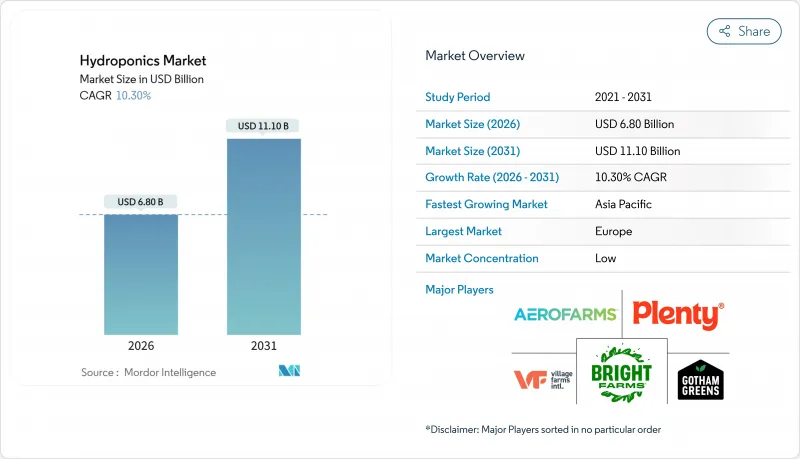
This report is Segmented by Production System (Greenhouse Hydroponics, Indoor Vertical Farms, and More), by Crop Type (Leafy Greens, Tomatoes, Cucumbers, and More), by Equipment (Lighting Systems, Irrigation Components and Pumps, and More) by Production Scale (Large, Medium, and Small), and by Geography (North America, South America, Europe, and More). The Market Forecasts are Provided in Terms of Value (USD).
Global Hydroponics Market Trends and Insights
Controlled-Environment Food-Security Initiatives
National programs now position hydroponics within critical-infrastructure strategies that mitigate climate shocks. The United States Department of Agriculture (USDA) funds urban and indoor agriculture under 7 USC 5925g, turning research grants into pilot facilities that demonstrate commercial viability. Japan's Ministry of Agriculture, Forestry and Fisheries (MAFF) targets 50% smart-agriculture adoption by 2030, prioritizing controlled environments that stabilize output during typhoon seasons. China's National Smart Agriculture Action Plan mandates the use of the Internet of Things (IoT) and artificial intelligence in facility agriculture pilots, thereby accelerating domestic investment in this sector. India's Digital Agriculture Mission earmarked Rs 2,817 crore (USD 338 million) for precision-farming infrastructure, while the Clean Plant Programme channels Rs 1,765.67 crore (USD 212 million) into disease-free nursery material. These policies compress financing costs and standardize regulatory pathways, speeding adoption among commercial growers who once viewed hydroponics as capital-prohibitive.
Declining Arable Land per Capita
Land scarcity intensifies the economic rationale for soilless cultivation. The Food and Agriculture Organization (FAO) recorded a 20% drop in global arable land per person, from 0.24 to 0.20 hectares between 2000 and 2024. Urban sprawl in the Asia-Pacific and water constraints in the Middle East leave limited expansion room for soil farming. Hydroponics multiplies usable growing area up to 80 times by stacking production vertically or fitting systems onto non-arable sites, such as rooftops and warehouses. The Netherlands utilizes greenhouse clusters to export high-yield vegetables, despite having scarce farmland, illustrating the potential leverage when land is no longer the limiting factor. As per-capita arable acreage becomes increasingly scarce, the cost-benefit of vertical infrastructure outweighs land acquisition, especially near high-density cities.
High Capital Expenditure for Large Systems
Turnkey vertical farming systems can exceed USD 1,000 per square meter, often extending payback periods beyond seven years for smaller investors. While several large-scale operators historically relied on substantial venture funding to finance automated facilities, capital intensity has proven challenging for highly leveraged expansion strategies, as evidenced by the Chapter 11 filing of Kalera PLC. Village Farms International Inc. opted to privatize its fresh-produce unit for USD 40 million and a 37.9% equity stake in 2025, illustrating structural pressure to streamline its balance sheet. To mitigate upfront investment risk, smaller growers are increasingly favoring modular or leased cultivation formats that shift capital expenditures toward operating expenses, thereby improving flexibility and reducing financial exposure.
Other drivers and restraints analyzed in the detailed report include:
- Year-Round Output Advantages
- Pharmaceutical-Grade Ingredient Demand
- Energy-Cost Sensitivity for Artificial Lighting
For complete list of drivers and restraints, kindly check the Table Of Contents.
Segment Analysis
Greenhouse hydroponics generated 68.3% of 2025 revenue, supported by the 5.5 million-square-foot Village Farms International Inc. complex in Texas and extensive Dutch clusters that combine sunlight with waste-heat capture. Indoor vertical farms are projected to grow at a 13.4% CAGR through 2031, as municipalities pursue resilient last-mile supply chains while minimizing refrigerated freight. Container-based hydroponic systems, although representing a niche market, continue to address remote and decentralized demand through modular, rapidly deployable units suited for institutional, research, and emergency-response settings.
Automation compresses labor costs, narrowing the historical cost gap between vertical structures and greenhouses. Signify's newest LEDs reduce energy draw, making high-rise grow towers more viable in power-intensive regions. Plenty Unlimited Inc.'s USD 680 million joint venture with Mawarid signals that Middle Eastern capital is gravitating toward vertical platforms where conventional greenhouse cooling is cost-prohibitive. As lighting and robotics mature, the hydroponics market will shift further toward multi-tier formats that capitalize on scarce urban land.
Leafy greens accounted for 47.2% of the hydroponics market size in 2025, driven by 30-45 day harvest cycles that maximize turns and cash flow for hydroponic growers. Herbs and microgreens are anticipated to post a 12.6% CAGR through 2031, as pharmaceutical and nutraceutical buyers demand pesticide-free biomass with traceable phytochemical profiles. Tomatoes, cucumbers, and peppers collectively form the second-largest value block, utilizing high-wire greenhouse systems to produce year-round volumes in line with supermarket contracts.
Pharmaceutical uptake redefines revenue potential. AeroFarms Inc. partners with drug developers to produce specialty extracts, illustrating how growers can pivot from commodity produce to active-ingredient supply. Leaf-crop dominance will continue near large consumer bases because rapid cycles offset operating expenses, yet the margin upside in high-value herbs acts as a buffer against energy volatility. Over time, carbon-pricing schemes that reward lower water and energy footprints may further shift production toward crops with superior efficiency metrics.
Complete Report Scope:
- By Production System
- Greenhouse Hydroponics
- Indoor Vertical Farms
- Container Farms
- By Crop Type
- Leafy Greens
- Tomatoes
- Cucumbers
- Peppers
- Herbs and Microgreens
- By Equipment
- Lighting Systems
- Irrigation Components and Pumps
- Climate Systems
- Automation and Control Systems
- Structural Components
- By Production Scale
- Large
- Medium
- Small
- By Geography
- North America
- United States
- Canada
- Rest of North America
- South America
- Brazil
- Argentina
- Rest of South America
- Europe
- Germany
- Netherlands
- United Kingdom
- France
- Spain
- Rest of Europe
- Asia-Pacific
- China
- Japan
- India
- Australia
- Rest of Asia-Pacific
- Middle East
- United Arab Emirates
- Saudi Arabia
- Rest of Middle East
- Africa
- South Africa
- Kenya
- Rest of Africa
- North America
Geography Analysis
Europe accounted for 34.3% of the hydroponics market revenue in 2025, driven by Dutch greenhouse exports and stringent European Union (EU) discharge regulations that have spurred innovations in water reuse. While regional growth is evident, it's tempered by already high capacities and rising electricity costs. Instead of expanding acreage, Germany, the United Kingdom, France, and Spain focus on retrofitting with LEDs and automating processes to enhance efficiency. Russia faces technological access challenges, whereas Scandinavian nations experiment with carbon-neutral greenhouses, harnessing geothermal and hydropower.
Asia-Pacific is set to lead with a 12.2% CAGR, outpacing other major regions. China's "Smart Agriculture Action Plan" for November 2024 allocates state funds to IoT-driven controlled environments, with a particular focus on hydroponics. India's Digital Agriculture Mission has allocated Rs 2,817 crore (approximately USD 338 million) to precision and controlled-environment systems, fostering the adoption of hydroponics to enhance water efficiency and yield stability. Japan aims for a 50% adoption rate of smart agriculture by 2030, with a focus on hydroponics for typhoon-resilient and climate-controlled production. In Australia, hydroponic greenhouse sites are being expanded near coastal cities to ensure a steady supply of fresh produce to urban areas. Meanwhile, Southeast Asian urban centers are experimenting with vertical hydroponics to reduce their dependence on imported produce.
In North America, the market growth is driven by funding from the United States Department of Agriculture, as well as investments from companies such as Village Farms International Inc. and Plenty Unlimited Inc., which are advancing large-scale, controlled-environment farming. In the Middle East, countries such as the United Arab Emirates and Saudi Arabia are investing in hydroponic systems to reduce import costs and conserve groundwater, as demonstrated by Abu Dhabi's 10-hectare AgTech Park initiative. In South America, urban hydroponic projects in Brazil and Argentina are driving progress. Meanwhile, in Africa, targeted deployments in South Africa and Kenya are leveraging hydroponics to address post-harvest losses, despite challenges related to power grid reliability.
- BrightFarms (Cox Enterprises)
- Plenty Unlimited Inc.
- Crop One Holdings Inc.
- 80 Acres Urban Agriculture Inc.
- Little Leaf Farms Inc.
- GoodLeaf Farms (McCain Foods Ltd.)
- Pure Harvest Smart Farms Holding
- Green Sense Farms Holdings Inc.
- Nordic Harvest A/S
- Oishii Farm Corporation
- Gotham Greens Inc.
- AeroFarms Inc.
- Village Farms International Inc.
- Sundrop Farms (Centuria Capital Group)
- GrowUp Farms (Sun Capital Partners)
Additional Benefits:
- The market estimate (ME) sheet in Excel format
- 3 months of analyst support
TABLE OF CONTENTS
1 Introduction
- 1.1 Study Assumptions and Market Definition
- 1.2 Scope of the Study
2 Research Methodology
3 Executive Summary
4 Market Landscape
- 4.1 Market Overview
- 4.2 Market Drivers
- 4.2.1 Controlled-environment food-security initiatives
- 4.2.2 Declining arable land per capita
- 4.2.3 Year-round output advantages
- 4.2.4 Carbon-credit revenue stacking
- 4.2.5 Pharmaceutical-grade ingredient demand
- 4.2.6 Urban wastewater-reuse regulations
- 4.3 Market Restraints
- 4.3.1 High capital expenditure for large systems
- 4.3.2 Energy-cost sensitivity for artificial lighting
- 4.3.3 Tightening micronutrient-discharge regulations
- 4.3.4 Limited seed genetics for hydroponic inputs
- 4.4 Regulatory Landscape
- 4.5 Technological Outlook
- 4.6 Porter's Five Forces Analysis
- 4.6.1 Threat of New Entrants
- 4.6.2 Bargaining Power of Buyers
- 4.6.3 Bargaining Power of Suppliers
- 4.6.4 Threat of Substitutes
- 4.6.5 Intensity of Competitive Rivalry
5 Market Size and Growth Forecasts (Value)
- 5.1 By Production System
- 5.1.1 Greenhouse Hydroponics
- 5.1.2 Indoor Vertical Farms
- 5.1.3 Container Farms
- 5.2 By Crop Type
- 5.2.1 Leafy Greens
- 5.2.2 Tomatoes
- 5.2.3 Cucumbers
- 5.2.4 Peppers
- 5.2.5 Herbs and Microgreens
- 5.3 By Equipment
- 5.3.1 Lighting Systems
- 5.3.2 Irrigation Components and Pumps
- 5.3.3 Climate Systems
- 5.3.4 Automation and Control Systems
- 5.3.5 Structural Components
- 5.4 By Production Scale
- 5.4.1 Large
- 5.4.2 Medium
- 5.4.3 Small
- 5.5 By Geography
- 5.5.1 North America
- 5.5.1.1 United States
- 5.5.1.2 Canada
- 5.5.1.3 Rest of North America
- 5.5.2 South America
- 5.5.2.1 Brazil
- 5.5.2.2 Argentina
- 5.5.2.3 Rest of South America
- 5.5.3 Europe
- 5.5.3.1 Germany
- 5.5.3.2 Netherlands
- 5.5.3.3 United Kingdom
- 5.5.3.4 France
- 5.5.3.5 Spain
- 5.5.3.6 Rest of Europe
- 5.5.4 Asia-Pacific
- 5.5.4.1 China
- 5.5.4.2 Japan
- 5.5.4.3 India
- 5.5.4.4 Australia
- 5.5.4.5 Rest of Asia-Pacific
- 5.5.5 Middle East
- 5.5.5.1 United Arab Emirates
- 5.5.5.2 Saudi Arabia
- 5.5.5.3 Rest of Middle East
- 5.5.6 Africa
- 5.5.6.1 South Africa
- 5.5.6.2 Kenya
- 5.5.6.3 Rest of Africa
- 5.5.1 North America
6 Competitive Landscape
- 6.1 Market Concentration
- 6.2 Strategic Moves
- 6.3 Market Share Analysis
- 6.4 Company Profiles (Includes Global level Overview, Market Level Overview, Core Segments, Financials as Available, Strategic Information, Market Rank/Share for Key Companies, Products and Services, and Recent Developments)
- 6.4.1 BrightFarms (Cox Enterprises)
- 6.4.2 Plenty Unlimited Inc.
- 6.4.3 Crop One Holdings Inc.
- 6.4.4 80 Acres Urban Agriculture Inc.
- 6.4.5 Little Leaf Farms Inc.
- 6.4.6 GoodLeaf Farms (McCain Foods Ltd.)
- 6.4.7 Pure Harvest Smart Farms Holding
- 6.4.8 Green Sense Farms Holdings Inc.
- 6.4.9 Nordic Harvest A/S
- 6.4.10 Oishii Farm Corporation
- 6.4.11 Gotham Greens Inc.
- 6.4.12 AeroFarms Inc.
- 6.4.13 Village Farms International Inc.
- 6.4.14 Sundrop Farms (Centuria Capital Group)
- 6.4.15 GrowUp Farms (Sun Capital Partners)
7 Market Opportunities and Future Outlook

