PUBLISHER: Mordor Intelligence | PRODUCT CODE: 2120386

PUBLISHER: Mordor Intelligence | PRODUCT CODE: 2120386
North America Aseptic Packaging - Market Share Analysis, Industry Trends & Statistics, Growth Forecasts (2026 - 2031)
According to Mordor Intelligence, the North America aseptic packaging market size is expected to grow from USD 13.82 billion in 2025 to USD 15.11 billion in 2026 and is forecast to reach USD 23.65 billion by 2031 at 9.36% CAGR over 2026-2031.
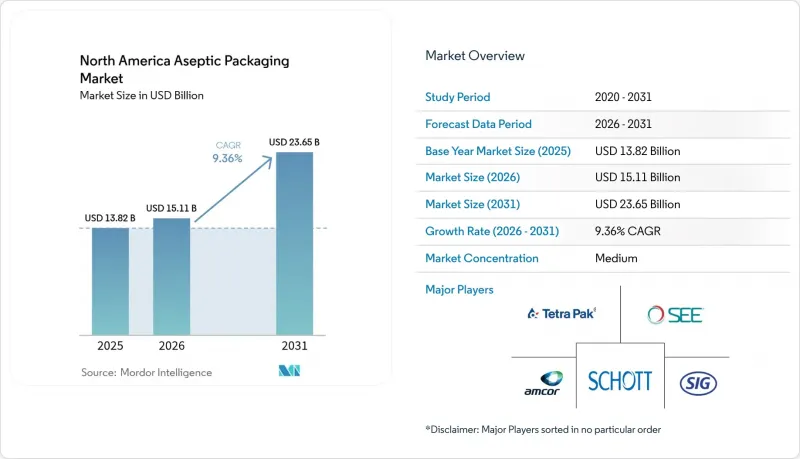
This report is Segmented by Packaging Material (Paper and Paperboard, Plastics, Glass, Aluminum Foil/Metal, and Multilayer Composites), Product Type (Bottles, Cartons, Bags and Pouches, and More), End-User Industry (Pharmaceutical, Beverage, Food, and More), Technology (Aseptic Liquid Packaging, Blow-Fill-Seal, and More), and Country. The Market Forecasts are Provided in Terms of Value (USD).
North America Aseptic Packaging Market Trends and Insights
Growing Demand to Cut Cold-Chain Logistics Costs
Temperature-controlled transport absorbs 15-25% of distribution budgets, so eliminating refrigeration quickly improves margins. Mexican milk imports, for instance, avoid USD 0.15-0.30 per liter in freight premiums when shipped ambient. Nestle has earmarked USD 1 billion for aseptic lines in Mexico between 2025 and 2027 to exploit the savings. Rural U.S. counties with limited cold storage echo the calculus, while Canadian dairies rely on shelf-stable packs to reach remote northern communities where logistics costs often exceed product value. As diesel prices and driver shortages linger, the North America aseptic packaging market finds a durable advantage in cutting refrigerated miles.
Preference for Products with >=12-Month Shelf Life
Bulk buying expanded during pandemic pantry stocking, and ambient-stable items now fetch 20-30% mark-ups in city markets. Tetra Pak surveys show 67% of households rank shelf life above brand loyalty. In pharma, SCHOTT Pharma's USD 371 million North Carolina plant triples syringe output that holds room-temperature stability for 36 months. Urban shoppers equate longer life with convenience and emergency readiness, prompting beverage reformulations that withstand ambient warehousing. As a result, the North America aseptic packaging market gains momentum from both grocery aisles and hospital inventories.
High Cap-Ex and Long ROI for Aseptic Filling Lines
Turnkey systems cost USD 10-50 million, and pharmaceutical validation adds another USD 2-5 million, extending payback to 7-10 years. Smaller processors struggle to finance such outlays, especially when technical talent commands 25-30% wage premiums. Leasing models seldom suit bespoke aseptic rigs, so mergers and private equity funding dominate expansion. Consolidation, therefore, rises even as demand surges, tempering the growth curve of the North America aseptic packaging market.
Other drivers and restraints analyzed in the detailed report include:
- Sustainability Push for Paper-Based and Lightweight Formats
- Rapid Expansion of Aseptic Capacity in U.S. Dairy Plants
- Complex Multi-Material Recycling Infrastructure Gaps
For complete list of drivers and restraints, kindly check the Table Of Contents.
Segment Analysis
Paperboard contributed 61.78% revenue in 2025, a testament to entrenched supply chains and consumer trust in renewable fibers. The segment also aligns with state recycled-content statutes, adding regulatory tailwind to the North America aseptic packaging market. Yet glass records a 10.24% CAGR through 2031, propelled by pharma's need for chemical inertness. Innovations such as Corning Valor Glass solve historic delamination issues, while SCHOTT's pre-sterilized vials shrink fill-finish steps. Plastics keep a foothold in flexibles, but single-use scrutiny caps upside. Aluminum foil remains essential for ultra-low oxygen transmission in sensitive biologics. Multilayer composites blend these attributes but confront recycling headwinds already outlined. Overall, material choice in the North America aseptic packaging industry depends on striking an equilibrium among sterility, sustainability, and cost targets.
The outlook shows glass emerging from niche status. Pharma manufacturers value its compatibility with lyophilized biologics and its immunity to extractables, justifying higher weight penalties. Conversely, beverage brands retain paper cartons for ambient juices, plant milks, and broths where fiber-based stories resonate with shoppers. Polymer barrels of regulatory pressure spur a gradual pivot toward bio-based coatings rather than outright abandonment. Collectively, these currents reinforce a diversified substrate mix that shields the North America aseptic packaging market from raw-material shocks.
Cartons captured 41.95% of 2025 volume thanks to decades-old shelf-stable beverage lines and efficient pallet utilization. Nonetheless, vials and ampoules outpace all other formats at a 10.79% CAGR, buoyed by expanding biologic injections that need pristine primary packs. The segment benefits from ready-to-use configurations that arrive washed and depyrogenated, trimming drugmaker cycle times. Blow-fill-seal single-dose designs also attract vaccine programs that require needle-free workstreams. Consequently, pharmaceuticals tilt the North America aseptic packaging market toward container miniaturization and higher unit value.
Bottles serve premium cold brew coffees and nutritional shakes that justify heavier glass or PET. Pouches address soup and sauce brands needing flexible geometry at low gram weight. Meanwhile, in-line AI inspection embedded in new filling heads adds another layer of differentiation by slashing sterile failure rates. Every product family, therefore, jockeys for share via either convenience or compliance, making adaptive production platforms a strategic must for converters.
Complete Report Scope:
- By Packaging Material
- Paper and Paperboard
- Plastics
- Glass
- Aluminum Foil/Metal
- Multilayer Composites
- By Product Type
- Bottles
- Cartons
- Bags and Pouches
- Vials and Ampoules
- Other Product Types
- By End-User Industry
- Pharmaceutical
- Beverage
- Fruit-based Drinks
- Milk and Other Dairy Beverages
- Ready-to-Drink (RTD)
- Other Beverage Types
- Food
- Fruit-based Foods
- Dairy Food
- Processed Foods
- Soups and Broths
- Other Food Types
- Personal Care and Cosmetics
- Industrial
- Other End-User Industries
- By Technology
- Aseptic Liquid Packaging
- Blow-Fill-Seal (BFS)
- Form-Fill-Seal (FFS)
- Electron-Beam Sterilization
- Ultra-High-Temperature (UHT) / HTST
- By Country
- United States
- Canada
- Mexico
List of Companies Covered in this Report:
- Tetra Pak International S.A.
- SIG Combibloc Group AG
- Amcor plc
- Sealed Air Corporation
- Smurfit WestRock
- Schott AG
- Scholle IPN Corporation
- International Paper Company
- Elopak ASA
- Mondi plc
- Reynolds Group Holdings Ltd.
- Sonoco Products Company
- Stora Enso Oyj
- UFlex Limited
- Greatview Aseptic Packaging Co., Ltd.
- Ecolean AB
- Graphic Packaging Holding Company
Additional Benefits:
- The market estimate (ME) sheet in Excel format
- 3 months of analyst support
TABLE OF CONTENTS
1 INTRODUCTION
- 1.1 Study Assumptions and Market Definition
- 1.2 Scope of the Study
2 RESEARCH METHODOLOGY
3 EXECUTIVE SUMMARY
4 MARKET LANDSCAPE
- 4.1 Market Overview
- 4.2 Market Drivers
- 4.2.1 Growing demand to cut cold-chain logistics costs
- 4.2.2 Preference for products with >=12-month shelf life
- 4.2.3 Sustainability push for paper-based and lightweight formats
- 4.2.4 Rapid expansion of aseptic capacity in U.S. dairy plants
- 4.2.5 Surge in biologics and RTU injectables needing sterile packs
- 4.2.6 AI-enabled inline sterility monitoring reducing recalls
- 4.3 Market Restraints
- 4.3.1 High cap-ex and long ROI for aseptic filling lines
- 4.3.2 Complex multi-material recycling infrastructure gaps
- 4.3.3 Contamination recalls eroding brand trust and margins
- 4.3.4 Rising polymer and paperboard prices squeezing converters
- 4.4 Industry Value Chain Analysis
- 4.5 Porter's Five Forces Analysis
- 4.5.1 Bargaining Power of Suppliers
- 4.5.2 Bargaining Power of Buyers
- 4.5.3 Threat of New Entrants
- 4.5.4 Threat of Substitute Products
- 4.5.5 Intensity of Competitive Rivalry
- 4.6 Impact of Macroeconomic Factors on the Market
- 4.7 Regulatory Landscape
5 MARKET SIZE AND GROWTH FORECASTS (VALUE)
- 5.1 By Packaging Material
- 5.1.1 Paper and Paperboard
- 5.1.2 Plastics
- 5.1.3 Glass
- 5.1.4 Aluminum Foil/Metal
- 5.1.5 Multilayer Composites
- 5.2 By Product Type
- 5.2.1 Bottles
- 5.2.2 Cartons
- 5.2.3 Bags and Pouches
- 5.2.4 Vials and Ampoules
- 5.2.5 Other Product Types
- 5.3 By End-User Industry
- 5.3.1 Pharmaceutical
- 5.3.2 Beverage
- 5.3.2.1 Fruit-based Drinks
- 5.3.2.2 Milk and Other Dairy Beverages
- 5.3.2.3 Ready-to-Drink (RTD)
- 5.3.2.4 Other Beverage Types
- 5.3.3 Food
- 5.3.3.1 Fruit-based Foods
- 5.3.3.2 Dairy Food
- 5.3.3.3 Processed Foods
- 5.3.3.4 Soups and Broths
- 5.3.3.5 Other Food Types
- 5.3.4 Personal Care and Cosmetics
- 5.3.5 Industrial
- 5.3.6 Other End-User Industries
- 5.4 By Technology
- 5.4.1 Aseptic Liquid Packaging
- 5.4.2 Blow-Fill-Seal (BFS)
- 5.4.3 Form-Fill-Seal (FFS)
- 5.4.4 Electron-Beam Sterilization
- 5.4.5 Ultra-High-Temperature (UHT) / HTST
- 5.5 By Country
- 5.5.1 United States
- 5.5.2 Canada
- 5.5.3 Mexico
6 COMPETITIVE LANDSCAPE
- 6.1 Market Concentration
- 6.2 Strategic Moves
- 6.3 Market Share Analysis
- 6.4 Company Profiles (includes Global level Overview, Market level overview, Core Segments, Financials as available, Strategic Information, Market Rank/Share for key companies, Products and Services, and Recent Developments)
- 6.4.1 Tetra Pak International S.A.
- 6.4.2 SIG Combibloc Group AG
- 6.4.3 Amcor plc
- 6.4.4 Sealed Air Corporation
- 6.4.5 Smurfit WestRock
- 6.4.6 Schott AG
- 6.4.7 Scholle IPN Corporation
- 6.4.8 International Paper Company
- 6.4.9 Elopak ASA
- 6.4.10 Mondi plc
- 6.4.11 Reynolds Group Holdings Ltd.
- 6.4.12 Sonoco Products Company
- 6.4.13 Stora Enso Oyj
- 6.4.14 UFlex Limited
- 6.4.15 Greatview Aseptic Packaging Co., Ltd.
- 6.4.16 Ecolean AB
- 6.4.17 Graphic Packaging Holding Company
7 MARKET OPPORTUNITIES AND FUTURE OUTLOOK
- 7.1 White-space and Unmet-need Assessment

