PUBLISHER: Mordor Intelligence | PRODUCT CODE: 2120390

PUBLISHER: Mordor Intelligence | PRODUCT CODE: 2120390
Next-generation Storage - Market Share Analysis, Industry Trends & Statistics, Growth Forecasts (2026 - 2031)
According to Mordor Intelligence, the next-generation storage market size is expected to increase from USD 71.26 billion in 2025 to USD 75.30 billion in 2026 and reach USD 96.55 billion by 2031, growing at a CAGR of 5.10% over 2026-2031.
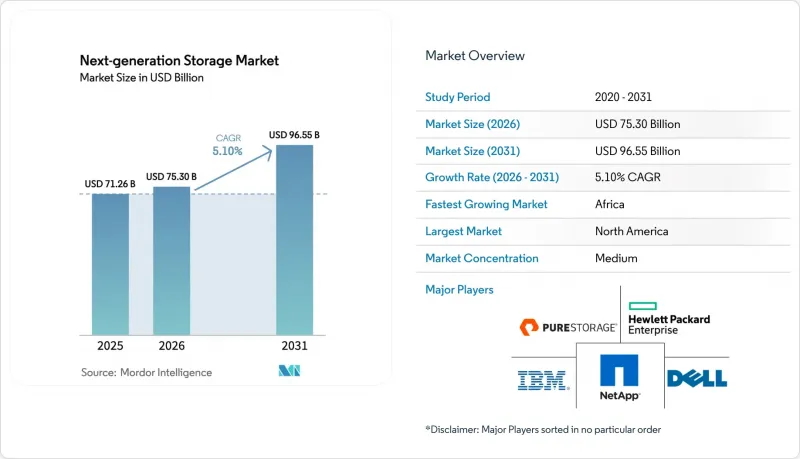
This report is Segmented by Storage System (Direct Attached Storage, Network Attached Storage, and Storage Area Network), Storage Architecture (File and Object-Based Storage, and Block Storage), End-User Industry (BFSI, Retail, IT and Telecom, and More), Deployment Model (On-Premises, Cloud, and Hybrid), and Geography. The Market Forecasts are Provided in Terms of Value (USD).
Global Next-generation Storage Market Trends and Insights
Rapid AI-Driven Demand for Enterprise SSDs
Generative AI training has turned storage throughput into a competitive differentiator, shrinking refresh cycles from five to three years as hyperscalers adopt all-flash clusters that deliver millions of random read IOPS. Enterprise SSD bit shipments surged 42% year-over-year in 2Q 2025, with Samsung's PM9E1 and Micron's 6550 ION surpassing 2 million IOPS in a single drive, enabling one server to replace multiple legacy nodes. Cloud operators now dictate the design of roadmaps, pushing vendors toward higher layer counts and lower power consumption per terabyte, which raises the total available market for next-generation storage.
Expansion Of Scale-Out NAS In Hybrid Clouds
Enterprises consolidating departmental filers onto distributed clusters that automatically tier cold data to public-cloud object stores are fueling double-digit growth in Network Attached Storage. NetApp's all-flash NAS revenue climbed 28% in fiscal 3Q 2025, while Dell's PowerScale added native S3 support, allowing the same namespace to span on-premises flash and cloud buckets. By eliminating gateways and manual migrations, scale-out NAS reduces administrative overhead and accelerates data mobility, thereby increasing its market share in the next-generation storage market.
Persistent Supply-Chain Volatility For NAND Flash
Geopolitical frictions are causing erratic NAND pricing, with contract rates rising 18% in 1H 2025 before falling 8% in 3Q as new South Korean capacity came online. Vendor gross margins compress when hedging at elevated spot levels, prompting some customers to extend hybrid deployments that combine SSDs with hard-disk drives, thereby delaying the full adoption of next-generation storage architectures.
Other drivers and restraints analyzed in the detailed report include:
- Regulatory Push For Sovereign Data-Residency Storage
- 5G-Enabled Edge Storage
- Data-Security Breaches In Cloud Services
For complete list of drivers and restraints, kindly check the Table Of Contents.
Segment Analysis
Network Attached Storage captured a 41.40% slice of the next-generation storage market share in 2025 and is forecast to climb at an 11.50% CAGR to 2031. The aggressive adoption of scale-out file clusters, which sustain petabyte-scale namespaces for AI training footage, media libraries, and genomics repositories, underpins this growth. Direct-Attached Storage is fading as converged infrastructure allows for pooled capacity, while Storage Area Networks remain relevant for deterministic latency in core banking and airline systems, yet they grow at only 3.2% annually.
The shift reflects the dominance of unstructured data, now accounting for more than 80% of generated bits, which naturally aligns with NAS protocols that permit billions of files in a single namespace. Vendors such as Qumulo report media customers writing 100 GB/s sustained to petabyte clusters, while NetApp's ONTAP now includes autonomous ransomware detection that snapshots anomalous activity within seconds. Security plus scalability accelerates NAS encroachment into workloads once reserved for object storage, reinforcing the ascendancy of NAS within the next-generation storage market.
File and object-based systems controlled 57.80% of revenue in 2025, yet block arrays are on track for a 9.46% CAGR through 2031, reflecting renewed interest in ultra-low latency. SAP HANA, Oracle Exadata, and container persistent volumes rely on atomic writes, which file semantics cannot guarantee, prompting enterprises to adopt NVMe-over-Fabrics arrays that deliver 10 times the throughput of legacy Fibre Channel. Consequently, block arrays are reclaiming relevance for stateful microservices and in-memory analytics, expanding their slice of the next-generation storage market in transactional contexts.
Capacity-oriented archives still favor file and object platforms that deliver exabyte scalability at one-tenth the cost per terabyte. Cloudian claims average customer deployments exceed 5 PB, while Scality's ARTESCA collapses multi-petabyte repositories into a single namespace with sub-second metadata lookups. This bifurcation leaves little room for hybrid architectures, positioning block storage for performance workloads and file storage for capacity, each integral to the broader next-generation storage market.
Complete Report Scope:
- By Storage System
- Direct Attached Storage (DAS)
- Network Attached Storage (NAS)
- Storage Area Network (SAN)
- By Storage Architecture
- File and Object-Based Storage (FOBS)
- Block Storage
- By End-User Industry
- BFSI
- Retail
- IT and Telecom
- Healthcare
- Media and Entertainment
- By Deployment Model
- On-Premises
- Cloud
- Hybrid
- By Geography
- North America
- United States
- Canada
- Mexico
- Europe
- Germany
- United Kingdom
- France
- Italy
- Spain
- Russia
- Rest of Europe
- Asia-Pacific
- China
- Japan
- India
- South Korea
- Australia
- Rest of Asia-Pacific
- Middle East
- Saudi Arabia
- United Arab Emirates
- Turkey
- Rest of Middle East
- Africa
- South Africa
- Nigeria
- Rest of Africa
- South America
- Brazil
- Argentina
- Rest of South America
- North America
Geography Analysis
North America held 37.46% of 2025 revenue, reflecting dense hyperscale footprints in Virginia, Texas, Oregon and Iowa. Spending tilts toward performance upgrades like Frontier's 700 PB all-flash supercomputer in Tennessee. Canada's data-residency rules spurred AWS to add a Calgary region in 2025, while Mexico's nearshoring boom fuels edge deployments.
Europe fragments along sovereignty lines as the Digital Operational Resilience Act enforces EU-resident replicas, prompting Oracle and AWS to open Europe-only regions. Germany's cybersecurity agency recommends on-premises arrays for classified workloads, slowing cloud migration, whereas post-Brexit United Kingdom institutions leverage U.S. regions for cost advantage.
Africa is the standout, predicted to grow at 14.10% CAGR to 2031. Microsoft Azure's Kenya launch and Google Cloud's forthcoming Lagos region satisfy in-country data mandates, catalyzing local adoption. Parallel momentum in the Middle East and South America rounds out the regional mosaic that sustains the next-generation storage market.
- Dell Technologies Inc.
- Hewlett Packard Enterprise Company
- NetApp, Inc.
- Hitachi Vantara LLC
- International Business Machines Corporation (IBM)
- Toshiba Corporation
- Pure Storage, Inc.
- DataDirect Networks, Inc.
- Scality SA
- Fujitsu Limited
- NETGEAR, Inc.
- Huawei Technologies Co., Ltd.
- Western Digital Corporation
- Samsung Electronics Co., Ltd.
- Micron Technology, Inc.
- Seagate Technology Holdings plc
- Synology Inc.
- QNAP Systems, Inc.
- Buffalo Inc.
- Qumulo, Inc.
- Cloudian, Inc.
Additional Benefits:
- The market estimate (ME) sheet in Excel format
- 3 months of analyst support
TABLE OF CONTENTS
1 INTRODUCTION
- 1.1 Study Assumptions and Market Definition
- 1.2 Scope of the Study
2 RESEARCH METHODOLOGY
3 EXECUTIVE SUMMARY
4 MARKET LANDSCAPE
- 4.1 Market Overview
- 4.2 Market Drivers
- 4.2.1 Increasing Volume of Digital Data
- 4.2.2 Rising Adoption of Solid-State Devices
- 4.2.3 Rapid AI-Driven Demand for Enterprise SSDs
- 4.2.4 5G-Enabled Edge Storage
- 4.2.5 Expansion of Scale-Out NAS in Hybrid Clouds
- 4.2.6 Regulatory Push for Sovereign Data-Residency Storage
- 4.3 Market Restraints
- 4.3.1 Data-Security Breaches in Cloud Services
- 4.3.2 Persistent Supply-Chain Volatility for NAND Flash
- 4.3.3 Talent Shortage in Storage-Centric DevOps
- 4.3.4 High Up-Front Capex for All-Flash Arrays
- 4.4 Industry Value Chain Analysis
- 4.5 Regulatory Landscape
- 4.6 Technological Outlook
- 4.7 Impact of Macroeconomic Factors
- 4.8 Porter's Five Forces Analysis
- 4.8.1 Threat of New Entrants
- 4.8.2 Bargaining Power of Suppliers
- 4.8.3 Bargaining Power of Buyers
- 4.8.4 Threat of Substitutes
- 4.8.5 Competitive Rivalry
5 MARKET SIZE AND GROWTH FORECASTS (VALUE)
- 5.1 By Storage System
- 5.1.1 Direct Attached Storage (DAS)
- 5.1.2 Network Attached Storage (NAS)
- 5.1.3 Storage Area Network (SAN)
- 5.2 By Storage Architecture
- 5.2.1 File and Object-Based Storage (FOBS)
- 5.2.2 Block Storage
- 5.3 By End-User Industry
- 5.3.1 BFSI
- 5.3.2 Retail
- 5.3.3 IT and Telecom
- 5.3.4 Healthcare
- 5.3.5 Media and Entertainment
- 5.4 By Deployment Model
- 5.4.1 On-Premises
- 5.4.2 Cloud
- 5.4.3 Hybrid
- 5.5 By Geography
- 5.5.1 North America
- 5.5.1.1 United States
- 5.5.1.2 Canada
- 5.5.1.3 Mexico
- 5.5.2 Europe
- 5.5.2.1 Germany
- 5.5.2.2 United Kingdom
- 5.5.2.3 France
- 5.5.2.4 Italy
- 5.5.2.5 Spain
- 5.5.2.6 Russia
- 5.5.2.7 Rest of Europe
- 5.5.3 Asia-Pacific
- 5.5.3.1 China
- 5.5.3.2 Japan
- 5.5.3.3 India
- 5.5.3.4 South Korea
- 5.5.3.5 Australia
- 5.5.3.6 Rest of Asia-Pacific
- 5.5.4 Middle East
- 5.5.4.1 Saudi Arabia
- 5.5.4.2 United Arab Emirates
- 5.5.4.3 Turkey
- 5.5.4.4 Rest of Middle East
- 5.5.5 Africa
- 5.5.5.1 South Africa
- 5.5.5.2 Nigeria
- 5.5.5.3 Rest of Africa
- 5.5.6 South America
- 5.5.6.1 Brazil
- 5.5.6.2 Argentina
- 5.5.6.3 Rest of South America
- 5.5.1 North America
6 COMPETITIVE LANDSCAPE
- 6.1 Market Concentration
- 6.2 Strategic Moves
- 6.3 Market Share Analysis
- 6.4 Company Profiles (includes Global level Overview, Market level overview, Core Segments, Financials as available, Strategic Information, Market Rank/Share for key companies, Products and Services, and Recent Developments)
- 6.4.1 Dell Technologies Inc.
- 6.4.2 Hewlett Packard Enterprise Company
- 6.4.3 NetApp, Inc.
- 6.4.4 Hitachi Vantara LLC
- 6.4.5 International Business Machines Corporation (IBM)
- 6.4.6 Toshiba Corporation
- 6.4.7 Pure Storage, Inc.
- 6.4.8 DataDirect Networks, Inc.
- 6.4.9 Scality SA
- 6.4.10 Fujitsu Limited
- 6.4.11 NETGEAR, Inc.
- 6.4.12 Huawei Technologies Co., Ltd.
- 6.4.13 Western Digital Corporation
- 6.4.14 Samsung Electronics Co., Ltd.
- 6.4.15 Micron Technology, Inc.
- 6.4.16 Seagate Technology Holdings plc
- 6.4.17 Synology Inc.
- 6.4.18 QNAP Systems, Inc.
- 6.4.19 Buffalo Inc.
- 6.4.20 Qumulo, Inc.
- 6.4.21 Cloudian, Inc.
7 MARKET OPPORTUNITIES AND FUTURE OUTLOOK
- 7.1 White-Space and Unmet-Need Assessment

