PUBLISHER: Mordor Intelligence | PRODUCT CODE: 2120450

PUBLISHER: Mordor Intelligence | PRODUCT CODE: 2120450
Workforce Management Software - Market Share Analysis, Industry Trends & Statistics, Growth Forecasts (2026 - 2031)
According to Mordor Intelligence, the workforce management software market size is expected to increase from USD 9.36 billion in 2025 to USD 9.76 billion in 2026 and reach USD 12.04 billion by 2031, growing at a CAGR of 4.29% over 2026-2031.
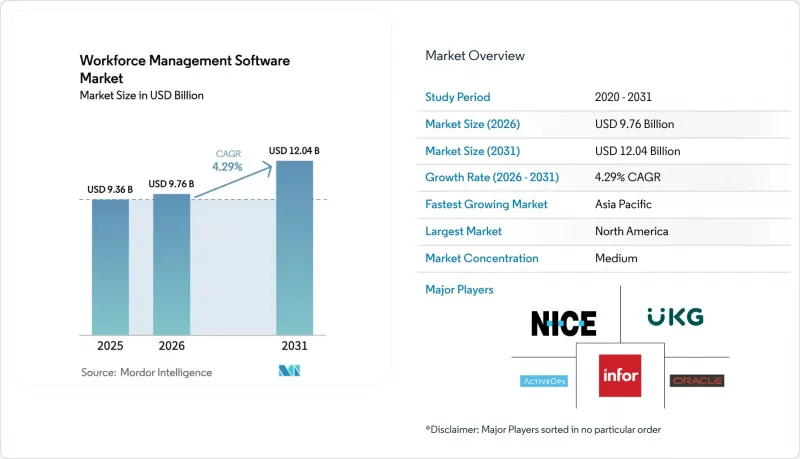
This report is Segmented by Component (Software, and Services), Software Type (Time and Attendance Management, Workforce Scheduling, and More), Deployment Mode (Cloud, and On-Premise), Organization Size (Large Enterprises, and Small and Medium Enterprises), End-Use Industry (BFSI, Consumer Goods and Retail, and More), and Geography. The Market Forecasts are Provided in Terms of Value (USD).
Global Workforce Management Software Market Trends and Insights
AI-Driven Labor Forecasting Pilots Accelerate Adoption in EU Shift-Based Industries
European manufacturers and logistics operators utilize machine-learning models that ingest point-of-sale and weather data to enhance hourly labor forecasts by 15-20% compared to static templates. Workday's Skills Intelligence feature matches certifications to shift requirements, reducing dependence on temporary agencies. EU Platform Work Directive provisions require algorithmic transparency, pushing vendors to build auditable scheduling trails. Deloitte's 2024 survey found that 68% of shift-based employers in Germany, France, and the Netherlands plan to pilot AI forecasting by the end of 2025, up from 42% in 2023. SAP and ATOSS respond by bundling predictive scheduling compliant with works council rights. Competitive pressure now outweighs transparency concerns, accelerating the roll-out of solutions.
Mobile-First WFM Penetration in Southeast Asian Multi-Site Retail Chains
Retailers with 50-500 stores across Indonesia, Thailand, and Vietnam are abandoning desktop systems for smartphone apps that enable managers to approve leave and broadcast callouts in minutes. Telkomsel cited 47% growth in enterprise mobile data in 2024, driven by workforce applications. Boston Consulting Group reported that schedule-change cycle times fell from 48 hours to under 4 hours among adopters, improving responsiveness during Ramadan and Lunar New Year. The ASEAN Digital Economy Framework reduces cross-border compliance costs, while 72% of regional CEOs rank workforce productivity as the top operational priority. Deputy and Roubler localize Bahasa Indonesia and Thai, integrate with payroll providers, and undercut legacy vendors on price.
Legacy MES/ERP Integration Costs among German Mittelstand Manufacturers
Many German firms still run Siemens SIMATIC or SAP ECC from early 2000s vintages that lack modern APIs, incurring EUR 200,000-500,000 (USD 225,000-565,000) in integration bills and 12-18 month timelines.[2] SAP's 2024 survey noted 62% of sub-1,000-employee manufacturers remain on-premise. Rockwell Automation reported that 47% cited integration complexity as the key barrier, over cost and security. VDMA found Mittelstand IT budgets average just 3.2% of revenue, limiting large-scale digital projects. Pre-built connectors help, but often require customization, which sustains manual data transfer and slows cloud migration.
Other drivers and restraints analyzed in the detailed report include:
- GCC Healthcare Staffing Shortages Spur Cloud-Based WFM Investments
- Real-Time Payroll Tax Reporting Mandates in Australia and New Zealand
- China's Data Residency Rules Limiting Foreign SaaS WFM Deployments
For complete list of drivers and restraints, kindly check the Table Of Contents.
Segment Analysis
Software represented 71.34% of revenue in 2025, primarily driven by multi-year subscriptions that bundle scheduling, time and attendance, and analytics services. Services, however, are growing 130 basis points faster at a 5.61% CAGR because enterprises need outside experts to fine-tune generative AI features. PwC found 67% of organizations deploying AI in HR required consulting to set guardrails and train staff. Large integrators capitalize on this gap, earning USD 1-2 million in services for every USD 0.5 million in software deals. Managed services now command a 20% premium, allowing mid-size hospitals to outsource compliance monitoring.
Software growth remains solid as vendors offer 10-15% discounts on three-year agreements, stabilizing annual recurring revenue. The workforce management software market size for services is on a higher trajectory as AI spreads beyond pilots, ensuring consultant pipelines remain full. Vendors hedge churn risk by stitching services into renewal discussions, locking customers into broader ecosystems.
Time and attendance accounted for a 29.63% share in 2025, driven by payroll statutes; however, analytics led to growth at a 6.81% CAGR through 2031. McKinsey estimated predictive models cut voluntary turnover 18%, saving USD 3-5 million for a 1,000-employee firm. As 71% of CHROs now report directly to CEOs, board-level visibility drives increased analytics spending. Scheduling software grows roughly in line with the workforce management software market, aided by AI pattern recognition. Fatigue-risk tools are being adopted from aviation into mining and utilities, reflecting broader safety mandates.
The workforce management software market share for analytics is expected to increase as predictive dashboards become a table stake in CFO presentations. Vendors differentiate themselves by incorporating external signals, such as weather and social media, into forecasts that help justify overtime budgets.
Complete Report Scope:
- By Component
- Software
- Services
- By Software Type
- Time and Attendance Management
- Workforce Scheduling
- Workforce Analytics
- Absence and Leave Management
- Fatigue and Task Management
- By Deployment Mode
- Cloud
- On-Premise
- By Organization Size
- Large Enterprises
- Small and Medium Enterprises
- By End-Use Industry
- BFSI
- Consumer Goods and Retail
- Automotive
- Energy and Utilities
- Healthcare
- Manufacturing
- IT and Telecommunications
- Logistics and Transportation
- Other End-Use Industries
- By Geography
- North America
- United States
- Canada
- Mexico
- South America
- Brazil
- Argentina
- Rest of South America
- Europe
- United Kingdom
- Germany
- France
- Spain
- Italy
- Rest of Europe
- Asia Pacific
- China
- India
- Japan
- Australia
- South Korea
- Rest of Asia Pacific
- Middle East and Africa
- Middle East
- Saudi Arabia
- United Arab Emirates
- Turkey
- Rest of Middle East
- Africa
- South Africa
- Kenya
- Rest of Africa
- Middle East
- North America
Geography Analysis
North America accounted for 38.91% of the 2025 revenue, driven by early adoption of cloud human capital management and stringent record-keeping laws. Market maturity tempers growth to 3.8% CAGR, yet replacement cycles spur AI upgrades. Mexico's USD 36 billion near-shoring inflows in 2024 boost bilingual solution demand and profit-sharing compliance. Canada's provincial overtime rules drive niches for region-specific absence trackers.
Europe contributed about 28% and shows mixed dynamics. The U.K.'s 2024 Employment Rights Bill accelerates retail conversions, while Germany's works council approvals slow full-stack rollouts. Southern Europe outpaces continental averages at 5.2% CAGR as tourism rebounds. Nordic countries, with their generous leave policies, require sophisticated absence management modules that global suites have historically lacked.
The Asia Pacific is the fastest-growing territory, with a 6.17% CAGR. India's 5.4 million IT-services workforce relies on solutions that combine project billing and state-wise compliance. Japan's projected 6.4 million labor deficit by 2030 drives the need for AI scheduling among aging staff. South Korea's 52-hour cap enforces precise time tracking, benefiting vendors integrated with biometric clocks. Australia and New Zealand see tailwinds from payroll-tax mandates that expose compliance gaps in spreadsheet-driven environments.
South America, the Middle East and Africa comprise roughly 15% of revenue but expand at 5.5-6% CAGR. Brazil's tougher fraud penalties spur biometric adoption, while GCC healthcare bed targets create a USD 300 million opportunity for roster optimization. Sub-Saharan Africa adoption centers on South Africa, Kenya, and Nigeria where mobile-money pay runs circumvent limited banking access. Poor broadband outside capitals means offline-first design is non-negotiable.
- ActiveOps PLC
- NICE Ltd.
- Infor Group
- Oracle Corporation
- UKG Inc.
- SAP SE
- ADP LLC
- Blue Yonder Group, Inc. (Panasonic)
- IBM Corporation
- Workday Inc.
- Reflexis Systems Inc. (Zebra)
- SISQUAL Workforce Management, Lda
- ServiceMax Inc.
- Atoss Software AG
- Mitrefinch Ltd (Advanced)
- Deputy Group Pty Ltd
- 7shifts Employee Scheduling Software Inc.
- Sage Group plc
- Roubler Australia Pty Ltd
- tamigo ApS
- Verint Systems Inc.
- ClickSoftware (Salesforce Field Service)
- Ceridian HCM Holding Inc.
- Humanity (TCP Software)
Additional Benefits:
- The market estimate (ME) sheet in Excel format
- 3 months of analyst support
TABLE OF CONTENTS
1 INTRODUCTION
- 1.1 Study Assumptions and Market Definition
- 1.2 Scope of the Study
2 RESEARCH METHODOLOGY
3 EXECUTIVE SUMMARY
4 MARKET LANDSCAPE
- 4.1 Market Overview
- 4.2 Market Drivers
- 4.2.1 AI-Driven Labor Forecasting Pilots Accelerate Adoption in EU Shift-Based Industries
- 4.2.2 Mobile-First WFM Penetration in Southeast Asian Multi-Site Retail Chains
- 4.2.3 GCC Healthcare Staffing Shortages Spur Cloud-Based WFM Investments
- 4.2.4 Real-Time Payroll Tax Reporting Mandates in Australia and New Zealand Boost Integrated Suites
- 4.2.5 Biometric Time and Attendance to Curb Payroll Fraud in South American Logistics Hubs
- 4.2.6 Adoption of Generative AI Copilots for Frontline Scheduling Optimization
- 4.3 Market Restraints
- 4.3.1 Legacy MES/ERP Integration Costs among German Mittelstand Manufacturers
- 4.3.2 China's Data Residency Rules Limiting Foreign SaaS WFM Deployments
- 4.3.3 Unreliable Broadband Infrastructure Hindering Cloud Adoption in Sub-Saharan Africa
- 4.3.4 French Union Pushback Against Algorithmic Shift Scheduling
- 4.4 Industry Value Chain Analysis
- 4.5 Regulatory Outlook
- 4.6 Technological Outlook
- 4.7 Porter's Five Forces Analysis
- 4.7.1 Threat of New Entrants
- 4.7.2 Bargaining Power of Buyers
- 4.7.3 Bargaining Power of Suppliers
- 4.7.4 Threat of Substitutes
- 4.7.5 Intensity of Competitive Rivalry
- 4.8 Impact of Macroeconomic Factors on the Market
- 4.9 Investment Analysis (Capital Flow and VC Funding Trends)
5 MARKET SIZE AND GROWTH FORECASTS (VALUES)
- 5.1 By Component
- 5.1.1 Software
- 5.1.2 Services
- 5.2 By Software Type
- 5.2.1 Time and Attendance Management
- 5.2.2 Workforce Scheduling
- 5.2.3 Workforce Analytics
- 5.2.4 Absence and Leave Management
- 5.2.5 Fatigue and Task Management
- 5.3 By Deployment Mode
- 5.3.1 Cloud
- 5.3.2 On-Premise
- 5.4 By Organization Size
- 5.4.1 Large Enterprises
- 5.4.2 Small and Medium Enterprises
- 5.5 By End-Use Industry
- 5.5.1 BFSI
- 5.5.2 Consumer Goods and Retail
- 5.5.3 Automotive
- 5.5.4 Energy and Utilities
- 5.5.5 Healthcare
- 5.5.6 Manufacturing
- 5.5.7 IT and Telecommunications
- 5.5.8 Logistics and Transportation
- 5.5.9 Other End-Use Industries
- 5.6 By Geography
- 5.6.1 North America
- 5.6.1.1 United States
- 5.6.1.2 Canada
- 5.6.1.3 Mexico
- 5.6.2 South America
- 5.6.2.1 Brazil
- 5.6.2.2 Argentina
- 5.6.2.3 Rest of South America
- 5.6.3 Europe
- 5.6.3.1 United Kingdom
- 5.6.3.2 Germany
- 5.6.3.3 France
- 5.6.3.4 Spain
- 5.6.3.5 Italy
- 5.6.3.6 Rest of Europe
- 5.6.4 Asia Pacific
- 5.6.4.1 China
- 5.6.4.2 India
- 5.6.4.3 Japan
- 5.6.4.4 Australia
- 5.6.4.5 South Korea
- 5.6.4.6 Rest of Asia Pacific
- 5.6.5 Middle East and Africa
- 5.6.5.1 Middle East
- 5.6.5.1.1 Saudi Arabia
- 5.6.5.1.2 United Arab Emirates
- 5.6.5.1.3 Turkey
- 5.6.5.1.4 Rest of Middle East
- 5.6.5.2 Africa
- 5.6.5.2.1 South Africa
- 5.6.5.2.2 Kenya
- 5.6.5.2.3 Rest of Africa
- 5.6.5.1 Middle East
- 5.6.1 North America
6 COMPETITIVE LANDSCAPE
- 6.1 Market Concentration
- 6.2 Strategic Moves
- 6.3 Market Share Analysis
- 6.4 Company Profiles (includes Global-Level Overview, Market-Level Overview, Core Segments, Financials, Strategic Information, Market Rank/Share, Products and Services, Recent Developments)
- 6.4.1 ActiveOps PLC
- 6.4.2 NICE Ltd.
- 6.4.3 Infor Group
- 6.4.4 Oracle Corporation
- 6.4.5 UKG Inc.
- 6.4.6 SAP SE
- 6.4.7 ADP LLC
- 6.4.8 Blue Yonder Group, Inc. (Panasonic)
- 6.4.9 IBM Corporation
- 6.4.10 Workday Inc.
- 6.4.11 Reflexis Systems Inc. (Zebra)
- 6.4.12 SISQUAL Workforce Management, Lda
- 6.4.13 ServiceMax Inc.
- 6.4.14 Atoss Software AG
- 6.4.15 Mitrefinch Ltd (Advanced)
- 6.4.16 Deputy Group Pty Ltd
- 6.4.17 7shifts Employee Scheduling Software Inc.
- 6.4.18 Sage Group plc
- 6.4.19 Roubler Australia Pty Ltd
- 6.4.20 tamigo ApS
- 6.4.21 Verint Systems Inc.
- 6.4.22 ClickSoftware (Salesforce Field Service)
- 6.4.23 Ceridian HCM Holding Inc.
- 6.4.24 Humanity (TCP Software)
7 MARKET OPPORTUNITIES AND FUTURE OUTLOOK
- 7.1 White-Space and Unmet-Need Assessment

