PUBLISHER: Mordor Intelligence | PRODUCT CODE: 2154887

PUBLISHER: Mordor Intelligence | PRODUCT CODE: 2154887
South America Workforce Management Software - Market Share Analysis, Industry Trends & Statistics, Growth Forecasts (2026 - 2031)
According to Mordor Intelligence, the South America workforce management software market size was valued at USD 515.24 million in 2025 and is estimated to grow from USD 581.37 million in 2026 to reach USD 896.58 million by 2031, at a CAGR of 9.05% during the forecast period (2026-2031).
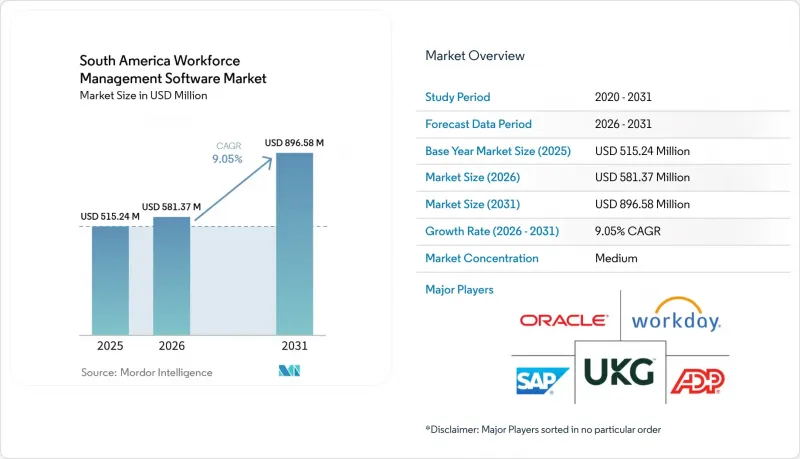
South America Workforce Management Software Market Trends and Insights
Brazil's Digital Labor Compliance and Auditability Requirements
Brazil's digital labor framework is a leading driver of the South America workforce management software market. eSocial and FGTS Digital provide authorities with access to payroll, working hours, and occupational health information through integrated reporting processes. A consolidated MTE ordinance recently brought key electronic labor obligations under a common framework, reducing uncertainty for employers that had delayed investment in automated records and reporting. Updated eSocial guidance introduced validation rules and substantial fines for inaccurate employee data. Employers, therefore, need systems that connect attendance, leave, payroll inputs, and compliance records rather than relying on separate timekeeping applications.
Cloud Adoption Among Mid-Sized Employers
Cloud adoption among mid-sized employers is widening the addressable base for the South America workforce management software market. Employers with 200 to 999 workers often need enterprise-level compliance controls but lack large internal technology teams. Subscription pricing can replace the higher initial cost of on-premises software and allows adoption in smaller stages. Chile's Exempt Resolution No. 38, which took effect in April 2025, required a government-authorized electronic attendance registration system and created a clear need for compatible digital tools. This requirement supports cloud-compatible products that can work with the certification framework and protect employee information.
Legacy Payroll and ERP Integration Friction
Legacy payroll and ERP integration remains a significant restraint for the South America workforce management software market. Employers often operate regional payroll or ERP systems with proprietary data structures that require custom interfaces. The challenge is most evident in Brazil, where payroll can include profit-sharing, night-shift differentials, and hazard pay. Generic integration approaches may not generate the reconciliation logic needed for these elements. A phased migration can reduce disruption, but it can also leave data split between workforce and payroll systems for a period. This extends project timelines and reduces the immediate return from automation.
Other drivers and restraints analyzed in the detailed report include:
- Expansion of Shift-Intensive Retail, Logistics and Agribusiness Operations
- AI-Enabled Labor Forecasting to Reduce Overtime Penalties
- Currency Volatility Increasing Effective SaaS Costs
For complete list of drivers and restraints, kindly check the Table Of Contents.
Segment Analysis
Software held 68.52% of the South America workforce management software market size in 2025. The share reflected employer demand for suites that bring time and attendance, scheduling, and analytics into a common workflow. Integrated software is useful when attendance inputs need to connect with payroll, leave, and labor reporting requirements. It also provides a foundation for employers that want to add more advanced functions after initial compliance needs are addressed. The software category remains central because it carries the core recordkeeping, workflow, and reporting functions that buyers require. Its position is supported by the need to manage recurring labor events across multiple locations and employee groups.
Services are projected to expand at a 9.28% CAGR through 2031, faster than the other component segment. Implementation, customization, and managed support are becoming more important as mid-sized buyers adopt systems without dedicated internal teams. Providers often must configure local eSocial requirements, payroll connections, and data management processes during deployment. Data-governance advice also extends work beyond a one-time implementation, particularly where employers need support for local privacy and labor requirements. Regional integrators can help global suppliers reach Brazil, Colombia, and Argentina without building every delivery capability internally. The South America workforce management software industry therefore has recurring services potential as buyers seek continued compliance support after go-live.
Time and attendance management held 34.26% of the South America workforce management software market size in 2025. The category serves a broad need because employers must collect reliable hours and attendance information before they can improve scheduling or payroll accuracy. Brazil's eSocial obligations and Chile's authorized electronic attendance system reinforce the role of this basic capability. It gives employers a traceable source for working-time records and supports regular reporting. For many buyers, it is the first application selected when replacing manual processes. This makes time and attendance a practical entry point for wider workforce platform adoption.
Workforce analytics is projected to expand at a 9.32% CAGR through 2031. Employers are using analytics to move from recording labor events toward examining overtime risk, absenteeism patterns, and scheduling effectiveness. Workforce scheduling and absence and leave management also support retail, logistics, and manufacturing employers that need better control of changing shifts. Fatigue and task management remains smaller, but it is relevant for agribusiness and mining settings where workload and safety documentation need closer attention.
Complete Report Scope:
- By Component
- Software
- Services
- By Software Type
- Time and Attendance Management
- Workforce Scheduling
- Workforce Analytics
- Absence and Leave Management
- Fatigue and Task Management
- By Deployment Mode
- Cloud
- On-Premises
- By Organization Size
- Large Enterprises
- Small and Medium Enterprises
- By End-Use Industry
- BFSI
- Consumer Goods and Retail
- Automotive
- Energy and Utilities
- Healthcare
- Manufacturing
- IT and Telecommunications
- Logistics and Transportation
- Other End-Use Industries
- By Geography
- Brazil
- Argentina
- Chile
- Colombia
- Rest of South America
List of Companies Covered in this Report:
- Automatic Data Processing, Inc.
- Oracle Corporation
- SAP SE
- Ultimate Kronos Group, Inc.
- Workday, Inc.
- Dayforce, Inc.
- WorkForce Software, LLC
- Infor (US), LLC
- TOTVS S.A.
- Senior Sistemas S.A.
- SOLIDES TECNOLOGIA SA
- Odoo S.A.
- Cegid Group SA
- Meta4 Spain S.A.U.
- Deel Inc.
- Rippling People Center Inc.
- Quinyx AB
- Deputy Technology Pty Ltd
- Replicon Inc.
Additional Benefits:
- The market estimate (ME) sheet in Excel format
- 3 months of analyst support
TABLE OF CONTENTS
1 INTRODUCTION
- 1.1 Study Assumptions and Market Definition
- 1.2 Scope of the Study
2 RESEARCH METHODOLOGY
3 EXECUTIVE SUMMARY
4 MARKET LANDSCAPE
- 4.1 Market Overview
- 4.2 Market Drivers
- 4.2.1 Brazil's Digital Labor Compliance and Auditability Requirements
- 4.2.2 Cloud Adoption Among Mid-sized Employers
- 4.2.3 Expansion of Shift-intensive Retail, Logistics and Agribusiness Operations
- 4.2.4 Biometric Attendance to Reduce Payroll Fraud in Logistics Hubs
- 4.2.5 AI-enabled Labor Forecasting to Reduce Overtime Penalties
- 4.2.6 Offline-first Workforce Management for Remote Industrial Sites
- 4.3 Market Restraints
- 4.3.1 Legacy Payroll and ERP Integration Friction
- 4.3.2 Uneven Broadband and Data-center Coverage Outside Capital Cities
- 4.3.3 Currency Volatility Increasing Effective SaaS Costs
- 4.3.4 Biometric-data Governance and Persistent Monitoring Concerns
- 4.4 Impact of Macroeconomic Factors on the Market
- 4.5 Industry Value Chain Analysis
- 4.6 Regulatory Landscape
- 4.7 Technological Outlook
- 4.8 Porter's Five Forces Analysis
- 4.8.1 Bargaining Power of Suppliers
- 4.8.2 Bargaining Power of Buyers
- 4.8.3 Threat of New Entrants
- 4.8.4 Threat of Substitutes
- 4.8.5 Competitive Rivalry
5 MARKET SIZE AND GROWTH FORECASTS (VALUE)
- 5.1 By Component
- 5.1.1 Software
- 5.1.2 Services
- 5.2 By Software Type
- 5.2.1 Time and Attendance Management
- 5.2.2 Workforce Scheduling
- 5.2.3 Workforce Analytics
- 5.2.4 Absence and Leave Management
- 5.2.5 Fatigue and Task Management
- 5.3 By Deployment Mode
- 5.3.1 Cloud
- 5.3.2 On-Premises
- 5.4 By Organization Size
- 5.4.1 Large Enterprises
- 5.4.2 Small and Medium Enterprises
- 5.5 By End-Use Industry
- 5.5.1 BFSI
- 5.5.2 Consumer Goods and Retail
- 5.5.3 Automotive
- 5.5.4 Energy and Utilities
- 5.5.5 Healthcare
- 5.5.6 Manufacturing
- 5.5.7 IT and Telecommunications
- 5.5.8 Logistics and Transportation
- 5.5.9 Other End-Use Industries
- 5.6 By Geography
- 5.6.1 Brazil
- 5.6.2 Argentina
- 5.6.3 Chile
- 5.6.4 Colombia
- 5.6.5 Rest of South America
6 COMPETITIVE LANDSCAPE
- 6.1 Market Concentration
- 6.2 Strategic Moves
- 6.3 Market Share Analysis
- 6.4 Company Profiles (includes Global Level Overview, Market Level Overview, Core Segments, Financials as available, Strategic Information, Market Rank/Share, Products and Services, Recent Developments)
- 6.4.1 Automatic Data Processing, Inc.
- 6.4.2 Oracle Corporation
- 6.4.3 SAP SE
- 6.4.4 Ultimate Kronos Group, Inc.
- 6.4.5 Workday, Inc.
- 6.4.6 Dayforce, Inc.
- 6.4.7 WorkForce Software, LLC
- 6.4.8 Infor (US), LLC
- 6.4.9 TOTVS S.A.
- 6.4.10 Senior Sistemas S.A.
- 6.4.11 SOLIDES TECNOLOGIA SA
- 6.4.12 Odoo S.A.
- 6.4.13 Cegid Group SA
- 6.4.14 Meta4 Spain S.A.U.
- 6.4.15 Deel Inc.
- 6.4.16 Rippling People Center Inc.
- 6.4.17 Quinyx AB
- 6.4.18 Deputy Technology Pty Ltd
- 6.4.19 Replicon Inc.
7 MARKET OPPORTUNITIES AND FUTURE OUTLOOK
- 7.1 White-Space and Unmet-Need Assessment

