PUBLISHER: Mordor Intelligence | PRODUCT CODE: 2120506

PUBLISHER: Mordor Intelligence | PRODUCT CODE: 2120506
Lab Automation In Drug Discovery - Market Share Analysis, Industry Trends & Statistics, Growth Forecasts (2026 - 2031)
According to Mordor Intelligence, the lab automation market size in the drug discovery sector was valued at USD 5.66 billion in 2025 and estimated to grow from USD 5.90 billion in 2026 to reach USD 7.27 billion by 2031, at a CAGR of 4.28% during the forecast period (2026-2031).
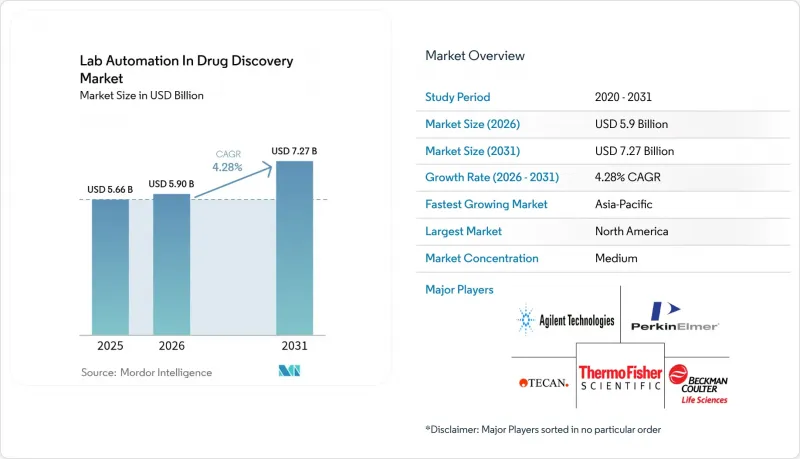
This report is Segmented by Equipment (Automated Liquid Handlers, Automated Plate Handlers, and More), Application (Target Identification and Validation, Hit-To-Lead, and More), End User (Pharmaceutical Companies, Biotechnology Companies, and More), and Geography (North America, South America, Europe, Asia-Pacific, and More). The Market Forecasts are Provided in Terms of Value (USD).
Global Lab Automation In Drug Discovery Market Trends and Insights
Rapid Miniaturization and HTS Platforms
High-throughput screening now reaches daily volumes of over 100,000 compounds, thanks to miniaturized 1,536- and 3,456-well plates, which cut reagent use by 95% without compromising data quality.Acoustic dispensers deliver sub-microliter precision, and plate handlers equipped with environmental sensors maintain assay integrity under stringent regulatory controls. The technology lowers per-assay cost, broadens library coverage for small molecules, and widens adoption among biotechnology start-ups that once lacked capital for large-footprint robotics. Integrated systems reduce handoffs between sample preparation and analysis, boosting uptime and minimizing the need for manual checks by operators. Regulators in the United States and Europe now accept miniaturized assay results for submission dossiers, removing the last institutional hurdle.
Integration of AI-enabled Analytics
Artificial intelligence converts conventional robots into adaptive research companions that optimize protocols in real time. Platforms such as NVIDIA BioNeMo enable liquid handlers to self-adjust based on historical performance, reducing variance by up to 40% while flagging anomalies before data review. Predictive maintenance algorithms equally shrink unplanned downtime, extending annual productive hours. In parallel, deep-learning engines sift through screening outputs to auto-rank hits, trimming hit-to-lead timelines by roughly 30%.
High CAPEX for SMEs
Comprehensive automation lines cost over USD 2 million, a threshold beyond the reach of many biotech start-ups despite proven paybacks. Leasing and robotics-as-a-service schemes have emerged, yet stiff credit checks and multi-year commitments still deter early-stage firms. Regional banks offer targeted loans, but limited quotas leave demand unmet.
Other drivers and restraints analyzed in the detailed report include:
- Chronic-disease Research and Devlopment Spending Up-cycle
- Demand for Faster Time-to-clinic
- Legacy-software Interoperability Gaps
For complete list of drivers and restraints, kindly check the Table Of Contents.
Segment Analysis
Automated liquid handlers accounted for 31.05% of the 2025 expenditure, underscoring their centrality in nearly every screen and assay. Continuous improvements in acoustic dispensing now enable sub-microliter transfers that safeguard expensive reagents while preserving analytical precision. Vendors embed AI dashboards, allowing operators to fine-tune protocols based on historical error trends. As laboratories extend operating hours, uptime and tip economy become decisive buying factors. Parallel innovation in contactless cleaning lowers cross-contamination risk and reduces consumable budgets.
Automated storage and retrieval systems, although smaller in base, represent the fastest-growing cluster with a 5.45% CAGR. Multi-temperature towers integrate barcode verification and chain-of-custody logging that satisfy FDA audit trails. Modular footprints let mature facilities add capacity without disrupting workflows, and cloud dashboards issue predictive maintenance alerts that prevent costly downtime. Looking ahead, hybrid systems that co-locate cryogenic and ambient racks in a single aisle are expected to yield further utilization gains.
Complete Report Scope:
- By Equipment
- Automated Liquid Handlers
- Automated Plate Handlers
- Robotic Arms
- Automated Storage and Retrieval Systems
- Analyzers
- By Application
- Target Identification and Validation
- Hit-to-Lead
- Lead Optimisation
- High-Throughput Screening
- ADME-Tox Studies
- By End User
- Pharmaceutical Companies
- Biotechnology Companies
- Contract Research Organisations (CROs)
- Academic and Government Labs
- By Geography
- North America
- United States
- Canada
- Mexico
- South America
- Brazil
- Argentina
- Rest of South America
- Europe
- Germany
- United Kingdom
- France
- Italy
- Spain
- Russia
- Rest of Europe
- Asia-Pacific
- China
- Japan
- India
- South Korea
- South-East Asia
- Rest of Asia-Pacific
- Middle East and Africa
- North America
Geography Analysis
North America accounted for 34.20% of global revenue in 2025 and remains the largest market for advanced platforms. The United States leads through sustained National Institutes of Health grants that modernize shared-core facilities, while Canada's research clusters in Ontario and Quebec favor modular robotics that fit in retrofit labs. Mexico's manufacturing corridors now produce subassemblies for U.S. and European vendors, streamlining cross-border supply.
Europe follows with robust adoption in Germany, the United Kingdom, and Switzerland. Sustainability rules drive the rapid uptake of microfluidic cartridges, which slash solvent use by 90% compared with legacy plates. Horizon Europe grants support multi-institutional automation projects, and the European Medicines Agency's data-integrity guidance positions automated audit trails as a standard practice, spurring repeat orders for laboratory information management upgrades.
The Asia-Pacific region grows at the fastest rate of 5.62% CAGR, driven by substantial public investment. China has earmarked a significant portion for automated labs that align with its "Made in China 2025" strategy, while India's CRDMO sector is scaling into double digits as Western sponsors shift preclinical briefs eastward. Japan and South Korea add momentum by integrating AI layers into established robotic lines, ensuring global alignment on quality. Regional regulators streamline standards through ASEAN harmonization, simplifying cross-border deployments and fueling multinational rollout plans.
- Thermo Fisher Scientific Inc.
- Beckman Coulter Life Sciences
- Hudson Robotics Inc.
- Becton, Dickinson and Company
- MolGen B.V.
- Agilent Technologies Inc.
- Siemens Healthineers AG
- Tecan Group AG
- PerkinElmer Inc.
- Bio-Rad Laboratories Inc.
- F. Hoffmann-La Roche AG
- Eppendorf SE
- Shimadzu Corporation
- Aurora Biomed Inc.
- Hamilton Company
- HighRes Biosolutions Inc.
- SPT Labtech Ltd.
- Biosero Inc.
- TTP Labtech Holdings
- Automata Tech
- Opentrons Labworks Inc.
- Analytik Jena GmbH
- Andrew Alliance SA
- Arctoris Ltd.
- Labman Automation Ltd.
Additional Benefits:
- The market estimate (ME) sheet in Excel format
- 3 months of analyst support
TABLE OF CONTENTS
1 INTRODUCTION
- 1.1 Study Assumptions and Market Definition
- 1.2 Scope of the Study
2 RESEARCH METHODOLOGY
3 EXECUTIVE SUMMARY
4 MARKET LANDSCAPE
- 4.1 Market Overview
- 4.2 Market Drivers
- 4.2.1 Rapid miniaturisation and HTS platforms
- 4.2.2 Integration of AI-enabled analytics
- 4.2.3 Chronic-disease RandD spending up-cycle
- 4.2.4 Demand for faster time-to-clinic
- 4.2.5 Open-source lab-automation consortia
- 4.2.6 Sustainability-driven micro-fluidics
- 4.3 Market Restraints
- 4.3.1 High CAPEX for SMEs
- 4.3.2 Legacy-software interoperability gaps
- 4.3.3 Supplier back-orders on precision actuators
- 4.3.4 Post-COVID wet-lab talent crunch
- 4.4 Impact of Macroeconomic Factors
- 4.5 Technological Outlook
- 4.6 Regulatory Landscape
- 4.7 Industry Value Chain Analysis
- 4.8 Porter's Five Forces Analysis
- 4.8.1 Bargaining Power of Suppliers
- 4.8.2 Bargaining Power of Buyers
- 4.8.3 Threat of New Entrants
- 4.8.4 Threat of Substitutes
- 4.8.5 Intensity of Rivalry
5 MARKET SIZE AND GROWTH FORECASTS (VALUE)
- 5.1 By Equipment
- 5.1.1 Automated Liquid Handlers
- 5.1.2 Automated Plate Handlers
- 5.1.3 Robotic Arms
- 5.1.4 Automated Storage and Retrieval Systems
- 5.1.5 Analyzers
- 5.2 By Application
- 5.2.1 Target Identification and Validation
- 5.2.2 Hit-to-Lead
- 5.2.3 Lead Optimisation
- 5.2.4 High-Throughput Screening
- 5.2.5 ADME-Tox Studies
- 5.3 By End User
- 5.3.1 Pharmaceutical Companies
- 5.3.2 Biotechnology Companies
- 5.3.3 Contract Research Organisations (CROs)
- 5.3.4 Academic and Government Labs
- 5.4 By Geography
- 5.4.1 North America
- 5.4.1.1 United States
- 5.4.1.2 Canada
- 5.4.1.3 Mexico
- 5.4.2 South America
- 5.4.2.1 Brazil
- 5.4.2.2 Argentina
- 5.4.2.3 Rest of South America
- 5.4.3 Europe
- 5.4.3.1 Germany
- 5.4.3.2 United Kingdom
- 5.4.3.3 France
- 5.4.3.4 Italy
- 5.4.3.5 Spain
- 5.4.3.6 Russia
- 5.4.3.7 Rest of Europe
- 5.4.4 Asia-Pacific
- 5.4.4.1 China
- 5.4.4.2 Japan
- 5.4.4.3 India
- 5.4.4.4 South Korea
- 5.4.4.5 South-East Asia
- 5.4.4.6 Rest of Asia-Pacific
- 5.4.5 Middle East and Africa
- 5.4.1 North America
6 COMPETITIVE LANDSCAPE
- 6.1 Market Concentration
- 6.2 Strategic Moves
- 6.3 Market Share Analysis
- 6.4 Company Profiles (includes Global level Overview, Market level overview, Core Segments, Financials as available, Strategic Information, Market Rank/Share, Products and Services, Recent Developments)
- 6.4.1 Thermo Fisher Scientific Inc.
- 6.4.2 Beckman Coulter Life Sciences
- 6.4.3 Hudson Robotics Inc.
- 6.4.4 Becton, Dickinson and Company
- 6.4.5 MolGen B.V.
- 6.4.6 Agilent Technologies Inc.
- 6.4.7 Siemens Healthineers AG
- 6.4.8 Tecan Group AG
- 6.4.9 PerkinElmer Inc.
- 6.4.10 Bio-Rad Laboratories Inc.
- 6.4.11 F. Hoffmann-La Roche AG
- 6.4.12 Eppendorf SE
- 6.4.13 Shimadzu Corporation
- 6.4.14 Aurora Biomed Inc.
- 6.4.15 Hamilton Company
- 6.4.16 HighRes Biosolutions Inc.
- 6.4.17 SPT Labtech Ltd.
- 6.4.18 Biosero Inc.
- 6.4.19 TTP Labtech Holdings
- 6.4.20 Automata Tech
- 6.4.21 Opentrons Labworks Inc.
- 6.4.22 Analytik Jena GmbH
- 6.4.23 Andrew Alliance SA
- 6.4.24 Arctoris Ltd.
- 6.4.25 Labman Automation Ltd.
7 MARKET OPPORTUNITIES AND FUTURE OUTLOOK
- 7.1 White-space and Unmet-need Assessment

