PUBLISHER: Mordor Intelligence | PRODUCT CODE: 2120530

PUBLISHER: Mordor Intelligence | PRODUCT CODE: 2120530
Europe Smart Office - Market Share Analysis, Industry Trends & Statistics, Growth Forecasts (2026 - 2031)
According to Mordor Intelligence, the Europe smart office market size in 2026 is estimated at USD 4.66 billion, growing from 2025 value of USD 4.04 billion with 2031 projections showing USD 9.45 billion, growing at 15.24% CAGR over 2026-2031.
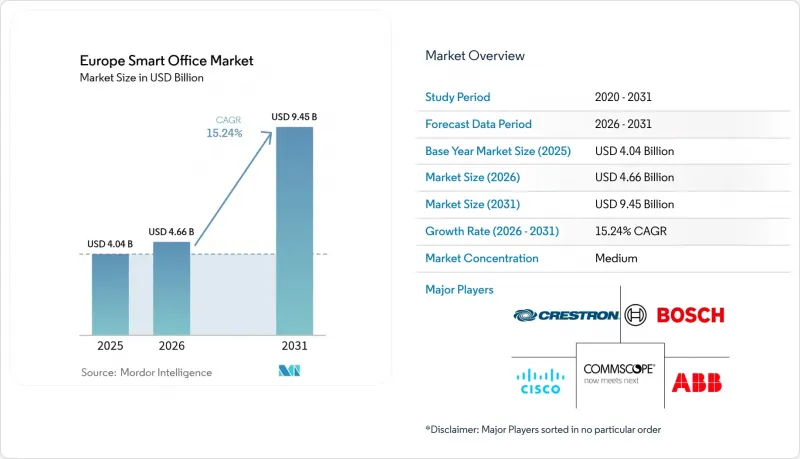
This report is Segmented by Product Type (Security and Access Control Systems, Energy Management Systems, and More), Building Type (Retrofits, and New Buildings), Connectivity Technology (Wired, and Wireless), Offering (Hardware, Software, and Services), End-User Industry (IT and Telecom, BFSI, and More), and Country. The Market Forecasts are Provided in Terms of Value (USD).
Europe Smart Office Market Trends and Insights
Stringent European Union Energy Efficiency Regulations
The 2024 revision of the Energy Performance of Buildings Directive forces every new commercial building to reach zero-emission status by 2030. Germany set aside EUR 14.5 billion (USD 15.5 billion) in retrofit grants that favor AI-driven energy optimization. The directive introduces smart readiness indicators that score a building's response to occupant needs and grid signals, pushing demand for dense sensor networks. France's RE2020 code limits lifecycle carbon, steering developers toward prefabricated modules with embedded controls. Together, these rules replace incremental upgrades with full digital orchestration across lighting, HVAC, and security.
Growing Adoption of Hybrid and Flexible Work Models
Average office footprints shrank 18% between 2020 and 2024, yet daily occupancy swings from 40% to 70% create planning uncertainty. Finance regulators note that 82% of U.K. financial firms now run flexible policies, accelerating hot-desking and analytics investments. Real-time data lets facility teams shut unused floors and trim energy budgets. Activity-based working also demands granular comfort controls that legacy systems lack.
High Upfront Capital Expenditure for Retrofit Projects
Smart office retrofits can cost EUR 150-400 (USD 160-426) per square meter, placing a EUR 1.6 million bill on a 5,000 square-meter site. Italy's generous Superbonus fell from 110% to 70% coverage, slowing activity until fresh deductions arrived. Payback horizons stretching beyond seven years deter smaller landlords, even as European Investment Bank grants remain oversubscribed.
Other drivers and restraints analyzed in the detailed report include:
- Rapid Decline in IoT Sensor and Connectivity Costs
- Integration of Digital Twins for Predictive Workplace Management
- Heightened Data Privacy and Cybersecurity Concerns under GDPR
For complete list of drivers and restraints, kindly check the Table Of Contents.
Segment Analysis
Smart Lighting Systems held 28.12% of Europe Smart Office Market Share in 2025. Europe Smart Office Market Size for workplace analytics is on track to expand at 15.73% CAGR, driven by demand for real-time space data. Microsoft's Viva Insights covers 3,200 locations and links with Azure Digital Twins to offer predictive heatmaps. Security and access systems stay resilient due to growing biometric use. Energy management tools see rising orders as Germany's commercial power price averaged EUR 0.28 (USD 0.30) per kilowatt-hour in 2024.
Hardware advances spur audio-video systems with spatial audio and auto-framing, while fire and safety controls integrate deeper into building networks. Commodity pressure on sensors pushes suppliers toward bundling hardware with analytics subscriptions. The Europe Smart Office Industry continues to emphasize interoperability so that lighting, HVAC, and security data converge in one analytics layer.
Retrofits represented 54.84% of deployments yet face higher labor costs. Europe Smart Office Market Size for new buildings is projected to rise at 16.01% CAGR. Skanska embeds AI-ready building management in every project started after January 2024, adding 3% to cost but earning 8-12% rental premiums. Mass timber structures demand precise humidity control, pushing early adoption of smart sensors.
Retrofit activity remains vast because 70% of offices pre-date 2010 and must meet new efficiency rules. However, unforeseen legacy wiring issues and the need for live-occupied installation prolong payback. Developers increasingly choose smart-enabled rebuilds where local rules allow demolition, especially in Germany, France, and the Nordics.
Complete Report Scope:
- By Product Type
- Security and Access Control Systems
- Energy Management Systems
- Smart HVAC Control Systems
- Smart Lighting Systems
- Audio-Video Conferencing Systems
- Fire and Safety Control Systems
- Smart Sensors
- Workplace Analytics Solutions
- Others
- By Building Type
- Retrofits
- New Buildings
- By Connectivity Technology
- Wired
- Wireless
- Wi-Fi
- Zigbee
- Bluetooth
- Z-Wave
- Thread
- Others
- By Offering
- Hardware
- Sensors
- Controllers and Actuators
- Networking Equipment
- Software
- Building Management Platforms
- Analytics and AI Software
- Services
- Professional Services
- Managed Services
- Hardware
- By End-User Industry
- IT and Telecom
- BFSI
- Healthcare and Life Sciences
- Government and Public Sector
- Manufacturing
- Retail and Hospitality
- Education
- Others
- By Country
- Germany
- United Kingdom
- France
- Italy
- Spain
- Netherlands
- Nordics
- Russia
- Rest of Europe
List of Companies Covered in this Report:
- ABB Ltd.
- Bosch Building Technologies GmbH
- Cisco Systems, Inc.
- CommScope Holding Company, Inc.
- Crestron Electronics, Inc.
- Delta Electronics, Inc.
- Emerson Electric Co.
- Google LLC
- Honeywell International Inc.
- Huawei Technologies Co., Ltd.
- IBM Corporation
- Johnson Controls International plc
- Koninklijke Philips N.V. (Signify)
- Legrand SA
- Lutron Electronics Co., Inc.
- Microsoft Corporation
- Robert Bosch GmbH
- Schneider Electric SE
- Siemens AG
- Sony Group Corporation
- RTX Corporation (formerly United Technologies Corporation)
Additional Benefits:
- The market estimate (ME) sheet in Excel format
- 3 months of analyst support
TABLE OF CONTENTS
1 INTRODUCTION
- 1.1 Study Assumptions and Market Definition
- 1.2 Scope of the Study
2 RESEARCH METHODOLOGY
3 EXECUTIVE SUMMARY
4 MARKET LANDSCAPE
- 4.1 Market Overview
- 4.2 Market Drivers
- 4.2.1 Stringent European Union Energy Efficiency Regulations
- 4.2.2 Growing Adoption of Hybrid and Flexible Work Models
- 4.2.3 Rapid Decline in IoT Sensor and Connectivity Costs
- 4.2.4 Expansion of 5G Private Networks in Commercial Buildings
- 4.2.5 Rising Corporate ESG and Net-Zero Commitments
- 4.2.6 Integration of Digital Twins for Predictive Workplace Management
- 4.3 Market Restraints
- 4.3.1 High Upfront Capital Expenditure for Retrofit Projects
- 4.3.2 Complex Interoperability Across Legacy Building Systems
- 4.3.3 Heightened Data Privacy and Cybersecurity Concerns under GDPR
- 4.3.4 Shortage of Skilled Technicians for Smart Building Deployment
- 4.4 Industry Value / Supply-Chain Analysis
- 4.5 Regulatory Landscape
- 4.6 Technological Outlook
- 4.7 Impact of Macroeconomic Factors on the Market
- 4.8 Porter's Five Forces Analysis
- 4.8.1 Bargaining Power of Suppliers
- 4.8.2 Bargaining Power of Consumers
- 4.8.3 Threat of New Entrants
- 4.8.4 Threat of Substitute Products
- 4.8.5 Intensity of Competitive Rivalry
5 MARKET SIZE AND GROWTH FORECASTS (VALUE)
- 5.1 By Product Type
- 5.1.1 Security and Access Control Systems
- 5.1.2 Energy Management Systems
- 5.1.3 Smart HVAC Control Systems
- 5.1.4 Smart Lighting Systems
- 5.1.5 Audio-Video Conferencing Systems
- 5.1.6 Fire and Safety Control Systems
- 5.1.7 Smart Sensors
- 5.1.8 Workplace Analytics Solutions
- 5.1.9 Others
- 5.2 By Building Type
- 5.2.1 Retrofits
- 5.2.2 New Buildings
- 5.3 By Connectivity Technology
- 5.3.1 Wired
- 5.3.2 Wireless
- 5.3.2.1 Wi-Fi
- 5.3.2.2 Zigbee
- 5.3.2.3 Bluetooth
- 5.3.2.4 Z-Wave
- 5.3.2.5 Thread
- 5.3.2.6 Others
- 5.4 By Offering
- 5.4.1 Hardware
- 5.4.1.1 Sensors
- 5.4.1.2 Controllers and Actuators
- 5.4.1.3 Networking Equipment
- 5.4.2 Software
- 5.4.2.1 Building Management Platforms
- 5.4.2.2 Analytics and AI Software
- 5.4.3 Services
- 5.4.3.1 Professional Services
- 5.4.3.2 Managed Services
- 5.4.1 Hardware
- 5.5 By End-User Industry
- 5.5.1 IT and Telecom
- 5.5.2 BFSI
- 5.5.3 Healthcare and Life Sciences
- 5.5.4 Government and Public Sector
- 5.5.5 Manufacturing
- 5.5.6 Retail and Hospitality
- 5.5.7 Education
- 5.5.8 Others
- 5.6 By Country
- 5.6.1 Germany
- 5.6.2 United Kingdom
- 5.6.3 France
- 5.6.4 Italy
- 5.6.5 Spain
- 5.6.6 Netherlands
- 5.6.7 Nordics
- 5.6.8 Russia
- 5.6.9 Rest of Europe
6 COMPETITIVE LANDSCAPE
- 6.1 Market Concentration
- 6.2 Strategic Moves
- 6.3 Market Share Analysis
- 6.4 Company Profiles (includes Global Level Overview, Market Level Overview, Core Segments, Financials as Available, Strategic Information, Market Rank/Share for Key Companies, Products and Services, and Recent Developments)
- 6.4.1 ABB Ltd.
- 6.4.2 Bosch Building Technologies GmbH
- 6.4.3 Cisco Systems, Inc.
- 6.4.4 CommScope Holding Company, Inc.
- 6.4.5 Crestron Electronics, Inc.
- 6.4.6 Delta Electronics, Inc.
- 6.4.7 Emerson Electric Co.
- 6.4.8 Google LLC
- 6.4.9 Honeywell International Inc.
- 6.4.10 Huawei Technologies Co., Ltd.
- 6.4.11 IBM Corporation
- 6.4.12 Johnson Controls International plc
- 6.4.13 Koninklijke Philips N.V. (Signify)
- 6.4.14 Legrand SA
- 6.4.15 Lutron Electronics Co., Inc.
- 6.4.16 Microsoft Corporation
- 6.4.17 Robert Bosch GmbH
- 6.4.18 Schneider Electric SE
- 6.4.19 Siemens AG
- 6.4.20 Sony Group Corporation
- 6.4.21 RTX Corporation (formerly United Technologies Corporation)
7 MARKET OPPORTUNITIES AND FUTURE OUTLOOK
- 7.1 White-Space and Unmet-Need Assessment

