PUBLISHER: Mordor Intelligence | PRODUCT CODE: 2120733

PUBLISHER: Mordor Intelligence | PRODUCT CODE: 2120733
Smart Office - Market Share Analysis, Industry Trends & Statistics, Growth Forecasts (2026 - 2031)
According to Mordor Intelligence, the smart office market size in 2026 is estimated at USD 66.52 billion, growing from 2025 value of USD 58.65 billion with 2031 projections showing USD 124.83 billion, growing at 13.42% CAGR over 2026-2031.
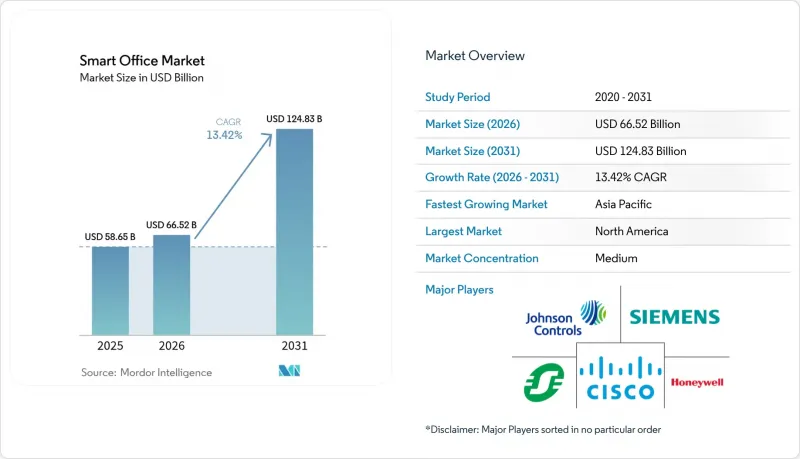
This report is Segmented by Product (Security and Access Control Systems, Energy Management Systems, Smart HVAC Control Systems, and More), Component (Hardware, Software Platforms, Services), Building Type (Retrofits, New Buildings), Connectivity Technology (Wi-Fi, Bluetooth Low Energy, Zigbee and Thread, Wired Ethernet/PoE, Cellular), and Geography. The Market Forecasts are Provided in Terms of Value (USD).
Global Smart Office Market Trends and Insights
Growing Hybrid and Flexible Working Models
Hybrid work is now the default operating model for large employers, raising demand for real-time occupancy analytics that match HVAC and lighting output to headcount. In 2024, 68% of Fortune 500 companies used flexible seating, up from 41% in 2020.Reduced occupancy has pushed landlords to install granular monitoring that demonstrates efficiency to tenants and supports premium rents. Properties with certified smart-building credentials captured lease rates 8-12% above non-instrumented peers. The shift accelerates cloud-based building-management adoption that integrates with collaboration tools to synchronize cleaning, HVAC setpoints, and room availability.
Increasing Focus on Energy Efficiency and Sustainability Mandates
Climate policy has become the most durable demand driver. The EU's Energy Performance of Buildings Directive recast mandates zero-emission status for new non-residential buildings by 2028 and sets renovation targets for 42% of existing stock by 2033. Germany requires an automation class B for buildings over 1,000 m2. California's 2024 Title 24 update requires fault detection in HVAC systems exceeding 54,000 BTU/h. South Korea's expanded certification scope covers all commercial properties over 3,000 m2. Such rules create a compliance floor that insulates the smart office market from macro cycles.
Security Concerns Relating to IoT Devices and Data
Intrusions into building-automation networks increased, with 37 confirmed incidents reported in the United States alone in 2023. The EU's NIS2 directive classifies large commercial buildings as essential entities, imposing audit obligations that can exceed EUR 200,000 per year. Data-residency rules compel vendors to localize their cloud infrastructure, which can fragment service delivery and increase operating costs, particularly for tenants in financial services and healthcare.
Other drivers and restraints analyzed in the detailed report include:
- Declining IoT Sensor and Connectivity Module Prices
- AI-Based Space Utilization Optimization
- High Retrofit Costs for Legacy Buildings
For complete list of drivers and restraints, kindly check the Table Of Contents.
Segment Analysis
Energy-management platforms accounted for 28.82% of 2025 revenue, the largest slice of the smart office market share. Demand-response incentives of USD 50-150 per curtailed kilowatt make participation financially attractive, and Johnson Controls reported 2 GW of commercial load enrolled under its OpenBlue platform in 2024. Smart HVAC controls are projected to expand at a 14.28% CAGR, the fastest among all products, aided by refrigerant phasedowns that trigger equipment upgrades compatible with lower global warming potential (GWP) gases. Security and access systems continue to benefit from the adoption of biometric and zero-trust technologies in regulated sectors. Fire and safety controls are incorporating NFPA 72-compliant wireless supervision, while smart lighting gains momentum through utility-backed LED rebate schemes that shorten paybacks to under 18 months.
Incremental demand is now tied to measurable outcomes, not just hardware counts. Energy dashboards that demonstrate kilowatt-hour savings help landlords justify premium service fees, and predictive maintenance modules embedded in HVAC controllers reduce unplanned downtime, which historically eroded tenant satisfaction. Combined, these factors solidify energy management and HVAC as twin growth engines within the larger smart office market.
Hardware held 45.76% of 2025 revenue as sensors, controllers, and edge gateways remain foundational to any deployment. Services, however, are forecast to grow at a 14.57% CAGR, outpacing hardware as owners pivot toward outcome-based contracts. Schneider Electric's EcoStruxure crossed 1 million connected devices in 2024, embedding ML models that optimize chiller staging without manual intervention. The smart office market size allocated to managed services is expanding as integrators package hardware, cloud licenses, and continuous commissioning into multi-year agreements.
Complexity fuels this service uptick. A typical enterprise footprint incorporates 8-12 discrete system categories, and few facility teams have the expertise to harmonize protocols across HVAC, lighting, metering, and conferencing. Systems integrators now carry performance risk, guaranteeing kilowatt-hour reductions or uptime, and recuperate costs through recurring fees that convert capex into opex. Meanwhile, hardware commoditization continues, but edge devices that host AI inference locally maintain pricing power due to latency and data-sovereignty needs.
Complete Report Scope:
- By Product
- Security and Access Control Systems
- Energy Management Systems
- Smart HVAC Control Systems
- Audio-Video Conferencing Systems
- Fire and Safety Control Systems
- Other Products
- By Component
- Hardware
- Software Platforms
- Services (Integration, Managed, Consulting)
- By Building Type
- Retrofits
- New Buildings
- By Connectivity Technology
- Wi-Fi
- Bluetooth Low Energy (BLE)
- Zigbee and Thread
- Wired Ethernet / PoE
- Cellular (4G/5G)
- By Geography
- North America
- United States
- Canada
- South America
- Brazil
- Mexico
- Rest of South America
- Europe
- Germany
- United Kingdom
- France
- Spain
- Italy
- Rest of Europe
- Asia Pacific
- China
- India
- Japan
- Australia
- South Korea
- Rest of Asia Pacific
- Middle East and Africa
- Middle East
- Saudi Arabia
- United Arab Emirates
- Qatar
- Turkey
- Rest of Middle East
- Africa
- South Africa
- Nigeria
- Kenya
- Rest of Africa
- Middle East
- North America
Geography Analysis
North America generated 36.12% of 2025 revenue and retains the largest smart office market share due to mature commercial real estate inventory, stringent coastal energy codes, and tenant demand for WELL and LEED certifications. Growth moderates to high single digits as the installed base deepens, but retrofit volume remains resilient thanks to New York's carbon fines and California's Title 24 updates. Federal tax incentives for high-efficiency HVAC under the Inflation Reduction Act further support ROI models, especially for campuses that pair heat-pump retrofits with solar power purchase agreements.
Asia Pacific is projected to record a 14.05% CAGR, the fastest regional pace, underpinned by China's expansion of its Three-Star Green Building Standard to all public buildings over 20,000 m2. India's Smart Cities Mission continues to funnel capital toward connected infrastructure in Pune, Surat, and Ahmedabad, while Japan subsidizes up to 50% of BEMS installations for SMEs. The Middle East follows with gigascale projects, such as Saudi Arabia's NEOM, which stipulates 100% renewable power and AI-driven building control, creating showcase opportunities for global vendors.
Europe sits between these poles. The Energy Performance of Buildings Directive imposes binding renovation quotas that pull forward demand for building automation, and Germany's subsidy programs cover up to 40% of retrofit outlays. However, inflationary pressure and higher cost of capital temper volume, particularly in Southern Europe where real-estate yields remain compressed. South America grows modestly as multinationals enforce corporate sustainability standards on regional headquarters, but financing and technical-skills gaps slow uptake outside Sao Paulo, Mexico City, and Santiago.
- Johnson Controls International plc
- Cisco Systems Inc.
- Carrier Global Corporation
- Siemens AG
- Schneider Electric SE
- Koninklijke Philips N.V.
- Honeywell International Inc.
- ABB Ltd.
- Lutron Electronics Co. Inc.
- Crestron Electronics Inc.
- Legrand SA
- CommScope Holding Company Inc.
- Delta Electronics Inc.
- Huawei Technologies Co. Ltd.
- Google LLC (Google Nest for Enterprise)
- Samsung Electronics Co. Ltd.
- Somfy SA
- Hubbell Incorporated
- Eaton Corporation plc
- Axis Communications AB
- Advantech Co. Ltd.
- Telit Cinterion GmbH
- Avnet Inc. (IoT Solutions)
- PointGrab Ltd.
Additional Benefits:
- The market estimate (ME) sheet in Excel format
- 3 months of analyst support
TABLE OF CONTENTS
1 INTRODUCTION
- 1.1 Study Assumptions and Market Definition
- 1.2 Scope of the Study
2 RESEARCH METHODOLOGY
3 EXECUTIVE SUMMARY
4 MARKET LANDSCAPE
- 4.1 Market Overview
- 4.2 Market Drivers
- 4.2.1 Growing Hybrid and Flexible Working Models
- 4.2.2 Increasing Focus on Energy Efficiency and Sustainability Mandates
- 4.2.3 Declining IoT Sensor and Connectivity Module Prices
- 4.2.4 Workplace Wellness and Indoor-Air-Quality Regulations
- 4.2.5 AI-Based Space Utilization Optimization
- 4.2.6 Government-Backed Smart Building Initiatives
- 4.3 Market Restraints
- 4.3.1 Security Concerns Relating to IoT Devices and Data
- 4.3.2 High Retrofit Costs for Legacy Buildings
- 4.3.3 Inter-operability Gaps Across Vendor Ecosystems
- 4.3.4 Slow Decision Cycles in Commercial Real-Estate
- 4.4 Industry Value Chain Analysis
- 4.5 Impact of Macroeconomic Factors on the Market
- 4.6 Regulatory Landscape
- 4.7 Technological Outlook
- 4.8 Porter's Five Forces Analysis
- 4.8.1 Bargaining Power of Suppliers
- 4.8.2 Bargaining Power of Buyers
- 4.8.3 Threat of New Entrants
- 4.8.4 Threat of Substitute Products
- 4.8.5 Intensity of Competitive Rivalry
5 MARKET SIZE AND GROWTH FORECASTS (VALUE)
- 5.1 By Product
- 5.1.1 Security and Access Control Systems
- 5.1.2 Energy Management Systems
- 5.1.3 Smart HVAC Control Systems
- 5.1.4 Audio-Video Conferencing Systems
- 5.1.5 Fire and Safety Control Systems
- 5.1.6 Other Products
- 5.2 By Component
- 5.2.1 Hardware
- 5.2.2 Software Platforms
- 5.2.3 Services (Integration, Managed, Consulting)
- 5.3 By Building Type
- 5.3.1 Retrofits
- 5.3.2 New Buildings
- 5.4 By Connectivity Technology
- 5.4.1 Wi-Fi
- 5.4.2 Bluetooth Low Energy (BLE)
- 5.4.3 Zigbee and Thread
- 5.4.4 Wired Ethernet / PoE
- 5.4.5 Cellular (4G/5G)
- 5.5 By Geography
- 5.5.1 North America
- 5.5.1.1 United States
- 5.5.1.2 Canada
- 5.5.2 South America
- 5.5.2.1 Brazil
- 5.5.2.2 Mexico
- 5.5.2.3 Rest of South America
- 5.5.3 Europe
- 5.5.3.1 Germany
- 5.5.3.2 United Kingdom
- 5.5.3.3 France
- 5.5.3.4 Spain
- 5.5.3.5 Italy
- 5.5.3.6 Rest of Europe
- 5.5.4 Asia Pacific
- 5.5.4.1 China
- 5.5.4.2 India
- 5.5.4.3 Japan
- 5.5.4.4 Australia
- 5.5.4.5 South Korea
- 5.5.4.6 Rest of Asia Pacific
- 5.5.5 Middle East and Africa
- 5.5.5.1 Middle East
- 5.5.5.1.1 Saudi Arabia
- 5.5.5.1.2 United Arab Emirates
- 5.5.5.1.3 Qatar
- 5.5.5.1.4 Turkey
- 5.5.5.1.5 Rest of Middle East
- 5.5.5.2 Africa
- 5.5.5.2.1 South Africa
- 5.5.5.2.2 Nigeria
- 5.5.5.2.3 Kenya
- 5.5.5.2.4 Rest of Africa
- 5.5.5.1 Middle East
- 5.5.1 North America
6 COMPETITIVE LANDSCAPE
- 6.1 Market Concentration
- 6.2 Strategic Moves
- 6.3 Market Share Analysis
- 6.4 Company Profiles (includes Global Level Overview, Market Level Overview, Core Segments, Financials as Available, Strategic Information, Market Rank/Share for Key Companies, Products and Services, and Recent Developments)
- 6.4.1 Johnson Controls International plc
- 6.4.2 Cisco Systems Inc.
- 6.4.3 Carrier Global Corporation
- 6.4.4 Siemens AG
- 6.4.5 Schneider Electric SE
- 6.4.6 Koninklijke Philips N.V.
- 6.4.7 Honeywell International Inc.
- 6.4.8 ABB Ltd.
- 6.4.9 Lutron Electronics Co. Inc.
- 6.4.10 Crestron Electronics Inc.
- 6.4.11 Legrand SA
- 6.4.12 CommScope Holding Company Inc.
- 6.4.13 Delta Electronics Inc.
- 6.4.14 Huawei Technologies Co. Ltd.
- 6.4.15 Google LLC (Google Nest for Enterprise)
- 6.4.16 Samsung Electronics Co. Ltd.
- 6.4.17 Somfy SA
- 6.4.18 Hubbell Incorporated
- 6.4.19 Eaton Corporation plc
- 6.4.20 Axis Communications AB
- 6.4.21 Advantech Co. Ltd.
- 6.4.22 Telit Cinterion GmbH
- 6.4.23 Avnet Inc. (IoT Solutions)
- 6.4.24 PointGrab Ltd.
7 MARKET OPPORTUNITIES AND FUTURE OUTLOOK
- 7.1 White-Space and Unmet-Need Assessment

