PUBLISHER: Mordor Intelligence | PRODUCT CODE: 2120553

PUBLISHER: Mordor Intelligence | PRODUCT CODE: 2120553
North America Hemodynamic Monitoring - Market Share Analysis, Industry Trends & Statistics, Growth Forecasts (2026 - 2031)
According to Mordor Intelligence, the North America hemodynamic monitoring market size is expected to increase from USD 674.42 million in 2025 to USD 705.85 million in 2026 and reach USD 934.07 million by 2031, growing at a CAGR of 5.76% over 2026-2031.
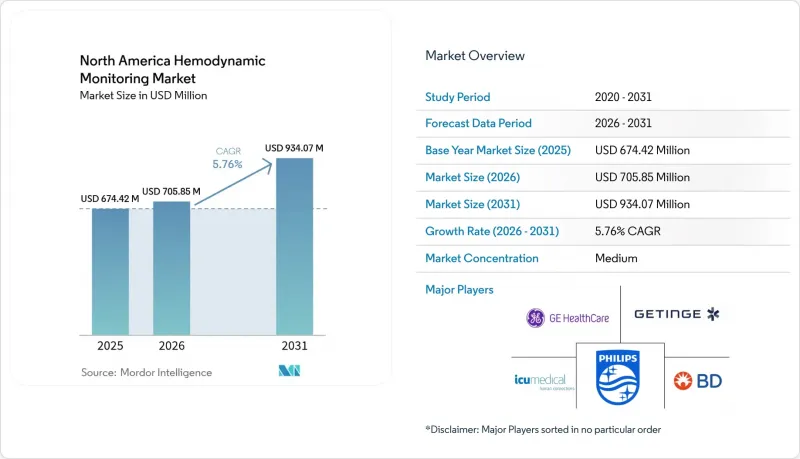
This report is Segmented by Product Type (Invasive, Minimally Invasive, Non-Invasive Systems), Component (Monitors, Sensors, Disposables, Software, Services), Application (Cardiac Surgery, and More), Monitoring Parameter (Cardiac Output, and More), End User (Hospitals, and More), and Geography (United States, Canada, Mexico). Market Forecasts are Provided in Value (USD).
North America Hemodynamic Monitoring Market Trends and Insights
Rising Cardiovascular & Critical-Care Caseload
Heart disease caused 702,880 U.S. deaths in 2022, and 6.7 million adults lived with heart failure in 2024; projections place the cohort at 8.7 million by 2030, extending ICU stays and favoring sensors that remain in-situ for days without infection risks.[1] Sepsis guidelines that mandate hemodynamic assessment within one hour further load ICUs, accelerating demand for pulse-contour and bioreactance monitors.
Advances in Minimally Invasive Monitoring Technologies
Fourth-generation FloTrac algorithms cleared in 2025 employ machine-learning corrections that narrow error margins during vasoplegic shock, while esophageal Doppler gained U.S. endorsement for guiding fluid therapy in major surgery. Vendors that bundle sensors with cloud-connected decision support are displacing standalone hardware as clinicians prioritize workflow integration.
High Capital & Consumable Costs
A fully configured HemoSphere unit costs USD 35,000-50,000, and a 20-bed ICU may invest up to USD 600,000 before disposables; smaller hospitals struggle to justify this outlay, while Mexico's IMSS budgets only USD 12,000 per ICU bed for all monitoring gear.
Other drivers and restraints analyzed in the detailed report include:
- Rapidly Growing Elderly Population
- Favorable U.S. Reimbursement Policies
- Procedure-Related Infection & Complication Risks
For complete list of drivers and restraints, kindly check the Table Of Contents.
Segment Analysis
Minimally invasive systems held 44.56% of 2025 revenue, anchored by pulse-contour and esophageal Doppler devices that avoid pulmonary-artery catheterization while supplying beat-to-beat data. However, non-invasive platforms are growing at an 8.46% CAGR through 2031 as tele-ICU models favor sensors that work without arterial lines. The North America hemodynamic monitoring market size for non-invasive platforms is expected to expand steadily under this momentum. Wearable patches under development correlate strongly with arterial-line measurements, suggesting future clearance will accelerate bedside replacement of invasive hardware.
The North America hemodynamic monitoring market share commanded by invasive catheters persists in complex cardiac cases, yet FDA approval of the Cordella pulmonary-artery sensor in 2024 validated ambulatory hemodynamics and pressured bedside-monitor vendors to match home-care capabilities. Vendors that integrate cloud connectivity, predictive analytics, and minimal consumable requirements are positioned to capture the next wave of procurement.
Monitors delivered 34.72% of 2025 component revenue, but software and data-management suites are advancing at a 9.25% CAGR, the quickest component trajectory. Hospitals regard predictive algorithms that alert clinicians 15 minutes before hypotension as essential rather than optional, redefining purchasing criteria. Open APIs that welcome third-party sepsis or ventilator-weaning algorithms differentiate platforms and encourage ecosystem stickiness.
Sensors and disposables still underpin recurring revenue, yet price pressure mounts as hospitals scrutinize total cost of ownership. The North America hemodynamic monitoring market size attributed to services remains stable because multi-year maintenance contracts accompany every capital sale. Vendors now emphasize analytic-software subscriptions to lock in annuity streams and offset hardware commoditization.
Complete Report Scope:
- By Product Type
- Invasive Hemodynamic Monitoring Systems
- Catheters
- Pressure Transducers
- Consumables (pressure tubing, flush sets, etc.)
- Minimally-Invasive Hemodynamic Monitoring Systems
- Pulse-Contour Analysis Devices
- Esophageal Doppler Monitors
- Non-Invasive Hemodynamic Monitoring Systems
- Impedance/ Bioreactance Cardiology Systems
- Wearable Continuous-BP & CO Patch Sensors
- Invasive Hemodynamic Monitoring Systems
- By Component
- Monitors
- Sensors / Transducers
- Disposables & Accessories
- Software and Platforms
- Services
- By Application
- Cardiac Surgery
- General & Orthopedic Surgery
- Interventional Cardiology
- Trauma & Emergency Care
- Sepsis and Septic Shock Management
- By Monitoring Parameter
- Cardiac Output & Derived Indices (CI, SV, SVV, PPV)
- Continuous Blood Pressure (ART/NIBP)
- Volume Status / Fluid Responsiveness Metrics
- Tissue Oxygenation (StO2, rSO2)
- By End User
- Hospitals
- Ambulatory Surgical Centers
- Home-Care Providers
- Specialty Cardiology & Critical-Care Clinics
- By Country
- United States
- Canada
- Mexico
List of Companies Covered in this Report:
- Baxter (Cheetah Medical)
- CNSystems Medizintechnik
- Deltex Medical
- Dragerwerk
- Edward Lifesciences
- GE Healthcare
- Getinge (Pulsion)
- ICU Medical
- Koninklijke Philips
- Lepu Medical
- LiDCO (Spacelabs)
- Masimo
- Mindray Bio-Medical
- Nihon Kohden
- Schwarzer Cardiotek
- Tensys Medical
Additional Benefits:
- The market estimate (ME) sheet in Excel format
- 3 months of analyst support
TABLE OF CONTENTS
1 Introduction
- 1.1 Study Assumptions & Market Definition
- 1.2 Scope of the Study
2 Research Methodology
3 Executive Summary
4 Market Landscape
- 4.1 Market Overview
- 4.2 Market Drivers
- 4.2.1 Rising Cardiovascular & Critical-Care Caseload
- 4.2.2 Advances in Minimally Invasive Monitoring Technologies
- 4.2.3 Rapidly Growing Elderly Population
- 4.2.4 Favorable U.S. Reimbursement for Invasive & Minimally Invasive Procedures
- 4.2.5 AI-Guided Fluid-Management Analytics Gaining Traction
- 4.2.6 Expansion of Tele-ICU Platforms Adopting Continuous Non-Invasive Monitors
- 4.3 Market Restraints
- 4.3.1 High Capital & Consumable Costs of Advanced Systems
- 4.3.2 Procedure-Related Infection & Complication Risks
- 4.3.3 Clinician Alarm-Fatigue & Waveform Data Overload
- 4.3.4 Shortage of Waveform-Interpretation-Skilled Critical-Care Nurses
- 4.4 Value / Supply-Chain Analysis
- 4.5 Regulatory Landscape
- 4.6 Technological Outlook
- 4.7 Porter's Five Forces Analysis
- 4.7.1 Threat of New Entrants
- 4.7.2 Bargaining Power of Suppliers
- 4.7.3 Bargaining Power of Buyers
- 4.7.4 Threat of Substitutes
- 4.7.5 Intensity of Competitive Rivalry
5 Market Size & Growth Forecasts (Value in USD)
- 5.1 By Product Type
- 5.1.1 Invasive Hemodynamic Monitoring Systems
- 5.1.1.1 Catheters
- 5.1.1.2 Pressure Transducers
- 5.1.1.3 Consumables (pressure tubing, flush sets, etc.)
- 5.1.2 Minimally-Invasive Hemodynamic Monitoring Systems
- 5.1.2.1 Pulse-Contour Analysis Devices
- 5.1.2.2 Esophageal Doppler Monitors
- 5.1.3 Non-Invasive Hemodynamic Monitoring Systems
- 5.1.3.1 Impedance/ Bioreactance Cardiology Systems
- 5.1.3.2 Wearable Continuous-BP & CO Patch Sensors
- 5.1.1 Invasive Hemodynamic Monitoring Systems
- 5.2 By Component
- 5.2.1 Monitors
- 5.2.2 Sensors / Transducers
- 5.2.3 Disposables & Accessories
- 5.2.4 Software and Platforms
- 5.2.5 Services
- 5.3 By Application
- 5.3.1 Cardiac Surgery
- 5.3.2 General & Orthopedic Surgery
- 5.3.3 Interventional Cardiology
- 5.3.4 Trauma & Emergency Care
- 5.3.5 Sepsis and Septic Shock Management
- 5.4 By Monitoring Parameter
- 5.4.1 Cardiac Output & Derived Indices (CI, SV, SVV, PPV)
- 5.4.2 Continuous Blood Pressure (ART/NIBP)
- 5.4.3 Volume Status / Fluid Responsiveness Metrics
- 5.4.4 Tissue Oxygenation (StO2, rSO2)
- 5.5 By End User
- 5.5.1 Hospitals
- 5.5.2 Ambulatory Surgical Centers
- 5.5.3 Home-Care Providers
- 5.5.4 Specialty Cardiology & Critical-Care Clinics
- 5.6 By Country
- 5.6.1 United States
- 5.6.2 Canada
- 5.6.3 Mexico
6 Competitive Landscape
- 6.1 Market Concentration
- 6.2 Market Share Analysis
- 6.3 Company Profiles (includes Global level Overview, Market level overview, Core Segments, Financials as available, Strategic Information, Market Rank/Share for key companies, Products and Services, and Recent Developments)
- 6.3.1 Baxter (Cheetah Medical)
- 6.3.2 CNSystems Medizintechnik
- 6.3.3 Deltex Medical
- 6.3.4 Draegerwerk
- 6.3.5 Edwards Lifesciences
- 6.3.6 GE HealthCare
- 6.3.7 Getinge (Pulsion)
- 6.3.8 ICU Medical
- 6.3.9 Koninklijke Philips N.V.
- 6.3.10 Lepu Medical
- 6.3.11 LiDCO (Spacelabs)
- 6.3.12 Masimo Corporation
- 6.3.13 Mindray Bio-Medical
- 6.3.14 Nihon Kohden
- 6.3.15 Schwarzer Cardiotek
- 6.3.16 Tensys Medical
7 Market Opportunities & Future Outlook
- 7.1 White-space & Unmet-Need Assessment

