PUBLISHER: Mordor Intelligence | PRODUCT CODE: 2120611

PUBLISHER: Mordor Intelligence | PRODUCT CODE: 2120611
North America Process Automation - Market Share Analysis, Industry Trends & Statistics, Growth Forecasts (2026 - 2031)
According to Mordor Intelligence, the North America process automation market size is projected to expand from USD 40.60 billion in 2025 and USD 41.77 billion in 2026 to USD 47.94 billion by 2031, registering a CAGR of 2.79% between 2026 to 2031.
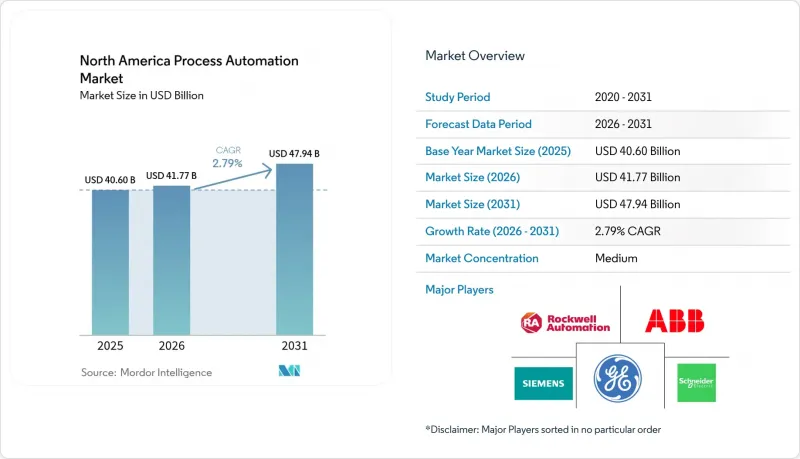
This report is Segmented by Communication Protocol (Wired, and Wireless), System Type (Hardware, and Software), Component (Hardware, Software, and Services), Deployment Mode (On-Premises, and Cloud and Edge), End-User Industry (Oil and Gas, Chemical and Petrochemical, Power and Utilities, Water and Wastewater, and More), and Geography. The Market Forecasts are Provided in Terms of Value (USD).
North America Process Automation Market Trends and Insights
Rising Focus on Energy-Efficiency and OpEx Reduction
Process manufacturers are recasting automation as an emissions-cutting tool. The U.S. Department of Energy's 2024 Industrial Decarbonization Roadmap outlines a 10%-15% reduction target for industrial energy intensity by 2030, prioritizing advanced process control and real-time optimization for chemical and refining assets. Canadian oil-sands operators face a legislated carbon price of CAD 170 per tonne by 2030, prompting the rollout of edge analytics that adjust combustion-air ratios and feedwater chemistry inside steam generators, trimming natural-gas use by up to 5% per barrel of synthetic crude. Payback periods under 18 months have been documented at Gulf Coast facilities that fine-tune distillation and heat-exchanger networks through multivariable controllers. These early wins are steering 2026 capital budgets toward digital debottlenecking rather than pure capacity expansions.
Heightened Demand for Safety-Instrumented Systems
A string of refinery and chemical-plant incidents in 2024-2025 elevated regulatory scrutiny. The U.S. Chemical Safety and Hazard Investigation Board linked several fires to inadequate safety-integrity-level verification, spurring retrofits of pneumatic trip systems with smart positioners that enable online diagnostics. Compliance with OSHA Process Safety Management now requires documented proof tests, driving purchases of integrated safety controllers that interface with existing DCS networks through secure OPC-UA gateways. Vendors report double-digit order growth for safety PLCs as pharmaceutical and food processors adopt the same architectures to satisfy sterile-fill and allergen-control mandates.
High Upfront CapEx and Integration Complexity
Comprehensive migrations from proprietary DCS platforms can exceed USD 50 million per site, a sum that clashes with payback horizons demanded by corporate finance teams. An American Fuel and Petrochemical Manufacturers survey found that 62% of refineries defer cloud historians because of cutover risks and the need for dual operations during commissioning. Brownfield plants often rely on legacy fieldbus networks that necessitate costly protocol converters when interfacing with modern edge devices, stretching project timelines to seven years when tackled in phased turnarounds.
Other drivers and restraints analyzed in the detailed report include:
- Proliferation of Industrial IoT Platforms
- Shift Toward Predictive and Prescriptive Maintenance Analytics
- Operational Cybersecurity Talent Deficit
For complete list of drivers and restraints, kindly check the Table Of Contents.
Segment Analysis
Wired networks held 61.19% of North America process automation market share in 2025. Their dominance stems from entrenched HART, PROFIBUS, and Foundation Fieldbus loops that anchor safety-critical interlocks and high-speed controls. WirelessHART and ISA100.11a devices, however, are forecast to expand at a 3.11% CAGR as intrinsic-safety-certified transmitters allow deployment inside Class I Division 1 areas, eliminating conduit runs that can cost USD 3,000 per meter. Shell's Norco refinery used 400 wireless transmitters to cut installation labour by 60% while maintaining 99.5% packet reliability. In parallel, edge gateways normalize wired and wireless data so that predictive algorithms detect sensor drift regardless of medium. Regulatory updates to NFPA 70 have formalized this coexistence by permitting wireless devices where risk assessments validate signal integrity.
Wired links remain indispensable for emergency shutdown valves, burner-management systems, and compressor anti-surge controls because IEC 61511 demands deterministic latency. Consequently, the North America process automation market retains a hybrid topology in which wireless augments, rather than replaces, critical hardwired loops. Project teams now model radio-frequency propagation in 3-D digital twins to pre-empt interference before issuing hot-work permits.
Hardware generated 58.43% of 2025 revenue, yet software is projected to register the leading 3.56% CAGR through 2031. Open-standard controllers running on commercial off-the-shelf hardware are eroding the pricing power of proprietary DCS cabinets. Subscription-based advanced process control suites mean operators can unlock new functionality without capital projects, a trend exemplified by pulp and paper mills that deploy multivariable controllers to shave 6% off steam demand. Meanwhile, North America process automation market size for manufacturing execution systems is rising as pharmaceutical firms embrace electronic batch records to comply with FDA data-integrity guidance.
Cyber-hardened SCADA upgrades form a brisk replacement cycle because many midstream pipeline systems still run on unsupported operating systems vulnerable to ransomware. Vendors now package SCADA kernels inside virtual machines hosted on hardened Linux, slashing patch windows and supporting rapid disaster recovery. Smart sensors with embedded diagnostics lengthen calibration intervals, reinforcing the shift from capital equipment toward digital lifecycle services.
Complete Report Scope:
- By Communication Protocol
- Wired
- Wireless
- By System Type
- Hardware
- Scada
- Distributed Control System (Dcs)
- Programmable Logic Controller (Plc)
- Human-Machine Interface (Hmi)
- Process Safety Systems
- Valves And Actuators
- Electric Motors
- Sensors And Transmitters
- Software
- Advanced Process Control (Arc, Mvc, Inferential)
- Data Analytics And Reporting
- Manufacturing Execution Systems (Mes)
- Other Software
- Hardware
- By Component
- Hardware
- Software
- Services
- By Deployment Mode
- On-Premises
- Cloud And Edge
- By End-User Industry
- Oil And Gas
- Chemical And Petrochemical
- Power And Utilities
- Water And Wastewater
- Food And Beverage
- Pulp And Paper
- Pharmaceutical
- Other End-User Industry
- By Country
- United States
- Canada
- Mexico
List of Companies Covered in this Report:
- Abb Ltd.
- Siemens Ag
- Schneider Electric Se
- General Electric Company
- Rockwell Automation, Inc.
- Emerson Electric Co.
- Mitsubishi Electric Corporation
- Honeywell International Inc.
- Omron Corporation
- Fuji Electric Co., Ltd.
- Delta Electronics, Inc.
- Yokogawa Electric Corporation
- Phoenix Contact Gmbh & Co. Kg
- Bosch Rexroth Ag
- Beckhoff Automation Gmbh & Co. Kg
- Festo Se & Co. Kg
- Endress+Hauser Group Services Ag
- Aspen Technology, Inc.
- Aveva Group Plc
- Azbil Corporation
Additional Benefits:
- The market estimate (ME) sheet in Excel format
- 3 months of analyst support
TABLE OF CONTENTS
1 INTRODUCTION
- 1.1 Study Assumptions And Market Definition
- 1.2 Scope Of The Study
2 RESEARCH METHODOLOGY
3 EXECUTIVE SUMMARY
4 MARKET LANDSCAPE
- 4.1 Market Overview
- 4.2 Market Drivers
- 4.2.1 Rising Focus On Energy-Efficiency And Opex Reduction
- 4.2.2 Heightened Demand For Safety-Instrumented Systems
- 4.2.3 Proliferation Of Industrial Iot Platforms
- 4.2.4 Shift Toward Predictive And Prescriptive Maintenance Analytics
- 4.2.5 Carbon-Intensity Penalties Accelerating Digital Process Control
- 4.2.6 Demand For Fenceless Cobots In Hybrid Process Lines (under-reported)
- 4.3 Market Restraints
- 4.3.1 High Upfront Capex And Integration Complexity
- 4.3.2 Brown-Field Interoperability Challenges
- 4.3.3 Operational Cybersecurity Talent Deficit
- 4.3.4 Long-Term Service-Contract Lock-Ins Limiting Vendor Switch
- 4.4 Industry Value-Chain Analysis
- 4.5 Regulatory Landscape And Standards
- 4.6 Technological Outlook
- 4.7 Porter's Five Forces Analysis
- 4.7.1 Bargaining Power Of Suppliers
- 4.7.2 Bargaining Power Of Buyers
- 4.7.3 Threat Of New Entrants
- 4.7.4 Threat Of Substitutes
- 4.7.5 Intensity Of Competitive Rivalry
- 4.8 Impact Of Macroeconomic Factors On The Market
- 4.9 Industrial-Automation Hot-Spots Analysis (United States And Canada)
- 4.10 Pandemic Recovery Themes (V-Shape, Mid-Range, Slump)
- 4.11 United States - Base-Variable End-User Performance
- 4.12 Canada - Base-Variable End-User Performance
- 4.13 Supply-Related Challenges And Policy Stimulus
5 MARKET SIZE AND GROWTH FORECASTS (VALUE)
- 5.1 By Communication Protocol
- 5.1.1 Wired
- 5.1.2 Wireless
- 5.2 By System Type
- 5.2.1 Hardware
- 5.2.1.1 Scada
- 5.2.1.2 Distributed Control System (Dcs)
- 5.2.1.3 Programmable Logic Controller (Plc)
- 5.2.1.4 Human-Machine Interface (Hmi)
- 5.2.1.5 Process Safety Systems
- 5.2.1.6 Valves And Actuators
- 5.2.1.7 Electric Motors
- 5.2.1.8 Sensors And Transmitters
- 5.2.2 Software
- 5.2.2.1 Advanced Process Control (Arc, Mvc, Inferential)
- 5.2.2.2 Data Analytics And Reporting
- 5.2.2.3 Manufacturing Execution Systems (Mes)
- 5.2.2.4 Other Software
- 5.2.1 Hardware
- 5.3 By Component
- 5.3.1 Hardware
- 5.3.2 Software
- 5.3.3 Services
- 5.4 By Deployment Mode
- 5.4.1 On-Premises
- 5.4.2 Cloud And Edge
- 5.5 By End-User Industry
- 5.5.1 Oil And Gas
- 5.5.2 Chemical And Petrochemical
- 5.5.3 Power And Utilities
- 5.5.4 Water And Wastewater
- 5.5.5 Food And Beverage
- 5.5.6 Pulp And Paper
- 5.5.7 Pharmaceutical
- 5.5.8 Other End-User Industry
- 5.6 By Country
- 5.6.1 United States
- 5.6.2 Canada
- 5.6.3 Mexico
6 COMPETITIVE LANDSCAPE
- 6.1 Market Concentration
- 6.2 Strategic Moves
- 6.3 Market Share Analysis
- 6.4 Company Profiles (includes Global Level Overview, Market Level Overview, Core Segments, Financials As Available, Strategic Information, Market Rank/Share, Products And Services, Recent Developments)
- 6.4.1 Abb Ltd.
- 6.4.2 Siemens Ag
- 6.4.3 Schneider Electric Se
- 6.4.4 General Electric Company
- 6.4.5 Rockwell Automation, Inc.
- 6.4.6 Emerson Electric Co.
- 6.4.7 Mitsubishi Electric Corporation
- 6.4.8 Honeywell International Inc.
- 6.4.9 Omron Corporation
- 6.4.10 Fuji Electric Co., Ltd.
- 6.4.11 Delta Electronics, Inc.
- 6.4.12 Yokogawa Electric Corporation
- 6.4.13 Phoenix Contact Gmbh & Co. Kg
- 6.4.14 Bosch Rexroth Ag
- 6.4.15 Beckhoff Automation Gmbh & Co. Kg
- 6.4.16 Festo Se & Co. Kg
- 6.4.17 Endress+Hauser Group Services Ag
- 6.4.18 Aspen Technology, Inc.
- 6.4.19 Aveva Group Plc
- 6.4.20 Azbil Corporation
7 MARKET OPPORTUNITIES AND FUTURE OUTLOOK
- 7.1 White-Space And Unmet-Need Assessment

