PUBLISHER: Mordor Intelligence | PRODUCT CODE: 2122034

PUBLISHER: Mordor Intelligence | PRODUCT CODE: 2122034
Europe Process Automation - Market Share Analysis, Industry Trends & Statistics, Growth Forecasts (2026 - 2031)
According to Mordor Intelligence, the Europe process automation market size reached USD 20.33 billion in 2026 and is projected to climb to USD 31.42 billion by 2031, reflecting a 9.1% CAGR.
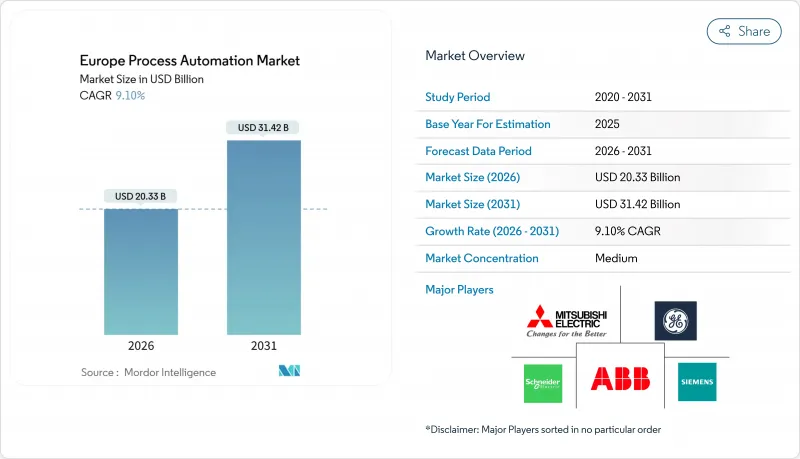
This report is Segmented by Communication Protocol (Wired, and Wireless), System Type (Hardware, and Software), Deployment Model (On-Premise, Cloud, Edge), End-User Industry (Oil and Gas, Chemical and Petrochemical, Power and Utilities, Water and Wastewater, Food and Beverage, Paper and Pulp, Pharmaceutical, and More), and Country. The Market Forecasts are Provided in Terms of Value (USD).
Europe Process Automation Market Trends and Insights
Growing Emphasis on Energy Efficiency and Cost Reduction
European plants are contending with electricity prices that remain 40-60% above pre-2021 levels; therefore, operators are installing variable-speed drives, waste-heat recovery loops, and energy dashboards that reduce specific consumption by double-digit percentages. As carbon-border taxes begin in 2026, real-time energy metrics are transforming from a cost topic into a market-access prerequisite. Advanced process control software, once limited to refineries, now optimizes ovens, dryers, and fermenters, revealing energy waste hidden behind batch variability. Machine-learning models are being layered on historians to predict fouling or compressor-blade wear before losses compound. Vendors are shifting toward subscription pricing because energy dashboards and predictive models require continual updates rather than one-off sales.
Industry 4.0 and IIoT Integration Across Brownfield Plants
With the median European process asset older than three decades, retrofits dominate capex. Wireless vibration probes and infrared cameras bypass cable trays, letting plants digitalize piecemeal instead of shutting down for rewiring. Edge gateways run fast loops locally yet pass curated data to cloud historians, balancing latency and analytics. The retrofit wave, however, increases cybersecurity exposure, so operators now allocate up to 12% more for network segmentation, one-way firewalls, and anomaly detection. Growth, therefore, hinges on suppliers that offer pre-integrated cyber-secure sensor-edge bundles ready for brownfield deployment.
High Capital Expenditure and Integration Complexity
Retrofit projects often top EUR 5 million (USD 5.65 million) for mid-sized sites, and more than half of that sum finances integration labor that stitches PROFIBUS, Modbus, and HART loops into Ethernet backbones. Financing remains scarce for smaller firms in Southern and Eastern Europe, so many projects proceed in phases that extend the payback period. Edge sensors and hybrid clouds increase architectural complexity, forcing operators to manage three distinct data planes: on-premises, edge, and cloud, each with its own governance rules.
Other drivers and restraints analyzed in the detailed report include:
- EU Decarbonisation Policies Driving Retrofit Automation
- Digital Product Passport Mandate Boosting Traceability Automation
- Cybersecurity Compliance Costs in OT Networks
For complete list of drivers and restraints, kindly check the Table Of Contents.
Segment Analysis
Wired links secured 79.16% of the 2025 process automation market share, as deterministic PROFIBUS, Modbus, and HART continue to dominate safety-critical duties. Wireless nodes, however, are set to grow at a 9.46% CAGR, particularly in hazardous oil, chemical, and wastewater zones where conduit trenching is cost-prohibitive. Emerson shipped 29% more Wireless 1410 gateways into European refineries in 2025, enabling operators to instrument tanks and flare stacks that had previously run blind. Municipal water utilities choose battery-powered LoRaWAN level sensors for remote lift stations, cutting civil works.
Latency and certification keep wired backbones entrenched around safety instrumented systems. Pharmaceutical vision systems flood networks with high-speed images that still overload wireless bands. A hybrid future is emerging where edge gateways aggregate wireless field data, compress it, and then forward it to historians over redundant fiber backhauls, maintaining loop integrity while easing retrofit economics.
Hardware captured 56.19% of 2025 revenue as distributed control systems and programmable logic controllers form the control core of continuous plants. Software revenues, growing at a 9.52% CAGR, reflect a pivot toward predictive maintenance, model-predictive control, and digital twins that boost yields without requiring the removal of installed equipment. Honeywell notes that 68% of its European Experion customers now subscribe to cloud analytics that surface optimization opportunities.
Distributed control systems remain the standard for petrochemical polymerization and biotech fermentation, where hundreds of tightly coupled loops demand deterministic scans. Programmable logic controllers dominate batch sectors such as flavors and fragrances. Sensors, valves, and motors are increasingly bundled with algorithms that flag failures before downtime occurs. Human-machine interfaces migrate from proprietary panels to browser dashboards on tablets, shrinking capex but widening the threat surface for cyber attackers.
Complete Report Scope:
- By Communication Protocol
- Wired
- Wireless
- By System Type
- Hardware
- Supervisory Control and Data Acquisition System (SCADA)
- Distributed Control System (DCS)
- Programmable Logic Controller (PLC)
- Manufacturing Execution System (MES)
- Valves and Actuators
- Electric Motors
- Human Machine Interface (HMI)
- Process Safety Systems
- Sensors and Transmitters
- Software
- Advanced Process Control (APC)
- Data Analytics and Reporting Software
- Other Software
- Hardware
- By Deployment Model
- On-Premise
- Cloud
- Edge
- By End-User Industry
- Oil and Gas
- Chemical and Petrochemical
- Power and Utilities
- Water and Wastewater
- Food and Beverage
- Paper and Pulp
- Pharmaceutical
- Other End-User Industry
- By Country
- United Kingdom
- Germany
- France
- Rest of Europe
List of Companies Covered in this Report:
- ABB Ltd
- Siemens AG
- Schneider Electric SE
- Emerson Electric Co.
- Rockwell Automation Inc.
- Honeywell International Inc.
- Mitsubishi Electric Corporation
- Yokogawa Electric Corporation
- General Electric Co.
- Delta Electronics Inc.
- Eaton Corporation
- Fuji Electric Co. Ltd.
- Endress+Hauser Group
- Bosch Rexroth AG
- Omron Corporation
- KUKA AG
- Phoenix Contact GmbH and Co. KG
- Festo SE and Co. KG
- Valmet Oyj
- Hitachi Ltd.
Additional Benefits:
- The market estimate (ME) sheet in Excel format
- 3 months of analyst support
TABLE OF CONTENTS
1 INTRODUCTION
- 1.1 Study Assumptions and Market Definition
- 1.2 Scope of the Study
2 RESEARCH METHODOLOGY
3 EXECUTIVE SUMMARY
4 MARKET LANDSCAPE
- 4.1 Market Overview
- 4.2 Market Drivers
- 4.2.1 Growing Emphasis on Energy Efficiency and Cost Reduction
- 4.2.2 Demand for Safety Automation Systems
- 4.2.3 Industry 4.0 and IIoT Integration Across Brownfield Plants
- 4.2.4 EU Decarbonisation Policies Driving Retrofit Automation
- 4.2.5 Digital Product Passport Mandate Boosting Traceability Automation
- 4.2.6 Green Hydrogen Pilot Plants Requiring Modular Automation
- 4.3 Market Restraints
- 4.3.1 High Capital Expenditure and Integration Complexity
- 4.3.2 Cybersecurity Compliance Costs in OT Networks
- 4.3.3 Ageing Workforce and OT-IT Skills Shortage
- 4.3.4 Vendor Lock-in Concerns With Proprietary Architectures
- 4.4 Industry Value Chain Analysis
- 4.5 Regulatory Landscape
- 4.6 Technological Outlook
- 4.7 Porter's Five Forces Analysis
- 4.7.1 Bargaining Power of Suppliers
- 4.7.2 Bargaining Power of Buyers
- 4.7.3 Threat of New Entrants
- 4.7.4 Threat of Substitutes
- 4.7.5 Intensity of Competitive Rivalry
- 4.8 Impact of Macroeconomic Factors on the Market
- 4.9 Analysis of Industrial Automation Hubs in United Kingdom, Germany and France
- 4.10 Assessment of the Impact of COVID-19 on the Process Automation Industry in Europe
5 MARKET SIZE AND GROWTH FORECASTS (VALUE)
- 5.1 By Communication Protocol
- 5.1.1 Wired
- 5.1.2 Wireless
- 5.2 By System Type
- 5.2.1 Hardware
- 5.2.1.1 Supervisory Control and Data Acquisition System (SCADA)
- 5.2.1.2 Distributed Control System (DCS)
- 5.2.1.3 Programmable Logic Controller (PLC)
- 5.2.1.4 Manufacturing Execution System (MES)
- 5.2.1.5 Valves and Actuators
- 5.2.1.6 Electric Motors
- 5.2.1.7 Human Machine Interface (HMI)
- 5.2.1.8 Process Safety Systems
- 5.2.1.9 Sensors and Transmitters
- 5.2.2 Software
- 5.2.2.1 Advanced Process Control (APC)
- 5.2.2.2 Data Analytics and Reporting Software
- 5.2.2.3 Other Software
- 5.2.1 Hardware
- 5.3 By Deployment Model
- 5.3.1 On-Premise
- 5.3.2 Cloud
- 5.3.3 Edge
- 5.4 By End-User Industry
- 5.4.1 Oil and Gas
- 5.4.2 Chemical and Petrochemical
- 5.4.3 Power and Utilities
- 5.4.4 Water and Wastewater
- 5.4.5 Food and Beverage
- 5.4.6 Paper and Pulp
- 5.4.7 Pharmaceutical
- 5.4.8 Other End-User Industry
- 5.5 By Country
- 5.5.1 United Kingdom
- 5.5.2 Germany
- 5.5.3 France
- 5.5.4 Rest of Europe
6 COMPETITIVE LANDSCAPE
- 6.1 Market Concentration
- 6.2 Strategic Moves
- 6.3 Market Share Analysis
- 6.4 Company Profiles {(includes Global Level Overview, Market Level Overview, Core Segments, Financials as Available, Strategic Information, Market Rank/Share for Key Companies, Products and Services, and Recent Developments)}
- 6.4.1 ABB Ltd
- 6.4.2 Siemens AG
- 6.4.3 Schneider Electric SE
- 6.4.4 Emerson Electric Co.
- 6.4.5 Rockwell Automation Inc.
- 6.4.6 Honeywell International Inc.
- 6.4.7 Mitsubishi Electric Corporation
- 6.4.8 Yokogawa Electric Corporation
- 6.4.9 General Electric Co.
- 6.4.10 Delta Electronics Inc.
- 6.4.11 Eaton Corporation
- 6.4.12 Fuji Electric Co. Ltd.
- 6.4.13 Endress+Hauser Group
- 6.4.14 Bosch Rexroth AG
- 6.4.15 Omron Corporation
- 6.4.16 KUKA AG
- 6.4.17 Phoenix Contact GmbH and Co. KG
- 6.4.18 Festo SE and Co. KG
- 6.4.19 Valmet Oyj
- 6.4.20 Hitachi Ltd.
7 MARKET OPPORTUNITIES AND FUTURE OUTLOOK
- 7.1 White-Space and Unmet-Need Assessment
- 7.2 Investment Analysis and Market Outlook

