PUBLISHER: Mordor Intelligence | PRODUCT CODE: 2120636

PUBLISHER: Mordor Intelligence | PRODUCT CODE: 2120636
Refining Catalysts - Market Share Analysis, Industry Trends & Statistics, Growth Forecasts (2026 - 2031)
According to Mordor Intelligence, the refining catalysts market size was valued at 1.24 Million tons in 2025 and is estimated to grow from 1.27 Million tons in 2026 to reach 1.45 Million tons by 2031, at a CAGR of 2.69% during the forecast period (2026-2031).
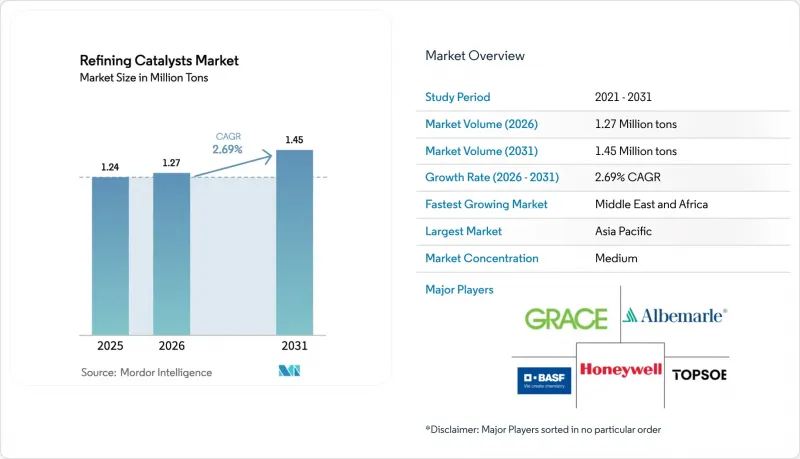
This report is Segmented by Product Type (CoMo, Nimo, Alumina-Based Noble Metal, Niw, Zeolites, and Other Products), Process (Hydrotreating, Fluid Catalytic Cracking, Residue Fluid Catalytic Cracking, and Hydrocracking), and Geography (North America, South America, Europe, Asia-Pacific, and Middle East and Africa). Market Forecasts are Provided in Terms of Volume (Tons).
Global Refining Catalysts Market Trends and Insights
Stricter Global Sulfur-Cap Regulations
The International Maritime Organization's 0.50% sulfur limit for marine fuels, effective since January 2020, still reverberates across coastal refineries that now hydrotreat residual streams to supply compliant bunker blends. China's nationwide China VI gasoline and diesel standards, implemented in 2024, limit sulfur to 10 ppm and forced state-owned refiners to add hydrotreating capacity equal to nearly 1.2 million barrels per day of throughput. The United States Environmental Protection Agency's Tier 3 gasoline program maintains a comparable 10 ppm cap, bolstering demand for noble-metal alumina catalysts that reach deep desulfurization under moderate hydrogen partial pressures. Europe's Fuel Quality Directive replicates the 10 ppm threshold, reinforcing NiMo and CoMo demand throughout the continent. Overlapping mandates deliver a 0.8 percentage-point uplift to the base CAGR mainly through 2026 as multiple deadlines converge.
Refinery Capacity Build-Out in Asia-Pacific and Middle East
Greenfield and brownfield projects in China, India, Saudi Arabia, and Kuwait add roughly 3 million barrels per day of crude distillation between 2024 and 2028, translating into multi-ton catalyst charges for FCC, hydrotreating, and hydrocracking units. Saudi Aramco and China Petrochemical Corporation's Fujian complex will consume an estimated 12,000 tons of zeolite FCC catalysts annually at full stride, while India's Panipat, Gujarat, and Barauni expansions boost local hydrotreating demand through 2027. Kuwait's Al-Zour refinery processes 615,000 barrels per day of heavy crude, relying on NiW and CoMo residue hydrocracking catalysts to maximize middle-distillate yields. The combined build-out contributes a 0.9 percentage-point push to the forecast CAGR, peaking as these new units reach nameplate throughput over 2026-2028.
Volatility in Cobalt, PGMs, and Other Critical Metals
Cobalt prices rose 18% in 2025 on tight supply from the Democratic Republic of Congo, while platinum and palladium climbed 12% amid South African output curbs. CoMo hydrotreating catalysts that contain 2-4% cobalt by weight face margin compression because regulated fuel prices limit pass-through. Platinum-bearing reforming catalysts see similar strain: a 10% palladium rise inflates finished-catalyst cost by roughly USD 50 per kilogram. Suppliers pursue cobalt-free NiW chemistries and accelerate recycling to cushion volatility, yet commercialization may take two to three years. Price swings trim 0.4 percentage points from the base CAGR, with most impact between 2024 and 2026 as refiners lengthen change-out intervals.
Other drivers and restraints analyzed in the detailed report include:
- Rising Demand for Higher-Octane Gasoline and Petro-Feedstocks
- Bio-Feed Co-Processing Needs Dual-Function Catalysts
- EV Penetration Curbing Long-Term Gasoline Demand
For complete list of drivers and restraints, kindly check the Table Of Contents.
Segment Analysis
Zeolites captured 96.01% of the refining catalysts market share in 2025 and are expected to grow 2.72% annually through 2031. This extensive dominance underscores how the refining catalysts market revolves around FCC operations that crack vacuum gas oil into gasoline, diesel, and light olefins. Rare-earth Y-zeolites remain the workhorse at riser temperatures of 500 °C-550 °C, while ZSM-5 additives lifted propylene production. CoMo catalysts are primarily utilized in Asian and Middle Eastern hydrotreaters processing high-sulfur feeds. NiMo formulations are preferred by aviation fuel refiners for kerosene desulfurization. Alumina-supported noble-metal products play a niche role in reforming applications, as the volatility of precious metals limits broader adoption. NiW catalysts are commonly used for residue hydrocracking in heavy-crude regions. Experimental solutions, such as metal-organic frameworks, are also being explored. Clariant's planned 2025 launch of a hierarchical zeolite combining micro- and mesopores highlights incremental innovation within the dominant segment.
The upcoming replacement cycle underscores the sustained demand for zeolite formulations, despite the impact of electric vehicle adoption. Asia-Pacific FCC units designed for petrochemical integration are specifying higher ZSM-5 doses, while Middle Eastern residue hydrocrackers are favoring NiW systems with enhanced metal tolerance, contributing to market diversity. Cobalt-free NiW formulations entering pilot trials may eventually capture share from CoMo in diesel hydrotreaters, but commercialization is unlikely before 2028, suggesting a stable competitive mix through the midpoint of the forecast window.
Complete Report Scope:
- By Product Type
- CoMo
- NiMo
- Alumina-based Noble Metal
- NiW
- Zeolites
- Other Products
- By Process
- Hydrotreating
- Gasoline
- Kerosene
- Diesel
- Vacuum Gas Oil
- Catalytic-Cracking Gasoline
- Residual Feed
- Fluid Catalytic Cracking (FCC)
- Residue Fluid Catalytic Cracking (RFCC)
- Hydrocracking
- Hydrotreating
- By Geography
- North America
- United States
- Canada
- Mexico
- South America
- Brazil
- Argentina
- Rest of South America
- Europe
- Germany
- United Kingdom
- Italy
- France
- Spain
- Russia
- Rest of Europe
- Asia-Pacific
- China
- India
- Japan
- South Korea
- ASEAN Countries
- Rest of Asia-Pacific
- Middle-East and Africa
- South Africa
- Saudi Arabia
- Rest of Middle-East and Africa
- North America
Geography Analysis
Asia-Pacific accounted for a 52.03% share of the global refining catalyst market in 2025. China and Saudi Aramco's Fujian complex will eventually draw 12,000 tons of zeolite annually, and Indian expansions add significant hydrocracking demand under Albemarle's USD 45 million contract. Southeast Asian projects in Indonesia, Vietnam, and Thailand add about 500,000 barrels per day of distillation capacity through 2028, broadening hydrotreating and FCC opportunities.
North America and Europe face refinery shutdowns and electric-vehicle-driven gasoline decline. Europe's 6% gasoline retreat from 2019-2025 and North American unit reconfiguration toward propylene and diesel reshape catalyst specifications rather than spark volume growth. The United States Tier 3 rule keeps noble-metal demand steady, and Canada's oil-sands upgraders sustain specialized hydrocracking volume. Yet the refining catalysts market in these mature regions edges sideways as plant rationalization offsets unit upgrades.
In South America, Argentina's La Plata hydrocracker, scheduled for 2027, adds 600 tons of annual demand. These incremental additions solidify the region's leadership in growth rate terms, even if Asia alone retains absolute volume dominance.
The Middle East and Africa are witnessing a significant rise in demand for refining catalysts with the fastest 2.78% CAGR from 2026 to 2031. Saudi Arabia's liquids-to-chemicals agenda and Kuwait's Al-Zour heavy-crude platform generate constant demand for residue hydrocracking catalysts. Africa presents long-term upside through Nigeria's 650,000 barrels-per-day Dangote refinery, which when fully loaded in 2026 will require roughly 5,000 tons of FCC and hydrotreating catalysts each year. South Africa's Secunda gas-conversion retrofit will lift hydrotreating volume by 15%.
- Albemarle Corporation
- Axens
- BASF SE
- China Petrochemical Corporation
- Clariant
- CLG
- Evonik
- Exxon Mobil Corporation
- Honeywell International
- JGC C & C
- Johnson Matthey
- KNT Group
- Kuwait Catalyst Company
- Rezel Catalysts Corporation
- Shell plc
- Topsoe
- Umicore
- W. R. Grace & Co.
Additional Benefits:
- The market estimate (ME) sheet in Excel format
- 3 months of analyst support
TABLE OF CONTENTS
1 Introduction
- 1.1 Study Assumptions and Market Definition
- 1.2 Scope of the Study
2 Research Methodology
3 Executive Summary
4 Market Landscape
- 4.1 Market Overview
- 4.2 Market Drivers
- 4.2.1 Stricter global sulfur-cap regulations
- 4.2.2 Refinery capacity build-out in Asia-Pacific and Middle East
- 4.2.3 Rising demand for higher-octane gasoline and petro-feedstocks
- 4.2.4 Bio-feed co-processing needs dual-function catalysts
- 4.2.5 AI-driven catalyst performance analytics adoption
- 4.3 Market Restraints
- 4.3.1 Volatility in cobalt, PGMs and other critical metals
- 4.3.2 EV penetration curbing long-term gasoline demand
- 4.3.3 Crude-to-chemicals complexes bypass traditional units
- 4.4 Value Chain Analysis
- 4.5 Porter's Five Forces
- 4.5.1 Bargaining Power of Suppliers
- 4.5.2 Bargaining Power of Buyers
- 4.5.3 Threat of New Entrants
- 4.5.4 Threat of Substitutes
- 4.5.5 Degree of Competition
5 Market Size and Growth Forecasts (Volume)
- 5.1 By Product Type
- 5.1.1 CoMo
- 5.1.2 NiMo
- 5.1.3 Alumina-based Noble Metal
- 5.1.4 NiW
- 5.1.5 Zeolites
- 5.1.6 Other Products
- 5.2 By Process
- 5.2.1 Hydrotreating
- 5.2.1.1 Gasoline
- 5.2.1.2 Kerosene
- 5.2.1.3 Diesel
- 5.2.1.4 Vacuum Gas Oil
- 5.2.1.5 Catalytic-Cracking Gasoline
- 5.2.1.6 Residual Feed
- 5.2.2 Fluid Catalytic Cracking (FCC)
- 5.2.3 Residue Fluid Catalytic Cracking (RFCC)
- 5.2.4 Hydrocracking
- 5.2.1 Hydrotreating
- 5.3 By Geography
- 5.3.1 North America
- 5.3.1.1 United States
- 5.3.1.2 Canada
- 5.3.1.3 Mexico
- 5.3.2 South America
- 5.3.2.1 Brazil
- 5.3.2.2 Argentina
- 5.3.2.3 Rest of South America
- 5.3.3 Europe
- 5.3.3.1 Germany
- 5.3.3.2 United Kingdom
- 5.3.3.3 Italy
- 5.3.3.4 France
- 5.3.3.5 Spain
- 5.3.3.6 Russia
- 5.3.3.7 Rest of Europe
- 5.3.4 Asia-Pacific
- 5.3.4.1 China
- 5.3.4.2 India
- 5.3.4.3 Japan
- 5.3.4.4 South Korea
- 5.3.4.5 ASEAN Countries
- 5.3.4.6 Rest of Asia-Pacific
- 5.3.5 Middle-East and Africa
- 5.3.5.1 South Africa
- 5.3.5.2 Saudi Arabia
- 5.3.5.3 Rest of Middle-East and Africa
- 5.3.1 North America
6 Competitive Landscape
- 6.1 Market Concentration
- 6.2 Strategic Moves
- 6.3 Market Share/Ranking Analysis
- 6.4 Company Profiles (includes Global level Overview, Market level overview, Core Segments, Financials as available, Strategic Information, Market Rank/Share for key companies, Products and Services, and Recent Developments)
- 6.4.1 Albemarle Corporation
- 6.4.2 Axens
- 6.4.3 BASF SE
- 6.4.4 China Petrochemical Corporation
- 6.4.5 Clariant
- 6.4.6 CLG
- 6.4.7 Evonik
- 6.4.8 Exxon Mobil Corporation
- 6.4.9 Honeywell International
- 6.4.10 JGC C & C
- 6.4.11 Johnson Matthey
- 6.4.12 KNT Group
- 6.4.13 Kuwait Catalyst Company
- 6.4.14 Rezel Catalysts Corporation
- 6.4.15 Shell plc
- 6.4.16 Topsoe
- 6.4.17 Umicore
- 6.4.18 W. R. Grace & Co.
7 Market Opportunities and Future Outlook
- 7.1 White-space and Unmet-need Assessment

