PUBLISHER: Mordor Intelligence | PRODUCT CODE: 2120651

PUBLISHER: Mordor Intelligence | PRODUCT CODE: 2120651
Smart Airport - Market Share Analysis, Industry Trends & Statistics, Growth Forecasts (2026 - 2031)
According to Mordor Intelligence, the smart airport market size is expected to grow from USD 6.61 billion in 2025 to USD 7.3 billion in 2026 and is forecasted to reach USD 12.19 billion by 2031 at a 10.82% CAGR over 2026-2031.
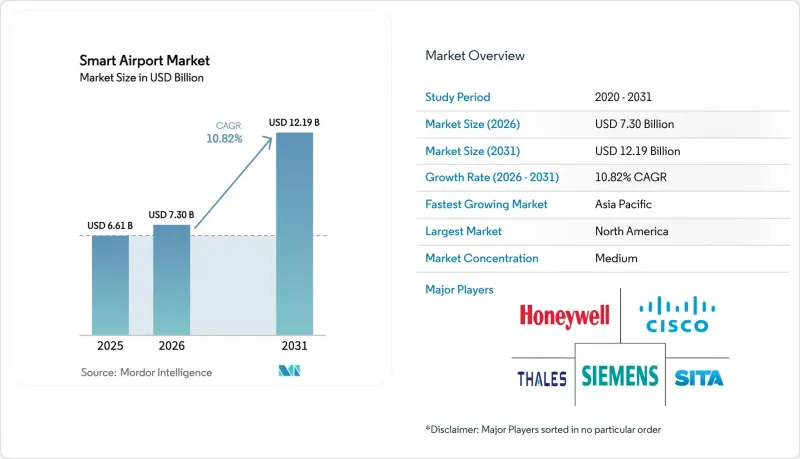
This report is Segmented by Technology (Security Systems, Communication Systems, Air and Ground Traffic Control, and More), Solution (Hardware, Software, and Services), Application (Landside, Airside, and Terminal Side), Airport Size (Large, Medium, and Small), Airport Technology (Airport 2. 0, and More), and Geography (North America, Europe, and More). The Market Forecasts are Provided in Terms of Value (USD).
Global Smart Airport Market Trends and Insights
Rising Passenger Volumes Boosting Biometric and Self-service Rollouts
Global traffic is expected to reach 8.5 billion journeys in 2024 and is projected to exceed 9.5 billion by 2030, straining checkpoints designed for lower passenger volumes. Biometric boarding has reduced processing times from 45 seconds to less than 10 seconds, improving passenger satisfaction scores by up to 20 percentage points. A 2024 cross-border trial at Narita and Hong Kong demonstrated a 40% reduction in immigration queues, highlighting the scalability of interoperable frameworks across jurisdictions. By 2025, global self-bag-drop installations exceeded 1,200, reflecting a 35% annual growth as airlines shifted staff to revenue-generating roles. ICAO Document 9303 now standardizes touchless journeys, reducing the number of contact points by 60-70%.
Growing Airport IT Spending Pivoting to Digital-first Operations
Airports allocated USD 8.9 billion to IT investments in 2024, marking a 12% year-on-year increase, with a focus on cloud migration, predictive maintenance, and baggage tracking. Brussels Airport implemented a digital twin in 2024, coordinating 22 stakeholders and reducing turnaround delays by 18%. Heathrow has committed GBP 2.3 billion (approximately USD 2.9 billion) to 5G networks and autonomous vehicles by 2028. According to Amadeus, 48% of airports surveyed in 2025 had migrated at least one core system to the cloud, with scalability identified as the primary motivation. Atlanta Hartsfield-Jackson utilized predictive analytics to reroute 300 flights during a 2024 storm, saving USD 15 million in delay costs.
Significant Capex and Complex System Integration Requirements
Innovative airport projects require investments ranging from USD 50 million to USD 500 million per hub, with payback periods of 7-12 years, which can deter investors seeking quicker returns. Retrofitting biometric gates increases costs by up to 40% and delays schedules by two years in brownfield terminals. Changi Airport's Terminal 5 project, with a budget of SGD 3 billion (USD 2.34 billion), exemplifies the scale of fully integrated ecosystems. Heathrow Airport has included a 20% contingency buffer in its GBP 2.3 billion (approximately USD 3.09 billion) digital roadmap to address unforeseen integration challenges.
Other drivers and restraints analyzed in the detailed report include:
- Mandatory Security and Border-control Upgrades
- Proliferation of IoT and 5G for Real-time Operational Data
- Growing Concerns over Cybersecurity and Passenger Data Protection
For complete list of drivers and restraints, kindly check the Table Of Contents.
Segment Analysis
Security systems accounted for 26.49% of the smart airport market in 2025, driven by regulatory requirements for CT scanners and biometric access systems. Smart retail and hospitality are growing at a 13.59% CAGR through 2031. They are expected to capture a significantly larger share of the market by 2031, as analytics enhance per-passenger spending. Communication systems are transitioning to IP-based networks, enabling video streaming to improve situational awareness.
Passenger, cargo, baggage, and ground-handling systems utilize RFID and robotic automation to achieve a 99.50% accuracy rate in baggage delivery. According to SITA's recent press releases, innovative parking solutions reduce landside congestion by 40%. Upgrades in air and ground traffic control, such as remote towers, are reducing staffing costs by up to 40% at regional airports. The focus is shifting from perimeter defense to revenue generation and operational efficiency, reflecting airports' transformation into omni-channel retail hubs that also manage aircraft operations.
Hardware maintained a 44.78% share of the smart airport market in 2025, supported by mandatory scanners, e-gates, and IoT sensors that form the foundation of digital ecosystems. Services, however, are expanding at a CAGR of 12.29%, as operators increasingly adopt managed models that bundle integration, cybersecurity, and updates. Software continues to grow steadily, with cloud platforms enabling functionality independent of proprietary hardware.
The cost of biometric kiosks has decreased to USD 30,000 from USD 50,000 in 2020, compressing equipment margins and encouraging OEMs to focus on recurring-revenue services. Cybersecurity-as-a-service is emerging, with vendors operating multi-airport SOCs to achieve economies of scale that are difficult to replicate in-house. Medium-sized airports are adopting "airport-as-a-service" bundles to avoid capital expenditures of up to USD 50 million, positioning service revenue as the primary growth driver for the sector by 2031.
Complete Report Scope:
- By Technology
- Security Systems
- Communication Systems
- Air and Ground Traffic Control
- Passenger, Cargo, Baggage, and Ground Handling
- Smart Retail and Hospitality Systems
- Smart Transport and Parking
- Airport Management Software (AMS) Platforms
- By Solution
- Hardware
- Software
- Services
- By Application
- Landside
- Airside
- Terminal Side
- By Airport Size
- Large
- Medium
- Small
- By Airport Technology
- Airport 2.0
- Airport 3.0
- Airport 4.0
- By Geography
- North America
- United States
- Canada
- Mexico
- Europe
- United Kingdom
- France
- Germany
- Italy
- Spain
- Rest of Europe
- Asia-Pacific
- China
- India
- Japan
- South Korea
- Rest of Asia-Pacific
- South America
- Brazil
- Rest of South America
- Middle East and Africa
- Middle East
- Saudi Arabia
- United Arab Emirates
- Qatar
- Rest of Middle East
- Africa
- South Africa
- Nigeria
- Rest of Africa
- Middle East
- North America
Geography Analysis
In 2025, North America accounted for 31.94% of the smart airport market, driven by the rollout of TSA CAT-2 and FAA NextGen upgrades. High labor costs in the region are driving the rapid adoption of automation. However, brownfield constraints at major airports, such as John F. Kennedy International Airport and Los Angeles International Airport, are increasing retrofit expenses by 40%. Europe leads in biometric border control, with plans to install 2,500 e-gates by 2026 and implement digital-twin pilots, which are expected to reduce delays by up to 22%.
Asia-Pacific is the fastest-growing region, with a CAGR of 11.90% through 2031, supported by greenfield megaprojects such as Beijing Daxing Airport, designed for 100 million passengers, and Navi Mumbai Airport, targeting a capacity of 90 million. The Middle East is also advancing, incorporating Airport 4.0 designs into the USD 35 billion King Salman International Airport, which aims to handle 120 million passengers annually by 2030.
South America and Africa are lagging in absolute spending. Still, they are adopting biometric gates at high-traffic terminals, such as Sao Paulo Guarulhos and OR Tambo, to accommodate the increasing intra-regional traffic. Regulatory differences persist, with GDPR compliance adding 12% to IT budgets in the EU, while less stringent regulations in parts of Asia are accelerating biometric adoption but raising privacy concerns.
- Honeywell International Inc.
- Cisco Systems, Inc.
- Amadeus IT Group, S.A.
- Siemens AG
- T-Systems International GmbH
- Thales Group
- SITA N.V.
- RTX Corporation
- NATS Holdings Limited
- Sabre GLBL Inc.
- IBM Corporation
- L3Harris Technologies, Inc.
- Huawei Technologies Co., Ltd.
- Indra Sistemas, S.A.
- Smiths Detection Group Ltd. (Smiths Group plc)
- VISION BOX - SOLUCOES DE VISAO POR COMPUTADOR, S.A.
- NEC Corporation
- Leonardo S.p.A
- Teledyne Technologies Incorporated
- Garrett Electronics Inc.
- Vanderlande Industries BV
- QinetiQ Group
Additional Benefits:
- The market estimate (ME) sheet in Excel format
- 3 months of analyst support
TABLE OF CONTENTS
1 INTRODUCTION
- 1.1 Study Assumptions and Market Definition
- 1.2 Scope of the Study
2 RESEARCH METHODOLOGY
3 EXECUTIVE SUMMARY
4 MARKET LANDSCAPE
- 4.1 Market Overview
- 4.2 Market Drivers
- 4.2.1 Rising passenger volumes accelerating demand for biometric screening and self-service technologies
- 4.2.2 Growing airport IT investments to support digital-first operational models
- 4.2.3 Mandatory compliance with upgraded security and border-control regulations
- 4.2.4 Proliferation of IoT and 5G enabling real-time visibility into airport operations
- 4.2.5 Data-driven retail analytics improving non-aeronautical revenue generation
- 4.2.6 Deployment of digital twins for predictive planning and maintenance optimization
- 4.3 Market Restraints
- 4.3.1 Significant capital investment and complex system integration requirements
- 4.3.2 Growing concerns over cybersecurity and passenger data protection
- 4.3.3 Limited availability of skilled professionals for OT-IT system convergence
- 4.3.4 Incompatibility with legacy aviation communication systems
- 4.4 Value Chain Analysis
- 4.5 Regulatory Landscape
- 4.6 Technological Outlook
- 4.7 Porter's Five Forces Analysis
- 4.7.1 Bargaining Power of Buyers
- 4.7.2 Bargaining Power of Suppliers
- 4.7.3 Threat of New Entrants
- 4.7.4 Threat of Substitutes
- 4.7.5 Competitive Rivalry
5 MARKET SIZE AND GROWTH FORECASTS (VALUE)
- 5.1 By Technology
- 5.1.1 Security Systems
- 5.1.2 Communication Systems
- 5.1.3 Air and Ground Traffic Control
- 5.1.4 Passenger, Cargo, Baggage, and Ground Handling
- 5.1.5 Smart Retail and Hospitality Systems
- 5.1.6 Smart Transport and Parking
- 5.1.7 Airport Management Software (AMS) Platforms
- 5.2 By Solution
- 5.2.1 Hardware
- 5.2.2 Software
- 5.2.3 Services
- 5.3 By Application
- 5.3.1 Landside
- 5.3.2 Airside
- 5.3.3 Terminal Side
- 5.4 By Airport Size
- 5.4.1 Large
- 5.4.2 Medium
- 5.4.3 Small
- 5.5 By Airport Technology
- 5.5.1 Airport 2.0
- 5.5.2 Airport 3.0
- 5.5.3 Airport 4.0
- 5.6 By Geography
- 5.6.1 North America
- 5.6.1.1 United States
- 5.6.1.2 Canada
- 5.6.1.3 Mexico
- 5.6.2 Europe
- 5.6.2.1 United Kingdom
- 5.6.2.2 France
- 5.6.2.3 Germany
- 5.6.2.4 Italy
- 5.6.2.5 Spain
- 5.6.2.6 Rest of Europe
- 5.6.3 Asia-Pacific
- 5.6.3.1 China
- 5.6.3.2 India
- 5.6.3.3 Japan
- 5.6.3.4 South Korea
- 5.6.3.5 Rest of Asia-Pacific
- 5.6.4 South America
- 5.6.4.1 Brazil
- 5.6.4.2 Rest of South America
- 5.6.5 Middle East and Africa
- 5.6.5.1 Middle East
- 5.6.5.1.1 Saudi Arabia
- 5.6.5.1.2 United Arab Emirates
- 5.6.5.1.3 Qatar
- 5.6.5.1.4 Rest of Middle East
- 5.6.5.2 Africa
- 5.6.5.2.1 South Africa
- 5.6.5.2.2 Nigeria
- 5.6.5.2.3 Rest of Africa
- 5.6.5.1 Middle East
- 5.6.1 North America
6 COMPETITIVE LANDSCAPE
- 6.1 Market Concentration
- 6.2 Strategic Moves
- 6.3 Market Share Analysis
- 6.4 Company Profiles (includes Global level Overview, Market level overview, Core Segments, Financials as available, Strategic Information, Market Rank/Share for key companies, Products and Services, and Recent Developments)
- 6.4.1 Honeywell International Inc.
- 6.4.2 Cisco Systems, Inc.
- 6.4.3 Amadeus IT Group, S.A.
- 6.4.4 Siemens AG
- 6.4.5 T-Systems International GmbH
- 6.4.6 Thales Group
- 6.4.7 SITA N.V.
- 6.4.8 RTX Corporation
- 6.4.9 NATS Holdings Limited
- 6.4.10 Sabre GLBL Inc.
- 6.4.11 IBM Corporation
- 6.4.12 L3Harris Technologies, Inc.
- 6.4.13 Huawei Technologies Co., Ltd.
- 6.4.14 Indra Sistemas, S.A.
- 6.4.15 Smiths Detection Group Ltd. (Smiths Group plc)
- 6.4.16 VISION BOX - SOLUCOES DE VISAO POR COMPUTADOR, S.A.
- 6.4.17 NEC Corporation
- 6.4.18 Leonardo S.p.A
- 6.4.19 Teledyne Technologies Incorporated
- 6.4.20 Garrett Electronics Inc.
- 6.4.21 Vanderlande Industries BV
- 6.4.22 QinetiQ Group
7 MARKET OPPORTUNITIES AND FUTURE OUTLOOK
- 7.1 White-space and Unmet-Need Assessment

