PUBLISHER: Mordor Intelligence | PRODUCT CODE: 2120668

PUBLISHER: Mordor Intelligence | PRODUCT CODE: 2120668
Automotive Airbag Inflator - Market Share Analysis, Industry Trends & Statistics, Growth Forecasts (2026 - 2031)
According to Mordor Intelligence, the automotive airbag inflator market size was valued at USD 5.23 billion in 2025 and is estimated to grow from USD 5.63 billion in 2026 to reach USD 8.17 billion by 2031, at a CAGR of 7.73% during the forecast period (2026-2031).
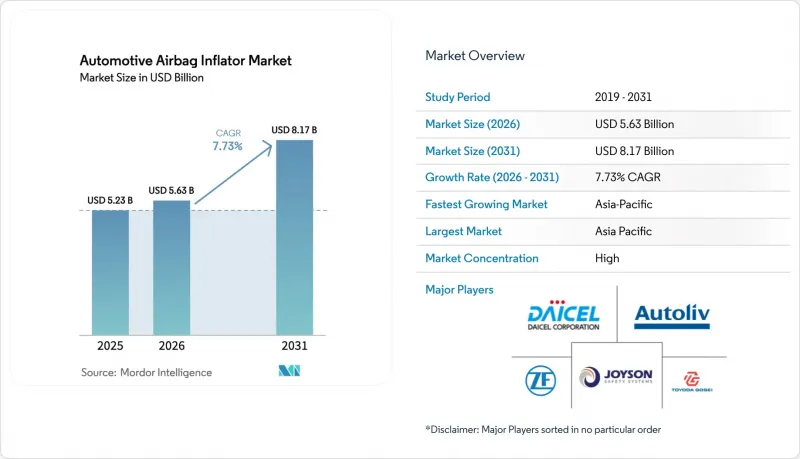
This report is Segmented by Airbag Type (Passenger, Curtain, Knee, and More), Inflator Type (Pyrotechnic, Stored-Gas, and More), Vehicle Type (Passenger Cars and More), Propellant Chemistry (Azide-Based and Non-Azide), Technology Stage (Single-Stage, and Dual/Multi-Stage), Sales Channel (OEM and Aftermarket), and Geography. Market Forecasts are Provided in Terms of Value (USD) and Volume (Units).
Global Automotive Airbag Inflator Market Trends and Insights
EV Giga-Casting Chassis Creating Need for Ultra-Slim Curtain Inflators
Tesla's Cybertruck and Model Y utilize single-piece rear underbodies, cast in massive presses. This innovation removes traditional B-pillar reinforcement zones and significantly reduces the space available for side-curtain inflators. Similarly, BYD's Seagull and Dolphin lines employ mega-castings, which drastically cut the body-in-white part count but result in a more constrained space for restraint hardware. In response, Hyundai Mobis introduced door-mounted curtain modules in 2024, designed to meet ejection-mitigation standards. As a result, suppliers are shifting from cylindrical pyrotechnic inflators to hybrid flat-pack devices. These newer devices combine compressed gases, such as argon or nitrogen, with a wafer-style solid charge, enabling faster deployment and lower peak temperatures. This transition reflects the growing preference for hybrid inflators, even as pyrotechnic units remain widely used in existing installations.
ADAS-Led Adoption of Multi-Stage Inflators in Chinese Mid-SUVs
Sensor-rich mid-SUVs manufactured by Chinese brands fuse crash-severity data with inflator logic, allowing tailored gas releases that protect a wider occupant range. Five-star New Car Assessment Program scores support showroom appeal and showcase multi-stage inflators as visible proof of ADAS value. Automakers that lag in multi-stage deployment risk negative showroom comparisons, creating fast-follower pressure. Software updates allow future calibration tweaks, shielding OEMs from retooling costs. Component suppliers leverage the trend to upsell firmware maintenance contracts, adding an annuity-style revenue layer. Therefore, the convergence of sensor fusion and inflator modulation sustains premium price points within the automotive airbag inflator market.
Helium Supply Crunch
Geopolitical disruptions lifted industrial-grade helium spot prices, inflating the bill of materials for stored-gas inflators and squeezing margins. Exploration campaigns in Tanzania seek green helium, with preliminary flow-rate data suggesting a viable commercial supply for safety-system producers. OEMs respond by shifting procurement toward hybrid inflators that dilute helium with pyrotechnic gas. Contract clauses now include helium-price adjustment formulas, transferring part of the risk back to suppliers. While temporary, cost spikes have already slowed new design iterations for stored gas, moderating near-term growth for that subsegment of the automotive airbag inflator market.
Other drivers and restraints analyzed in the detailed report include:
- L4/L5 Autonomous Vehicle Rollout Demanding Multi-Directional Inflator Arrays
- Emergence of Indian Export Hubs
- Lithium-Ion Battery Fire Risks Delaying EV Airbag Integration
For complete list of drivers and restraints, kindly check the Table Of Contents.
Segment Analysis
Passenger airbags represented 30.69% of the automotive airbag inflator market share in 2025. Their dominance rests on star-rating protocols that mandate robust side-impact protection. Recent refreshes reveal interest in segmented gas channels that enhance fill uniformity along narrow roof rails. Emerging giga-cast EV frames create slimmer rails, so oval-section cylinders preserve gas volume without raising roof-height constraints. The automotive airbag inflator market continues to reward platforms that mix shape innovation with reliable chemistry.
Pedestrian-protection airbags register the fastest 9.82% CAGR to 2031. Crash dummies that weigh more on lower-leg injuries and insurance scoring models reinforce uptake. Suppliers now offer one-piece housings that clip into existing under-dash beams, trimming line-side assembly minutes. Fleet buyers highlight lower worker-compensation claims when knee protection is present, boosting specification rates. Growing traction strengthens the long-term diversity of the automotive airbag inflator industry, which benefits from multiple growth vectors rather than a single dominant category.
Pyrotechnic inflators remained the anchor with a 66.56% share in 2025, supported by well-established supply chains and cost advantages over stored-gas alternatives. However, rising helium prices and the need for adaptive control systems have driven increased interest in hybrid inflators, with the segment gaining traction at an 8.27% CAGR. Stored-gas units, which rely on 300-bar helium-argon blends, lose favor as EU sanctions squeeze supply. Hybrid designs fuse a compact solid charge with a gas reservoir, enabling two-stage inflation that balances rapid bag fill and extended pressure for rollover events. ZF and Autoliv are field-testing flat-pack hybrid modules for electric SUVs whose giga-castings allow only 35 mm of package depth.
Pyrotechnic inflators still inflate a 60-liter bag within 30 ms, but EU REACH directives drive a pivot toward low-toxicity guanidine-nitrate propellants. Stored-gas inflators occupy niche luxury programs that accept cost premiums for quieter deployment. Hybrid inflators are forecast to capture 18% share by 2031, driven by UN R155 cybersecurity rules that pair electronic control units with variable-pressure valves.
Complete Report Scope:
- By Airbag Type
- Passenger
- Curtain
- Knee
- Side
- Pedestrian Protection
- By Inflator Type
- Pyrotechnic
- Stored-Gas
- Hybrid
- By Vehicle Type
- Passenger Cars
- Light Commercial Vehicles
- Heavy Commercial Vehicles
- By Propellant Chemistry
- Azide-Based
- Non-Azide (e.g., Guanidine Nitrate)
- By Technology Stage
- Single-Stage
- Dual-Stage & Multi-Stage
- By Sales Channel
- OEM Fitted
- Aftermarket / Recall Replacement
- By Geography
- North America
- United States
- Canada
- Rest of North America
- South America
- Brazil
- Argentina
- Rest of South America
- Europe
- Germany
- United Kingdom
- France
- Spain
- Russia
- Rest of Europe
- Asia-Pacific
- India
- China
- Japan
- South Korea
- Rest of Asia-Pacific
- Middle East and Africa
- United Arab Emirates
- Saudi Arabia
- Turkey
- Egypt
- South Africa
- Rest of Middle-East and Africa
- North America
Geography Analysis
Asia-Pacific owned 38.88% of global revenue in 2025 and is on track for a 9.42% CAGR through 2031, the steepest among all regions. China alone accounted for 28% of the automotive airbag inflator market in 2025; stringent 2024 C-NCAP rules mean 76% of new Chinese passenger cars already feature dual-stage driver modules. India's inflator segment benefits from the Production-Linked Incentive plan, which has prompted investments such as ZF Rane's 3 million-unit plant in Tamil Nadu. Japan leads pedestrian-protection penetration at 68% as revised JNCAP scoring incentivizes external airbags.
South America follows with a 7.23% CAGR, as Brazil's Rota 2030 mandates most local content for restraint systems starting in 2026, encouraging in-country inflator assembly. Argentina's automakers leverage MERCOSUR export routes, while local subsidiaries of global suppliers open smaller plants to bypass tariffs. North America grows at 4.76%; although driver-passenger airbags saturate at 98% fitment, EV platform launches and ongoing Takata replacements sustain nominal upticks.
Europe posts a 5.44% CAGR as the Carbon Border Adjustment Mechanism raises costs on Asian imports from January 2026, motivating tier-ones to establish lower-carbon sites in Poland and Romania. Sodium-azide's share has already dropped to 26% in Europe, reflecting accelerated REACH compliance. The Middle East and Africa wrestle with counterfeit inflator influxes that depress supplier confidence, while Russia's 3.51% CAGR lags due to sanctions cutting helium supplies vital for stored-gas modules.
- Autoliv Inc.
- ZF Friedrichshafen AG
- Joyson Safety Systems (Key SS)
- Daicel Corporation
- Nippon Kayaku Co.
- ARC Automotive Inc.
- Toyoda Gosei Co.
- Hyundai Mobis Co.
- Continental AG
- Denso Corporation
- Yanfeng Safety Systems
- Nihon Plast Co.
- Ashimori Industry Co.
- Takata (Residual Recall Operations)
- Kolon Industries Inc.
- GWR Safety Systems
- ARC China Ltd.
- Tenaris Inflators
- Jinzhou Jinheng Automotive
Additional Benefits:
- The market estimate (ME) sheet in Excel format
- 3 months of analyst support
TABLE OF CONTENTS
1 Introduction
- 1.1 Study Assumptions & Market Definition
- 1.2 Scope of the Study
2 Research Methodology
3 Executive Summary
4 Market Landscape
- 4.1 Market Drivers
- 4.1.1 EV Giga-Casting Chassis Creating Need for Ultra-Slim Curtain Inflators
- 4.1.2 ADAS-Led Adoption of Multi-Stage Inflators in Chinese Mid-SUVs
- 4.1.3 L4/L5 Autonomous Vehicle Rollout Demanding Advanced Multi-Directional Inflator Arrays
- 4.1.4 Emergence of Indian Export Hubs Elevating Captive Inflator Off-take
- 4.1.5 Phase-out of Azide Propellants Driving EU & Japan Retrofit Demand
- 4.1.6 UN-R155 Cyber-Security Compliance Boosting Smart Inflator Modules in NA
- 4.2 Market Restraints
- 4.2.1 Helium Supply Crunch Inflating Stored-Gas Inflator Pricing
- 4.2.2 Lithium-ion Battery Fire Risks Delaying EV Airbag System Integration
- 4.2.3 EU Carbon Border Tariff Raising Cost of Asian Inflator Imports
- 4.2.4 Proliferation of Counterfeit Inflators in MEA Eroding OEM Programs
- 4.3 Value / Supply-Chain Analysis
- 4.4 Regulatory or Technological Outlook
- 4.5 Porter's Five Forces
- 4.5.1 Threat of New Entrants
- 4.5.2 Bargaining Power of Buyers/Consumers
- 4.5.3 Bargaining Power of Suppliers
- 4.5.4 Threat of Substitute Products
- 4.5.5 Intensity of Competitive Rivalry
5 Market Size & Growth Forecasts (Value & Volume)
- 5.1 By Airbag Type
- 5.1.1 Passenger
- 5.1.2 Curtain
- 5.1.3 Knee
- 5.1.4 Side
- 5.1.5 Pedestrian Protection
- 5.2 By Inflator Type
- 5.2.1 Pyrotechnic
- 5.2.2 Stored-Gas
- 5.2.3 Hybrid
- 5.3 By Vehicle Type
- 5.3.1 Passenger Cars
- 5.3.2 Light Commercial Vehicles
- 5.3.3 Heavy Commercial Vehicles
- 5.4 By Propellant Chemistry
- 5.4.1 Azide-Based
- 5.4.2 Non-Azide (e.g., Guanidine Nitrate)
- 5.5 By Technology Stage
- 5.5.1 Single-Stage
- 5.5.2 Dual-Stage & Multi-Stage
- 5.6 By Sales Channel
- 5.6.1 OEM Fitted
- 5.6.2 Aftermarket / Recall Replacement
- 5.7 By Geography
- 5.7.1 North America
- 5.7.1.1 United States
- 5.7.1.2 Canada
- 5.7.1.3 Rest of North America
- 5.7.2 South America
- 5.7.2.1 Brazil
- 5.7.2.2 Argentina
- 5.7.2.3 Rest of South America
- 5.7.3 Europe
- 5.7.3.1 Germany
- 5.7.3.2 United Kingdom
- 5.7.3.3 France
- 5.7.3.4 Spain
- 5.7.3.5 Russia
- 5.7.3.6 Rest of Europe
- 5.7.4 Asia-Pacific
- 5.7.4.1 India
- 5.7.4.2 China
- 5.7.4.3 Japan
- 5.7.4.4 South Korea
- 5.7.4.5 Rest of Asia-Pacific
- 5.7.5 Middle East and Africa
- 5.7.5.1 United Arab Emirates
- 5.7.5.2 Saudi Arabia
- 5.7.5.3 Turkey
- 5.7.5.4 Egypt
- 5.7.5.5 South Africa
- 5.7.5.6 Rest of Middle-East and Africa
- 5.7.1 North America
6 Competitive Landscape
- 6.1 Market Concentration
- 6.2 Strategic Moves
- 6.3 Market Share Analysis
- 6.4 Company Profiles (Includes Global level Overview, Market level overview, Core Segments, Financials as available, Strategic Information, Market Rank/Share for key companies, Products & Services, and Recent Developments)
- 6.4.1 Autoliv Inc.
- 6.4.2 ZF Friedrichshafen AG
- 6.4.3 Joyson Safety Systems (Key SS)
- 6.4.4 Daicel Corporation
- 6.4.5 Nippon Kayaku Co.
- 6.4.6 ARC Automotive Inc.
- 6.4.7 Toyoda Gosei Co.
- 6.4.8 Hyundai Mobis Co.
- 6.4.9 Continental AG
- 6.4.10 Denso Corporation
- 6.4.11 Yanfeng Safety Systems
- 6.4.12 Nihon Plast Co.
- 6.4.13 Ashimori Industry Co.
- 6.4.14 Takata (Residual Recall Operations)
- 6.4.15 Kolon Industries Inc.
- 6.4.16 GWR Safety Systems
- 6.4.17 ARC China Ltd.
- 6.4.18 Tenaris Inflators
- 6.4.19 Jinzhou Jinheng Automotive
7 Market Opportunities & Future Outlook
- 7.1 White-space and Unmet-Need Assessment

